Published on : 19 Jan 2026
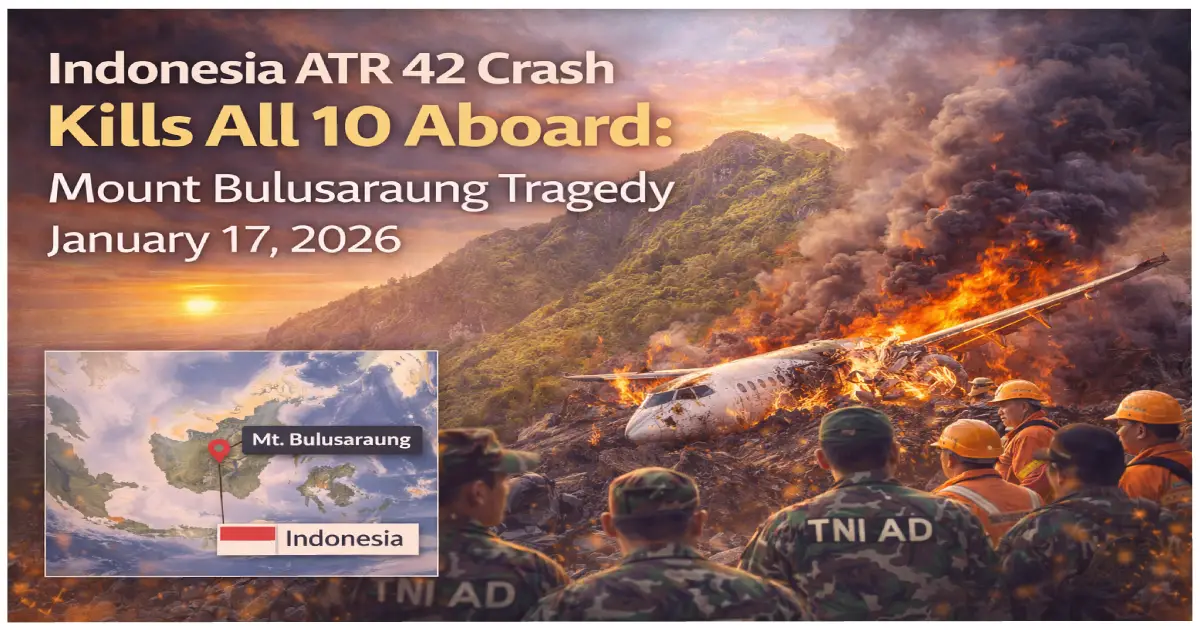
BREAKING TRAGEDY: Indonesia Air Transport ATR 42-512 crashes into Mount Bulusaraung on Friday, January 17, 2026, killing all 10 aboard during marine surveillance flight. 25-year-old aircraft vanishes at 1:37 PM local time just 20 kilometers from Makassar Airport. Here’s everything we know about this devastating controlled-flight-into-terrain accident and what it means for travelers.
Published: January 19, 2026 Crash Date: January 17, 2026 (2 days ago) Total Fatalities: 10 people (7 crew + 3 passengers) Aircraft: ATR 42-512, Registration PK-THT, 25 years old Route: Yogyakarta (JOG) to Makassar (UPG) Wreckage Found: January 18, 2026 (Saturday) Crash Site: Mount Bulusaraung, 8,200 feet elevation, South Sulawesi
Flight Details:
✈️ Aircraft: ATR 42-512 (twin-engine turboprop), Registration PK-THT ✈️ Age: 25 years old (manufactured 2000) ✈️ Operator: Indonesia Air Transport (charter/government contractor) ✈️ Mission: Marine surveillance for Indonesia’s Fisheries Ministry ✈️ Route: Yogyakarta → Makassar (550 km / 340 miles) ✈️ Departed: 8:09 AM local time, January 17 ✈️ Last Contact: 1:37 PM local time (04:20 UTC) ✈️ Crash Location: Mount Bulusaraung southern slope, Pangkep Regency ✈️ Distance from Airport: 20 kilometers (12 miles) northeast of Makassar ✈️ Altitude When Lost: 5,150 feet (dangerously low for mountainous terrain) ✈️ Ground Speed: 221 knots at last radar contact
The aircraft received clearance to approach Runway 21 at Sultan Hasanuddin International Airport (Makassar) at 11:23 AM. Air traffic controllers immediately noticed the plane was NOT on the correct approach path and issued multiple corrective instructions.
At 1:37 PM, the crew made final radio contact while flying at 5,150 feet. Seconds later, the aircraft vanished from radar 20 kilometers from the airport—directly over mountainous terrain.
Wreckage Discovery: Indonesian search and rescue teams (Basarnas) found the burning crash site at 1:30 PM Saturday, January 18—nearly 24 hours after impact. Debris scattered across steep mountain slopes at 8,200 feet elevation inside Bantimurung-Bulusaraung National Park. Flames still burning. No survivors.
Total Fatalities: 10 people Crew Members: 7 (including Director of Operations) Passengers: 3 (Marine and Fisheries surveillance officials)
The crew included Indonesia Air Transport’s Director of Operations Andy Dahananto, who was piloting the aircraft—a dual role highlighting challenges at smaller Indonesian operators.
The three passengers were government officials from Indonesia’s Marine and Fisheries Resources Surveillance agency conducting airborne monitoring of illegal fishing, marine protected areas, and territorial waters across the vast Indonesian archipelago.
Recovery Status (January 19, 2026):
ATR 42-512 Specifications:
✈️ Type: Twin-engine turboprop regional airliner ✈️ Registration: PK-THT ✈️ Serial Number: 611 ✈️ Manufactured: 2000 (25 years old at crash) ✈️ First Operator: Air Dolomiti (Italy), March 2001-2010 ✈️ Indonesia Air Transport: 2010-2026 (15+ years) ✈️ Recent Conversion: Reconfigured as surveillance platform April 2025 (9 months before crash) ✈️ Engines: 2x Pratt & Whitney Canada PW120 turboprops ✈️ Manufacturer: ATR (Airbus/Leonardo joint venture)
The aircraft spent its first decade as a 46-seat passenger plane with Air Dolomiti before Indonesia Air Transport purchased it in 2010. Last year, it was stripped of passenger seats and fitted with surveillance equipment for marine monitoring missions.
PRELIMINARY FINDING: Controlled Flight Into Terrain (CFIT)
Indonesia’s National Transportation Safety Committee head Soerjanto Tjahjono says the crash appears to be controlled flight into terrain—meaning the pilots were flying a functioning aircraft but inadvertently struck the mountain during approach.
Contributing Factors Under Investigation:
❌ Wrong Approach Path Air traffic control warned the crew multiple times they were NOT on correct approach to Runway 21. The aircraft deviated from standard procedures.
❌ Dangerously Low Altitude At 5,150 feet when radar contact lost—far too low for mountainous terrain. Mount Bulusaraung rises to 8,200 feet, creating massive obstacle.
❌ Severe Weather Heavy fog reduced visibility to just 5 meters (16 feet) at mountain summit. Dense clouds obscured terrain. Local residents reported seeing the aircraft through thick fog seconds before impact.
❌ Challenging Geography Makassar Airport surrounded by mountains requiring precise navigation. The approach path crosses over 8,000+ foot peaks between Java Sea and landing runway.
❌ Possible Shortcut Attempt Similar to deadliest ATR 42 crash (Trigana Air 267, Papua 2015, 54 dead), investigators examining whether pilots deviated from standard route to save time or avoid weather—a practice that has killed hundreds in Indonesia.
CRITICAL CONTEXT: Indonesia has one of Asia’s worst aviation safety records.
Geographic Challenges:
Industry Problems:
ATR 42/72 Crashes in Indonesia:
Trigana Air Flight 267 (August 2015): ATR 42-300 crashed into Papua mountain, 54 dead—deadliest ATR 42 accident in history. Cause: Pilot deviated from approach path, controlled flight into terrain.
Current Crash (January 2026): ATR 42-512 into Mount Bulusaraung, 10 dead. Investigation ongoing.
Global ATR Safety: The ATR 42 has been involved in 53 accidents worldwide with 37 hull losses since 1985. While ATR maintains a “pretty fine” safety record for turboprops, mountainous terrain with poor visibility dramatically increases risk.
IMMEDIATE SAFETY ACTIONS:
✅ Avoid Indonesia Air Transport This charter operator serves government contracts, not commercial passengers. But verify operators carefully when booking Indonesian flights.
✅ Check Airline Safety Records Before flying in Indonesia or developing markets, research:
✅ Weather = Deal Breaker Airports surrounded by mountains (Makassar, Jayapura, Wamena, Oksibil) are HIGH RISK in poor weather. If visibility is low or storms present, delays/cancellations are GOOD SIGNS—pilots refusing to fly is smart, not annoying.
✅ Prefer Major Carriers When flying in Indonesia:
✅ Avoid High-Risk Airports in Bad Weather
Riskiest Indonesian airports:
Search and Rescue Challenges:
Terrain Obstacles:
Weather Hazards:
Recovery Status (January 19):
Major-General Bangun Nawoko, South Sulawesi military commander, confirmed ground and air teams continue working despite extreme conditions.
Indonesia’s National Transportation Safety Committee (NTSC) leads investigation with support from:
Critical Evidence Needed:
Investigation Timeline:
Next 7-14 Days:
1-3 Months:
6-18 Months:
Possible Outcomes:
Founded: 1968 Years Operating: 58 years (as of 2026) Primary Customer: Indonesian government agencies Fleet History: 34 aircraft over company lifetime
Aircraft Types Operated:
Business Model: Government charter contracts including marine/fisheries surveillance, oil/gas industry support, government official transport, specialized cargo. NOT a scheduled passenger airline—does not sell tickets to public.
TRAVELER CHECKLIST:
✅ Research airline on aviation-safety.net database ✅ Check EU Air Safety List for banned carriers ✅ Prefer aircraft under 15 years old ✅ Avoid flights in poor weather to mountain airports ✅ Book morning flights (better weather conditions) ✅ Buy comprehensive travel insurance with medical evacuation ✅ Register with your embassy when traveling to Indonesia ✅ Choose direct flights (minimize exposure) ✅ Use Flightradar24 app for real-time flight tracking ✅ Know passenger rights for cancellations/refunds
RED FLAGS TO AVOID:
❌ Airlines with recent accidents ❌ Aircraft older than 25 years ❌ Operators with poor maintenance ❌ Flights to remote mountain airports in bad weather ❌ Charter operators with limited safety oversight
Ten people died serving Indonesia’s marine conservation efforts. The crew and passengers were protecting Indonesia’s fisheries, combating illegal fishing, and monitoring marine protected areas across the world’s largest archipelago.
Captain Andy Dahananto—both pilot and Indonesia Air Transport’s Director of Operations—represented the challenges at smaller aviation companies where management flies operations.
Three Marine and Fisheries surveillance officials were public servants working to preserve Indonesia’s ocean resources for future generations.
For US/UK/Canada/Australia visitors:
Indonesia remains a major destination for tourism, business, and connecting flights through Singapore/Bangkok/Kuala Lumpur to Australia.
Major carriers (Garuda, Singapore Airlines, international operators) maintain strong safety records. But heightened awareness is critical when:
The aviation industry will watch the NTSC investigation for lessons preventing future controlled-flight-into-terrain accidents—not just in Indonesia, but worldwide.
As 1,200 rescue personnel work on Mount Bulusaraung’s fog-covered slopes, the global aviation community mourns 10 lives lost and recommits to the fundamental principle: Safety must always come first, regardless of schedule pressure, weather challenges, or operational demands.
DEVELOPING STORY: Updates coming as Indonesian investigators analyze flight recorders and release preliminary findings. Check back for victim identification, black box data, and investigation results.
Travel Advisory: Travelers to Indonesia should check the EU Aviation Safety List and FAA safety assessments before booking flights. Always verify operator safety records and aircraft age.
Share this critical safety information with fellow travelers planning Indonesia trips.
For More Resources:
Related Articles:
Posted By : Vinay
Lastest News
2nd Floor, 39, Above Kirti Club, DLF Industrial Area, Kirti Nagar, New Delhi, Delhi 110015



Travel Tourister is a leading Travel portal where we introduce travellers to trusted travel agents to make their journey hasselfree, memorable And happy. Travel Tourister is a platform where travellers get Tour packages ,Hotel packages deals through trusted travel companies And hoteliers who are working with us across the world. We always try to find new and more travel agents and hoteliers from every nook and corners across the world so that you could compare the deals with different travel agents and hoteliers and book your tour or hotel with the one you have chosen according to your taste and budget.
Copyright © Travel Tourister, India. All Rights Reserved

 Call
Call Enquiry