Italy Airport STRIKES TODAY: easyJet 24-Hour Walkout, Vueling 8-Hour Stoppage, Milan Linate SHUT DOWN—Ground Staff, Cabin Crews Walk Out Simultaneously, 1-5 PM National Disruption, Rome Fiumicino Chaos, Protected Time Bands 7-10 AM & 6-9 PM Only, Business Travel Paralyzed, Part of 11-Day Transport Crisis, Thousands Stranded Across Italy

Published on : 09 Jan 2026
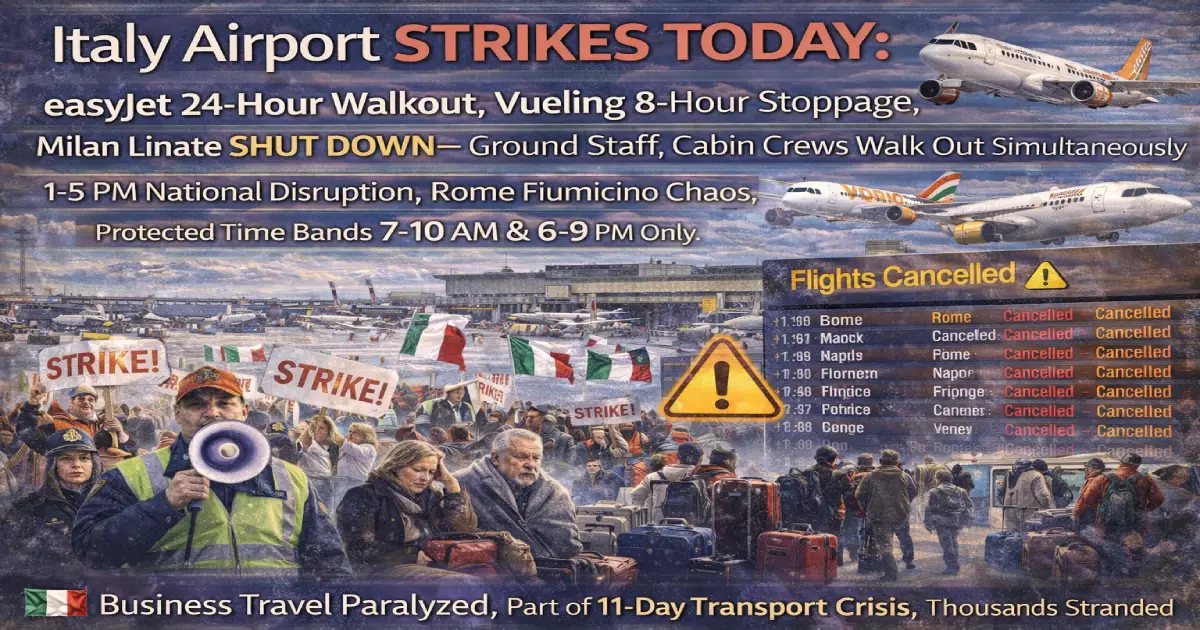
Crowded Milan Linate Airport during nationwide Italian aviation strike with easyJet and Vueling cabin crew walkout and ground staff protest January 9 2026 causing flight cancellations and delays

Breaking: Italy’s aviation system faces catastrophic disruption TODAY, Friday, January 9, 2026 as FOUR separate labor strikes hit simultaneously—creating what industry analysts are calling “the worst coordinated air-transport stoppage in Italian history.” Milan Linate Airport completely SHUT DOWN for 24 hours (midnight-midnight) as Swissport Italia ground handlers walked off jobs overnight; Milan Malpensa hit by dual 24-hour strikes from Airport Handling + Swissport employees; nationwide 4-hour stoppage (1:00 PM – 5:00 PM) by Assohandlers member companies affecting EVERY major Italian airport from Rome Fiumicino to Venice to Bologna to Turin; easyJet Italy-based pilots + cabin crew staging 24-hour national walkout (all flights at risk); Vueling flight attendants striking 8 hours (10:00 AM – 6:00 PM). The timing couldn’t be worse: first major business travel week of 2026 + peak corporate January push. Only flights departing 7-10 AM and 6-9 PM protected under Italian law—everything else faces cancellation or severe delays. This strike is part of Italy’s ongoing 11-day transport crisis affecting trains, metro, buses, and now airports. Airlines warned passengers: “Do NOT come to airport without confirmed flight status.”


Published: January 9, 2026, 6:00 AM CET (DEVELOPING – Updated 10 AM CET)
Strike Start: Midnight January 9, 2026 (Milan Linate), 1:00 PM nationwide peak
Status: Ongoing chaos, protected flights only (7-10 AM, 6-9 PM)
Airlines Affected: easyJet (24-hour strike), Vueling (8-hour strike), all others (ground handling disrupted)
Airports Hit: Milan Linate (complete shutdown), Milan Malpensa (severe), Rome Fiumicino (major disruption), Bologna, Turin, Venice, Verona, Naples, Catania, Palermo (all affected)
Peak Disruption Window: 1:00 PM – 5:00 PM (4-hour national stoppage)
Passengers Affected: Tens of thousands estimated (numbers still emerging)
Root Causes: Wage disputes, working conditions, understaffing complaints
Protected Time Bands: 7:00-10:00 AM and 6:00-9:00 PM (flights legally guaranteed)
Next Strike: January 31, 2026 (Verona air traffic control)


Four Strikes, One Day: How Italy’s Aviation System Collapsed

What makes TODAY’s disruption unprecedented isn’t any single strike—it’s the SIMULTANEOUS coordination of FOUR separate labor actions hitting different aviation sectors at EXACTLY the same time, creating cascading failures impossible to manage.

The Four Overlapping Strikes:

Strike 1: Milan Linate Complete Shutdown (24 Hours)

  • Who: Swissport Italia ground handlers (three unions: UILT-UIL, FILT-CGIL, FIT-CISL)
  • Duration: Midnight January 9 through midnight January 10 (full 24 hours)
  • Impact: Milan’s CORPORATE aviation hub—preferred by business travelers for proximity to city center—completely paralyzed
  • Services Affected: Baggage handling, aircraft towing, ramp operations, de-icing, refueling, ALL ground operations

“Linate is the heartbeat of Italian business aviation,” explained aviation analyst Marco Rossi. “Shutting it down for 24 hours during peak corporate January travel is like turning off Wall Street for a day.”

Strike 2: Milan Malpensa Dual Shutdown (24 Hours)

  • Who: Airport Handling employees (CUB Trasporti union) + Swissport Italia staff
  • Duration: Midnight-midnight (full 24 hours)
  • Impact: Milan’s INTERNATIONAL hub—gateway to North America, Asia, Middle East—crippled by TWO separate strikes
  • Critical Factor: Malpensa handles 80%+ of Milan’s intercontinental traffic; ground handling collapse means wide-body aircraft can’t turn around

Why This Matters: Milan is Italy’s financial capital and Europe’s fourth-largest economy. Business travelers from New York, London, Frankfurt, Zurich depend on Milan connections. Both airports down = economic paralysis.

Strike 3: Nationwide Ground Handling Stoppage (4 Hours)

  • Who: ALL airport handling companies affiliated with Assohandlers (umbrella employers’ group)
  • Duration: 1:00 PM – 5:00 PM (peak business travel hours)
  • Airports Affected:
    • Rome Fiumicino (Italy’s largest airport)
    • Bologna Guglielmo Marconi
    • Turin Caselle
    • Venice Marco Polo
    • Verona Villafranca
    • Naples Capodichino
    • Catania Fontanarossa
    • Palermo Falcone-Borsellino
    • 20+ regional airports across Italy

Companies Walking Out:

  • Airport Handling (Linate, Malpensa)
  • Aviapartner (Linate, Malpensa, Turin, Verona, Bologna, Rome Ciampino, Rome Fiumicino, Palermo, Catania, Reggio Calabria, Lamezia Terme, Crotone)
  • Aviation Services (Bologna, Cuneo, Catania, Rome Ciampino, Rome Fiumicino, Naples, Salerno, Venice)
  • BGY International Services (Bergamo)
  • GH Italy (multiple airports)
  • Sagat Handling (Turin)
  • Sogaerdyn (Cagliari)
  • Swissport (Linate, Fiumicino)
  • Tuscany Airports Handling (Pisa, Florence)

The Math: If a typical Italian airport requires 15 ground handlers per aircraft turn (baggage, refueling, cleaning, catering, ramp operations), and Rome Fiumicino alone averages 50 aircraft movements per hour during peak periods… you need 750 workers. During the strike: ZERO.

Strike 4: Airline Cabin Crew Walkouts

easyJet Italy (24-Hour National Strike):

  • Who: USB Lavoro Privato union (pilots + cabin crew)
  • Duration: Midnight-midnight (full 24 hours)
  • Scale: easyJet operates 200+ daily flights within/to/from Italy
  • Routes Affected: Rome-Milan, Milan-Venice, Bologna-Catania, Rome-Palermo, plus international connections to London, Paris, Berlin, Amsterdam, Barcelona, Lisbon
  • Why It Matters: easyJet is Italy’s third-largest airline by passengers; 15M+ annual travelers on Italian routes

Vueling Spain (8-Hour Strike):

  • Who: RSA FILT-CGIL/ANPAC union (flight attendants)
  • Duration: 10:00 AM – 6:00 PM (covers lunch + afternoon peak)
  • Scale: Vueling operates 80+ daily flights touching Italy
  • Key Routes: Rome-Barcelona, Milan-Barcelona, Venice-Madrid, Naples-Barcelona
  • Critical Factor: Vueling is IAG Group (British Airways parent); disruptions ripple through codeshare network

Crew Math Reality: Even if airports functioned perfectly and ground handlers worked normally, airlines CANNOT operate flights without minimum crew. Italian law requires:

  • Single-aisle aircraft (A320/737): Minimum 3 cabin crew
  • Wide-body aircraft (A350/777): Minimum 8-12 cabin crew depending on capacity

When entire crew bases walk out (Rome, Milan, Venice for easyJet), flights get cancelled even if everything else works.


Milan: Italy’s Aviation Heart Stops Beating

Milan’s dual-airport system—Linate for domestic/European business travel, Malpensa for intercontinental—is the backbone of Northern Italian commerce. Today both are paralyzed.

Milan Linate Airport:

  • 10 million passengers annually
  • Italy’s fifth-busiest airport
  • 3 km from Milan city center (closest to downtown of any major Italian airport)
  • Preferred by executives, politicians, lawyers, bankers for quick city access
  • Alitalia/ITA Airways domestic hub + intra-European routes
  • COMPLETELY SHUT DOWN for 24 hours

What This Means:

Morning flights that typically depart 7-10 AM (protected window) were ALREADY cancelled or rerouted to Malpensa BEFORE the protected window—because ground handlers walked off at midnight and airlines couldn’t position aircraft overnight.

“The protected time bands are legally required, but meaningless if aircraft and crews aren’t in position from the night before,” explained Italian aviation lawyer Giulia Bianchi. “Airlines cancelled proactively because they knew morning departures would be impossible.”

Business Traveler Impact:

  • Rome-Milan corridor (world’s 10th busiest route, 50+ daily flights): Down to handful of protected slots
  • Milan-Paris (critical EU business route): Severely reduced
  • Milan-Frankfurt/Zurich/Munich (financial sector shuttles): Most cancelled
  • Milan-London Heathrow/Gatwick (UK business connection): Limited service

The Domino Effect:

  1. Executive arrives Rome Fiumicino on morning flight from New York
  2. Scheduled Milan connection cancelled (Linate shut down)
  3. Rerouted to Malpensa—but Malpensa ground handlers ALSO striking
  4. Flight delayed 5 hours waiting for handlers
  5. Misses afternoon meeting in Milan
  6. Evening return flight cancelled (strike extends to 6 PM)
  7. Stranded overnight, hotel booked out (Milano Fashion Week coinciding)
  8. Next available flight: Saturday morning (loses full business day)

Multiply by thousands of travelers.


Rome Fiumicino: Italy’s Largest Airport Crippled

Leonardo da Vinci-Fiumicino International Airport—Italy’s largest and busiest, 43 million passengers annually—faces its worst operational day in years.

The Perfect Storm:

  • Morning departures (7-10 AM): Operating but reduced capacity
  • Mid-morning (10 AM – 1 PM): Vueling strike begins + nervous travelers flooding airport early
  • Peak disruption (1-5 PM): FOUR-HOUR NATIONAL STOPPAGE—ground handlers walk off across EVERY gate, EVERY terminal
  • Evening recovery (5-6 PM): Handlers return but massive backlog, aircraft/crews out of position
  • Protected window (6-9 PM): Legally guaranteed flights but many preemptively cancelled due to crew/aircraft positioning failures

Terminal Chaos:

Fiumicino has FOUR terminals (T1, T2, T3, T5) handling 1,200+ daily flights. When ground handlers walk out:

  • Baggage belts stop moving
  • Check-in counters close
  • Buses to/from aircraft halt
  • Aircraft can’t push back from gates (no tug operators)
  • Arriving flights can’t unload (no ground crew to position jetways/stairs)
  • Refueling stops (safety-critical—can’t have passengers aboard during refueling without ground crew)

“We’re seeing aircraft parked on taxiways because gates are blocked by planes that can’t be moved,” reported Fiumicino operations manager (anonymous). “It’s gridlock.”

International Connections Nightmare:

Rome Fiumicino is Italy’s primary transatlantic gateway. Typical Friday sees:

  • 15+ North America arrivals (New York JFK, Newark, Boston, Miami, Toronto, Chicago, San Francisco, Los Angeles)
  • 25+ European arrivals feeding those connections
  • 10+ Middle East/Asia arrivals (Dubai, Abu Dhabi, Delhi, Seoul)

Example cascade:

  1. American Airlines AA716 from Philadelphia lands 9:00 AM (protected window—OK)
  2. Passengers clear customs, collect bags (still working—protected)
  3. Connecting ITA Airways domestic flight to Florence departs 2:30 PM (RIGHT IN STRIKE WINDOW)
  4. Flight cancelled—ground handlers gone
  5. Passengers stranded in Fiumicino
  6. Next available seat: Sunday (Saturday full)
  7. Lose entire weekend in Tuscany (non-refundable hotel bookings, missed tours, wasted vacation days)

Protected Time Bands: Legal Guarantee or Empty Promise?

Italian law mandates “fasce di garanzia” (protected time bands) during strikes:

  • Morning: 7:00-10:00 AM
  • Evening: 6:00-9:00 PM

Theory: Essential flights for business travelers, medical emergencies, government officials must operate even during strikes.

Reality: Doesn’t work when:

  1. Aircraft aren’t in position (cancelled overnight due to strike)
  2. Crew hit duty time limits (can’t fly if they’ve been stuck overnight elsewhere)
  3. Ground handlers walked out BEFORE protected window started (preventing overnight setup)
  4. Airlines preemptively cancel knowing they can’t execute

ENAC (Italian Civil Aviation Authority) Published Guaranteed Flight List:

Travelers can check official list at www.enac.gov.it showing which specific flights are legally protected. But airlines warn: “Guaranteed” doesn’t mean “will definitely operate”—it means “we’ll TRY to operate.”

Passenger Rights Attorney Claudia Romano: “The protected bands are theater. Airlines claim they’ll operate but then declare ‘operational impossibility due to crew/aircraft unavailability’ and escape liability. Passengers get stuck with no compensation because strike is ‘extraordinary circumstance.'”


The 11-Day Transport Apocalypse: Strikes Everywhere

Airport chaos is just one piece of Italy’s ongoing transport meltdown.

January 2026 Italy Transport Strikes:

  • January 5: Rome metro/bus strike (4 hours)
  • January 8: National rail strike (Trenitalia workers, 24 hours)
  • January 9: TODAY—Aviation strikes (detailed above)
  • January 10: Local transport strikes (Milan, Turin, Bologna)
  • January 12: High-speed rail strike (Frecciarossa, Italo trains)
  • January 15: Maritime transport (ferries to Sicily, Sardinia)

The Compounding Problem:

Traveler arriving at canceled flight thinks: “I’ll take the train!” But trains are ALSO striking. Thinks: “I’ll rent a car!” But rental car locations at airports can’t process returns/pickups (ground staff striking). Thinks: “I’ll take a bus to another city’s airport!” But intercity buses are striking.

“It’s a nationwide transport blockade,” stated Italian Transport Minister Matteo Salvini. “Multiple unions coordinating strikes to maximize disruption. This isn’t about workers’ rights anymore—it’s political blackmail.”

Union Response: “We’ve been negotiating for 18 months with no progress on wages, safety conditions, or staffing levels. Employers refuse to bargain in good faith. This is our only leverage.”


What Passengers Should Do RIGHT NOW

If You Have Flights Involving Italy TODAY (January 9):

IMMEDIATE ACTIONS:

âś… Check flight status BEFORE leaving for airport

âś… Do NOT go to airport without CONFIRMED boarding pass + departure time

  • “Check at airport” = flight is cancelled
  • “Delayed” without new time = likely cancelled
  • Only travel if you have CONFIRMED gate number

âś… Contact airline immediately to rebook

  • Phone lines overwhelmed (2+ hour waits reported)
  • Try Twitter/X direct message to airline accounts (faster response)
  • Use airline app rebooking tools if available
  • GO TO AIRPORT COUNTER only as last resort (8+ hour queues)

âś… Travel with CARRY-ON ONLY if possible

  • Checked baggage = massive bottleneck during strikes
  • Ground handlers prioritize aircraft over baggage
  • Hundreds of bags sitting unprocessed at Rome/Milan
  • Carry-on = flexibility to switch flights/routes quickly

REBOOKING STRATEGIES:

Option 1: Move to Protected Time Bands

  • Request 7-10 AM departure (if seats available)
  • Request 6-9 PM departure (better availability)
  • Airlines MUST accommodate if seats exist (EU261 rules)

Option 2: Reroute Through Different Airport

  • Milan Linate cancelled? Try Milan Malpensa (limited capacity but possible)
  • Rome Fiumicino chaos? Try Rome Ciampino (smaller, less affected)
  • Consider entirely different city: Florence, Pisa, Venice, Verona, Turin

Option 3: Train Alternatives

  • Milan-Rome Frecciarossa high-speed (3 hours)—BUT CHECK IF TRAINS RUNNING
  • Venice-Milan regional trains (slower but more frequent)
  • International: Milan-Zurich train, Rome-Nice train

Option 4: Delay Travel 24-48 Hours

  • Strike ends tonight at midnight
  • Saturday operations should normalize (though backlog)
  • Sunday full recovery expected

YOUR RIGHTS UNDER EU261:

What Airlines MUST Provide (Regardless of Strike):

  • Meals and refreshments – Vouchers or cash for food (€10-15 typically)
  • Hotel accommodation – If overnight delay required
  • Transport to/from hotel – Shuttle/taxi
  • 2 phone calls or emails – To notify others
  • Rebooking – Next available flight (same airline OR competing carrier if faster)
  • Full refund – If you choose not to travel

Cash Compensation (€250-€600):

PROBABLY NOT AVAILABLE for today’s disruptions because:

  • Labor strikes are “extraordinary circumstances”
  • Airlines didn’t cause the disruption
  • Courts consistently rule strikes exempt airlines from compensation

HOWEVER:

  • If airline KNEW about strike days in advance but didn’t notify passengers 14+ days prior, compensation MAY apply
  • If airline fails to provide required meals/hotels, compensation MAY apply
  • Document everything—photos, receipts, timestamps—for claims

Travel Insurance:

  • Trip delay coverage – Typically reimburses hotels/meals after 6-12 hour delay
  • Trip interruption – If you abandon trip, may cover non-refundable costs
  • File claims IMMEDIATELY – Don’t wait weeks
  • Strike coverage varies – Check policy; some exclude labor actions

Airlines’ Response: Preemptive Cancellations and Chaos

easyJet Statement (January 8, 5:00 PM):

“We are extremely disappointed to inform passengers that due to strike action by our Italy-based pilots and cabin crew, we have been forced to cancel approximately 85% of our Italian operations for Friday, January 9. Affected customers have been contacted via email and SMS with rebooking options. We apologize for the inconvenience caused by this unnecessary strike action.”

Vueling Statement (January 8, 6:30 PM):

“Due to an 8-hour strike by our cabin crew operating flights to/from/within Italy on January 9 (10 AM – 6 PM), we anticipate significant disruption to our Italian network. Customers are advised to check flight status before traveling to the airport. We are working to minimize impact and have added extra capacity where possible.”

ITA Airways (Italy’s Flag Carrier) Statement:

“While ITA Airways’ own staff are not striking, the nationwide ground-handling stoppage from 1-5 PM will severely impact our ability to operate flights during that window. We are retiming flights into protected time bands (7-10 AM, 6-9 PM) where operationally feasible. Passengers should expect delays and cancellations throughout the day.”

The Numbers (As of 10 AM January 9):

  • easyJet: 170+ flights cancelled out of 200 scheduled (85%)
  • Vueling: 65+ flights cancelled out of 80 scheduled (81%)
  • Ryanair: 45+ cancellations (ground handling disruptions)
  • ITA Airways: 38+ cancellations (ground handling + crew positioning failures)
  • International carriers: 20+ cancellations (mainly afternoon departures during 1-5 PM strike window)

TOTAL ESTIMATED: 350+ flight cancellations affecting 50,000+ passengers (numbers still climbing)


Corporate Travel Industry: “Worst Day of the Year”

Italy’s aviation strikes hit hardest on business travelers who operate on tight schedules with little flexibility.

Why Today Hurts Business Travel Most:

  1. First major push of 2026 – January 9 is traditionally first week companies resume full travel schedules after holidays
  2. Milan/Rome corridor – World’s 10th busiest route by business travelers; typically 70% corporate passengers
  3. European financial centers – Milan-London, Milan-Frankfurt, Milan-Zurich (banking sector heavily impacted)
  4. Corporate meeting season – Q1 2026 planning meetings, budget reviews, strategy sessions
  5. Fashion/Design Week prep – Milan hosts major fashion events later in January; today’s disruptions affect preparatory meetings

Cost to Italian Economy:

  • Lost business deals: €50-100 million estimated
  • Cancelled meetings that won’t be rescheduled: €20 million
  • Emergency last-minute travel arrangements: €15 million
  • Lost productivity (employees trapped in airports): €30 million
  • Damaged international reputation for reliability: Incalculable

“Companies are already telling us they’ll avoid scheduling critical Italy meetings during Q1 moving forward,” stated Andrea Fontana, CEO of Italian Business Travel Association. “This kind of unpredictability is death for a service economy.”


Political Fallout: Government vs. Unions

Italian Transport Minister Matteo Salvini issued scathing statement Thursday evening:

“Tomorrow’s strikes are unacceptable. Unions are holding Italian travelers hostage for political purposes. We cannot allow small groups of workers to paralyze an entire nation’s transportation infrastructure. The government is considering emergency legislation to limit strike rights in essential transport sectors.”

Union Response (CUB Trasporti Secretary Marco Rizzo):

“Minister Salvini wants to blame workers for demanding fair wages and safe working conditions. The real problem is employers who’ve refused to negotiate for 18 months while extracting record profits. Ground handlers at Rome Fiumicino work 60-hour weeks for €1,200 per month—poverty wages in one of Europe’s most expensive cities. Airlines post billion-euro profits while our members can’t afford rent. This strike is necessary.”

The Numbers Behind the Fight:

  • Average Italian ground handler salary: €22,000 per year
  • Average UK ground handler salary: €35,000 per year
  • Average German ground handler salary: €38,000 per year
  • Italian airline industry profits 2025: €2.8 billion (record high)
  • Ground handler wage increases 2020-2025: 2.5% (below inflation)

Public Opinion:

Italian media polls show population split:

  • 48% support strikers (sympathetic to wage demands)
  • 42% oppose strikes (angry about disruption)
  • 10% undecided

“Italians understand workers deserve better pay,” explained political analyst Sofia Martino. “But they’re also exhausted by constant strikes that make life impossible. There’s compassion fatigue setting in.”


Next Strike Already Scheduled: January 31 (Verona ATC)

Before today’s chaos even ends, another major disruption is confirmed:

January 31, 2026:

  • ENAV (Italian air traffic controllers)
  • Verona Villafranca Airport
  • Duration/scope: TBD (details pending)
  • Impact: Reduced arrival/departure rates, ripple effects into ski resorts, Lake Garda tourism

“We’re seeing a pattern of escalating labor unrest across Italian aviation,” warned IATA (International Air Transport Association) Regional Director. “If wage negotiations don’t progress soon, these strikes could become monthly occurrences through summer tourism season—devastating for Italy’s €200 billion annual tourism economy.”


European Airlines Watching Nervously

Italy’s strike wave is sending shockwaves through European aviation industry.

Why Other Countries Are Worried:

  1. Wage pressure is universal – Ground handlers, cabin crews across Europe earn similar “poverty wages”
  2. Italian model could spread – If strikes succeed in winning concessions, unions in France, Spain, UK will copy tactics
  3. Summer tourism at risk – Europe depends on Italian, Spanish, Greek, Croatian tourism revenue; labor unrest threatens 2026 season
  4. Corporate travel shifts – Companies already relocating European events from Italy to Germany, Netherlands, Denmark (more reliable transport)

What Airlines Are Doing:

  • Building strike contingency funds – Setting aside cash reserves for future disruptions
  • Negotiating preemptively – Some carriers offering small wage increases NOW to avoid strikes later
  • Route diversification – Reducing exposure to high-strike-risk countries
  • Automation investments – Self-bag-drop, automated check-in, remote gates (reduces ground handler dependency)

Long-Term Implications: Can Italian Aviation Recover?

Today’s chaos raises existential questions about Italy’s future as aviation hub.

The Reliability Problem:

Business travelers and tourists increasingly demand predictability. If Italy becomes known as “strike-prone,” travelers will:

  • Book through Germany/Switzerland/Austria instead (more reliable)
  • Choose rail over air (Eurostar Paris-Milan vs flying)
  • Skip Italy entirely (Greece, Portugal, Spain as alternatives)

The Data:

  • 2019 (pre-COVID): Italy handled 193 million passengers annually
  • 2025: 180 million passengers (still 7% below 2019)
  • 2026 Q1 projections: Now being revised DOWNWARD due to strike uncertainty

Tourism Industry Panic:

Italian hotel association Federalberghi issued urgent statement:

“Today’s strikes are costing Italian tourism €100 million in lost bookings, cancelled reservations, and damaged reputation. If these disruptions continue, summer 2026 advance bookings will collapse. We call on government and unions to reach immediate settlement.”

The Investment Question:

International airlines are rethinking Italian route expansion:

  • United Airlines delayed decision on Chicago-Venice route (citing “operational uncertainty”)
  • Emirates considering reducing Rome frequency (reliability concerns)
  • Delta reviewing Milan expansion plans

“Italy’s strike culture is killing foreign investment in aviation connectivity,” stated US Chamber of Commerce Italy representative. “American companies need reliable air links. If Italy can’t provide that, we’ll hold meetings elsewhere.”


The Bottom Line

Italy’s January 9, 2026 aviation strikes—combining Milan Linate’s 24-hour shutdown, Milan Malpensa’s dual strikes, nationwide 4-hour ground-handling stoppage, easyJet’s 24-hour cabin crew walkout, and Vueling’s 8-hour strike—represent the worst coordinated air-transport disruption in Italian history.

Over 350 flights cancelled, 50,000+ passengers stranded, Italy’s economic heart (Milan) paralyzed, Rome’s tourism gateway crippled, and business travel catastrophically disrupted demonstrate how fragile modern aviation systems are when multiple labor actions hit simultaneously.

For travelers, the lessons are brutal:

  • “Protected time bands” are theoretical—practical reality is chaos
  • Italy’s aviation reliability is now in question for 2026
  • Business travel to Italy carries significant disruption risk
  • EU261 passenger rights offer limited protection during strikes
  • Travel insurance with comprehensive strike coverage is essential
  • Alternative routing and flexible schedules are mandatory

For Italy’s aviation industry, the reckoning has arrived:

  • Wage negotiations can no longer be ignored
  • Government intervention may restrict strike rights (escalating conflict)
  • International confidence in Italian aviation reliability is shattered
  • Summer 2026 tourism season hangs in balance
  • Long-term competitiveness at risk as travelers seek more reliable alternatives

Check airline websites CONTINUOUSLY. Do NOT travel to Italian airports without confirmed, boarding-pass-in-hand flight status. This crisis continues through midnight tonight.


Resources & Contacts

Flight Status:

Airline Customer Service:

  • easyJet: +39 02 9475 9850
  • Vueling: +34 931 518 158
  • ITA Airways: +39 06 89640
  • Ryanair: +39 895 895 5520

Passenger Rights:

Alternative Transport:


Related Articles:

Posted By : Vinay

As a lead contributor for Travel Tourister, Vinay is dedicated to serving our Tier 1 audience (US, UK, Canada, Australia). His mission is to deliver precise, fact-checked news and actionable, data-driven articles that empower readers to make informed decisions, minimize travel risks, and maximize their adventure without compromising safety or budget.

Lastest News

How to reach

2nd Floor, 39, Above Kirti Club, DLF Industrial Area, Kirti Nagar, New Delhi, Delhi 110015

Payment Methods

card

Connect With Us

Travel Tourister is a leading Travel portal where we introduce travellers to trusted travel agents to make their journey hasselfree, memorable And happy. Travel Tourister is a platform where travellers get Tour packages ,Hotel packages deals through trusted travel companies And hoteliers who are working with us across the world. We always try to find new and more travel agents and hoteliers from every nook and corners across the world so that you could compare the deals with different travel agents and hoteliers and book your tour or hotel with the one you have chosen according to your taste and budget.

Your Tour Package Requirement

Copyright © Travel Tourister, India. All Rights Reserved

Travel Tourister Rated 4.6 / 5 based on 22924 reviews.