Published on : 03 Mar 2026
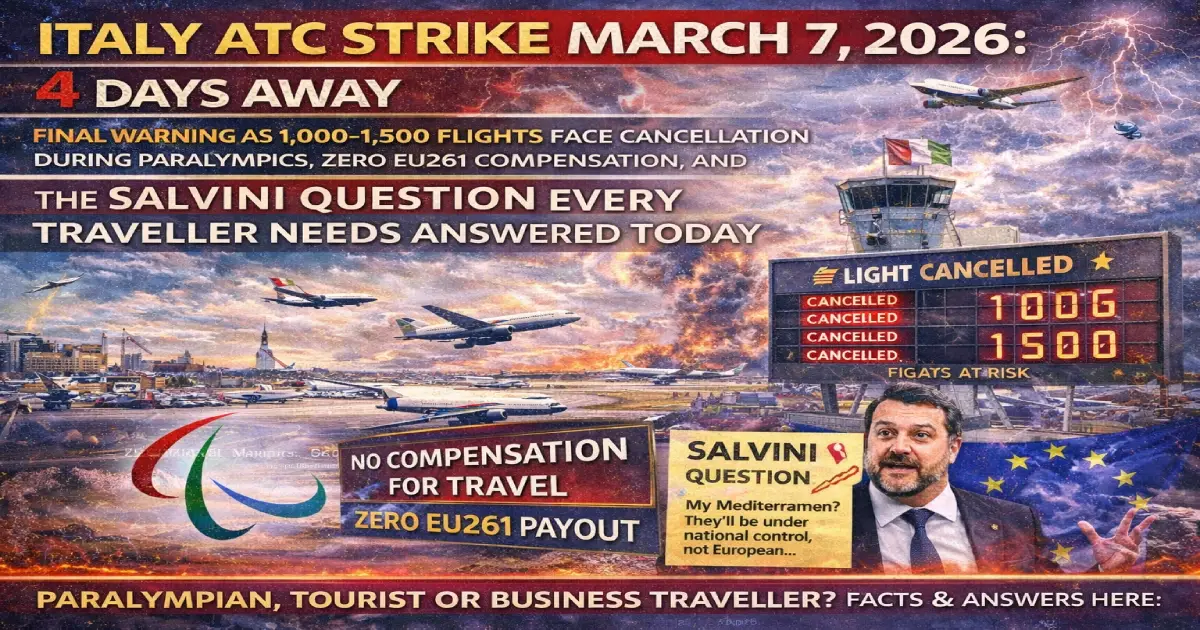
🔴 FINAL WARNING — Tuesday March 3, 2026 | Strike Date: Saturday March 7 — 4 Days Away
Four days. That is all the time you have left to act if you have a flight to, from, or through Italy this Saturday.
Italy’s aviation system has already been battered by four separate strikes in 2026. The February 16 airline strike stranded up to 100,000 passengers during Milan Fashion Week. The February 26 aviation walkout shut down 55% of ITA Airways’ schedule and was immediately followed by a 48-hour national rail blackout. Each time, passengers with cancelled flights could at least claim EU261 fixed cash compensation — up to €600 per person.
Saturday, March 7 is categorically different. And it is worse.
ENAV, Italy’s national air traffic control services provider, will walk out at Rome’s Area Control Centre for 8 hours — from 10:00 to 18:00 CET — on the second day of the Milan–Cortina 2026 Paralympic Winter Games. When ENAV Rome ACC strikes, it does not merely disrupt one airline or one hub. It degrades Italian airspace itself, creating cascading delays and cancellations for every aircraft of every airline flying through one of Europe’s busiest skies — from budget carriers to long-haul operators, from domestic puddle-jumpers to transatlantic connections, none are exempt.
Between 1,000 and 1,500 flights are at risk across every major Italian airport. And unlike every Italy strike before it in 2026: EU261 fixed-sum cash compensation does not apply. Not one euro. Not for any passenger. On any airline.
Here is everything you need to know — and the four decisions you need to make before this Saturday morning.
| Detail | Confirmed Information |
|---|---|
| Strike Date | Saturday, March 7, 2026 |
| Who Is Striking | ENAV ACC Rome air traffic controllers |
| Unions | RSA FILT-CGIL, FAST-Confsal-AV, and ASTRA (added as third organiser) |
| Strike Window | 10:00 to 18:00 CET — 8 hours |
| Only Exempt Airport | Pescara (PSR) — all other Italian airports affected |
| Flights at Risk | 1,000–1,500 (more than twice the Feb 26 airline strike) |
| EU261 Fixed Compensation | ❌ ZERO — ATC strike = extraordinary circumstance |
| Duty of Care (meals/hotel) | ✅ Still fully owed by airlines |
| Ripple Effects | Cascading delays into March 8–9 |
| Olympic Context | Day 2 of Milan–Cortina 2026 Paralympic Winter Games (March 6–15) |
| Government Injunction | ⚠️ Possible but not yet issued — see full analysis below |
| Back-to-Back Risk | March 9 Slai Cobas general strike also filed; March 18 Malpensa/Linate ground strike confirmed |
Italy has now produced more aviation disruption in a single month than most European countries see in an entire year. But passengers who lived through the February strikes need to understand why March 7 is structurally worse — not just larger.
February strikes were airline strikes. When ITA Airways, easyJet or Vueling pilots walked out, it affected those carriers’ operations. Ryanair flew normally. British Airways flew normally. Lufthansa flew normally. Passengers had clear EU261 cash compensation rights because the courts have ruled that walkouts by an airline’s own staff are within that airline’s sphere of control — and therefore compensable.
March 7 is an ATC strike. When ENAV Rome ACC controllers down tools, they do not target one carrier. They reduce Italy’s total airspace management capacity across the board. Every aircraft, every airline, every nationality of passenger — all are affected simultaneously. Ryanair’s planes cannot fly any better than ITA’s. British Airways cannot call ENAV Rome and request priority service. The entire Italian sky operates at severely reduced throughput for 8 hours, and the knock-on effects cascade for 24 to 48 hours beyond the strike window itself.
This distinction carries two enormous consequences for passengers:
First, the scale is almost double any previous Italy 2026 disruption. The February 26 airline strike put 470–580 flights at risk. March 7’s ATC action puts 1,000–1,500 in jeopardy — across every airline, not just those whose staff are walking out.
Second, EU261 fixed compensation is completely eliminated. Air traffic control strikes are classified as extraordinary circumstances beyond any airline’s control — the same classification as extreme weather events or security incidents. The European Court of Justice has repeatedly upheld this position. Any claims management company that tells you otherwise is either mistaken or selling false hope.
This is the single most important open question for every passenger with a March 7 Italy booking.
On February 13, Deputy Prime Minister and Transport Minister Matteo Salvini issued a formal injunction banning both the February 16 airline strike and the March 7 ATC strike from proceeding as scheduled. His stated justification was the need to protect mobility during the Milano-Cortina Winter Olympics and Paralympics — both events that he described as being “watched by two billion people.”
The February 16 airline strike was successfully rescheduled to February 26 as a result. The March 7 ATC strike, however, was specifically included in that same injunction — but the Italy’s national strike-guarantee authority had recommended unions move their actions to the February 24 to March 4 window, which has now passed without the ATC controllers acting.
Here is the complication: the strike-guarantee authority’s watchdog warned that walkouts at airports and air-traffic-control centres during the Games could constitute serious prejudice to citizens’ freedom of movement. The Paralympic Games run from March 6 to 15. March 7 falls squarely within this protected window.
This means Salvini has the same legal basis to issue a second injunction for March 7 as he did for February 16. However, as of Tuesday March 3, no second injunction has been issued or formally announced.
The two scenarios every passenger must prepare for:
Scenario A — Strike proceeds as authorised (currently most likely): ENAV Rome ACC controllers walk out 10:00–18:00 CET on March 7. 1,000–1,500 flights cancelled or severely delayed. Zero EU261 cash compensation. Duty of care owed. Ripple effects into March 8–9. Act now — see the rebooking guide below.
Scenario B — Government injunction issued before March 5: Salvini invokes Article 8 of Italy’s 1990 Strike-in-Essential-Services Act again and formally bans the action. The strike is either postponed to after March 15 (when the Paralympics end) or rescheduled to a later date. If this happens, your March 7 flight operates normally.
What you should monitor today: The Ministero delle Infrastrutture e dei Trasporti website (mit.gov.it) and ENAC.gov.it. Any government injunction must legally be published there before it takes effect. If no notice appears by Thursday March 5 morning, the strike will go ahead on Saturday. Do not assume silence means cancellation.
Our honest assessment: The government successfully blocked the February 16 action, but only because unions eventually agreed to reschedule. The ATC union has made no such agreement for March 7, and their public position — that negotiations have produced no concrete wage offer — has not changed. The government’s leverage is also weaker now: they already used their strongest argument (Olympic protection) once. Using the same argument twice, 13 days into the Paralympic Games, tests the legal and political limits of the Essential Services Act.
The ENAV Rome Area Control Centre oversees the majority of Italian airspace. When its controllers strike, the capacity restriction affects inbound and outbound traffic at every commercial airport in the country except Pescara (PSR), which is the single exempted airport confirmed in the strike filing.
Rome’s primary international gateway will be the epicentre. FCO handles the highest volume of flights managed by the Rome ACC. Morning departures (before 10:00) are your only safe window. All afternoon departures — particularly 11:00–20:00 — are at severe risk of cancellation or multi-hour delay. ITA Airways operates its hub from FCO; expect near-total disruption to the flag carrier’s afternoon schedule.
Malpensa handles all of Milan’s long-haul traffic. Long-haul transatlantic departures timed for afternoon and evening — typically the heaviest departure wave — will be most exposed. British Airways, Lufthansa, Air France, Emirates (if resumed), American Airlines, and United all operate MXP long-haul services. Any transatlantic passenger connecting through a European hub must factor in the possibility of missing their connection entirely.
Additional March 18 warning for MXP/LIN passengers: Even after March 7, Milan airports face a separate confirmed threat. Airport Handling, ALHA, and Dnata have already filed a 24-hour ground services strike at Milan Malpensa and Linate for March 18. This means baggage handlers, check-in agents, ramp staff, and cargo handling at both airports will walk out — even if the aircraft and crews are operating normally. If you are rebooked from March 7 to March 18 to avoid the ATC strike, you may be walking directly into the next disruption.
Linate handles primarily domestic and short European routes. Afternoon domestic services face significant delay risk.
Venice is one of Italy’s most tourism-dependent airports. Spring season arrivals from the UK, US, and Germany peak in March. The strike falls on a Saturday — traditionally the highest inbound leisure travel day. Passengers flying in for weekend city breaks face the most acute risk.
Naples airport handles significant Ryanair and easyJet volume. Afternoon low-cost departures face cancellation risk. Ryanair’s point-to-point model means any Naples cancellation typically offers no same-day alternative.
Bologna is a growing hub for Central Italy. Ryanair, Vueling, and easyJet operate significant frequency here. All afternoon departures at risk.
Sicily’s busiest airport. Domestic connections to Rome and Milan face particular disruption as Rome ACC manages the overwater routing between Sicily and the Italian mainland.
Verona is the gateway airport for the Paralympic Games in the Dolomites. Paralympic athletes, support staff, media, and spectators using Verona airport on March 7 will face the same disruption as leisure passengers. There is no special exemption for Paralympic-related travel.
The only confirmed exempted airport. If you can find a routing that avoids all other Italian airports and operates purely through Pescara, your flight is protected. In practice, this option is irrelevant for the vast majority of passengers.
This is the most important section of this article for every passenger affected on March 7.
What you CANNOT claim: EU261 Article 7 fixed-sum compensation — €250, €400, or €600 per person based on flight distance. ATC strikes are classified as extraordinary circumstances beyond the airline’s control. Every European court that has considered this question has upheld the extraordinary circumstance defence for ATC actions. No claims management company or solicitor can override this legal position. Do not pay anyone to pursue this claim on your behalf — it will fail.
What you CAN and MUST claim:
Full refund or rebooking (Article 8): If your flight is cancelled, the airline must offer you either a full refund of the unused portion of your ticket, OR rebooking on the next available service to your destination at no extra cost, OR rebooking at a later date that suits you. This right is absolute and not eliminated by extraordinary circumstances.
Duty of care (Article 9): If you are at the airport and face a delay of 2 hours or more, the airline must provide meals and refreshments in reasonable relation to the waiting time. If your delay requires an overnight stay, the airline must provide hotel accommodation and transport to and from the hotel. This duty of care applies regardless of the reason for the cancellation — even ATC strikes do not extinguish it.
The Article 9 trap airlines use: Some airlines — particularly low-cost carriers — will tell stranded passengers at the airport that “it’s an extraordinary circumstance, so we owe you nothing.” This is legally wrong. EU261 Article 9 duty of care is owed regardless of extraordinary circumstances. Only Article 7 cash compensation is extinguished. Any airline that refuses to provide meals or hotel accommodation for an ATC-cancelled flight stranded at the airport is in breach of EU261 and can be reported to the Civil Aviation Authority of whichever EU country the flight departed from.
Italian law protects two daily time bands during strikes, during which airlines operating scheduled services are required to maintain a minimum service level:
Everything between 10:00 and 18:00 CET is in the strike window and faces the highest cancellation risk. Even departures outside the strike window can be affected by ripple effects — an aircraft that was due to arrive from Rome at 09:30 and depart again at 11:30 will be stranded when the strike begins.
Highest-risk flights on March 7:
| Departure Time | Risk Level | Why |
|---|---|---|
| Before 07:00 | Low | Pre-strike, aircraft en route before action begins |
| 07:00–10:00 | Low–Moderate | Protected window, but inbound aircraft may already be delayed |
| 10:00–14:00 | 🔴 Very High | Strike active, full airspace restriction in effect |
| 14:00–18:00 | 🔴 Very High | Strike active, backlog compounding from 4 hours of restriction |
| 18:00–21:00 | Moderate–High | Protected window, but 8 hours of backlog takes hours to clear |
| After 21:00 | Moderate | Recovery underway, residual delays likely into Sunday |
If you have a flight departing Italy between 10:00 and 18:00 on Saturday, you are in the centre of the strike window. Act today — not Thursday, not Friday.
With four days remaining, you still have options. By Friday, those options will be significantly reduced as available seats on alternative routes are taken by the first wave of rebooking passengers. By Saturday morning, they will be almost gone.
Decision 1 — Rebook to Friday March 6 or Sunday March 8? Flying one day earlier or one day later eliminates strike exposure entirely. Friday is Day 1 of the Paralympic Games opening ceremony — airports will be busy but operational. Sunday March 8 recovery may carry residual delays from Saturday’s strike, but will largely be clear. This is the cleanest option for leisure travellers with flexibility.
Decision 2 — Fly via a non-Italian hub? If you are flying to Italy from the UK, US, Canada, or Australia, routing via a non-Italian hub adds time but eliminates Italian ATC exposure. Zurich (ZRH), Vienna (VIE), Munich (MUC), Paris (CDG), and Amsterdam (AMS) are all fully operational on March 7. A London–Zurich–Venice routing, for example, is only exposed to Italian ATC for the final ZRH–VCE sector — and that sector’s exposure depends on whether it is a departing or arriving flight within the strike window.
Decision 3 — Take the train instead? For passengers travelling within Italy or between Italy and neighbouring countries, rail is a genuinely viable alternative on March 7 — unlike the February 26 strike week, when a 48-hour rail blackout coincided with the aviation walkout. Trenitalia and Italo are currently operating normally on March 7, and Italy’s high-speed network connects Rome–Milan in under 3 hours, Rome–Florence in 90 minutes, and Milan–Venice in 2 hours 20 minutes. Book tickets tonight — Saturday morning train seats between major Italian cities sell out quickly during aviation disruptions.
Decision 4 — Stay and claim duty of care? If rebooking is not possible or practical, and your flight is cancelled, your airline must rebook you at no extra cost and provide meals and hotel accommodation at the airport if you cannot travel the same day. Keep all receipts. Submit your Article 9 claim within 6 weeks of the disruption. This is your fallback — not your first choice.
Ryanair: Ryanair is the single largest carrier by volume at Italian airports. Ryanair does not interline with other airlines, meaning a cancelled Ryanair flight cannot be automatically rebooked onto British Airways or Lufthansa. If your Ryanair Italy flight is cancelled, your options within Ryanair’s own network are limited to the next available Ryanair service — which on a peak Saturday may be 24–48 hours later. Ryanair passengers with Italy flights on March 7 face the highest single-carrier risk. Check ryanair.com for your flight status by Friday March 6 morning.
easyJet: easyJet has been heavily affected by every Italy disruption in 2026 and is likely to be similarly impacted on March 7. easyJet offers free flight changes within 14 days of the disruption under its “Disruption Promise,” but seat availability on alternative dates fills quickly. If you want to rebook proactively, use the easyJet app now — do not wait for a cancellation email.
ITA Airways (formerly Alitalia): As Italy’s flag carrier, ITA operates its hub from Rome Fiumicino — the airport most directly affected by the Rome ACC action. ITA is offering passengers affected by confirmed cancellations a full refund or free rebooking. ITA passengers on March 7 afternoon services should proactively rebook to the morning window or an alternative date.
British Airways: BA operates Rome Fiumicino, Milan Linate, Venice, and Naples from London Heathrow. British Airways has confirmed it will issue proactive rebooking emails to passengers on cancelled March 7 flights. However, given that BA is simultaneously managing the Middle East crisis waivers, customer service wait times are elevated. Use Manage My Booking online rather than calling.
Ryanair, Wizz Air, and Vueling passengers on domestic Italian routes: Domestic Italy connectivity on March 7 is severely at risk. If you rely on a domestic Italian flight as the first leg of an international itinerary (e.g., Catania to Rome, then Rome to London), a cancellation on the domestic leg breaks the entire journey. If these are separate bookings, the international carrier has no obligation to accommodate you. Book train alternatives tonight.
Passengers choosing Italy in March need to understand that March 7 is not an isolated event. Italy’s industrial action calendar currently looks like this:
This is not one bad day. It is the opening three weeks of what aviation analysts and union observers expect to be Italy’s most strike-disrupted spring travel season in at least a decade. The underlying cause — stalled national collective labour agreements covering air and ATC workers — has not moved toward resolution. Contract talks have produced no concrete wage offer. Until they do, expect further action.
Posted By : Vinay
Lastest News
2nd Floor, 39, Above Kirti Club, DLF Industrial Area, Kirti Nagar, New Delhi, Delhi 110015



Travel Tourister is a leading Travel portal where we introduce travellers to trusted travel agents to make their journey hasselfree, memorable And happy. Travel Tourister is a platform where travellers get Tour packages ,Hotel packages deals through trusted travel companies And hoteliers who are working with us across the world. We always try to find new and more travel agents and hoteliers from every nook and corners across the world so that you could compare the deals with different travel agents and hoteliers and book your tour or hotel with the one you have chosen according to your taste and budget.
Copyright © Travel Tourister, India. All Rights Reserved

 Call
Call Enquiry