Published on : 31 Dec 2025
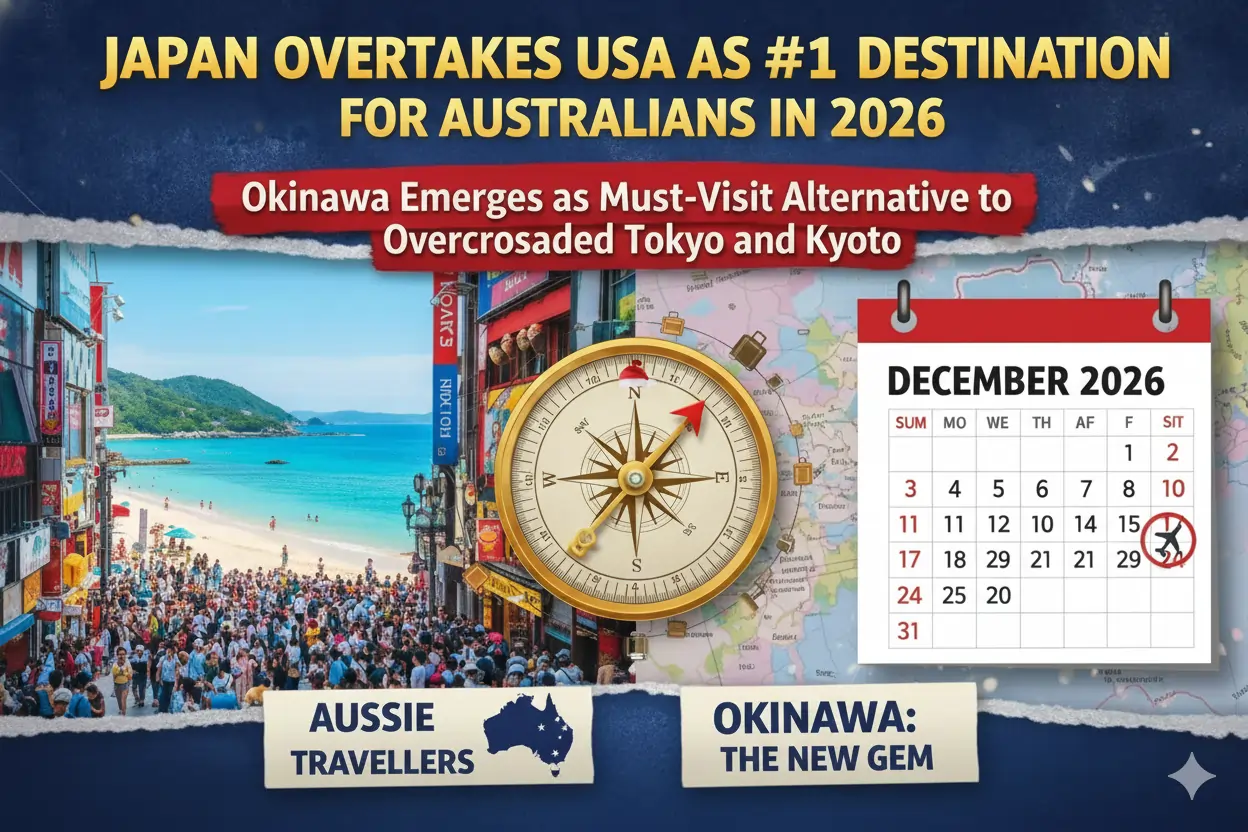
TRENDING: Japan surpasses United States to become Australia’s third-most popular overseas destination with over 1 million Australian visitors annually for first time—18.5% surge in 2025 driven by weak yen, direct flights, and Okinawa’s 71% search spike positioning subtropical islands as next Japan hotspot
Published: December 31, 2025 Source: Japan National Tourism Organization (JNTO), Expedia Group, Australian Bureau of Statistics Key Finding: Over 1 million Australians visited Japan in 2024-2025 fiscal year (28% increase) Breakthrough Moment: Japan overtakes USA to claim #3 spot for Australian travelers Rising Star: Okinawa sees 71% year-over-year search increase, ranks #2 globally on Expedia’s 2026 Destinations list
Japan overtook the United States to become Australian travelers’ third-most popular overseas destination during the 2024-2025 fiscal year when visitors surpassed one million annually for the first time—a milestone driven by the weak Japanese yen making travel affordable, expanded direct flight capacity from major Australian cities, and growing interest in regional destinations like Okinawa that offer authentic Japanese experiences without the overtourism crushing Tokyo and Kyoto.
The 28 percent year-over-year increase positions Japan behind only Indonesia (1.74 million Australian visitors) and New Zealand in popularity among Aussies, with September 2025 alone bringing 96,600 Australian visitors—a 12.8 percent jump from September 2024—as year-to-date arrivals climbed 18.5 percent to 755,200 compared to 637,273 during the same 2024 period, confirming sustained momentum heading into 2026.
“The steady growth in visitor numbers shows that Japan remains a top choice for Australians seeking a variety of travel experiences—from adventure and outdoor activities to cultural discoveries, food, wellness, and design,” confirms JNTO media & marketing manager Andrew Coombs. “We’re also seeing growing interest in regional and seasonal travel, as repeat visitors continue to explore more of what Japan has to offer.”
The surge coincides with Okinawa’s emergence as 2026’s hottest trending destination, with Expedia ranking the subtropical island chain #2 globally after recording a 71 percent year-over-year spike in flight and accommodation searches as Australian travelers increasingly seek Japan’s tropical beaches, coral reefs, and laid-back Ryukyu culture rather than fighting crowds in Kyoto’s temples or Tokyo’s neighborhoods where overtourism has prompted new restrictions and tourist taxes.
The Japanese yen’s weakness against the Australian dollar throughout 2024-2025 transformed Japan from premium destination into exceptional value, with one Australian dollar buying approximately 100-105 Japanese yen compared to historical averages around 80-85 yen—effectively making Japan 20-25% cheaper for Aussie travelers compared to pre-pandemic pricing.
“Increased airline capacity, special offers and a favourable exchange rate are spurring Australian travellers to discover Japan’s distinctive regions, each with their own character, culture and cuisine,” JNTO Australia Executive Director Naoki Kitazawa confirms, noting that the currency advantage combines with competitive airfares to create irresistible value.
Cost comparison examples (AUD):
Australian travelers accustomed to expensive domestic tourism—where Sydney hotel rooms easily exceed $200/night and casual dining costs $25+ per person—find Japan’s pricing remarkably affordable despite being developed nation with world-class infrastructure, making the 9-10 hour flight from major Australian cities worthwhile investment.
Japan Airlines (JAL) and All Nippon Airways (ANA) significantly increased flight capacity from Australian cities throughout 2025, responding to surging demand with additional routes, larger aircraft, and competitive pricing that makes Japan more accessible than ever for Aussie travelers.
Major Australia-Japan routes 2026:
Additionally, connecting flights through Singapore, Hong Kong, or Bangkok provide alternative routing options, with Singapore Airlines, Qantas, and Cathay Pacific all serving Japan-bound Australians, though direct flights increasingly dominate due to time-saving convenience and competitive pricing.
“Japanese airlines are investing heavily in the Australian market because we’re high-value travelers who stay longer and spend more per visit compared to other nationalities,” notes JNTO’s Andrew Coombs, highlighting that Australian visitors spent an average of 382,000 yen (approximately AUD $3,820) per capita in 2024, making them the second-highest spenders among all international visitors to Japan.
Japan’s legendary reputation for safety, cleanliness, efficient public transportation, and exceptional customer service resonates deeply with Australian travelers who appreciate organized, hassle-free travel experiences without the chaos, scams, or safety concerns plaguing some Southeast Asian destinations.
Why Aussies love Japan:
“While first-time visitors have historically headed to the Golden Route of Tokyo, Osaka and Kyoto, or the ski fields in Hokkaido and Nagano, Japan has so much more to offer, and we are delighted to welcome Australian travellers to embrace it all,” JNTO emphasizes, noting that repeat visitors increasingly explore regional Japan beyond traditional tourist circuits.
Expedia’s Unpack ’26 global travel trends report, based on 24,000 travelers surveyed across 18 countries and millions of actual bookings, ranks Okinawa as the second-most trending destination worldwide for 2026—trailing only Big Sky, Montana—after recording a stunning 71 percent year-over-year increase in flight and accommodation searches.
“Okinawa is booming as more travelers look beyond Tokyo and Kyoto,” confirms Expedia’s analysis. “With its laid-back island feel, it’s becoming a new favorite for visitors who want both adventure and relaxation.”
The subtropical island chain, located approximately 1,600 kilometers southwest of Tokyo and closer to Taiwan than mainland Japan, offers dramatically different experiences from traditional Japan tourism—pristine beaches rivaling those of Thailand or the Philippines, coral reefs perfect for snorkeling and diving, unique Ryukyu culture distinct from mainland Japanese traditions, and subtropical climate providing warm weather year-round unlike seasonal Tokyo/Kyoto.
What makes Okinawa suddenly trending:
“Rather than chasing the classic Tokyo-Kyoto-Osaka triangle, Japan is leaning into regional campaigns to steer visitors away from Tokyo and other major city centers,” notes travel industry analysis, with Okinawa perfectly positioned to absorb tourists seeking authentic Japanese experiences without contributing to urban overtourism problems.
Naha City:
Southern Okinawa:
Central Okinawa:
Northern Okinawa:
Ishigaki Island:
Miyako Island:
Taketomi Island:
Iriomote Island:
“Okinawa’s growth reflects a broader swing toward slower, more nature-forward itineraries that still offer deep cultural texture,” notes Expedia analysis. “The prefecture’s subtropical climate, offshore island diversity, and reef-fringed bays support snorkeling, paddling, and hiking, while traditional crafts, cuisine, and Ryukyu heritage add year-round depth.”
From Sydney:
From Melbourne:
From Brisbane:
From Cairns:
Connecting flights:
Australian travelers typically fly to Tokyo then connect domestically to Okinawa, though some routing goes via Osaka or other hubs depending on itinerary.
Tokyo to Naha (Okinawa main island):
Alternative routing:
Island-hopping within Okinawa:
Sydney to Okinawa Naha:
Melbourne to Okinawa:
Brisbane to Okinawa:
Comparable to flying Australia to Bali (8-9 hours total) or Thailand (9-11 hours), making Okinawa viable tropical alternative with dramatically different cultural experiences and Japanese service standards.
Accommodation:
Food:
Transport:
Activities:
Total daily budget (budget travel): $120-180 AUD including accommodation, food, local transport, activities.
Accommodation:
Food:
Transport:
Activities:
Total daily budget (mid-range): $280-450 AUD including accommodation, food, transport, activities.
Accommodation:
Food:
Transport:
Activities:
Total daily budget (luxury): $1,000-2,500+ AUD easily achievable with luxury accommodation, fine dining, private experiences.
Flights:
Accommodation (9 nights):
Transport:
Food (10 days, 2 people):
Activities/entrance fees:
Grand total 10-day trip (2 people): $9,040-11,540 AUD depending on flight timing, or approximately $4,520-5,770 AUD per person—comparable to Bali luxury trip but with dramatically higher quality infrastructure, safety, cultural depth.
Spring (March-May): Cherry Blossom Season
Summer (June-August): Beach Season
Autumn (September-November): Best Overall
Winter (December-February): Ski and Affordability
Japanese domestic tourism peaks during:
Australian school holiday peaks (Christmas-January, Easter, June-July) unfortunately overlap with some Japanese peak periods, making shoulder seasons (May, September, November) ideal for Aussie families seeking better value and fewer crowds.
Best for: First-time visitors, tech enthusiasts, urban explorers, food obsessives, nightlife seekers.
Highlights:
Time needed: 3-5 days minimum to scratch surface, 7-10 days to explore properly.
Best for: Culture seekers, temple enthusiasts, traditional experiences, slower pace.
Highlights:
Time needed: 3-4 days for main sites, 5-7 days for deep exploration plus day trips.
Best for: Beach lovers, divers/snorkelers, travelers seeking unique culture, those avoiding overtourism.
Highlights:
Time needed: Minimum 5 days (3 main island, 2 outer islands), ideal 7-10 days for multiple islands.
This balanced itinerary covers modern Japan (Tokyo), traditional Japan (Kyoto), and tropical Japan (Okinawa), providing diverse experiences that showcase the country’s range while avoiding the exhaustion of too many destinations.
Ramen: Regional variations nationwide—Tonkotsu (pork broth Fukuoka), Miso (Hokkaido), Shoyu (Tokyo)
Sushi/Sashimi: Fresh seafood beyond compare, but try beyond just tuna/salmon—uni (sea urchin), otoro (fatty tuna), seasonal specialties
Tempura: Lightly battered, perfectly fried vegetables and seafood—art form when done properly
Yakitori: Grilled chicken skewers with every part of bird used, pairs perfectly with beer at izakayas
Okonomiyaki: Savory pancake from Osaka/Hiroshima—customizable, fun to watch prepared on hot plate
Takoyaki: Octopus balls from Osaka—street food essential
Kaiseki: Multi-course traditional dining showcasing seasonal ingredients, presentation as art
Wagyu beef: Japanese beef varieties (Kobe, Matsusaka)—melt-in-mouth quality, expensive but unforgettable
Okinawan specialties:
Vegetarian/vegan challenges: Traditional Japanese cuisine uses dashi (fish stock) extensively. Major cities increasingly offer vegetarian options, but rural Japan challenging. Shojin ryori (Buddhist temple cuisine) is vegan option. Okinawa’s Goya Champuru can be made vegetarian.
Halal: Limited halal options outside Tokyo/Kyoto/Osaka. Research ahead, bring snacks.
Allergies: Carry allergy cards in Japanese. Gluten-free difficult (soy sauce contains wheat).
Japanese convenience stores (7-Eleven, Lawson, FamilyMart) offer surprisingly quality food:
Australian travelers amazed at 24-hour access to fresh, quality, affordable food at every corner—vastly superior to Western convenience stores.
Currency: Japanese yen (¥), currently excellent value for AUD (~105 yen per dollar)
Cash culture: Japan still heavily cash-based despite being high-tech. Many restaurants/shops don’t accept cards. Withdraw cash at 7-Eleven ATMs (accept international cards, English interface, reasonable fees).
How much cash daily: Carry ¥10,000-15,000 ($95-145 AUD) daily for meals, transport, shops. Hotels and major stores accept cards.
IC Cards: Purchase Suica or Pasmo card for Tokyo transit, works nationwide for trains/buses/vending machines/convenience stores. Load at stations.
English proficiency: Major cities improving, but still limited outside tourist areas. Older generations speak minimal English.
Google Translate app: Download Japanese language pack for offline use. Camera translation for menus/signs is lifesaver.
Useful phrases:
Staff helpfulness: Despite language barriers, Japanese staff go above and beyond assisting confused tourists. Don’t hesitate to ask for help.
Shoes off: Remove shoes when entering homes, some restaurants, traditional accommodations. Slippers provided.
Onsen rules: Wash thoroughly before entering communal baths. No tattoos allowed many places (yakuza association). Most are gender-separated, nude bathing.
Chopstick etiquette: Never stick chopsticks upright in rice (funeral ritual). Don’t pass food chopstick-to-chopstick.
Bowing: Slight bow when greeting/thanking appropriate. Staff bow deeply to customers—don’t need to match, simple nod fine for Australians.
Tipping: Never tip in Japan—considered insulting. Service included, staff take pride in work without gratuity expectations.
Train etiquette: Priority seats for elderly/pregnant/disabled. Silence phones. No eating/drinking (except shinkansen bullet trains). Queue orderly.
Trash: Very few public bins (terrorism concerns). Carry trash until finding proper disposal. Separate recyclables.
The Japan Rail Pass provides unlimited travel on JR trains (including most shinkansen bullet trains, local trains, JR buses) for fixed period—exceptional value for tourists.
Pass options:
When it pays off: One round-trip Tokyo-Kyoto on bullet train costs ~$260 AUD. Tokyo-Hiroshima costs ~$350 AUD. Pass easily pays for itself with 2-3 long-distance journeys.
How to use: Must purchase exchange order before arriving Japan (from authorized sellers Australia). Exchange for actual pass at major airports/stations upon arrival. Simply show pass at gates, staff wave you through.
Not covered: Nozomi/Mizuho fastest bullet trains (use Hikari instead, 20 minutes slower), private railways (though JR covers 95% of tourist needs).
Booking seats: Pass covers reserved seats free (book at JR ticket offices). Unreserved cars also available. Peak seasons book ahead.
Business hotels: Clean, efficient, tiny rooms (~15-20 sqm), excellent value $100-150 AUD Tokyo.
Capsule hotels: Novelty experience, very affordable $30-50 AUD, single-sex dorms, showering facilities. Try once for experience.
Ryokan: Traditional inns with tatami rooms, futon beds, kaiseki meals. Book well ahead peak seasons. Some require dinner included (adds cost but worthwhile cultural experience).
Airbnb: Legal in designated areas post-2018 regulations. Can offer apartments providing more space and kitchen facilities.
Okinawa: Beach resorts Naha/Okinawa main island, guesthouses outer islands. Car rental essential if staying beach areas.
Tourist SIM cards: Purchase at airport upon arrival (Narita, Haneda, Kansai). Unlimited data 7-14 days for $40-70 AUD from carriers like Sakura Mobile, IIJmio.
Pocket WiFi: Rent portable hotspot device ~$10-15 AUD/day, share with travel companions.
Free WiFi: Major cities, hotels, convenience stores, train stations offer free WiFi, but not ubiquitous. Data SIM recommended.
The surge of Australian visitors surpassing one million annually and Japan’s leap over the United States to claim third-most-popular overseas destination reflects fundamental shifts in how Aussies approach international travel—prioritizing safety, value, cultural depth, and service quality over the traditional pull of English-speaking Western destinations where escalating costs, lengthy travel times, and diminishing uniqueness make alternatives like Japan increasingly attractive.
The weak yen creating 20-25 percent savings compared to historical exchange rates, expanded direct flight capacity from major Australian cities cutting travel time to 9-10 hours, and Japan’s legendary reputation for safety, cleanliness, efficiency, and hospitality combine to position the country as the perfect destination for Australian travelers seeking cultural immersion without the chaos, scams, or infrastructure challenges plaguing some Southeast Asian alternatives.
Okinawa’s emergence as 2026’s second-most trending global destination—with 71 percent year-over-year search increases positioning the subtropical islands as must-visit alternative to overcrowded Tokyo and Kyoto—demonstrates how savvy Australian travelers increasingly seek regional Japan experiences offering pristine beaches, coral reefs, unique Ryukyu culture, and tropical climates without sacrificing Japanese service standards, safety, or infrastructure quality.
Key takeaways for Australian travelers planning Japan in 2026:
✓ Book early (cherry blossom season, autumn foliage require 6+ months advance) ✓ Purchase JR Rail Pass before departure (exceptional value, $380 AUD for 7 days unlimited travel) ✓ Allocate 10-14 days minimum for first visit covering Tokyo, Kyoto, and Okinawa ✓ Consider Okinawa seriously (71% search spike reflects genuine appeal as tropical alternative) ✓ Budget $120-180 AUD/day (budget travel) or $280-450 AUD/day (mid-range comfort) ✓ Capitalize on weak yen (exchange rate making Japan 20-25% cheaper than historical pricing) ✓ Fly direct (JAL/ANA daily services Sydney-Tokyo 9.5 hours beats connecting through Southeast Asia) ✓ Visit shoulder seasons (May, September, November avoid peak crowds and prices) ✓ Download Google Translate app (offline Japanese for menu/sign translation essential) ✓ Respect cultural etiquette (shoes off indoors, no tipping, quiet on trains, bow when greeting) ✓ Carry cash (¥10,000-15,000 daily, ~$95-145 AUD for cash-heavy culture) ✓ Book Okinawa domestic flights early (Tokyo-Naha 2.75 hours, budget $80-150 AUD)
“Japan checks every box for Australian travelers—it’s safe enough for solo female travelers and retirees, exciting enough for young adventurers, culturally rich enough for repeat visitors discovering new regions each trip, and now affordable enough to compete with Southeast Asian destinations while offering vastly superior infrastructure and experiences,” confirms JNTO’s regional strategy emphasizing Australia as priority growth market.
The combination of Japanese hospitality (“omotenashi”), cutting-edge technology coexisting with ancient traditions, world-class cuisine from Michelin-starred restaurants to $8 ramen shops, and the ability to experience modern megacities (Tokyo), traditional culture (Kyoto), and tropical beaches (Okinawa) within one trip creates unmatched diversity impossible to replicate elsewhere—explaining why Australian visitors spend an average $3,820 per capita, stay longer, and return more frequently than travelers from other nations.
For Australian families tired of expensive domestic tourism where Sydney hotels exceed $200/night and casual meals cost $25+ per person, Japan’s exceptional value at current exchange rates makes international travel more affordable than holidays at home while offering immeasurably richer cultural experiences, safer environments, and more efficient infrastructure than domestic Australian destinations struggling with over tourism and inflated prices.
For More Resources:
Related Travel Guides:
Final Encouragement: Whether you’re first-time visitor drawn to Tokyo’s neon-lit streets and Kyoto’s ancient temples, returning traveler ready to explore regional Japan beyond the Golden Route, or beach lover seeking tropical paradise with Japanese service standards in Okinawa, 2026 represents the perfect moment to experience Japan while the favorable exchange rate, expanded flight capacity, and growing infrastructure make Australian travel easier and more affordable than ever. Don’t wait—the weak yen won’t last forever, and Okinawa’s secret as Japan’s tropical treasure is already out. Book your Japan adventure today.
Posted By : Vinay
Lastest News
2nd Floor, 39, Above Kirti Club, DLF Industrial Area, Kirti Nagar, New Delhi, Delhi 110015



Travel Tourister is a leading Travel portal where we introduce travellers to trusted travel agents to make their journey hasselfree, memorable And happy. Travel Tourister is a platform where travellers get Tour packages ,Hotel packages deals through trusted travel companies And hoteliers who are working with us across the world. We always try to find new and more travel agents and hoteliers from every nook and corners across the world so that you could compare the deals with different travel agents and hoteliers and book your tour or hotel with the one you have chosen according to your taste and budget.
Copyright © Travel Tourister, India. All Rights Reserved

 Call
Call Enquiry