Published on : 06 Jan 2026
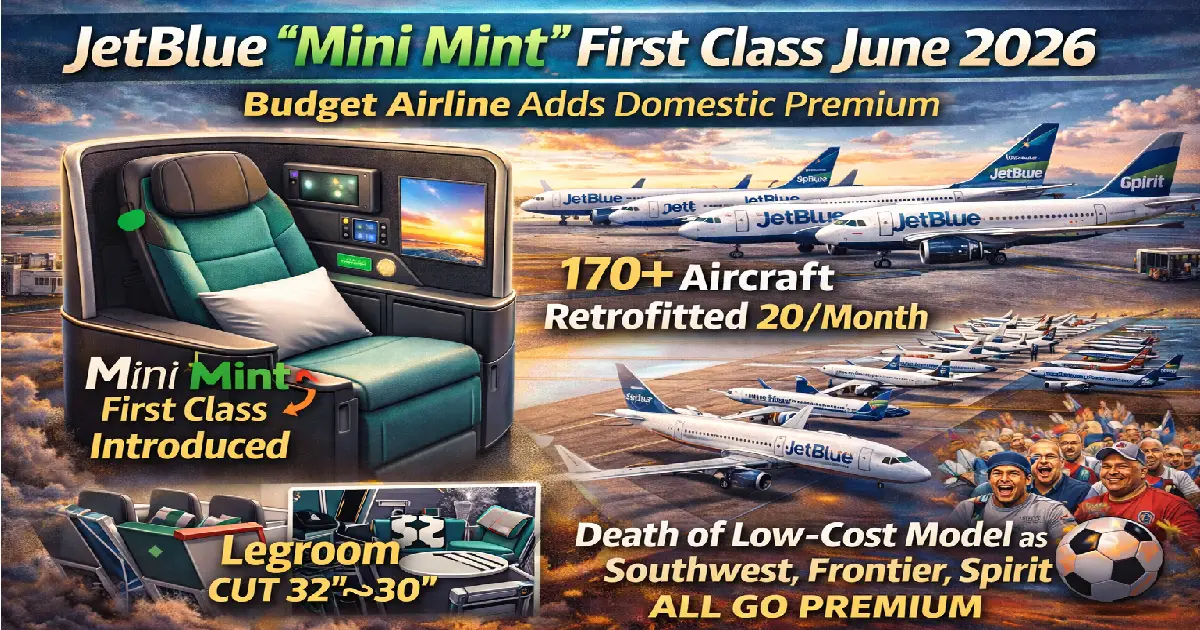
Breaking: JetBlue Airways launches historic “Mini Mint” domestic first-class product June 2026 (prototype aircraft), followed by fleet-wide rollout August 2026 retrofitting 20 aircraft monthly across 170+ Airbus A220/A320/A321s lacking existing Mint business class, marking budget carrier’s abandonment of egalitarian all-economy model in favor of premium revenue strategy mirroring legacy carriers American/Delta/United. Collins Aerospace MiQ recliner seats (identical to American’s domestic first) offer 36-37″ pitch vs economy’s newly-reduced 30″ (down from JetBlue’s signature 32″ most-legroom-in-America), sacrificing budget traveler comfort to create 2-3 premium rows generating 3-5× revenue per seat despite occupying same physical space. FAA certification underway targeting June prototype, August mass installations completing by end-2027 transforming JetBlue from “best economy experience” (free Wi-Fi, most legroom, free snacks) to tiered premium model where
highest-paying passengers get recliners while economy passengers lose 2″ legroom squeezed into industry-standard 30″ pitch matching Spirit/Frontier ultra-low-cost carriers JetBlue once mocked. Competitive pressure unmistakable: Alaska Airlines adding transatlantic (your article), American Airlines premium investments (lounges, Flagship suites), Delta premium revenue exceeding economy first time 2025, Southwest ending open seating January 27 (your article)—ALL carriers pursuing same “quality over quantity” strategy abandoning budget masses for premium few, proving low-cost airline model DEAD as inflation, labor costs, fuel prices make competing on price alone unprofitable, forcing differentiation through premium cabins charging 200-400% economy fares. JetBlue CEO Marty St. George: “Mint can’t be duplicated on shorter flights, so we need solution for passengers willing to pay for more space”—translation: economy legroom wasn’t generating premium revenue, losing high-paying customers to competitors offering first class, leaving money on table by NOT tiering service despite customer willingness to pay. Mini Mint targets transcontinental (JFK-LAX, BOS-SFO), high-business routes (NYC-Florida, Boston-Caribbean) where corporate travelers book first class regardless of price, leisure travelers upgrade celebrating anniversaries/honeymoons, Mosaic elite members use certificates—estimated $200-500 million annual incremental revenue once fleet retrofit complete 2027.
Published: January 6, 2026 Prototype Launch: June 2026 (first aircraft) Fleet Rollout: August 2026 (20 aircraft/month) Completion Target: End of 2027 (170+ aircraft) Seat Supplier: Collins Aerospace MiQ (same as American Airlines domestic first) Economy Pitch REDUCED: 32″ → 30″ (2-inch loss) First Class Pitch: 36-37″
December 12, 2025 Announcement:
JetBlue President Marty St. George sent memo to employees confirming airline’s long-rumored domestic first-class product:
“Since launching Mint over a decade ago, we’ve explored the idea of expanding a version of it across the fleet, often playfully calling it ‘mini-Mint’ or ‘junior Mint.’ Mint can’t be duplicated on shorter flights, so we need a solution for passengers willing to pay for more space on shorter flights.”
Translation:
JetBlue finally admits its egalitarian “best economy for everyone” strategy FAILED financially—customers willing to pay premium for first class choosing competitors (American, Delta, United) offering tiered cabins while JetBlue left money on table by NOT charging higher fares despite having best product.
The Numbers:
JetBlue hasn’t officially named product—internally referred to as “Mini Mint” or “Junior Mint” (playful reference to Mint business class + candy brand).
Likely final name: Something different (branding teams working on it).
Manufacturer: Collins Aerospace Model: MiQ recliner Also Used By: American Airlines (domestic first class), other legacy carriers
Specifications:
What This Means:
Mini Mint = identical product to American Airlines domestic first—nothing innovative, just copying competitors’ existing offering.
Typical A320/A321:
Economy SHRINKS to accommodate first class:
All aircraft WITHOUT existing Mint:
Excluded:
Critical Gating Factor:
Before JetBlue can install seats, Federal Aviation Administration must certify:
Why This Matters:
Stock seat (Collins Aerospace MiQ) already certified for OTHER airlines (American uses same seat)—BUT JetBlue’s specific cabin layout, aircraft modifications require SEPARATE certification process.
Expected: Certification approval May 2026 (targeting June prototype).
First aircraft:
Why Prototype Matters:
Catches issues BEFORE mass rollout—seat comfort problems, galley storage insufficient, crew workflow inefficiencies, passenger confusion about new cabin—all fixed during prototype phase avoiding costly fleet-wide corrections.
20 Aircraft Per Month:
Math:
170 aircraft ÷ 20 per month = 8.5 months = completion by April-May 2027
BUT: JetBlue targeting end of 2027 (conservative timeline accounting for delays).
Target:
JetBlue’s Financial Crisis:
Why Losing Money?
JetBlue’s Original Value Proposition:
Customer Response:
“Nice, but I’ll book Spirit if they’re $50 cheaper.”
Result:
Passengers APPRECIATED JetBlue’s better economy—but NOT WILLING TO PAY PREMIUM for it. Price-sensitive travelers chose ultra-low-cost despite worse experience. Premium travelers chose legacy carriers offering first class/business class JetBlue lacked.
JetBlue squeezed out of market: Too premium for budget travelers, too budget for premium travelers.
Economics 101:
Example Flight (JFK-LAX):
Current configuration (all economy, 32″ pitch):
After retrofit (Mini Mint + 30″ economy):
Plus:
Annual impact:
To create Mini Mint cabin space, JetBlue REDUCING economy pitch:
What 2 Inches Means:
Social Media Fury:
Twitter/X:
“JetBlue was the ONLY airline with decent legroom. Now they’re just another cramped carrier. Why would I choose them over cheaper Spirit?” —@FlyerComplaint, 15K likes
Reddit r/JetBlue:
“RIP JetBlue 1998-2026. You were the people’s airline. Now you’re just another corporate greed story.” —Top comment, 8K upvotes
FlyerTalk Forums:
“I’ve been loyal JetBlue flyer 20 years BECAUSE of 32″ economy. Switching to Southwest—at least their open seating ending January 27 gives assigned seats without legroom theft.” —Frequent flyer, 2M miles
Marty St. George (President):
“We’re keeping extra-legroom economy (35″ pitch, Even More Space product). Passengers who want legroom can still get it—just pay for it.”
Translation:
JetBlue wants economy passengers to PAY EXTRA for what was previously FREE (standard 32″).
Even More Space pricing:
JetBlue’s historic marketing:
2026 reality:
Brand identity crisis: What makes JetBlue different from Spirit/Frontier now?
JetBlue (2026):
Southwest (January 27, 2026):
Frontier (2024-2025):
Spirit (Bankrupt 2025-2026):
Economic Reality:
2000s-2010s:
2020s-2026:
Result:
Competing on PRICE ALONE = unprofitable. Must charge premium OR go bankrupt (Spirit proved this).
Delta Air Lines (Industry Leader):
American, United Following:
Budget Carriers Forced to Adapt:
Low-cost model DEAD—replaced by “tiered service” where airlines extract maximum revenue from every passenger segment.
Seats:
Soft Product (Speculative—JetBlue hasn’t announced details):
Routes:
What Economy Loses:
What Economy Keeps:
But:
Without legroom advantage, why choose JetBlue over cheaper Spirit/Frontier (if price-sensitive) OR better Delta/American (if comfort-sensitive)?
Identity crisis.
Before Mini Mint:
After Mini Mint:
Result: JetBlue LOSES differentiation—becomes “smaller, weaker version of legacy carriers.”
Before Mini Mint:
After Mini Mint:
Result: Price-sensitive passengers choose Spirit/Frontier (why pay more for same product?).
Before:
After January 27, 2026 (Southwest assigned seating):
Result: Southwest and JetBlue basically IDENTICAL—compete on price/route network, not product.
JetBlue Airways’ June 2026 “Mini Mint” domestic first-class rollout—170+ aircraft retrofitted with Collins Aerospace MiQ recliners at 20 planes monthly through end-2027—marks definitive abandonment of airline’s founding “humanity” ethos prioritizing egalitarian economy comfort (32″ most-legroom-in-America) over premium revenue extraction, now cutting economy pitch to industry-standard 30″ (matching Spirit/Frontier ultra-low-cost carriers JetBlue once mocked) to physically create space for 2-3 first-class rows generating 2-3× revenue per seat despite occupying same aircraft footprint.
Competitive economic pressure unmistakable: Southwest ending 53-year open seating January 27 (charging $30-80 extra-legroom premiums), Delta premium revenue exceeding economy first time 2025 (investing billions in lounges/suites), American/United pouring capital into Flagship/Polaris products, Alaska expanding internationally (transatlantic debut)—ALL pursuing identical “quality over quantity” strategy abandoning budget masses for premium few as fuel costs ($80-100/barrel), labor expenses (30-50% pilot wage increases), inflation make competing on price alone structurally unprofitable, forcing tiered-service models where airlines extract maximum revenue from every passenger segment through seat selection fees, legroom charges, premium cabin markups.
Passenger backlash inevitable but irrelevant: JetBlue loyalists mourning loss of 32″ economy differentiation face reality that “most legroom” strategy FAILED generating premium revenue—price-sensitive travelers chose cheaper Spirit/Frontier anyway (not willing to pay extra for comfort), premium travelers chose legacy carriers offering first class JetBlue lacked, squeezing JetBlue into unprofitable middle where better economy experience didn’t command price premium sufficient to offset higher costs, leaving airline losing $200-300M annually 2024 forcing strategic pivot toward premium monetization even if alienating core “humanity in air” customer base.
Long-term implications: Mini Mint completes JetBlue’s transformation from disruptive “high-value” carrier (2000s founding mission) to conventional tiered airline indistinguishable from competitors—economy matches Spirit/Frontier cramped 30″ pitch, first class duplicates American/Delta/United standard recliners (same Collins Aerospace MiQ seats), lounges copy legacy model (JFK/Boston openings 2026), destroying brand differentiation that historically justified choosing JetBlue over alternatives, leaving route network + WiFi quality as ONLY remaining competitive advantages against carriers offering identical hard product at potentially lower fares.
For passengers, June 2026 marks inflection point: JetBlue’s “humanity” dies, replaced by revenue optimization where economy passengers lose legroom subsidizing premium cabin creation, budget travelers abandon JetBlue for cheaper Spirit/Frontier (why pay more for same 30″ pitch?), premium travelers remain unconvinced JetBlue matches legacy carrier premium product/service (lounges inferior, network smaller, frequent flyer program weaker), potentially accelerating airline’s descent into niche market position between ultra-low-cost (too expensive) and legacy carriers (too limited) where sustainable profitability remains elusive despite abandoning founding principles that differentiated brand two decades.
Related Travel Tourister Coverage:
Published: January 6, 2026 Last Updated: January 6, 2026 at 2:00 PM ET Reading Time: 40 minutes
Posted By : Vinay
Lastest News
2nd Floor, 39, Above Kirti Club, DLF Industrial Area, Kirti Nagar, New Delhi, Delhi 110015



Travel Tourister is a leading Travel portal where we introduce travellers to trusted travel agents to make their journey hasselfree, memorable And happy. Travel Tourister is a platform where travellers get Tour packages ,Hotel packages deals through trusted travel companies And hoteliers who are working with us across the world. We always try to find new and more travel agents and hoteliers from every nook and corners across the world so that you could compare the deals with different travel agents and hoteliers and book your tour or hotel with the one you have chosen according to your taste and budget.
Copyright © Travel Tourister, India. All Rights Reserved

 Call
Call Enquiry