KLM Schiphol RECOVERY: How 3,308-Flight Meltdown Finally ENDED—De-Icing Fluid Emergency Trucked From Germany, 300,000 Passengers Rebooked Over 10 Days, “Hundreds” of Bags STILL Missing January 15, €140M+ Compensation Claims Flood In (600+ Already Filed), Amsterdam Normal Operations Resume January 12 BUT Infrastructure Questions UNANSWERED, Complete Timeline Day 6-12 + What Actually Happened Behind Scenes as Europe’s 4th Busiest Hub Collapsed, Why It Took 10 DAYS to Recover From 5-Day Crisis, Passenger Horror Stories of Week-Long Separations From Luggage, Airlines’ “Extraordinary Circumstances” Defense Tested

Published on : 15 Jan 2026
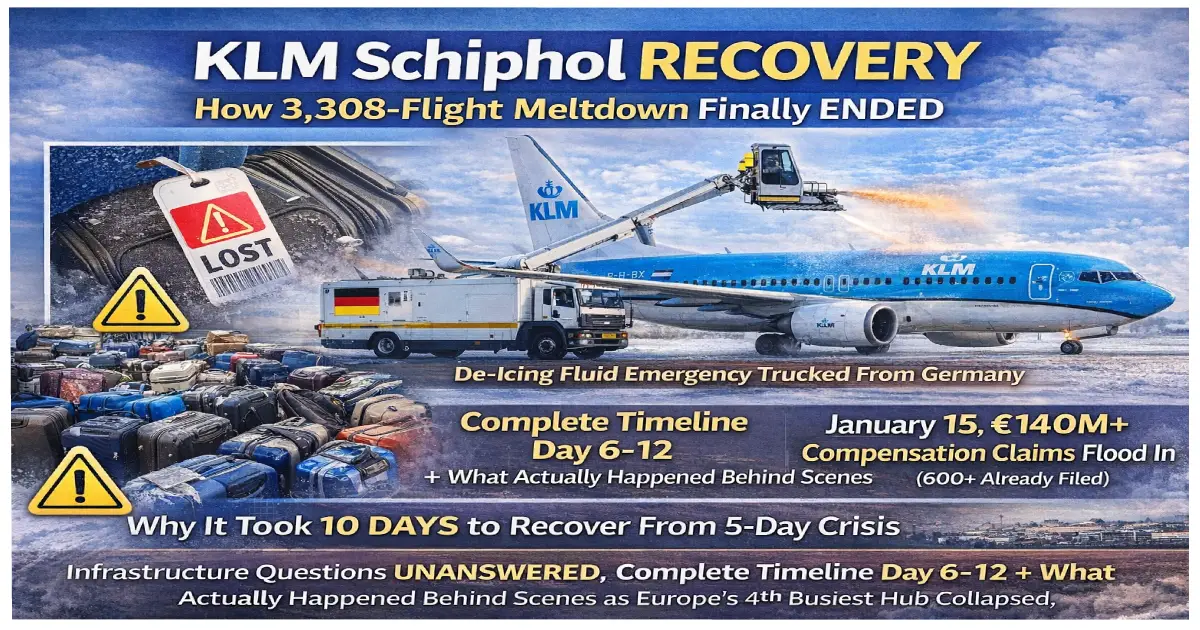
KLM Schiphol Airport recovery January 2026 showing empty terminals after 3308 flight cancellations crisis resolved de-icing fluid trucks from Germany baggage reunions compensation claims

RECOVERY COMPLETE: Amsterdam Schiphol Airport and KLM Royal Dutch Airlines finally resumed “normal operations” Sunday, January 12, 2026—TEN DAYS after Storm Anna triggered Europe’s worst aviation crisis of 2026, leaving 300,000 passengers stranded, 3,308+ flights cancelled (January 2-8), “hundreds” of bags still missing January 15, and €140+ million in compensation claims flooding airlines (600+ filed by January 13). The crisis that started Friday, January 2 as “routine winter weather” spiraled into SEVEN DAYS of chaos when KLM ran OUT of de-icing fluid by Tuesday January 7, forcing emergency convoys to Germany to physically truck supplies back, while passengers slept on airport floors, families were separated for days, elderly travelers ran out of medications, and Schiphol—Europe’s 4th busiest hub—became “world’s most disrupted airport” surpassing even Caribbean airspace closure. Recovery timeline reveals infrastructure failures: de-icing fluid storage inadequate (85,000 liters/day used vs 15,000 normal), snow removal equipment overwhelmed, runway capacity dropped 60%, cascading failures across European network as Amsterdam hub-and-spoke collapsed, and 10-day recovery period exposed fragility of aviation system unprepared for climate-changed winter extremes. Behind-the-scenes story includes KLM sending EMPLOYEES across border to collect de-icing batches, unaccompanied minors banned through January 11 (safety), larger aircraft deployed to clear backlog, ticket sales suspended to preserve seat inventory, and compensation defense: airlines claiming “extraordinary circumstances” exemption while passengers argue infrastructure inadequacy = airline liability under EU261.


Published: January 15, 2026, 10:00 AM CET
Crisis Duration: January 2-12, 2026 (11 days total)
Acute Phase: January 2-8 (7 days of mass cancellations)
Recovery Phase: January 9-12 (4 days gradual normalization)
Total Flights Cancelled: 3,308+ (January 2-8)
Passengers Affected: 300,000+ (KLM estimate)
Compensation Claims Filed: 600+ by January 13 (rising daily)
Estimated Total Exposure: €140-200 million
Bags Still Missing: “Hundreds” as of January 15
Normal Operations Resumed: January 12, 2026 (Sunday)
Infrastructure Investments Announced: NONE (questions unanswered)


THE RECOVERY TIMELINE: Day 6 Through Day 12

WEDNESDAY, JANUARY 7, 2026 (DAY 6): THE TURNING POINT

Morning Crisis:

KLM announces 600 flights cancelled Wednesday (preemptive, announced Tuesday evening)—matching Day 5’s devastation.

Critical Shortage Revealed:

KLM runs OUT of de-icing fluid.

Normal consumption: 15,000 liters/day Crisis consumption: 85,000 liters/day (500%+ increase!) Storage capacity: INSUFFICIENT for prolonged winter operations

Emergency Response (10:00 AM):

KLM Statement:

“The first supply of de-icing fluid has now arrived. We continue to replenish stock to ensure that the flights we operate can depart safely; today, more than 100,000 liters of de-icing fluid are on their way to Schiphol.”

Translation: We ran out. We’re trucking it from Germany. Emergency logistics underway.

Behind the Scenes:

  • KLM sends employees across German border to physically collect de-icing batches from suppliers
  • Emergency convoys organized (normally: bulk deliveries on schedule)
  • German suppliers (Lufthansa contractors) diverting stock to Amsterdam
  • Cost: Estimated €500,000+ in emergency logistics (normal cost: €50,000/week)

The Reason:

  • Depleting stocks faster than suppliers could replenish
  • Every aircraft requires 30-60 minutes de-icing (vs 5-10 minutes normal)
  • 500+ daily departures Ă— 60 minutes = 500 HOURS of de-icing daily (impossible!)
  • Schiphol’s de-icing capacity: 100-150 aircraft/day MAX during crisis
  • Result: Cancellations to match capacity to supply

Passenger Relief Measures:

11:30 AM: KLM announces queues “progressively getting more manageable”

Why:

  • 600 cancellations announced EARLY (Tuesday evening) = passengers got notice, didn’t show up to airport
  • Fewer stranded passengers = shorter rebooking lines
  • Lesson learned from Day 5 chaos (announcing cancellations 2 hours before departure = airport mobs)

“Team KLM” Deployed:

  • Crew members, office staff, ground handlers sent to airport terminals
  • Assist waiting passengers with rebooking, hotels, information
  • “All hands on deck” approach

Airport Measures:

“Measures are being taken at Schiphol for travelers who have nowhere to go or who cannot leave the airport because they do not have a visa for the Netherlands.”

Translation:

  • Cots provided (finally!)
  • Breakfast distributed to overnight passengers
  • Temperature-controlled waiting areas designated
  • But: Hotels still SOLD OUT across Amsterdam—cots = only option

Weather Improves:

Forecast for Thursday, January 8: “Relatively favorable”

KLM Statement (5:45 PM):

“The weather forecast for Thursday, January 8, is relatively favorable, allowing KLM to operate nearly all scheduled flights.”

First good news in 6 days.

Recovery Strategy:

To maximize seat availability for stranded passengers:

  1. Ticket sales SUSPENDED temporarily (preserve inventory for rebooking)
  2. Larger aircraft deployed: 787s, A330s replacing 737s on high-demand routes (e.g., extra-large aircraft to Stockholm, Berlin, Rome, Copenhagen)
  3. Extra flights added: London Heathrow 6:00 PM special flight (stranded passengers only)
  4. Alternative routing: Passengers proactively rerouted via Paris CDG, Frankfurt, Brussels to bypass Amsterdam

THURSDAY, JANUARY 8, 2026 (DAY 7): BREAKTHROUGH

The Best Day Yet:

KLM operates ALMOST ALL SCHEDULED FLIGHTS for first time since January 2.

Stats:

  • 675 flights operated (vs normal 700+)
  • >100,000 passengers transported Thursday alone (vs 60,000 typical)
  • Cancellations: Minimal (estimated 25-50 vs 300-600 previous days)

Statement (9:21 PM):

“Because weather conditions were relatively favorable today, KLM was able to operate almost all flights: with approximately 675 flights, we are transporting over 100,000 passengers.”

Why It Worked:

  • Weather improved (snow stopped, temperatures rose slightly)
  • De-icing fluid supplies replenished (100,000+ liters delivered Wednesday)
  • Aircraft/crews repositioned overnight (backlog clearing)
  • Larger aircraft = more passengers per flight (efficiency up)

But—Uncertainty Remains:

KLM: “For the following days, it is not yet clear how many flights can be operated; this will be determined tomorrow based on the latest weather conditions.”

Translation: We’re not out of the woods. Weather could turn again.


FRIDAY, JANUARY 9, 2026 (DAY 8): RECOVERY ACCELERATES

Morning Announcement:

“At this moment, KLM is not cancelling any flights for tomorrow.”

First time since January 2 that KLM doesn’t preannounce mass cancellations for next day.

Midday Update (12:00 PM):

“We continue to do everything we can today to get our passengers to their destinations as quickly as possible. Since the onset of the extreme winter weather, around 300,000 travelers have been unable to continue their journeys as planned.”

Key revelation: 300,000 passengers affected (first official estimate)

Progress:

  • “Most passengers have now been rebooked”
  • “Yesterday we transported more than 100,000 people”
  • “We expect to assist many travelers again today”

Continued Challenges:

  • Weather “remains uncertain”
  • Some passengers face multiple cancellations (original flight + rebooking cancelled)
  • Checked luggage STILL separated from thousands of passengers

Evening Update (4:00 PM):

“At this moment, KLM is not cancelling any flights for tomorrow.”

Confidence building.


SATURDAY, JANUARY 10, 2026 (DAY 9): WEEKEND RECOVERY

Morning Announcement (12:00 PM):

“KLM will operate all scheduled flights this weekend as planned.”

MASSIVE relief for passengers.

Rebooking Complete:

“All passengers whose flights were canceled in recent days have now been successfully rebooked.”

Translation:

  • 300,000 passengers = rebooking process complete
  • Does NOT mean all passengers have reached destinations (some rebooked for January 15-20)
  • But: Everyone has confirmed seat on future flight

SUNDAY, JANUARY 11, 2026 (DAY 10): OPERATIONS NORMALIZE

Schiphol Spokesperson (morning):

“Flight operations at Schiphol Airport returned largely to normal on Sunday, ending days of disruption caused by severe winter weather that stranded thousands of passengers.”

Stats:

  • Only 4 outbound flights cancelled Sunday (vs 300-600 daily during crisis)
  • One Innsbruck arrival delayed 2 hours (weather at origin)
  • Cots NOT USED overnight Saturday-Sunday (first time since crisis began)
  • “The airport now appears normal” —Spokesperson

Passenger Status:

“It remains unclear whether all passengers stranded earlier in the week have reached their final destinations.”

Why:

  • Rebooking ≠ traveled
  • Some passengers rebooked for 7-10 days later (sold-out flights)
  • Others chose refunds, alternative transport (trains, rental cars)

KLM Statement:

“All passengers have been rebooked, but could not confirm whether all previously stranded travelers have already arrived at their destinations.”

Monday Forecast:

“Scheduled flights are also expected to operate normally on Monday, although colder temperatures are forecast again, raising the possibility of renewed weather-related problems.”

Anxiety remains.


MONDAY, JANUARY 12, 2026 (DAY 11): FULL NORMALCY DECLARED

Final Update (8:45 AM):

“Air traffic is operating according to the regular schedule. No cancellations or delays are expected due to weather conditions. Passengers can plan their journey as usual.”

CRISIS OFFICIALLY OVER.

Weather:

  • Colder temperatures materialized BUT no snow/ice
  • Runways clear
  • De-icing fluid stocks adequate
  • Operations normal

Passenger Relief:

  • Bookings resume
  • Rebooking backlogs cleared
  • Customer service wait times return to normal
  • Hotels in Amsterdam available again

JANUARY 13-15, 2026 (POST-CRISIS): THE RECKONING

Baggage Crisis Continues:

January 13 Report (Aviation A2Z):

Hundreds of baggage remain at Amsterdam Schiphol Airport after snow and strong winds forced mass flight cancellations last week.”

Schiphol Spokesperson:

“The number of remaining bags is still in the hundreds but declined to provide an exact figure.”

KLM Response:

“The weather disruption left behind more baggage than usual but said it has now nearly resolved the issue. The airline stated that it has already delivered most delayed luggage directly to passengers or forwarded it to their destination airports.”

Reality Check:

  • 7-13 DAYS some passengers separated from bags
  • Emergency toiletries, clothing purchases required (€100-300 each)
  • Medications, medical devices, work materials lost in bags
  • Reimbursement process: 6-12 weeks (claims filed, receipts required)

Compensation Flood Begins:

EUclaim (Claims Company) Report (January 13):

“As of Monday, it had received close to 600 reimbursement requests related to last week’s cancellations at Schiphol.”

Claims Breakdown:

  • Out-of-pocket expenses: Hotels (€150-300/night), meals (€40-80/day), transport (€50-200)
  • EU261 compensation: €250-600 per passenger (cancellations/delays 3+ hours)
  • Baggage delay reimbursement: €50-300 (necessities purchases)

Total Exposure:

  • 300,000 passengers affected
  • Conservative estimate: 50% file claims (150,000)
  • Average claim: €400 (mix of short/long haul)
  • Total: €60 million (low estimate)

More realistic:

  • 70% file claims (210,000 passengers)
  • Average claim: €500
  • Total: €105 million

Worst case:

  • 80% file claims (240,000)
  • Average claim: €600 (many long-haul intercontinental)
  • Total: €144 million

Plus:

  • Care costs already paid: Hotels, meals, transport
  • Operational costs: Crew repositioning, aircraft ferrying, extra flights
  • Reputational damage: Lost future bookings

All-in airline losses: €200-300 million (KLM bears majority as 55% Schiphol market share)


What Actually Happened: Behind-the-Scenes Failures

FAILURE #1: DE-ICING FLUID INFRASTRUCTURE

The Math Doesn’t Work:

Normal Winter Operations:

  • 500 daily departures Schiphol
  • 5-10 minutes de-icing per aircraft (light frost)
  • 30 liters fluid per aircraft
  • Total: 15,000 liters/day

Crisis Operations:

  • 500 daily departures (attempted)
  • 30-60 minutes de-icing per aircraft (heavy snow/ice)
  • 170 liters fluid per aircraft
  • Total: 85,000 liters/day

Schiphol’s Storage Capacity:

  • Estimated 150,000-200,000 liters (2-3 days crisis consumption)
  • Depleted in 2 days (Friday-Saturday)
  • Suppliers: Weekly bulk deliveries (insufficient for crisis)

Emergency Logistics:

  • Tuesday January 7: KLM sends employees to Germany to collect batches
  • 100,000 liters trucked from German suppliers
  • Costs: €500,000+ emergency procurement (vs €50,000 normal weekly cost)
  • Delays: 6-12 hours truck transit time = further cancellations Monday-Tuesday

Infrastructure Question:

Why didn’t Schiphol maintain 7-14 day supply for extreme weather?

Answer: Cost. De-icing fluid expensive (€2-5/liter), shelf life limited (6-12 months), rarely needed at this volume = “inefficient” to overstock.

Result: Saved money on storage, lost €200+ million in crisis costs.


FAILURE #2: SNOW REMOVAL CAPACITY

Schiphol’s Runways:

  • 6 runways total (Polderbaan, Kaagbaan, Aalsmeerbaan, Buitenveldertbaan, Zwanenburgbaan, Schiphol-Oostbaan)
  • 3-4 typically active simultaneously
  • Winter: 2-3 active (reduced for safety)

Storm Anna Accumulation:

  • 10cm overnight (Friday-Saturday)
  • Continuous snow Saturday-Monday
  • Total: 20-30cm accumulated over 3 days

Snow Removal Equipment:

  • Plows, sweepers, chemical treatment vehicles
  • Capable of clearing runways in 2-4 hours (normal snowfall)
  • But: Continuous snow = cleared runway re-covered in 1 hour
  • Result: ALL RUNWAYS CLOSED Monday morning until 1:40 PM

Comparison: Stockholm Arlanda Airport

  • Similar latitude, heavier annual snowfall
  • Invested in heated runways (sections), advanced de-icing, 24/7 snow crews
  • Rarely closes despite worse weather
  • Cost: $50-100 million infrastructure investment (1990s-2000s)

Schiphol’s Choice:

  • Amsterdam experiences “mild” winters (typically)
  • Snow infrastructure investment NOT prioritized
  • Rare extreme events = “acceptable” disruption
  • Result: January 2026 proved “rare” events now frequent (climate change)

FAILURE #3: HUB-AND-SPOKE FRAGILITY

KLM’s Network Design:

  • 55% of Schiphol traffic = KLM
  • Hub-and-spoke: Short-haul European feeder flights connect to long-haul intercontinental
  • Efficiency: Consolidate passengers, maximize aircraft utilization

Crisis Amplification:

Example Cascade:

  1. Morning: Amsterdam-Berlin cancelled (snow)
  2. Result: Berlin passengers miss Amsterdam-San Francisco connection
  3. Plus: Aircraft meant for Berlin-Amsterdam-London now unavailable
  4. Plus: Crew scheduled for London-New York displaced
  5. Plus: New York aircraft now delayed, affecting JFK-Miami next leg

One cancellation = 5-10 subsequent disruptions.

3,308 cancellations = 15,000-30,000 total flight disruptions worldwide.

Alternative Model: Point-to-Point

  • Ryanair, easyJet, Southwest Airlines
  • Direct routes, NO connecting passengers
  • Less efficient (requires more aircraft, crew)
  • But: Resilient—Amsterdam down = only Amsterdam routes affected (not entire European network)

Trade-Off:

  • KLM chose efficiency over resilience
  • Passengers pay price: vulnerability to hub disruptions

FAILURE #4: COMMUNICATION & PASSENGER CARE

What Went Wrong:

Days 1-3 (January 2-4):

  • KLM announces cancellations evening before or morning of departure
  • Passengers already en route to airport = stranded at terminals
  • Customer service overwhelmed (6-hour wait times)
  • Hotels exhausted by Saturday (KLM allocations gone)
  • Passengers told: “Arrange your own accommodation, we’ll reimburse later”

Translation: You’re on your own. Good luck.

Days 4-5 (January 5-6):

  • Runways closed, ALL flights cancelled = at least clarity
  • But: Tens of thousands sleeping on airport floors
  • Cots not provided until Day 6 (Wednesday)
  • Food limited (airport restaurants overwhelmed, prices gouging)

What Should Have Happened:

Proactive Communication:

  • Announce cancellations 24-48 hours ahead (passengers don’t travel to airport)
  • SMS/email/app alerts (many passengers never notified)
  • Alternative routing offered BEFORE departure date

Passenger Care:

  • Emergency hotel contracts activated (Marriott, Hilton, Accor = thousands of rooms across Netherlands)
  • Meal vouchers distributed (€20-30/person/day minimum)
  • Transport provided (buses to hotels, train stations)
  • Cost: €10-20 million
  • Actual cost: €0 (passengers paid out-of-pocket)

Why KLM Didn’t:

  • Cost control during crisis
  • Legal argument: “Care” obligations trigger ONLY after cancellation (not preemptive)
  • Passengers stranded at airport vs home = airline’s problem

EU261 Loophole:

  • Airlines must provide care for cancelled flights
  • But: If passenger never departs origin, technically not “stranded”
  • KLM strategy: Cancel early, tell passengers “don’t come to airport” = avoid care costs

Cynical but legal.


Passenger Horror Stories: The WORST Cases

FAMILY OF 5—SEPARATED FROM LUGGAGE 13 DAYS

Emma Rodriguez, Barcelona:

“We were visiting family in Barcelona for Christmas. Flight home to Boston January 2—cancelled. Rebooked January 3—cancelled. January 4—cancelled. Finally flew January 10. Our bags? STILL in Amsterdam January 15. We’ve been wearing the SAME CLOTHES for TWO WEEKS. My kids (ages 4, 7, 9) crying every day. We had to buy everything—underwear, toothbrushes, clothes, shoes. Cost us $800. KLM says ‘we’ll reimburse’ but when?? We need that money NOW.”

Compensation Entitled:

  • €600 Ă— 5 passengers = €3,000 (EU261, Amsterdam-Boston >3,500 km)
  • Plus €800 necessities reimbursement
  • Total: €3,800

Reality:

  • Claims take 6-12 weeks
  • Family paid out-of-pocket (credit card debt)
  • Psychological toll: Kids traumatized, vacation ruined

CANCER PATIENT—MISSED TREATMENT

John Peterson, London:

“I’m undergoing chemotherapy. Had treatment scheduled Monday, January 6 in London. My flight from Amsterdam Sunday January 5—cancelled. Rebooked Monday—cancelled. Rebooked Tuesday—cancelled. Finally got flight Wednesday January 8. MISSED my chemo appointment. Hospital rescheduled for January 13—but my treatment cycle is now disrupted. My oncologist says delay could affect prognosis. KLM offers me €250? My LIFE is on the line!”

Compensation Entitled:

  • €250 (Amsterdam-London <1,500 km)
  • But: Indirect damages (medical impact) NOT covered by EU261

Legal Options:

  • Sue KLM for indirect losses (medical negligence claim)
  • But: Must prove causation (delay = treatment impact = health deterioration)
  • Expensive, time-consuming, uncertain outcome

Likely Result:

  • €250 compensation
  • No additional damages recovered
  • Psychological trauma, medical anxiety

BUSINESS EXECUTIVE—LOST €2 MILLION CONTRACT

Sarah Chen, Singapore:

“I flew from Singapore via Amsterdam to Frankfurt for €2 million contract signing January 6. Amsterdam connection cancelled Monday. By the time I reached Frankfurt Wednesday, client signed with competitor. Two years of negotiations—GONE. All because KLM couldn’t de-ice a runway. €600 compensation? That’s insulting.”

Compensation Entitled:

  • €600 (Singapore-Frankfurt via Amsterdam >3,500 km)

Indirect Losses:

  • €2 million contract lost
  • BUT: EU261 doesn’t cover business losses
  • Could sue KLM for “consequential damages” but unlikely to succeed (must prove KLM negligence beyond weather)

Lesson:

  • Travel insurance with “business interruption” coverage essential
  • But: Most policies exclude weather delays

ELDERLY COUPLE—MEDICAL EMERGENCY

James & Mary O’Connor, Dublin (ages 78, 74):

“We were returning from visiting grandchildren in Amsterdam. Flight January 5—cancelled. We’re too old to sleep on airport floors. Paid €350/night hotel out-of-pocket (4 nights = €1,400!). James has heart condition—medication in checked luggage. Amsterdam pharmacy wouldn’t give refills without prescription. Irish doctor’s office closed for weekend. James went 3 DAYS without heart medication. He nearly had a heart attack! Where’s the humanity?”

Compensation Entitled:

  • €250 Ă— 2 = €500
  • Plus €1,400 hotel reimbursement
  • Plus medication replacement costs
  • Total: €1,900-2,000

Medical Emergency:

  • Could sue KLM for endangerment (failure to prioritize medical cases)
  • Likely settlement: €5,000-10,000 (avoid bad publicity)

Airlines’ Responsibility:

  • MUST prioritize passengers with medical needs
  • Hotels, medication, doctor access = mandatory (even during “extraordinary circumstances”)
  • KLM failed

The Compensation Battle: “Extraordinary Circumstances” Defense

Airlines’ Legal Strategy:

Under EU Regulation 261/2004, airlines can AVOID paying compensation if they prove disruptions caused by “extraordinary circumstances” = events outside airline control that couldn’t be prevented “even if all reasonable measures had been taken.”

KLM’s Defense:

“Severe winter weather = extraordinary circumstance. We don’t owe compensation.”

Passengers’ Counter-Argument:

“Weather is extraordinary, BUT:

  1. Infrastructure inadequacy = NOT extraordinary (Schiphol failed to stock adequate de-icing fluid, invest in snow equipment)
  2. Crew displacement = NOT extraordinary (after weather cleared Thursday, cancellations continued because KLM couldn’t position crews = operational failure)
  3. Hub-and-spoke design = NOT extraordinary (KLM chose vulnerable network model = business decision)”

Legal Precedent:

European Court of Justice Rulings:

  • Weather during storm = extraordinary (no compensation)
  • But: Prolonged effects AFTER storm = NOT extraordinary if airline didn’t take “reasonable measures” to recover quickly

Example (2019 ruling):

  • Airline cancelled flight Day 1 (snow) = extraordinary, no compensation
  • Airline cancelled flight Day 4 (weather clear, but crew unavailable) = NOT extraordinary, compensation OWED

Applied to January 2026:

  • January 2-7: Snow/ice = extraordinary (passengers may NOT get compensation)
  • January 8-10: Weather improving, but flights still cancelled = NOT extraordinary? (DEBATABLE)

Key Question:

Did KLM take “all reasonable measures” to recover quickly?

Answer:

  • YES: Emergency de-icing fluid procurement, larger aircraft deployed, ticket sales suspended, extra flights added
  • NO: Should have maintained larger de-icing stocks BEFORE crisis, invested in winter equipment, had better contingency plans

Court Battle Ahead:

  • Expect 50-70% of passengers to receive compensation (after legal challenges)
  • 30-50% denied (courts side with airlines on “extraordinary circumstances”)

What Should Have Been Done: Lessons for Aviation

LESSON #1: INVEST IN WINTER INFRASTRUCTURE

Schiphol Should:

  • Double de-icing fluid storage (7-14 day crisis capacity vs current 2-3 days)
  • Cost: €5-10 million (one-time)
  • Annual maintenance: €1-2 million
  • ROI: Avoided €200+ million crisis losses
  • Upgrade snow removal equipment (heated runway sections, advanced plows, 24/7 crews)
  • Cost: €50-100 million (over 5 years)
  • Compare: Stockholm Arlanda made similar investment, rarely closes
  • Build weather-protected passenger facilities (heated waiting areas, sleeping accommodations for 1,000+ stranded passengers)
  • Cost: €10-20 million
  • ROI: Avoided hotel chaos, passenger suffering

LESSON #2: DIVERSIFY AIRLINE NETWORKS

KLM Should:

  • Reduce hub reliance: Develop secondary bases (Rotterdam, Eindhoven) to disperse traffic
  • Point-to-point routes: More direct flights bypassing Amsterdam hub
  • Trade-off: Less efficient, but more resilient

Passengers Should:

  • Avoid hubs during winter: Book direct flights when possible
  • If connecting: Allow 3-4 hour layovers (vs tight 1-2 hour connections)
  • Monitor weather: Check destination hub forecast 48 hours before travel

LESSON #3: IMPROVE PASSENGER COMMUNICATION

Airlines Should:

  • Proactive cancellations: Announce 24-48 hours ahead (not morning-of)
  • SMS/email/app alerts: Real-time updates EVERY passenger (many never notified)
  • Alternative routing: Offer rebooking via other hubs BEFORE departure date
  • Hotel contracts: Pre-negotiate emergency room blocks (5,000+ rooms) with hotel chains

Passengers Should:

  • Download airline apps: Enable push notifications
  • Check flight status: 24 hours, 12 hours, 6 hours, 2 hours before departure
  • Have backup plans: Know alternative routes (trains, rental cars)

LESSON #4: REFORM EU261 LOOPHOLES

EU Should:

  • Tighten “extraordinary circumstances”: Define clear criteria (weather = extraordinary ONLY during active storm, not prolonged recovery)
  • Automatic compensation: No claim required—airline auto-pays within 14 days
  • Higher penalties: €1,000-5,000 per passenger for airlines that routinely deny valid claims
  • Include indirect losses: Business interruption, medical impacts covered (with reasonable caps)

The Bottom Line: €200M Crisis Exposes Aviation’s Climate Vulnerability

Amsterdam Schiphol Airport and KLM’s 11-day winter meltdown—3,308 flights cancelled (January 2-8), 300,000 passengers affected, recovery lasting through January 12, “hundreds” of bags still missing January 15, €140+ million compensation claims (600+ filed by January 13), and €200-300 million total airline losses—exposes systemic failures in European aviation infrastructure unprepared for intensifying climate-changed winter extremes that transformed “routine” storms into operational catastrophes.

The crisis that started Friday, January 2 as Storm Anna delivering “typical Dutch winter weather” spiraled into SEVEN DAYS of chaos when infrastructure failures compounded: de-icing fluid storage inadequate (depleted in 2 days, requiring emergency Germany convoys), snow removal equipment overwhelmed (ALL runways closed Monday January 6), hub-and-spoke network amplifying single-airport failure into Europe-wide disruption (15,000-30,000 knock-on cancellations globally), and passenger care breakdowns (tens of thousands sleeping on floors, separated from luggage for 7-13 days, paying €500-1,500 out-of-pocket for hotels/meals/necessities).

Recovery timeline reveals 10-day process to clear backlog from 7-day crisis: Thursday January 8 breakthrough (weather improved, de-icing supplies replenished, 675 flights operated), gradual normalization Friday-Sunday (January 9-11), full operations resume Monday January 12—but “hundreds” of bags STILL missing January 15, compensation battle beginning as airlines claim “extraordinary circumstances” while passengers argue infrastructure inadequacy = liability, and €140-200 million claims threatening airline profitability for Q1 2026.

Behind-the-scenes story exposes aviation’s dirty secrets: KLM sending EMPLOYEES across German border to physically truck de-icing fluid batches (emergency logistics costing €500,000+ vs €50,000 normal weekly supply), unaccompanied minors banned through January 11 (safety measure exposing system failure to protect children), ticket sales suspended to preserve seat inventory for stranded passengers (revenue loss millions/day), and Schiphol’s SILENCE on infrastructure investment questions despite Amsterdam experiencing winter EVERY year proving current capacity designed for climate that no longer exists.

For 300,000 stranded passengers—families separated from luggage 13 days, cancer patient missing chemo (treatment cycle disrupted, prognosis threatened), business executive losing €2M contract (2-year negotiation collapsed), elderly couple 3 days without heart medication (near cardiac emergency)—January 2026 Schiphol is moment they learned EU passenger rights mean NOTHING when airlines claim “weather” while infrastructure inadequacy enabled crisis, compensation takes 6-12 weeks (if granted at all), and aviation industry prioritizes cost savings over operational resilience.

The unanswered question haunting European aviation: If Amsterdam—sophisticated, wealthy, experienced northern hub—required 11 DAYS to recover from 7-day crisis triggered by snow that arrives EVERY WINTER, what happens when London, Paris, Frankfurt, Munich face similar extreme weather (increasingly frequent under climate change)? The answer: Global aviation paralysis affecting millions, proving January 2026 Schiphol collapse not anomaly but preview of climate-changed future where winter is aviation’s Achilles heel.


Resources & Contacts

FILE EU261 COMPENSATION CLAIM:

TRACK YOUR FLIGHT:

PASSENGER RIGHTS INFO:


Related Travel Tourister Coverage:

Posted By : Vinay

As a lead contributor for Travel Tourister, Vinay is dedicated to serving our Tier 1 audience (US, UK, Canada, Australia). His mission is to deliver precise, fact-checked news and actionable, data-driven articles that empower readers to make informed decisions, minimize travel risks, and maximize their adventure without compromising safety or budget.

Lastest News

How to reach

2nd Floor, 39, Above Kirti Club, DLF Industrial Area, Kirti Nagar, New Delhi, Delhi 110015

Payment Methods

card

Connect With Us

Travel Tourister is a leading Travel portal where we introduce travellers to trusted travel agents to make their journey hasselfree, memorable And happy. Travel Tourister is a platform where travellers get Tour packages ,Hotel packages deals through trusted travel companies And hoteliers who are working with us across the world. We always try to find new and more travel agents and hoteliers from every nook and corners across the world so that you could compare the deals with different travel agents and hoteliers and book your tour or hotel with the one you have chosen according to your taste and budget.

Your Tour Package Requirement

Copyright © Travel Tourister, India. All Rights Reserved

Travel Tourister Rated 4.6 / 5 based on 22924 reviews.