Published on : 03 Jan 2026
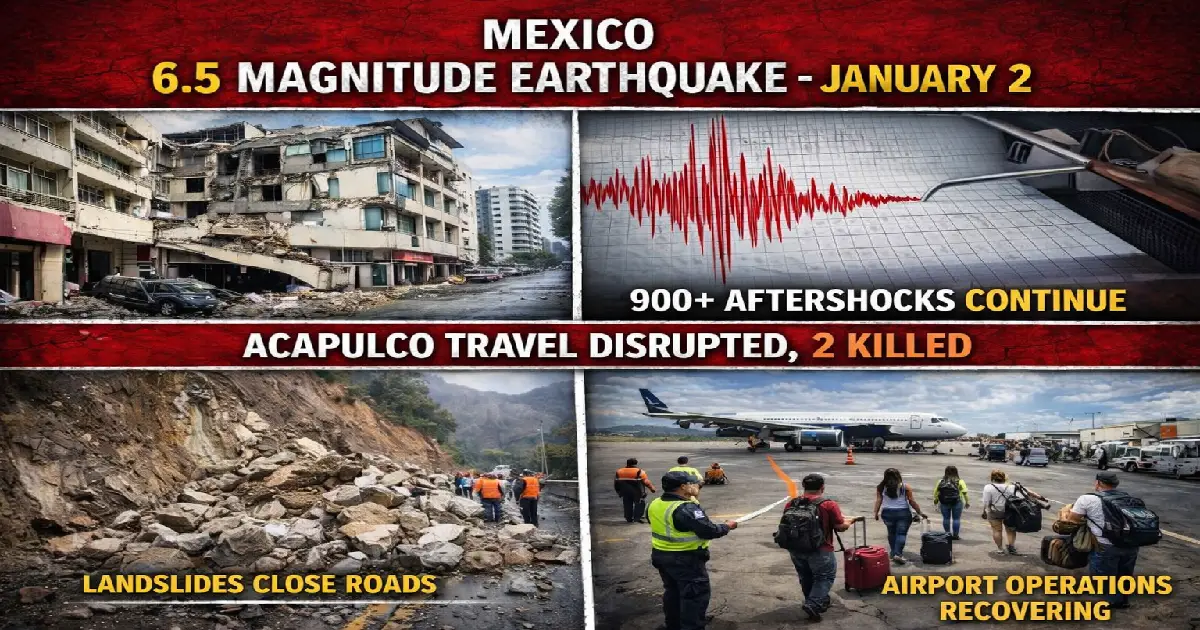
TRENDING: Powerful 6.5 magnitude earthquake struck Guerrero, Mexico January 2 at 7:58 AM—epicenter near San Marcos 57 km northeast of Acapulco, depth 35 km, killing 2 (Mexico City evacuation fall, Guerrero home collapse), triggering 900+ aftershocks (strongest 4.5 magnitude), landslides blocking Costa Chica highways, hotel evacuations across Acapulco resort zone while Mexico City/Acapulco airports remain operational despite initial delays affecting thousands of travelers during peak holiday period
Published: January 3, 2026 Source: USGS, Mexican National Seismological Service, Travel and Tour World, Multiple Sources Key Finding: 6.5 magnitude earthquake, 2 confirmed fatalities, 900+ aftershocks recorded Epicenter: San Marcos, Guerrero—57 km (35 miles) northeast of Acapulco resort area Depth: 35 km (21.7 miles)—shallow enough to cause strong shaking across wide region Felt: Mexico City (282 km away), Acapulco, Chilpancingo, throughout Guerrero state ANZ Impact: Acapulco popular with Australian/NZ tourists, safety concerns for current travelers
A powerful 6.5 magnitude earthquake struck Guerrero state’s Pacific coastal region at 7:58 AM local time January 2, 2026—with epicenter located near San Marcos approximately 57 kilometers northeast of the world-famous Acapulco resort destination—killing at least 2 people (a 60-year-old Mexico City man who fell while evacuating his second-floor apartment and a 50-year-old Guerrero woman when her home collapsed), triggering over 900 aftershocks (strongest measured 4.5 magnitude occurring 99 minutes after mainshock), causing landslides that blocked major highways including the Costa Chica route, and prompting mass hotel evacuations across Acapulco’s beachfront resort zone as tourists rushed into streets when seismic alarms blared and buildings swayed during one of Mexico’s strongest earthquakes in recent years.
The shallow 35-kilometer depth amplified ground shaking across a vast region—with tremors felt as far as Mexico City 282 kilometers (175 miles) from the epicenter, where seismic alarms provided critical warning seconds allowing millions to evacuate buildings before shaking arrived, interrupting President Claudia Sheinbaum’s first press briefing of 2026 as she coordinated emergency response with Guerrero Governor Evelyn Salgado while aftershocks continued rattling the region throughout the day and into following morning with more than 900 recorded tremors creating ongoing anxiety for residents and tourists alike in one of Mexico’s most seismically active zones.
“A powerful earthquake struck Mexico’s Guerrero region on the morning of January 2, 2026, disrupting travel and damaging infrastructure across Acapulco, Mexico City, and surrounding areas,” confirms Travel and Tour World reporting from affected zones. “This seismic event has resulted in fatalities, significant damage to buildings, road disruptions, and over 900 aftershocks that continue to pose risks to public safety and travel.”
For Australian and New Zealand travelers—who frequently visit Acapulco’s beaches, nightlife, and historic cliff divers, or transit through Mexico City’s international airport when connecting to Central/South American destinations or Caribbean islands—the earthquake creates immediate safety concerns for current visitors while raising questions about infrastructure damage, ongoing aftershock risks, and whether planned vacations to affected regions should proceed as booked or be postponed until seismic activity subsides and full damage assessments complete.
The United States Geological Survey (USGS) initially measured the earthquake at magnitude 6.2 before upgrading to 6.5 as additional seismic data refined calculations—a level classified as “strong” capable of causing moderate to severe damage in populated areas, though actual destruction depends on building quality, construction standards, and proximity to epicenter, with well-engineered modern structures typically withstanding such tremors better than older adobe or unreinforced masonry buildings common in rural Mexican communities.
Earthquake specifications:
The moderately shallow 35-kilometer depth explains why shaking was felt so intensely across such a wide region—deeper earthquakes dissipate energy through more rock layers before reaching surface, while shallow quakes transmit seismic waves more directly to populated areas, creating stronger ground motion at surface level that causes building damage, triggers landslides, and generates the terrifying sensation of ground liquefaction where solid earth momentarily behaves like liquid during peak shaking.
Mexico sits atop five tectonic plates—making it one of Earth’s most seismically active countries where the Cocos Plate subducts (slides beneath) the North American Plate along the Pacific coast creating a subduction zone responsible for most major Mexican earthquakes including the devastating 1985 magnitude 8.1 event that killed thousands in Mexico City and the 2017 magnitude 7.1 quake that claimed 369 lives primarily in the capital.
Guerrero Gap—the concern:
Seismologists have long monitored the “Guerrero Gap”—a section of the Mexico-Pacific subduction zone that hasn’t experienced a major earthquake since 1911 despite continuous tectonic stress accumulation, creating fears that this locked segment may rupture catastrophically in a magnitude 8+ megaquake similar to the 1985 disaster, though January 2’s 6.5 event occurred in a different fault zone and does not necessarily indicate imminent larger rupture.
Historical context:
Mexico City International Airport (Benito Juárez/MEX) and Felipe Ángeles International Airport (NLU)—serving the capital’s 9+ million residents and connecting millions of international travelers annually including substantial Australian and New Zealand traffic routing through Mexico City to South America, Central America, Caribbean, and United States destinations—briefly halted operations for safety inspections following the earthquake before resuming normal schedules with minor delays as runways, terminals, air traffic control systems, and ground infrastructure underwent structural assessments confirming no significant damage.
Mexico City airport status:
“Mexico City (MEX/NLU): Benito Juárez International Airport and Felipe Ángeles International Airport are fully operational. While minor flight delays were reported due to evacuations during the initial tremor, operations are back to normal,” confirms Travel and Tour World airport status reporting.
Acapulco International Airport (ACA)—serving the Pacific coast resort destination popular with Mexican domestic tourists, American spring breakers, and international travelers seeking beaches, nightlife, and La Quebrada cliff diving shows—remained open throughout the day despite the earthquake’s epicenter being just 57 kilometers away, with some flight delays occurring as airlines assessed aircraft for damage, crews underwent safety briefings, and passengers dealt with evacuation anxieties before boarding flights departing the affected zone.
Acapulco airport details:
Guerrero state’s civil defense agency reported “various landslides around Acapulco and on other highways in the state”—with the Costa Chica highway (connecting Acapulco southeast toward Oaxaca border) experiencing particularly severe disruptions as earthquake-triggered landslides blocked lanes, created dangerous driving conditions, and severed communications with coastal communities where residents and tourists found themselves temporarily isolated without reliable phone or internet connectivity.
Road impact details:
“Avoid Secondary Roads: Stick to main toll roads (cuotas) and avoid secondary mountain roads, particularly in Guerrero, where landslides continue to be a significant risk,” emphasizes travel safety guidance, noting that rural mountain routes lack the engineering, maintenance, and emergency services of major toll highways that typically recover faster from seismic damage due to priority clearing operations and structural standards designed to withstand earthquakes.
José Raymundo Díaz Taboada, a doctor living in Acapulco’s hillside neighborhoods, reported being “unable to reach some friends who live along the Costa Chica, southeast of Acapulco, because communications were cut”—highlighting how earthquake impacts extend beyond physical damage to infrastructure disruptions isolating communities and creating uncertainty for travelers attempting to verify safety of friends, family, or planned destinations in affected zones.
Dramatic scenes unfolded across Acapulco’s beachfront resort zone as seismic alarms blared at 7:58 AM—sending hotel guests rushing from rooms to lobbies, courtyards, parking lots, and beaches as buildings swayed and the ground rolled beneath feet, with photos showing tourists in pajamas, swimwear, and casual clothing gathered outside high-rise hotels nervously checking phones, comforting children, and waiting for all-clear signals from hotel staff before returning to rooms for belongings and deciding whether to continue vacations or evacuate the earthquake zone entirely.
Hotel impacts:
“Accommodation Tip: If staying in Acapulco, ensure that your accommodation has passed a post-quake safety inspection. Reputable hotels are providing guests with certificates confirming the structural integrity of their facilities,” advises travel safety guidance, noting that well-maintained modern hotels generally withstand moderate earthquakes without significant damage but older or poorly-maintained properties may have suffered structural weakening requiring professional assessment before safe occupancy resumes.
The first confirmed fatality occurred in Mexico City—282 kilometers from the epicenter—when a 60-year-old man fell while evacuating his second-floor apartment during the earthquake, sustaining injuries that proved fatal despite emergency medical response, highlighting how earthquake dangers extend beyond building collapses to include panicked evacuations where falls, stampedes, and accidents claim lives even when structures remain intact.
The second death occurred closer to the epicenter in Guerrero state when a 50-year-old woman died after her home collapsed during the shaking—demonstrating the vulnerability of older residential construction, adobe buildings, and unreinforced masonry common in rural Mexican communities that lack earthquake-resistant design features required in modern building codes, creating disproportionate fatality risks for poorer populations unable to afford seismically-sound housing.
The earthquake’s epicenter region near San Marcos and Ayutla de los Libres—communities of approximately 20,000-30,000 residents—suffered the most severe structural damage, with over 50 homes destroyed or experiencing severe cracks rendering them unsafe for habitation, forcing families into temporary shelters, straining local emergency resources, and creating humanitarian needs that Mexican federal and state authorities mobilized to address through emergency housing, food distribution, and medical assistance.
Damage overview:
President Claudia Sheinbaum—whose morning press briefing was dramatically interrupted mid-sentence as seismic alarms blared and the National Palace shook—initially reported “no serious damage” based on Governor Salgado’s preliminary assessment, though subsequent reports throughout the day revealed the fatalities and building collapses that weren’t immediately apparent as information slowly emerged from rural mountainous regions with limited communications infrastructure.
The most powerful aftershock—measuring magnitude 4.5—struck at 9:37 AM local time, 99 minutes (1 hour 39 minutes) after the mainshock, with epicenter located 71 kilometers east of Acapulco, creating additional anxiety for residents and tourists who had just begun recovering from the initial event only to experience renewed shaking that, while significantly weaker than the 6.5 mainshock, nonetheless triggered evacuation alarms and sent people back into streets fearing the pattern might escalate rather than diminish.
Aftershock patterns:
“Since the initial earthquake, over 900 aftershocks have been recorded. Most of these aftershocks have been below magnitude 4.5, but they can still pose risks in weakened structures,” warns Travel and Tour World safety advisory, emphasizing that buildings damaged during mainshock may collapse during aftershocks that alone wouldn’t typically cause structural failure but stress already-compromised walls, columns, and foundations beyond their remaining capacity.
Beyond physical damage, the continuous aftershocks create psychological toll on residents and tourists alike—where every rumble, every vibration, every sensation of movement triggers fight-or-flight responses, making sleep difficult, concentration impossible, and daily activities stressful as people remain hypervigilant for the next tremor, uncertain whether each aftershock represents the sequence’s final gasp or precursor to something larger.
Dr. José Raymundo Díaz Taboada described the experience: “I heard a strong rumble noise and all the neighborhood dogs began barking. In that moment the seismic alert went off on my cellphone, and then the shaking began to feel strong with a lot of noise”—noting he “prepared a backpack of essentials to be ready to leave as the aftershocks continued,” demonstrating how even experienced Acapulco residents familiar with earthquakes treat the situation seriously when major events strike close to home.
Immediate actions:
Aftershock precautions:
Assessment questions:
Booking considerations:
Mexico tourism official perspective:
“Tourism officials point out that tourist areas including Acapulco’s hotels, beaches and entertainment districts are open and welcoming visitors, with safety checks underway following the quake,” notes Travel and Tour World reporting, emphasizing that Mexican authorities want to reassure international travelers that the tourism industry remains operational, safe, and ready to accommodate visitors despite the earthquake’s disruptions—though individual travelers must assess personal risk tolerance and comfort levels with ongoing aftershock possibilities.
For Aussies and Kiwis planning or currently on Mexico vacations:
Australian Department of Foreign Affairs and Trade (DFAT) Smartraveller:
New Zealand Safe Travel:
Travel insurance claims:
Mexico’s Seismic Alert System (Sistema de Alerta Sísmica Mexicano/SASMEX)—one of world’s most advanced earthquake early warning networks—provided crucial seconds of warning before shaking reached Mexico City, allowing millions to evacuate buildings, halt elevators, and move to safe zones before the seismic waves arrived, demonstrating how investments in monitoring technology and public alert infrastructure save lives during inevitable earthquakes in seismically active zones.
How SASMEX works:
The January 2 earthquake demonstrated SASMEX’s effectiveness—with Karen Gomez, a 47-year-old Mexico City resident, telling AFP: “I woke up in terror. My cellphone alert said it was a powerful earthquake”—noting the warning arrived before shaking, allowing her to evacuate her 13th-floor apartment rather than being caught unaware during peak ground motion when exits might be blocked, elevators inoperable, or stairwells collapsing.
The catastrophic 1985 magnitude 8.1 earthquake that killed 5,000-10,000+ people (estimates vary due to incomplete records) in Mexico City—despite epicenter being 350+ kilometers away on Pacific coast—prompted comprehensive reforms to Mexican building codes, requiring seismic engineering, reinforced construction, base isolation systems, and regular inspections that dramatically improved structural resilience, explaining why January 2’s 6.5 event caused 2 confirmed deaths rather than hundreds or thousands that similar earthquake might have caused in less-prepared nations.
Post-1985 improvements:
Modern hotels, airports, government buildings, and newer residential construction generally performed well during January 2 earthquake—with most damage concentrated in older rural homes lacking seismic design, demonstrating the life-saving value of building code enforcement even when such regulations increase construction costs and slow development timelines.
The January 2, 2026 magnitude 6.5 earthquake striking Guerrero state 57 kilometers from Acapulco—killing 2 people, triggering 900+ aftershocks, blocking highways with landslides, and briefly disrupting airport operations—reminds Australian and New Zealand travelers that Mexico sits in one of Earth’s most seismically active zones where earthquakes represent inherent natural risks accompanying vacations to stunning Pacific beaches, colonial cities, ancient ruins, and vibrant cultural destinations that make the country Latin America’s second-most-visited nation (after only Brazil) despite occasional natural disasters.
For current travelers in affected regions, the priority is staying informed via official sources (@CNPC_MX civil protection updates, hotel safety briefings, embassy communications), understanding Mexico’s excellent SASMEX earthquake alert system, avoiding damaged structures and blocked roads, and maintaining calm during ongoing aftershocks that—while unsettling—typically don’t approach mainshock intensity or cause additional significant damage unless structures were compromised during initial event.
For travelers planning future Mexico trips, the earthquake highlights importance of comprehensive travel insurance covering natural disasters (preferably Cancel For Any Reason policies providing maximum flexibility), understanding that seismic activity occurs periodically throughout Mexico’s Pacific coast and central regions (though Caribbean coast experiences fewer/less severe quakes), and assessing personal risk tolerance for destinations where earthquakes remain possible though sophisticated warning systems, modern building codes, and emergency response infrastructure mitigate dangers substantially compared to less-prepared nations.
Key takeaways for Mexico travelers:
✓ 6.5 magnitude earthquake struck Guerrero January 2, 7:58 AM (2 deaths, 900+ aftershocks) ✓ Airports operational (Mexico City, Acapulco functional despite minor initial delays) ✓ Road disruptions (Costa Chica highway blocked by landslides, secondary roads risky) ✓ Hotels conducting inspections (reputable properties providing structural safety certificates) ✓ Aftershocks continuing (900+ recorded, expect ongoing tremors declining over weeks) ✓ SASMEX alert system (learn to recognize Alerta Sísmica sirens, respond immediately) ✓ Travel insurance essential (earthquake coverage requires specific policy language or CFAR) ✓ Monitor official sources (@CNPC_MX, local hotel updates, DFAT Smartraveller, NZ Safe Travel) ✓ Flexible booking (consider refundable rates, cancellation insurance given ongoing aftershock risks) ✓ Alternative destinations (Cancún/Caribbean side less seismically active if uncomfortable with risks)
“Tourism officials point out that tourist areas including Acapulco’s hotels, beaches and entertainment districts are open and welcoming visitors, with safety checks underway following the quake,” confirms Mexican tourism messaging, though individual travelers must balance official reassurances with personal comfort levels regarding ongoing seismic activity, infrastructure vulnerabilities, and unpredictable nature of aftershock sequences that may continue weeks or escalate unexpectedly if another significant tremor strikes already-weakened structures.
The relatively low death toll (2 confirmed fatalities from magnitude 6.5 event) validates Mexico’s investments in earthquake preparedness—SASMEX early warning providing critical evacuation seconds, modern building codes ensuring structural resilience, and public education creating culture where citizens automatically respond to alarms rather than ignoring or dismissing them—though travelers should recognize that earthquakes remain unpredictable natural phenomena where subsequent larger events cannot be ruled out, making situational awareness, emergency preparedness, and flexible travel plans essential for anyone visiting seismically active regions worldwide, not just Mexico.
For More Resources:
Related Travel Guides:
Final Reflection: Mexico’s January 2 earthquake—though causing 2 tragic deaths and infrastructure disruptions—demonstrated how modern seismic preparedness saves countless lives when inevitable earthquakes strike nations built atop active tectonic boundaries. SASMEX’s early warnings, earthquake-resistant construction codes, and culturally-embedded emergency response protocols transformed what could have been catastrophic disaster into manageable event where airports reopened within hours, hotels resumed operations after safety checks, and tourists continued vacations with heightened awareness rather than mass evacuations. For Australian and New Zealand travelers, the earthquake serves as reminder that adventure travel often involves accepting natural risks—whether tropical cyclones, volcanic eruptions, or seismic activity—that sophisticated infrastructure and preparation mitigate but never eliminate entirely, making comprehensive insurance, flexible booking, and realistic risk assessment essential components of responsible international travel to destinations offering rewards proportional to the inherent uncertainties.
Posted By : Vinay
Lastest News
2nd Floor, 39, Above Kirti Club, DLF Industrial Area, Kirti Nagar, New Delhi, Delhi 110015



Travel Tourister is a leading Travel portal where we introduce travellers to trusted travel agents to make their journey hasselfree, memorable And happy. Travel Tourister is a platform where travellers get Tour packages ,Hotel packages deals through trusted travel companies And hoteliers who are working with us across the world. We always try to find new and more travel agents and hoteliers from every nook and corners across the world so that you could compare the deals with different travel agents and hoteliers and book your tour or hotel with the one you have chosen according to your taste and budget.
Copyright © Travel Tourister, India. All Rights Reserved

 Call
Call Enquiry