Published on : 12 Mar 2026
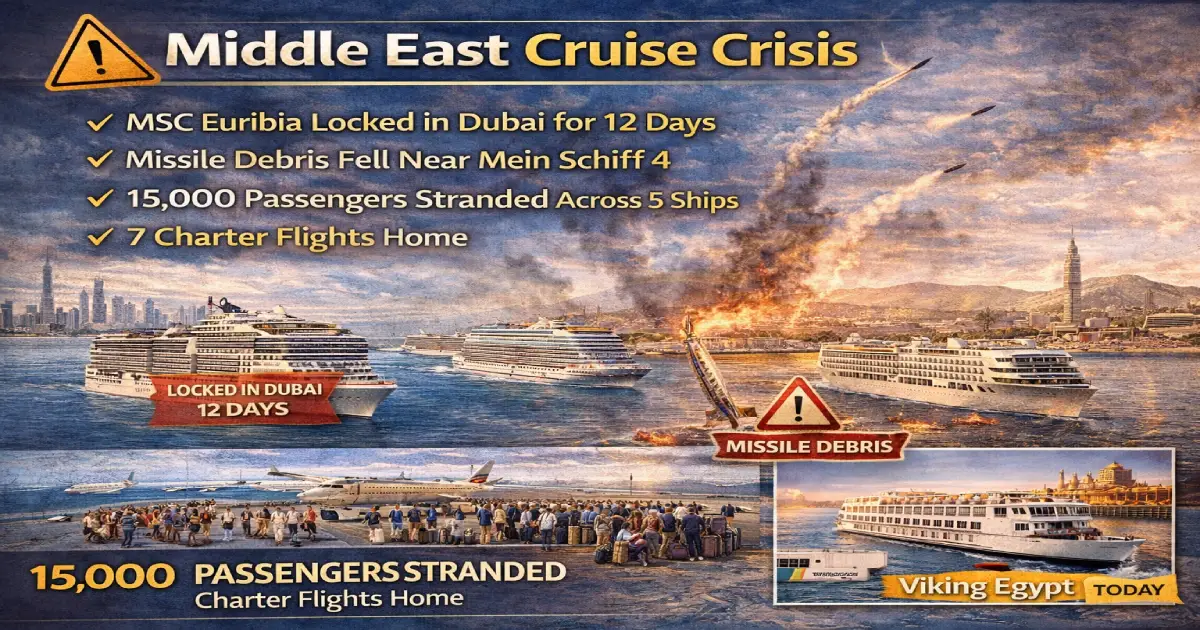
Breaking: The Middle East crisis created the largest cruise disruption since COVID-19 — five ships simultaneously locked in the Gulf, 15,000 passengers unable to leave, a 3am missile alert waking British passengers in their cabins, and Iranian missile debris confirmed falling near a TUI cruise ship in Abu Dhabi port. MSC Cruises funded seven charter flights to repatriate 1,500 guests. Every remaining Gulf cruise season has been cancelled. And today — March 12 — Viking River Cruises resumes Nile Egypt operations as the first major operator to reverse course. Here is the complete cruise crisis guide: every ship, every line, every refund right, and exactly where cruise travel stands today.
Published: March 12, 2026 Crisis Start: February 28, 2026 — Operation Epic Fury, US-Israeli strikes on Iran Ships Stranded (peak): 5 simultaneously — MSC Euribia, Celestyal Discovery, Celestyal Journey, Mein Schiff 4, Mein Schiff 5 Total Passengers Affected: ~15,000 across all stranded vessels (Cruise Lowdown estimate) MSC Euribia: 331-metre, 19-deck LNG-powered ship — berthed Port Rashid, Dubai Cruise Terminal 3 — 12 days docked MSC Euribia Capacity: 6,300 passengers Repatriated: 1,500+ MSC Euribia guests — 7 flights (5 MSC charter + Emirates + Flydubai + government flights) — to UK, Italy, Germany, Spain, US, Brazil MSC Cancelled Sailings: March 14, 21, 28 — entire remaining winter Gulf season — full refunds offered The 3am Moment: British passenger Lesley Ballantyne (Scotland) woke to emergency phone alert — “Potential missile threats, seek immediate shelter in the closest secure building” Missile debris confirmed: Iranian missile debris fell near Mein Schiff 4 berthed in Abu Dhabi port — confirmed by WarNewsPL footage and TUI Cruises statement Strait of Hormuz: Closed to ALL cruise traffic — Joint Maritime Information Centre risk level: “CRITICAL” — attack “almost certain” Celestyal Cruises: Both ships stuck — Celestyal Journey (Doha, March 7 release), Celestyal Discovery (Dubai) — entire remaining Gulf season cancelled TUI Cruises: Mein Schiff 4 (Abu Dhabi, missile debris nearby) + Mein Schiff 5 (Doha) — multiple sailings March 1, 2, 5, 8, 9 cancelled AROYA Cruises: Entire remaining 2026 Persian Gulf season cancelled Royal Caribbean: ALL Labadee (Haiti) visits suspended for remainder of 2026 Tauck: All March Jordan/Egypt departures cancelled — rolling evaluation after March 15 AmaWaterways: Israel post-cruise packages suspended indefinitely — Egypt operations continuing Avalon Waterways: All March Dubai, Qatar, Egypt, Jordan departures cancelled Viking Egypt — Nile: Resumes TODAY (March 12) — first major operator to reverse Gulf-area cancellations Still suspended (Gulf): Gulf Air, Celestyal Gulf, AROYA, TUI Gulf sailings Total flights cancelled globally (aviation): 27,000+ (Cirium confirmed) — cruise crisis is the tourism dimension of the same event Insurance: Policies purchased BEFORE February 28 likely covered — policies after = “known event” exclusion applies Cruise lines refund position: All confirmed full cash refunds for cancelled sailings
When US and Israeli forces struck Iran on February 28, 2026, five cruise ships were at sea or in Gulf ports completing routine winter leisure itineraries. Within hours, the world they had sailed into no longer existed.
The Strait of Hormuz — through which every Gulf cruise ship must pass to reach open water — became a closed maritime zone. The Joint Maritime Information Centre upgraded its regional risk assessment to “critical,” its highest level, indicating an attack is “almost certain.” With the strait blocked and missile activity reported across the UAE, cruise vessels could not reposition to safer waters even if they had wanted to.
At the same time, missile and drone strikes across Gulf countries forced airlines to suspend operations, removing the only other way to get 15,000 passengers home. Charter flights from Dubai to Europe were costing more than $200,000. Government repatriation aircraft were prioritising nationals. Cruise passengers found themselves in an extraordinary situation: safe on board their ships, unable to leave by sea, unable to leave by air, watching events unfold from cabin windows and poolside decks.
On the night of March 1–2, Lesley Ballantyne, a Scottish passenger aboard MSC Euribia berthed in Dubai, was woken in the early hours by an emergency alert on her phone: “Potential missile threats, seek immediate shelter in the closest secure building.” Her partner Alistair slept through it. She got out of bed and peered through the cabin window. Nothing but darkness outside — and the illuminated lights of Dubai port. She went back to bed.
A separate British passenger, Sharon Cockram, described the moment to CNN: “Never, never, ever did we think we’d get caught up in something like this. It’s always something you watch on the TV from home.”
In Abu Dhabi port, the situation was more acute. Iranian missile debris fell in the port of Abu Dhabi in the vicinity of Mein Schiff 4, the TUI Cruises vessel berthed there. No damage to the ship was reported and no guests or crew were injured — but the footage, confirmed by WarNewsPL, showed debris landing close to where the 2,894-passenger ship was docked. “We are monitoring the situation very closely and are in constant contact with the relevant authorities as well as the security departments of our parent companies TUI AG and Royal Caribbean Group,” TUI Cruises stated.
The largest ship. The longest stay. The biggest repatriation.
MSC Euribia is a 331-metre, 19-deck, LNG-powered vessel — one of the most environmentally advanced cruise ships ever built. It had been based in Dubai for the 2025–26 winter season, operating seven-night itineraries across the UAE, Qatar, and Bahrain. Its March 1 departure from Doha was cancelled within hours of the February 28 strikes. The ship remained at Cruise Terminal 3, Port Rashid, Dubai — where it stayed for 12 days.
Passengers were permitted to go ashore but advised to remain within the cruise terminal area. MSC kept all onboard services running — dining venues, entertainment, bars, pools — while issuing daily written updates and public announcements. Travelers described extended days at sea in port, with many spending unexpected time in cabins, lounges, and pool areas watching military aircraft overhead and naval activity in nearby waters.
The repatriation operation:
✈️ March 4: MSC begins coordinating with Emirates and Etihad for priority guest seats ✈️ March 5: MSC launches dedicated charter flight programme — 5 charter flights announced, first departing same day ✈️ March 6: 7 total flights confirmed departed — 5 MSC charters + Emirates + Flydubai + government flights ✈️ March 6: 1,500+ guests confirmed flown home to UK, Italy, Germany, Spain, US, Brazil ✈️ MSC Executive Chairman Pierfrancesco Vago: “I am immensely proud of how the whole company is coming together with this highly complex repatriation operation.” ✈️ Remaining three cruises cancelled: March 14, 21, 28 — full refunds offered to all booked guests
Current status (March 12): MSC Euribia remains in Dubai. No restart date for Gulf operations confirmed. MSC’s entire Arabian Gulf winter 2026 programme is over.
Greek cruise operator Celestyal Cruises had both its Gulf ships affected simultaneously. Celestyal Discovery was docked in Dubai alongside MSC Euribia. Celestyal Journey was held in Doha, Qatar — docked at the Doha Cruise Terminal, where Qatar’s own airspace restrictions made evacuation even more complex than in Dubai.
Celestyal Journey was held in Doha until March 7, when a limited window of repatriation flights allowed guests to begin departing. Celestyal Discovery remained docked in Dubai through the same period.
Both ships’ entire remaining Gulf seasons have been cancelled. Celestyal Cruises has scrapped all remaining Dubai, Doha, and Abu Dhabi sailings for 2026. All booked guests are being offered full refunds.
TUI Cruises operates two ships as part of its Gulf winter programme — both became stranded simultaneously.
Mein Schiff 4 was berthed in Abu Dhabi when Iranian missile debris fell in the port’s vicinity. Confirmed by WarNewsPL footage — the closest any cruise ship came to direct conflict impact during the crisis. No damage or injuries. TUI Cruises cancelled Mein Schiff 4’s planned 7-night departures of March 1 and 2, then confirmed further March 8 and March 9 cancellations.
Mein Schiff 5 was docked in Doha, Qatar — photographed at the Doha cruise terminal on March 2. Its 10-night sailing scheduled to begin February 28 was scrapped. The March 5 sailing was subsequently also cancelled.
TUI Cruises stated it was “monitoring the situation very closely” while keeping guests informed and onboard services operational.
Saudi Arabian cruise line AROYA Cruises has cancelled its entire remaining 2026 Persian Gulf season. For a carrier whose entire operating geography is the Gulf, this represents a complete operational pause. All booked guests are being contacted for refunds and rebooking options.
The cruise industry’s response to the Middle East crisis has been a spectrum from full cancellation to cautious resumption. Here is the complete picture as of March 12.
| Cruise Line | Status | Refund Policy |
|---|---|---|
| MSC Euribia | Gulf programme cancelled — ship in Dubai | Full refund OR future cruise credit |
| Celestyal Discovery + Journey | Entire Gulf season cancelled | Full refund |
| TUI Mein Schiff 4 + 5 | Multiple sailings cancelled | Full refund |
| AROYA Cruises | Entire 2026 Gulf season cancelled | Full refund |
| Avalon Waterways | All March Dubai/Qatar/Egypt/Jordan cancelled | Full refund or rebook |
| Tauck | All March Jordan + Egypt cancelled, rolling review | Full refund |
Viking River Cruises — Egypt Nile: RESUMES TODAY
Viking is today’s most significant cruise news. After initially cancelling all remaining March Nile departures out of an abundance of caution following the February 28 strikes, Viking reversed that decision on March 8. Voyages resume starting today — March 12, 2026.
The key reason for the reversal: a closer look at official guidance. The current advisory for Egypt remains at Level 2: Exercise Increased Caution — the same level it was before the conflict began. Despite a March 2 post on X by the State Department’s Assistant Secretary for Consular Affairs advising Americans in several Middle Eastern countries including Egypt to “depart now,” the formal State Department country advisory for Egypt was never upgraded. Viking consulted with longtime ground operators in Egypt and confirmed conditions are safe for Nile operations.
The official Viking statement, confirmed directly at vikingrivercruises.com today: “In consultation with our longtime ground operators in Egypt, we now expect to operate our Egypt voyages as planned beginning March 12, 2026.”
This makes Viking the first major cruise operator to resume Egypt operations and a notable outlier from an industry still largely pulling back. AmaWaterways and Uniworld Boutique River Cruises are also confirmed operating — neither suspended their Egypt programme at all.
Royal Caribbean — Caribbean Operations: Fully Operational (except Labadee)
Royal Caribbean’s main Caribbean programme is operating normally. The exception: ALL visits to Labadee (Haiti’s north coast — Royal Caribbean’s private destination) have been suspended for the remainder of 2026. This is a Haiti security issue unrelated to the Middle East crisis.
Every cruise line that cancelled Gulf sailings — MSC, Celestyal, TUI, AROYA, Avalon, Tauck — has confirmed full cash refunds for affected passengers. No cruise line is legally obligated under international maritime law to pay additional compensation for cancellations caused by force majeure events (war, missiles, closed waterways). However, duty of care while passengers remain onboard is unambiguous — all lines maintained full services throughout.
If you have not yet received your refund notification:
✈️ MSC Cruises: msccruises.com/int/update-situation-middle-east or your original booking channel ✈️ Celestyal Cruises: celestyal.com or your travel agent ✈️ TUI Cruises: tuicruises.com or your TUI travel agent ✈️ AROYA: aroyacruises.com ✈️ Avalon Waterways: avalonwaterways.com or Globus family of brands ✈️ Tauck: tauck.com — guests being contacted directly
Most cruise lines are offering a choice: full cash refund OR future cruise credit (FCC). FCCs are typically offered at the value of the cancelled cruise and sometimes with a small bonus percentage.
⚠️ Never accept a future cruise credit without understanding the terms: ✈️ FCCs typically expire within 12–24 months — if you cannot travel in that window, you lose the value ✈️ FCCs are usually non-transferable — if your circumstances change, they have no resale value ✈️ FCCs may be restricted to specific ships, itineraries, or cabin categories ✈️ If the cruise line were to face financial difficulties, FCCs become unsecured liabilities — cash refunds do not
If you want certainty: request the cash refund. You can always book a future cruise with that cash.
The most important question for cruise passengers is not what the cruise line owes — it is what their travel insurance covers.
If you purchased travel insurance BEFORE February 28, 2026:
You almost certainly have coverage for trip cancellation due to war, civil unrest, or mandatory evacuation. File your claim now if you have not done so. Document everything: the cruise line cancellation notice, any additional costs (hotels, transfers, meals while waiting for repatriation flights), and any non-refundable pre/post cruise hotel stays that became worthless.
If you purchased travel insurance AFTER February 28, 2026:
The crisis was a “known event” by February 28. Most policies explicitly exclude claims for events that were publicly known at the time of purchase. Policies purchased after February 28 will not cover Gulf cruise cancellation claims related to the current conflict. This is non-negotiable under standard travel insurance terms.
Additional costs that may be claimable:
✈️ Pre-cruise hotel nights in Dubai/Doha that you could not use (if policy purchased before Feb 28) ✈️ Emergency travel home costs above what the cruise line covered ✈️ Non-refundable excursions and tours that could not be completed ✈️ Medical costs if any illness or injury occurred during the extended dockside stay
The Gulf cruise season runs roughly October through April — winter sun itineraries from Dubai, Abu Dhabi, and Doha targeting UK, European, Australian, and North American leisure travellers. The 2025–26 season is now over. The question every cruise booker faces is: what about 2026–27?
Industry analysts say the perception of instability, coupled with practical challenges around airspace and insurance, could weigh on Gulf cruise bookings even after the current conflict subsides. Each turnaround call from a large ship like MSC Euribia typically delivers thousands of passengers into the local economy. The cancelled sailings represent lost room nights for Dubai’s waterfront resorts, fewer visitors for theme parks and museums, and reduced demand for local tour operators.
Regional tourism officials had been counting on a strong 2025–26 Gulf cruise season to build on record visitor numbers linked to major events and growing air connectivity. Instead, they face a near-term vacuum in cruise traffic.
The Viking data point is instructive: Viking’s President/CFO Leah Talactac noted the line is 86% sold for 2026. “We have the ability to wait for consumer reaction to catch up.” She added that Viking guests “are quite versed in reading a map so they can see where the areas of conflicts are. They trust the brand, meaning that we will not operate unless we feel it is safe.”
For 2026–27 Gulf cruise bookings: wait until the airspace situation normalises and JMIC risk levels drop before committing. The Egypt Nile market — which Viking has just resumed — is a viable alternative that keeps much of the cultural itinerary without the Gulf maritime risk.
Five ships. Fifteen thousand passengers. Twelve days docked in Dubai. A 3am missile alert on a phone. Debris falling near a ship in Abu Dhabi harbour. Seven charter flights funded by a cruise line at its own expense. The largest cruise disruption since the COVID-19 pandemic unfolded in the same two weeks that grounded 27,000 commercial flights and pushed oil to $100 a barrel.
For passengers still waiting for refunds: every cancelled Gulf cruise line has confirmed full cash refunds. Request cash — not future cruise credits — unless you have specific plans to rebook. For insurance claims: the February 28 date is the line — policies purchased before that date are likely covered.
The first sign of recovery is today. Viking’s Nile resumes. Egypt is stable. The Strait of Hormuz remains closed to cruise traffic. The Gulf 2025–26 season is over. How quickly the Gulf 2026–27 season recovers depends on a conflict whose end date nobody can predict.
If you are booked on a Gulf cruise before October 2026 — contact your cruise line today. If you are considering Egypt — Viking confirmed it is safe and is sailing as of today.
For More Resources:
Related Articles:
Posted By : Vinay
Lastest News
2nd Floor, 39, Above Kirti Club, DLF Industrial Area, Kirti Nagar, New Delhi, Delhi 110015



Travel Tourister is a leading Travel portal where we introduce travellers to trusted travel agents to make their journey hasselfree, memorable And happy. Travel Tourister is a platform where travellers get Tour packages ,Hotel packages deals through trusted travel companies And hoteliers who are working with us across the world. We always try to find new and more travel agents and hoteliers from every nook and corners across the world so that you could compare the deals with different travel agents and hoteliers and book your tour or hotel with the one you have chosen according to your taste and budget.
Copyright © Travel Tourister, India. All Rights Reserved

 Call
Call Enquiry