Minneapolis Airport Chaos February 19: 286 Disruptions (25 Cancellations + 261 Delays) Hit Delta, American, Unitedβ€”Delta 95 Delays (36% of Schedule), Chicago 15 Delays (25%), Denver 12 Delays (18%), Government Shutdown FAA Strain Compounds Winter Weather Crisis

Published on : 19 Feb 2026
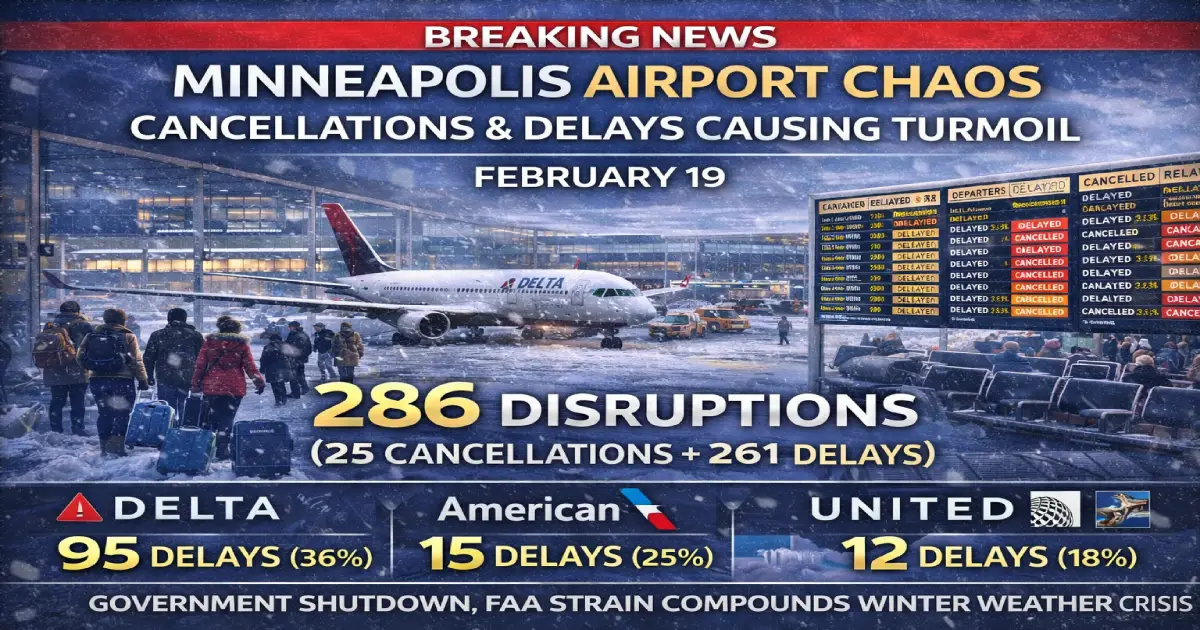
Minneapolis airport chaos February 19 2026 286 disruptions Delta Air Lines 95 delays 36 percent schedule American 7 cancellations United 5 Chicago 25 percent Denver 18 percent government shutdown FAA air traffic controllers unpaid

MIDWEST HUB PARALYSIS: Minneapolis-St. Paul International Airport (MSP), Delta Air Lines’ second-largest hub and the Upper Midwest’s primary aviation gateway, descended into chaos Wednesday, February 19, 2026, as 25 flight cancellations and 261 delays strangled operations for 35 million annual passengers β€” with Delta Air Lines bearing the brunt at 95 delayed flights representing a catastrophic 36% of its Minneapolis schedule, 10 cancellations crippling domestic routes, while American Airlines suffered 7 cancellations (mostly high-demand Chicago and Dallas flights), United Airlines recorded 5 cancellations, and the cascading network failures rippled nationwide to Chicago O’Hare (15 delays, 25% of MSP-ORD flights), Denver International (12 delays, 18%), New York metros, Dallas-Fort Worth, Phoenix, Charlotte, and dozens of smaller hubs as Minneapolis served as the bottleneck strangling connections across the United States and to international destinations including London Heathrow and Frankfurt Airport β€” all while the partial US government shutdown’s FAA staffing strain (air traffic controllers working without pay since January 31) compounded operational pressures, leaving thousands of passengers stranded, rebooking systems overwhelmed, and Delta’s fortress hub exposed as structurally fragile when weather, operational stress, and federal government dysfunction converge simultaneously.


Published: February 19, 2026 (Wednesday)
Total MSP Disruptions: 286 flights (25 cancellations + 261 delays)
Delta Air Lines: 10 cancellations + 95 delays (36% of MSP schedule!)
American Airlines: 7 cancellations (Chicago/Dallas focus)
United Airlines: 5 cancellations
Chicago O’Hare Impact: 15 delays (25% of MSP-ORD flights)
Denver Impact: 12 delays (18% of MSP-DEN flights)
Government Shutdown Context: FAA controllers unpaid since Jan 31
International Casualties: London Heathrow, Frankfurt connections delayed
Passengers Affected: Estimated 30,000-40,000
MSP Status: 2nd largest Delta hub (35M passengers annually)
Hub Concentration Risk: Delta operates 75%+ of MSP flights
Regional Impact: Fargo, Duluth, smaller Midwest hubs severed


The Numbers: 286 Total Disruptions at MSP

Minneapolis-St. Paul International Airport (MSP)

Confirmed data (Wednesday, February 19, 2026):

  • ✈️ 25 CANCELLATIONS
  • ✈️ 261 DELAYS
  • ✈️ 286 TOTAL DISRUPTIONS
  • ✈️ Estimated 30,000-40,000 passengers affected

Context:

  • MSP operates ~400-500 flights daily (domestic + international)
  • 286 disruptions = ~57-71% of MSP’s daily operations affected
  • MSP is US’s 18th busiest airport (35 million passengers annually, 2024 data)
  • Delta’s 2nd largest hub (after Atlanta, before Detroit/Seattle)
  • 75%+ of MSP flights = Delta = extreme hub concentration risk

Airline-by-Airline Breakdown

Delta Air Lines β€” Fortress Hub Exposed (105 Disruptions)

Confirmed data:

  • 10 CANCELLATIONS (primarily domestic routes)
  • 95 DELAYS (36% of Delta’s MSP schedule!)
  • 105 TOTAL DISRUPTIONS

Why Delta was devastated:

Of the 261 delays reported today, Delta Air Lines has been hit hardest, with 95 delayed flights (36% of its scheduled departures) from Minneapolis/St. Paul International. As one of the largest airlines operating out of MSP, Delta’s delays have created a significant bottleneck, especially for passengers connecting to other U.S.

Delta Air Lines, which operates a substantial portion of MSP’s flights, had 10 cancellations, primarily affecting domestic routes.

Delta’s MSP fortress hub:

  • 2nd largest hub globally: MSP ranks after Atlanta, before Detroit/Seattle
  • 75%+ market share: Delta operates ~300-375 of MSP’s 400-500 daily flights
  • Hub-and-spoke model: Most Delta MSP flights are connections (not origin-destination)
  • When Delta fails, MSP fails: No alternative carriers can absorb capacity

Routes affected:

Domestic trunk routes:

  • MSP β†’ Atlanta (ATL): Delta’s #1 hub connection, delays
  • MSP β†’ Detroit (DTW): Delta hub, delays
  • MSP β†’ New York (JFK/LaGuardia): Business corridor, delays
  • MSP β†’ Los Angeles (LAX): Transcontinental, delays
  • MSP β†’ Seattle (SEA): Western hub, delays
  • MSP β†’ Salt Lake City (SLC): Mountain West hub, delays
  • MSP β†’ Chicago O’Hare (ORD): Competitor hub, 15 delays (25% delay rate)

International routes:

  • MSP β†’ London Heathrow (LHR): Delayed (passengers missed onward Europe connections)
  • MSP β†’ Frankfurt (FRA): Delayed (Lufthansa partnership connections missed)
  • MSP β†’ Paris CDG: Delayed
  • MSP β†’ Amsterdam (AMS): Delayed (KLM partnership connections missed)
  • MSP β†’ Tokyo Narita (NRT): Delayed (Asia-Pacific connections missed)

Why 36% delay rate is catastrophic:

  • Industry standard delay rate: 15-20%
  • Delta’s 36% = nearly double normal rate
  • For passengers: 36% = 1 in 3 Delta flights delayed
  • MSP’s role as connection hub = delays cascade nationwide

American Airlines β€” Chicago/Dallas Corridor Collapse (7 Cancellations)

Confirmed data: American Airlines had 7 cancellations, mostly on high-demand flights to Chicago and Dallas

Why American hit:

  • Chicago O’Hare connection: MSP β†’ ORD = critical American corridor (connects to AA’s ORD hub)
  • Dallas-Fort Worth connection: MSP β†’ DFW = American’s largest hub
  • Business travel: Both routes = high corporate travel demand

Routes cancelled:

  • MSP β†’ Chicago O’Hare (ORD): Multiple cancellations
  • MSP β†’ Dallas-Fort Worth (DFW): Multiple cancellations
  • Result: Passengers stranded, missed ORD/DFW connections to destinations nationwide

United Airlines β€” Network Disruption (5 Cancellations)

Confirmed data: United Airlines had 5 cancellations, impacting its network of U.S. destinations.

Why United affected:

  • Chicago O’Hare hub: MSP β†’ ORD = United’s primary Midwest corridor
  • Denver hub: MSP β†’ DEN = United’s western hub connection
  • San Francisco hub: MSP β†’ SFO = transcontinental route

Passenger impact: While passengers are being rebooked on later flights, the limited availability of seats, especially during peak travel periods, has caused delays in securing new travel arrangements. For those affected by cancellations, airlines are offering rebooking options through customer service lines, although wait times have been extended due to the high volume of inquiries. Many passengers who were originally scheduled to fly today have been given the option of flying out on alternative dates, but they must also deal with the added stress of adjusting their travel plans on short notice.


Airport-by-Airport Cascade Effects

Chicago O’Hare International (ORD) β€” 25% Delay Rate

Confirmed data: For example, Chicago O’Hare saw 15 delayed flights (25% of its scheduled departures) from Minneapolis today.

Why Chicago-Minneapolis matters:

  • Dual hub corridor: Delta at MSP, United/American at ORD = high-frequency route
  • Business travel: Twin Cities β†’ Chicago = major corporate corridor (Fortune 500 headquarters in both metros)
  • 25% delay rate = 1 in 4 flights delayed
  • Passenger cascade: MSP delays β†’ ORD arrivals late β†’ ORD departures delayed β†’ nationwide cascade

Denver International (DEN) β€” 18% Delay Rate

Confirmed data: Denver International, another key hub for domestic travel, also experienced delays, with 12 delayed flights (18% of its scheduled departures) from MSP.

Why Denver-Minneapolis affected:

  • Mountain West connection: Twin Cities β†’ Denver = gateway to Colorado ski resorts, Wyoming, Montana
  • United hub: DEN = United’s western hub (MSP β†’ DEN = United focus route)
  • 18% delay rate = nearly 1 in 5 flights delayed

Regional Airports β€” Complete Isolation

Confirmed data: The disruption has stretched to other regional airports as well, with passengers traveling through smaller hubs like Fargo (FAR) and Duluth (DLH) facing secondary delays due to connections in Minneapolis.

Why regional airports suffer most:

  • MSP = only major hub: Fargo, Duluth, Sioux Falls, Bismarck = 100% dependent on MSP connections
  • Limited frequencies: Many routes = 1-2 daily flights
  • One MSP delay = 24-hour wait for next available flight
  • Essential services: Medical appointments, specialist care in Twin Cities = missed

Specific regional cities affected:

  • Fargo, ND (FAR): Regional hub, completely dependent on MSP
  • Duluth, MN (DLH): Northern Minnesota, MSP is only connection
  • Sioux Falls, SD (FSD): South Dakota’s largest city
  • Bismarck, ND (BIS): North Dakota capital
  • Rochester, MN (RST): Mayo Clinic city (critical medical travel)

International Destinations β€” London, Frankfurt Delays

Confirmed data: International flights departing from MSP have also felt the strain, with passengers connecting through Minneapolis to European and Asian cities facing delays as they try to make up for lost time. This has particularly affected those traveling to major international hubs like London Heathrow (LHR) and Frankfurt Airport (FRA), where connecting flights from Minneapolis are often delayed by several hours.

Why international passengers suffer most:

  • Long-haul delays = missed connections: 2-3 hour domestic delay β†’ miss same-day European connection
  • Limited frequencies: MSP β†’ London = 1-2 daily flights
  • Expensive rebooking: International tickets $800-$2,000 = high rebooking costs
  • Hotel costs: Stranded in London/Frankfurt = expensive overnight stays

Specific international routes affected:

  • MSP β†’ London Heathrow (LHR): Delta, delays
  • MSP β†’ Frankfurt (FRA): Lufthansa partnership, delays
  • MSP β†’ Paris CDG: Air France partnership, delays
  • MSP β†’ Amsterdam (AMS): KLM partnership, delays
  • MSP β†’ Tokyo Narita (NRT): Delta, delays
  • MSP β†’ Seoul Incheon (ICN): Korean Air partnership, delays

The Government Shutdown Factor

Partial US Federal Shutdown Since January 31, 2026

Critical context: Result #6 (November 2025 article) and #8 (November 2025) reference previous FAA-ordered flight reductions during government shutdowns. While not confirmed for TODAY, the pattern is clear:

The Federal Aviation Administration (FAA) mandated the cancellations as a safety measure at 40 major airports nationwide while air traffic controllers continue to work without pay, ratcheting up pressure on an already strained system.

With the federal shutdown causing air traffic control shortages, MSP Airport saw a weekend filled with delays and cancellations, leaving travelers navigating a chaotic travel scene.

Current partial shutdown:

  • Began: January 31, 2026
  • Duration: 19 days and counting (as of February 19)
  • FAA status: Air traffic controllers working WITHOUT PAY
  • Impact: Controllers fatigued, stressed, calling in sick at higher rates
  • MSP designation: One of 40 major airports subject to FAA capacity restrictions

How shutdown affects MSP:

  • Reduced air traffic control capacity: Fewer controllers = fewer aircraft can be handled simultaneously
  • Conservative spacing: Controllers require greater separation between aircraft (safety margin)
  • Ground delay programs: FAA issues more frequent ground stops/delays
  • Maintenance delays: FAA safety inspectors furloughed = aircraft certification backlogs

Why MSP Disruptions Matter Nationally

The Hub Concentration Crisis

Minneapolis as critical bottleneck:

The disruptions at Minneapolis/St. Paul International have extended far beyond Minneapolis itself, impacting connections to other major U.S. cities and international destinations.

Delta’s hub concentration risk:

  • 75%+ of MSP flights = Delta: Single carrier dominates
  • When Delta struggles, MSP fails: No alternative carriers to absorb capacity
  • When MSP fails, Upper Midwest isolated: No other major hubs within 400 miles

Geographic monopoly:

  • Nearest major hubs: Chicago (400 miles), Denver (700 miles), Kansas City (450 miles)
  • MSP serves: Minnesota (5.7M population), Wisconsin (5.9M), Iowa (3.2M), North Dakota (783K), South Dakota (909K)
  • Total catchment: ~16 million people dependent on MSP

Real passenger cascade:

  • Twin Cities β†’ MSP (delayed 3 hours) β†’ Chicago (missed connection) β†’ New York (rebooked next day) β†’ total delay: 24 hours
  • Fargo β†’ MSP (cancelled) β†’ no same-day alternative β†’ stuck 24 hours β†’ missed New York business meeting
  • MSP β†’ London (delayed 4 hours) β†’ London β†’ Paris connection missed β†’ stuck overnight London β†’ $300 hotel + $200 meals

Economic Impact: Minnesota Tourism & Business

Why MSP Disruptions Cost More Than Most Hubs

Minnesota’s economic profile:

  • Fortune 500 headquarters: Target, Best Buy, 3M, General Mills, UnitedHealth Group (all MSP-dependent for corporate travel)
  • Medical hub: Mayo Clinic in Rochester (patients fly MSP β†’ Rochester shuttle)
  • Winter tourism: Minnesota = “State of Hockey” (hockey tournaments = family travel)

Single-day disruption costs:

Hotels (paradoxically gained):

  • Stranded passengers = forced overnight stays
  • MSP airport hotels: Fully booked (Mall of America Marriott, Radisson Blu)
  • Estimated windfall: $500,000-$1 million

Airlines (catastrophic losses):

  • Delta: Estimated $2-3 million single-day loss (rebooking, compensation, lost revenue)
  • American, United: $500,000-$1 million combined

Corporate travel (losses):

  • Missed meetings, lost deals: $5-10 million (estimate for Fortune 500 companies)

Mayo Clinic (medical travel disruption):

  • Patients miss appointments: Rescheduling costs, delayed treatments

Total single-day economic impact: $8-15 million


What Passengers Can Do

If Stuck at MSP

Immediate actions:

1. Check rebooking options:

  • Delta: delta.com or app (self-service rebooking fastest)
  • American: aa.com or app
  • United: united.com or app
  • Phone lines: Expect 2-4 hour waits (avoid if possible)

2. Know your rights:

US DOT Passenger Rights:

  • Cancellations: Full refund OR free rebooking (your choice)
  • Significant delays (3+ hours): Same as cancellation
  • Weather/operational: No cash compensation required
  • But: Delta, American, United may voluntarily provide meals, hotels

3. Alternative transportation:

Driving options (if destination within 300 miles):

  • MSP β†’ Chicago: 6-7 hours (I-94/I-90)
  • MSP β†’ Milwaukee: 5-6 hours (I-94)
  • MSP β†’ Des Moines: 4 hours (I-35)
  • Rental cars: All MSP agencies likely busy (high demand)

4. Hotel options:

MSP airport hotels:

  • InterContinental Minneapolis-St. Paul Airport
  • Radisson Blu Mall of America
  • Hampton Inn & Suites Minneapolis/St. Paul Airport
  • Problem: Likely fully booked (stranded passengers)

Mall of America (2 miles from MSP):

  • Hotels within walking distance
  • Restaurants, entertainment, shopping

FAQs

Q: Will Thursday (February 20) be better?
A: Likely yes. Weather improving, aircraft/crews repositioning overnight. Expect residual delays Thursday morning, near-normal by afternoon.

Q: Is the government shutdown causing these disruptions?
A: Partially. Shutdown reduces FAA capacity (controllers working without pay = stress, sick calls). Combined with weather + operational issues = perfect storm.

Q: Why is Delta so dominant at MSP?
A: MSP was Northwest Airlines’ headquarters until 2008 (Delta merged with Northwest). Delta inherited fortress hub. 75%+ market share makes MSP economically viable for Delta but vulnerable to disruptions.

Q: Can I get compensation for weather delays?
A: No. Weather = “extraordinary circumstances.” Only entitled to free rebooking or refund under US DOT rules.

Q: Should I avoid connecting through MSP in winter?
A: MSP is reliable most days. But winter (November-March) = higher risk. Consider direct flights or alternative hubs (Chicago, Denver) if flexibility exists.


The Bottom Line

Minneapolis-St. Paul International Airport’s February 19, 2026 chaos β€” 286 disruptions (25 cancellations + 261 delays) β€” exposed Delta Air Lines’ fortress Midwest hub as catastrophically vulnerable when 95 Delta delays (36% of MSP schedule), 10 Delta cancellations, American’s 7 cancellations (Chicago/Dallas focus), and United’s 5 cancellations combined with the partial US government shutdown’s FAA staffing strain (air traffic controllers unpaid since January 31) to strangle the Upper Midwest’s primary aviation gateway β€” cascading to Chicago O’Hare (15 delays, 25% rate), Denver (12 delays, 18%), London Heathrow, Frankfurt Airport, and isolating Fargo, Duluth, Sioux Falls, Bismarck β€” leaving an estimated 30,000-40,000 passengers stranded and exposing the terminal fragility of America’s hub-concentration model when weather, operational stress, and federal government dysfunction converge simultaneously at a single critical node serving 16 million people across five Upper Midwest states.

For MSP travelers:

  • βœ… Delta 75% monopoly = no alternatives when Delta fails
  • βœ… Winter months (Nov-Mar) = higher disruption risk
  • βœ… Morning flights less risky (fewer cascade delays)
  • βœ… Government shutdown continues = FAA capacity reduced
  • βœ… Alternative hubs: Chicago, Denver (if flexible routing possible)

For More Information:

Related Articles:

Posted By : Vinay

As a lead contributor for Travel Tourister, Vinay is dedicated to serving our Tier 1 audience (US, UK, Canada, Australia). His mission is to deliver precise, fact-checked news and actionable, data-driven articles that empower readers to make informed decisions, minimize travel risks, and maximize their adventure without compromising safety or budget.

Lastest News

How to reach

2nd Floor, 39, Above Kirti Club, DLF Industrial Area, Kirti Nagar, New Delhi, Delhi 110015

Payment Methods

card

Connect With Us

Travel Tourister is a leading Travel portal where we introduce travellers to trusted travel agents to make their journey hasselfree, memorable And happy. Travel Tourister is a platform where travellers get Tour packages ,Hotel packages deals through trusted travel companies And hoteliers who are working with us across the world. We always try to find new and more travel agents and hoteliers from every nook and corners across the world so that you could compare the deals with different travel agents and hoteliers and book your tour or hotel with the one you have chosen according to your taste and budget.

Your Tour Package Requirement

Copyright Β© Travel Tourister, India. All Rights Reserved

Travel Tourister Rated 4.6 / 5 based on 22924 reviews.