Published on : 10 Mar 2026
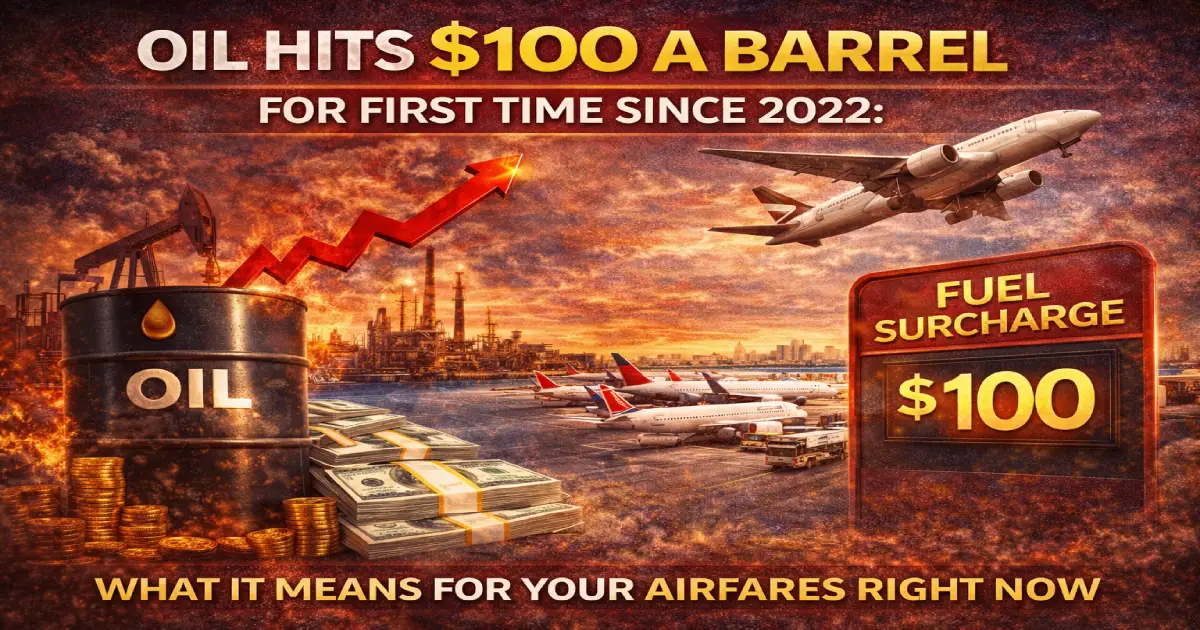
Breaking: Oil breached $100 a barrel on March 9—the first time since early 2022. Seoul–London fares jumped 673% in seven days. US airlines face $5 billion in extra fuel costs. Here’s exactly what happens to your airfares now, carrier by carrier and route by route.
Published: March 10, 2026 $100 Crossed: March 9, 2026 — Day 10 of Operation Epic Fury Brent Crude Peak: $104–$105/barrel intraday March 9 Brent Settlement: $98.96 (Monday close) | WTI: $94.77 Year-on-Year Surge: +50.36% vs March 9, 2025 ($69/barrel) Jet Fuel Price: Nearly doubled — $830/tonne → $1,500+/tonne in northwest Europe US Airline Extra Cost: ~$5 billion across the Big Three this quarter alone Mandatory Fare Hike: 11% minimum needed for US airlines to break even Seoul → London (March 11): $564 → $4,359 in 7 days (+673%) Los Angeles → Lima: $499 → $2,125 in same period (+326%) US Airline Stocks (March 9): United -8.7% | American -6% | Delta -5.5% | Southwest -5% Futures Market (Nov 2026 delivery): $80/barrel — market expects gradual recovery
Oil has not traded at these levels since early 2022, when Russia’s invasion of Ukraine sent global energy markets sharply higher. On March 9, Brent crude breached $100 intraday for the first time in four years as the Strait of Hormuz — through which 20% of the world’s oil travels — reached a near-complete commercial shutdown.
Oil prices jumped 15% to above $105 a barrel. At one point, Brent crude futures jumped as much as 29%. Some jet fuel prices have doubled since the start of the conflict, piling pressure on carriers already navigating tight airspace.
The conflict comparison that matters: the estimated 20% supply disruption is roughly twice as big as the record set during the Suez Crisis of 1956–1957, according to historical data from Rapidan Energy Group.
Why jet fuel rose even faster than crude:
Subhas Menon, head of the Association of Asia Pacific Airlines, put it plainly: “If crude is rising 20%, jet fuel is rising several times more as it is even more scarce, adding significant cost to operations together with crew resources, which are stretched due to longer flying times when airspace is closed.” Northwest European jet fuel prices crossed $1,500/tonne — up from $830/tonne before the conflict.
The good news: Oil traders don’t think $100 is permanent. Futures contracts for November 2026 delivery price at $80/barrel. The market is pricing a gradual recovery — but “eventually” is cold comfort when you’re booking summer 2026 right now.
These are live booking prices confirmed by Reuters and BNN Bloomberg from Google Flights data published March 9. Not projections — actual prices available to passengers today.
The headline numbers:
✈️ Seoul → London (Korean Air, March 11): $564 → $4,359 (+673% in 7 days) ✈️ Los Angeles → Lima (LATAM): $499 → $2,125 (+326%) ✈️ Hong Kong → London: $600–$1,400 normal → $2,500+ (up to +317%) ✈️ Singapore Airlines (SIN → LHR/JFK): Surged +200% vs pre-crisis baseline ✈️ Asia–Europe routes average: Up to 10× normal prices on last-minute inventory
Why these specific routes spiked hardest: For years, the Middle East served as a hub for international air travel. With Gulf airports temporarily closed or rerouting flights, airlines have been forced to find alternative routes that are not only longer but also much more costly. Limited seat availability on alternatives — as stranded passengers compete for the same seats — creates a supply-demand shock in booking systems.
Lorraine Tan, director of equity research at Morningstar, summed up the consequence: “The impact of high airfares could limit travel demand for much of 2026.”
The price of jet fuel has increased by up to $1.75 per gallon in recent weeks. This surge means each major US airline could be confronting approximately $1.5 billion or more in added quarterly fuel expenses. Across the three largest carriers, this could result in close to $5 billion in additional costs.
To put this in scale: US airline net margins in a good year run at 5–8%. A $5 billion quarterly cost increase — without equivalent fare increases — eliminates most or all of their annual profit. United CEO Scott Kirby has already confirmed: “The effect on ticket prices will probably begin quickly.”
The $0.01 rule: For every one cent increase in the price of a gallon of jet fuel, a major carrier like Delta faces roughly $40 million in annual costs. At $1.75/gallon increase, that equals $700 million per year for a single carrier — before counting United or American.
Your biggest decision right now is which carrier to book. Here is the complete picture of who is protected from $100 crude and who is buying at near-spot prices.
Lufthansa Group (Lufthansa, SWISS, Austrian, Brussels Airlines, ITA, Eurowings)
Confirmed hedging: 82% for Q1 2026, 77% for the full year 2026. The best-positioned major network carrier at $100 oil. Lufthansa’s consumers will see the least fare pressure of any full-service long-haul carrier through summer.
IAG (British Airways, Iberia, Vueling, Aer Lingus)
Confirmed hedging: 75% Q1 2026 → 64% Q2 → 58% Q3 → 50% Q4. IAG will be keen to see a quick end to the war, as it is only hedged for 39% for Q1 2027. The declining ratio through summer means BA’s peak-season fares carry increasing fuel cost exposure.
Air France-KLM
Confirmed hedging: 70% Q1 2026 → 69% Q2 → 60% Q3 → 47% Q4. Well-protected through H1, increasingly exposed through H2. Book Air France or KLM for spring — their hedges are doing the work.
easyJet
Confirmed hedging: 84% for H1 2026. The highest H1 coverage of any European LCC. This is the cheapest European flying window still available. H2 drops to 62% — late summer fares will begin reflecting $100 oil.
Ryanair
Confirmed: “Mostly hedged” for 2026, with Q2 locked in at approximately $67/barrel — dramatically below today’s spot. Of all low-cost carriers, Ryanair is most insulated right now. Spring and early summer Ryanair fares are the last genuinely cheap flying in this crisis.
Qantas
CEO Vanessa Hudson confirmed: “We’ve got pretty good hedging in place, but these are pretty significant impacts on aviation, and we’re just continuing to watch how it all unfolds.” Estimated 60–70% coverage based on Qantas’s historical patterns.
American Airlines
No significant fuel hedging for 2026. American Airlines stock dropped 6% on March 9 as investors priced in the carrier’s full fuel cost exposure. Every gallon of jet fuel American burns this quarter is being purchased at or near spot prices. Transatlantic fares will reflect this — expect surcharge revisions in April.
United Airlines
United Holdings saw the steepest decline — shares dropping as much as 8.7% in early March 9 trading. Same zero-hedging position as American. United CEO has confirmed higher prices are coming quickly. Transatlantic and transpacific routes are the most at-risk categories.
Delta Air Lines (partial natural hedge)
Delta will enjoy some immunity through its indirect ownership of the Trainer oil refinery near Philadelphia. At $100+ crude with a dramatically widened crack spread, the refinery’s value increases — but Delta is not immune. The natural hedge covers a portion of Delta’s jet fuel needs, not the whole.
Southwest Airlines
The most consequential single carrier exposure in US aviation. Southwest abandoned fuel hedging in 2025 after paying $157 million in premiums. Now it is buying every gallon at near-spot prices — with a domestic US fare model that has historically been the cheapest benchmark for American leisure travel. Southwest’s decision to stop hedging looks like the worst-timed strategic exit in US airline history.
Asian LCCs — Potential Groundings
Airlines in Asia aren’t as well hedged as rivals in Europe or the US, making them more vulnerable to sudden surges in jet fuel prices. That has prompted low-cost Southeast Asian carriers to start gaming out scenarios where they would ground planes if jet fuel becomes unaffordable or inaccessible. Vietnam faces a stark warning: state media reporting potential airfare hikes up to 70%. Asiana Airlines hit a 21-year low on March 9.
Asia ↔ Europe (all routings)
The closure of crucial airspace — especially over parts of the Caucasus and Saudi Arabia — means airlines must fly longer detours over Russia, Egypt, and other regions to reach their destinations. These diversions add between 300 and 800 nautical miles to journeys, extending flight times by 45 to 120 minutes and significantly increasing fuel consumption. The double pressure of $100 fuel on a longer route makes Asia–Europe the most severely impacted route category.
Transatlantic (US/Canada ↔ Europe)
Unhedged US carriers — American and United — will formally revise transatlantic surcharges within 4–6 weeks. Several network airlines are already testing targeted fuel surcharges on long-haul routes and premium cabins. Watch for formal YR/YQ surcharge table updates in April.
US Domestic
Southwest’s full spot exposure is the key variable. Airfares are expected to increase in coming months, even if oil prices stabilize. Every penny increase per gallon costs Southwest approximately $40 million annually. At $1.75/gallon increase — roughly $700 million in additional annual fuel costs — the carrier that defined cheap American domestic flying faces pressure unlike anything since 2008.
Ryanair and easyJet — European routes through June 2026
Both hedged at 80–84% through H1 2026. Ryanair’s $67/barrel Q2 hedge means its intra-European fares are disconnected from today’s spot market reality. This protection is temporary — their H2 hedges are 62% and lower. Spring and early summer European low-cost fares are the last affordable window in this crisis. Book now.
Scenario 1: Hormuz reopens within 2 weeks (25% probability)
Oil retreats to $75–80. Jet fuel follows with a 4–6 week lag. Summer 2026 fare increases limited to 4–7% on most routes. Hedged carriers absorb the spike entirely. Asian LCC groundings avoided.
Scenario 2: 4–8 week disruption then recovery (50% probability — current market pricing)
A barrel of crude oil delivered in November 2026 is priced at $80 — the futures market’s signal. Six weeks of $100 oil, gradual decline. Summer 2026 fares on unhedged US carriers rise 11–15%. Transatlantic on hedged European carriers: 4–6%. Asia–Europe: 8–12% above pre-crisis. Asian LCCs: reduced capacity, some route suspensions, 15–25% fare increases on surviving routes.
Scenario 3: Sustained conflict above $100 (25% probability)
Morgan Stanley analysis: 38% reduction in profits for airlines like Lufthansa if fuel costs remain high. Asian LCCs begin grounding aircraft. Rothschild Redburn has already begun downgrading the airline sector. Deutsche Bank noted that a sharp spike in jet fuel costs in the aftermath of hurricanes Katrina and Rita in 2005 resulted in major airlines Delta and Northwest filing for Chapter 11 that year. The current crisis is significantly larger than the 2005 fuel shock.
Decision 1: Book transatlantic on a hedged European carrier — not a US carrier
Air France, KLM, British Airways, Lufthansa — all hedged 58–77% through summer. American and United are at spot prices. The pricing gap between hedged European carriers and unhedged US carriers will only widen as April surcharge revisions hit. Book Air France or BA today.
Decision 2: Book Asia–Europe immediately — every day of delay costs more
Seat availability on non-Gulf routings via Singapore Airlines, Cathay Pacific, and Japanese carriers is the binding constraint. These airlines are filling fast. If you are travelling Asia–Europe in summer 2026, book now. There is no cheaper moment than today.
Decision 3: Lock in Ryanair and easyJet spring fares — these are the last cheap ones
Both are hedged at prices dramatically below today’s spot. Ryanair’s $67/barrel Q2 hedge means its intra-European fares are temporarily disconnected from market reality. When their H2 2026 hedges roll off, fares will adjust. Spring and early summer bookings are the last affordable European flying window.
Decision 4: Buy flexible fares or “cancel for any reason” travel insurance
The 25% probability of sustained $100+ oil is not trivial. If fares spike further and you want to rebook at lower post-resolution prices, refundable fares or CFAR coverage gives you that optionality. Do not lock in expensive non-refundable fares at peak $100-oil prices if you have any alternative.
Decision 5: Book award travel before April surcharge revisions
Loyalty programme surcharges — YQ/YR on Avios, Aeroplan, SkyMiles, MileagePlus awards — are updated quarterly. April is the next revision window. Award bookings made this week lock in today’s cash co-pay amounts. The miles cost stays the same. The cash surcharge component will increase in April. Book award travel now.
One unintended consequence of $100 oil: SAF (Sustainable Aviation Fuel) becomes economically competitive faster.
SAF prices exceed fossil-based jet fuel by a factor of two, and by up to a factor of four in mandated markets. At $60 Brent, SAF’s premium was a serious commercial barrier. At $100+ Brent, the economics narrow materially. The $100 oil mark is likely to accelerate the industry’s transition toward SAF. While it currently covers just 0.8% of total fuel consumption (2.4 million tonnes in 2026), the structural economics of SAF investment shifted permanently when crude crossed triple digits.
On March 9, 2026, the price of oil soared above $100 a barrel for the first time since 2022, placing the cost of jet fuel in limbo — and in turn the amount passengers pay for their tickets. A Korean Air flight from Seoul to London that cost $564 one week ago now costs $4,359. US airlines face $5 billion in additional quarterly costs. United’s CEO has confirmed higher prices are coming quickly.
The traveller’s window is narrow. Ryanair and easyJet are hedged and relatively cheap through June — but their H2 coverage drops sharply. Air France, KLM, and British Airways are hedged through summer but their declining Q3/Q4 ratios mean autumn fares are exposed. The three US majors are fully exposed right now — surcharge revisions are weeks away, not months.
Book today on hedged carriers. Book flexible fares. Watch the Strait of Hormuz — everything depends on a conflict whose end date nobody can predict.
For More Resources:
Related Articles:
Posted By : Vinay
Lastest News
2nd Floor, 39, Above Kirti Club, DLF Industrial Area, Kirti Nagar, New Delhi, Delhi 110015



Travel Tourister is a leading Travel portal where we introduce travellers to trusted travel agents to make their journey hasselfree, memorable And happy. Travel Tourister is a platform where travellers get Tour packages ,Hotel packages deals through trusted travel companies And hoteliers who are working with us across the world. We always try to find new and more travel agents and hoteliers from every nook and corners across the world so that you could compare the deals with different travel agents and hoteliers and book your tour or hotel with the one you have chosen according to your taste and budget.
Copyright © Travel Tourister, India. All Rights Reserved

 Call
Call Enquiry