Philippine Airlines A350-1000 Unlocks US East Coast: 8,700-Mile Range Enables Manila-Atlanta (8,400nm) + Miami (8,600nm) Nonstops FIRST TIME—42 Business Suites WITH DOORS, NYC Launch January 6, 9 Aircraft by 2028, 4M Filipino Diaspora Transformation, Challenges Cathay Pacific/Singapore/JAL One-Stop Dominance
Published on : 08 Jan 2026
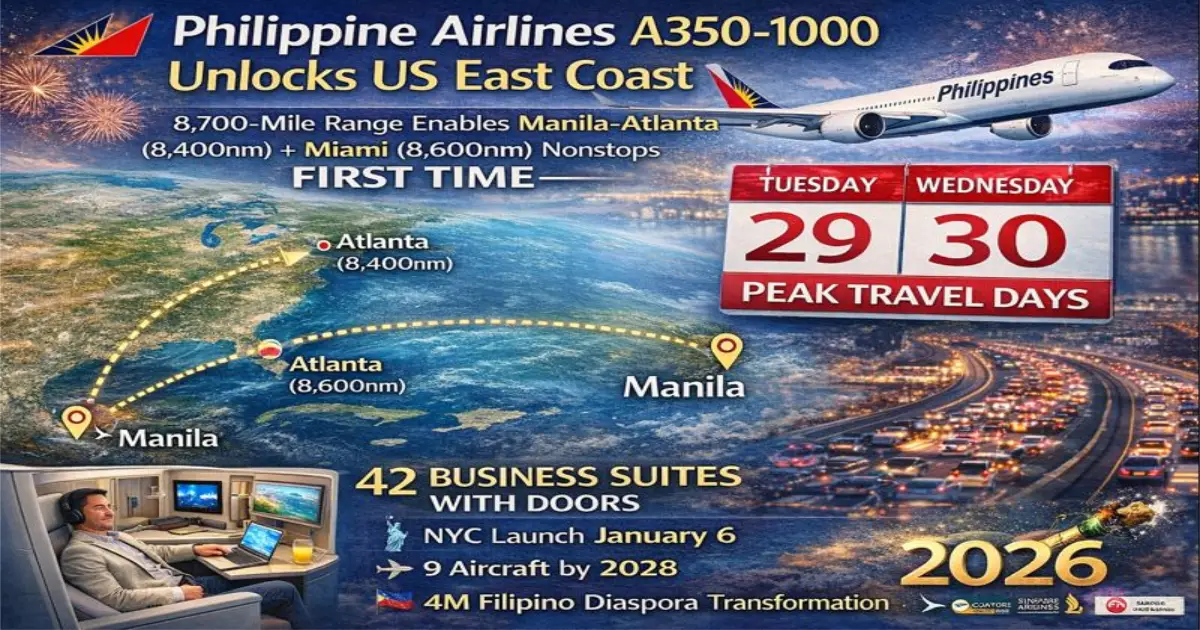
Breaking: Philippine Airlines (PAL) receives first Airbus A350-1000 (registration RP-C3510, delivered Toulouse December 22, 2025, arrived Manila December 20) becoming 10th airline worldwide + FIRST Southeast Asian carrier operating this aircraft, unlocking unprecedented US East Coast expansion through 8,700 nautical mile range (vs A350-900’s 8,200nm = 500nm advantage critical threshold) making Manila-Atlanta (8,400nm) + Manila-Miami (8,600nm) nonstop service technically feasible first time in history, transforming 4 million Filipino-American diaspora connectivity currently forced connecting Hong Kong/Tokyo/Seoul (18-22 hour total journey vs potential 16-17 hour direct) while competing Delta’s Atlanta hub gateway dominance Asia-Pacific + American’s Miami Latin America fortress positioning. Aircraft configured premium 382 total seats (42 Collins Aerospace Super Diamond business class lie-flat suites WITH privacy doors matching Etihad/British Airways/Qatar standard vs PAL’s older A350-900 fleet doorless open cabin = massive competitive upgrade, 24 premium economy, 316 economy) launching Manila-New York JFK route January 6, 2026 replacing current A350-900 operation (7,354nm = 15+ hour flight testing aircraft performance limits before expanding additional US cities). Fleet timeline aggressive: 9 total A350-1000s deliveries by 2028 (5 in 2026, 3 in 2027, 1 in 2028) enabling Los Angeles frequency increases, Seattle expansion (recently upgraded 3 → 5 weekly December 2025 proving demand), San Francisco confirmed targets PLUS Atlanta/Miami speculation based on range capabilities ending Cathay Pacific Hong Kong hub, Singapore Airlines, Japan Airlines Tokyo routing monopoly handling 2M+ annual passengers Philippines ↔ US Southeast indirectly through Asian mega-hubs adding 6-8 hours connections/layovers.
Published: January 8, 2026
Delivery Date: December 22, 2025 (arrived Manila December 20)
Registration: RP-C3510 (first of nine total)
Aircraft Type: Airbus A350-1000 (largest A350 variant)
Range: 8,700 nautical miles (16,112 km)
Configuration: 382 seats (42 business WITH doors, 24 premium economy, 316 economy)
First Route: Manila-New York JFK (PR127/PR128, January 6, 2026)
Current US Routes: NYC, LA, SF, Seattle
Potential NEW: Atlanta, Miami (first-ever nonstops Philippines-Southeast US)
Fleet Plan: 9 aircraft by 2028 (5 in 2026, 3 in 2027, 1 in 2028)
Filipino Diaspora US: 4 million (500K+ NYC, 500K+ LA, growing Southeast)
FIRST Southeast Asian carrier operating this specific aircraft type (ahead of regional competitors Singapore Airlines, Thai Airways, Malaysia Airlines who all operate smaller A350-900 only)
Lucio Tan III (President, PAL Holdings Inc.):
“The arrival of the A350-1000 marks a significant milestone in our ongoing commitment to fleet modernisation and network growth. This state-of-the-art aircraft will enable us to enhance connectivity between the Philippines and key markets worldwide, providing our passengers with unmatched comfort and efficiency. It will be a source of Filipino pride and a transformational step for our airline as we continue to elevate the Philippine flag in the global aviation landscape.”
Your JetBlue Fort Lauderdale article connection: JetBlue expanding Dallas DFW year-round (your article #14)—PAL could potentially serve same market from Manila direct
Result: 500 extra nautical miles = difference between “impossible” and “commercially viable” for entire US East Coast/Southeast region.
The Configuration: 382 Seats, Privacy Doors Business Class
PAL’s A350-1000 Cabin Layout:
Business Class (Mabuhay Class): 42 seats
Premium Economy: 24 seats
Economy: 316 seats
Total: 382 seats
BUSINESS CLASS: Collins Aerospace Super Diamond WITH DOORS
Major Upgrade from PAL’s A350-900 Fleet:
A350-1000 Business (NEW):
Seat: Collins Aerospace Super Diamond
Layout: 1-2-1 (all passengers have direct aisle access—no climbing over neighbors)
Privacy doors:NONE (open cabin, no doors—passengers see neighbors)
Entertainment: Smaller screens
Storage: Less refined
Power: Basic outlets only
Competitive Context:
With doors (matching PAL A350-1000):
Qatar Airways Qsuite: Doors + fully enclosed
British Airways Club Suite: Doors
Etihad Business Studio: Doors
Singapore Airlines Business: Doors
Cathay Pacific Aria Suite: Doors
Without doors (PAL’s older A350-900):
United Polaris: Open cabin (though still excellent product)
Delta One Suites: DOES have doors (competitive advantage vs PAL’s old fleet)
American Flagship Business: Open cabin on most aircraft
Result: PAL A350-1000 business class NOW competitive with world’s best (vs A350-900 lagging premium carriers) = critical for attracting high-yield business travelers willing pay $4K-8K roundtrip transpacific.
PREMIUM ECONOMY: 24 Seats New Revenue Stream
Specifications (PAL hasn’t fully disclosed, industry standard estimates):
Pitch: ~38-40 inches legroom (vs economy 31-32″)
Width: ~18-19 inches (vs economy 17-18″)
Recline: Enhanced 7-8 inches (vs economy 4-5″)
Amenities: Premium meals, priority check-in/boarding, extra baggage allowance, larger entertainment screens
PAL = Highest density among full-service carriers operating A350-1000 (ultra-low-cost carriers like French Bee configure even denser ~450+ seats but they’re budget leisure-only, not full-service competing PAL’s market).
Why Dense Configuration:
Maximize revenue: More passengers per flight = more ticket sales
Filipino market price-sensitive: Large diaspora population (4M US, 10M+ worldwide) = VFR (Visiting Friends/Relatives) traffic dominates, many passengers can’t afford business/premium economy = need high economy seat count
Load factors: PAL consistently achieves 85-90% load factors Manila-US routes = demand justifies density
Trade-off:
Higher revenue per aircraft BUT less comfort = may lose premium-seeking passengers to competitors with roomier cabins
Manila-New York JFK: Launch Route January 6, 2026
Inaugural Flight:
Route: Manila Ninoy Aquino International (MNL) ↔ New York John F. Kennedy (JFK)
Service industry: Restaurants, retail, hospitality = large Filipino workforce
Your tourism tax article connection: Filipinos visiting family NYC now face higher costs (Edinburgh £15 tax your article, NYC considering similar) = PAL’s direct service saves connection costs offsetting some tax burden.
2. VISITING FRIENDS & RELATIVES (VFR) TRAFFIC:
Primary demand driver: Filipino diaspora visiting family Philippines (Christmas, summer, family events)
Bidirectional: NYC Filipinos → Manila visiting relatives PLUS Manila residents → NYC visiting children/siblings who immigrated
NYC gateway: JFK = major connecting hub (Delta, American, JetBlue hubs your articles covered)
Beyond NYC destinations: Filipino passengers connecting JFK → Boston, Washington DC, Philadelphia, Atlanta (if no direct Manila service) = PAL captures feed traffic
A350-1000 BENEFITS VS A350-900:
Why PAL Upgrading NYC Route First:
Longest current route: 7,354nm = tests aircraft maximum performance (if A350-1000 handles NYC reliably, it handles anything)
Flagship route: NYC = PAL’s premium market (highest business class fares) = deserves best product (doors business class)
Crew training: NYC flights = train pilots/FAs on A350-1000 before expanding other routes (learn aircraft systems, service procedures)
87 more seats: 382 vs 295 = 29% more passengers per flight = higher revenue
Better economics: A350-1000’s larger size + efficiency = lower cost per seat-mile (~8-10% vs A350-900)
Business class doors: Competitive product = attract corporate travelers away from Cathay Pacific, Singapore Airlines alternatives
Premium economy: New cabin class = capture travelers currently booking economy (upgrading for comfort) OR downgrading from business (cost-conscious) = incremental revenue A350-900 lacks
Future US Routes: Where Will A350-1000 Fly Next?
PAL Official Statement (Vague Intentionally):
“The A350-1000’s advanced fuel efficiency and extended range will enable Philippine Airlines to expand its transpacific network with non-stop services to major destinations in North America, strengthening our commitment to connecting the Philippines with the world.”
Translation: PAL isn’t announcing specific routes yet (protecting competitive advantage, negotiating airport slots, awaiting government approvals) BUT industry analysts speculate based on:
Distance: ~7,300 nautical miles (easy A350-1000 range)
Current service: PAL flies Manila-LAX (A350-900 + 777-300ER mixed fleet)
Filipino population: 500,000+ LA County (largest US concentration)
A350-1000 role: Replace older 777-300ERs (fuel-inefficient, aging), increase frequencies (currently ~daily, could go 10-12× weekly)
Competition: Mostly PAL vs Cathay Pacific/China Airlines one-stop = PAL’s nonstop advantage
2. San Francisco (SFO):
Distance: ~7,100 nautical miles
Current service: PAL flies Manila-SFO (A350-900)
Filipino population: 300,000+ Bay Area
Tech industry: Silicon Valley Filipino workers (Apple, Google, Facebook employ thousands) = business travel
Your SFO runway closure article connection: SFO closing Runway 1R March 30-Oct 2 2026 (your article #12) = PAL’s A350-1000 operations may face delays during closure, but route demand strong enough justify maintaining service
Your Alaska transatlantic article connection: Alaska Airlines expanding Seattle international (your article #3: Seattle-Rome, London, Reykjavik) = Seattle becoming West Coast international gateway, PAL benefits from connecting traffic Seattle hub
A350-1000 role: Potentially upgrade 5× weekly → daily OR maintain 5× but use larger A350-1000 vs smaller A350-900 (more seats = more revenue same frequencies)
SPECULATED NEW ROUTES (Range-Enabled, Never Served Before):
4. Atlanta (ATL):
Distance: ~8,400 nautical miles
A350-900:IMPOSSIBLE (exceeds 8,200nm range)
A350-1000:NOW POSSIBLE (within 8,700nm with 300nm fuel reserves)
Southeast gateway: Atlanta connects Alabama, Georgia, Florida, Carolinas, Tennessee = underserved Filipino populations (currently must connect through LAX/SFO/NYC)
Growing diaspora: Atlanta metro Filipino population ~80K-100K (smaller than LA/NYC BUT growing fastest—tech industry, healthcare sector hiring)
Healthcare workers: Many Filipino nurses relocate Southeast (lower cost of living vs Northeast) = visiting family traffic
Military: Fort Benning (Georgia), Camp Lejeune (North Carolina) = Filipino military families
Competition:
Currently: No nonstop Philippines-Southeast US exists = PAL would be FIRST EVER
Alternatives: Cathay Pacific Hong Kong connections, Japan Airlines/ANA Tokyo connections, Korean Air Seoul connections = 18-22 hour total journey vs PAL’s 16-17 direct
Your United CEO article connection: United Airlines dominates Atlanta domestic connections (your article #11: United 100+ planes 2026, A321XLR) = PAL passengers could connect United’s domestic network ATL hub
Challenges:
Thin market: 80K-100K Filipino population = smaller than NYC (500K+), LA (500K+)—can PAL fill 382-seat A350-1000 profitably?
Currently: No nonstop Philippines-Florida exists = PAL would be FIRST EVER
Alternatives: Same as Atlanta (Hong Kong/Tokyo/Seoul connections = 19-23 hours total)
Your JetBlue Fort Lauderdale article connection: JetBlue expanding Fort Lauderdale-Orlando, Dallas (your article #14) = South Florida growing aviation market, PAL could tap into
Thinner market: 150K-200K Filipino population spread across Tampa/Orlando/Miami (vs concentrated NYC 500K+) = harder to fill 382 seats
Seasonal cruise industry: Demand peaks when cruise season active (Nov-April) BUT drops summer (hurricane season, fewer cruises) = load factor volatility
Verdict:Miami TECHNICALLY possible but OPERATIONALLY CHALLENGING—PAL more likely waits for A350-1000neo (next-gen variant, longer range) OR serves Miami via “fifth freedom” (stopover Honolulu Manila-HNL-MIA = refuel Hawaii, break journey into manageable segments).
6. Dallas/Fort Worth (DFW):
Distance: ~8,200 nautical miles
A350-900: Borderline (at absolute maximum range = unreliable)
Total widebody fleet 2028: ~21 aircraft (assuming 777s retired) = substantial US expansion possible.
The Filipino Diaspora: 4 Million Americans, 10 Million Worldwide
Why PAL’s US Expansion Matters:
US FILIPINO POPULATION BREAKDOWN:
Total: ~4 million Filipino-Americans (2020 Census)
Top 10 States:
California: 1.8 million (45% of US total)
Los Angeles County: 500K+
San Francisco Bay Area: 300K+
San Diego: 200K+
Sacramento: 100K+
Hawaii: 350,000 (25% of Hawaii’s total population!)
Illinois: 150,000 (Chicago metro)
New York: 140,000 (500K+ if including NYC metro New Jersey)
Texas: 250,000 (Dallas, Houston, San Antonio)
New Jersey: 150,000 (adjacent NYC metro)
Florida: 150,000 (Tampa, Orlando, Miami)
Washington: 100,000 (Seattle metro)
Nevada: 90,000 (Las Vegas)
Virginia: 80,000 (Washington DC suburbs)
VISITING FRIENDS & RELATIVES (VFR) TRAFFIC:
Characteristics:
Bidirectional: US Filipinos visiting family Philippines (Christmas, summer, weddings, funerals) + Manila residents visiting children/siblings immigrated US
High frequency: Many Filipinos travel 1-2× annually (vs typical American vacations 1× every 2-3 years)
Price-sensitive: Large families (4-6 people traveling together) = total cost $8K-15K roundtrip = seek cheapest fares
Flexible dates: Not tied to specific weeks (unlike business travelers) = PAL can offer discounts off-peak filling seats
Load Factors:
PAL Manila-US routes consistently achieve 85-90% load factors (industry average 80-85%) = VFR traffic extremely reliable demand
HEALTHCARE WORKERS:
Philippines = World’s Largest Exporter Nurses:
~150,000 Filipino nurses working US hospitals currently
~10,000-15,000 new nurses immigrate US annually (nursing shortages post-COVID = aggressive recruitment)
Popular destinations: NYC, Los Angeles, San Francisco, Houston, Chicago, Miami = exactly where PAL flies
Travel Patterns:
Initial immigration: Manila → US (PAL captures outbound)
Annual home visits: US → Manila (Christmas, summer = peak seasons)
Family visits: Parents/siblings Manila → US visiting nurse (PAL captures both directions)
Your British Airways breakfast cut article connection: Healthcare workers price-sensitive (despite decent salaries, supporting families both US + Philippines) = BA’s cost-cutting (your article #9) alienates this segment, but PAL maintains service quality capturing diaspora loyalty.
MILITARY FAMILIES:
~70,000 Filipino-Americans serving US military (Navy especially—Filipino culinary specialists famous)
Bases: California (San Diego, Camp Pendleton), Hawaii (Pearl Harbor), Virginia (Norfolk), North Carolina (Camp Lejeune), Georgia (Fort Benning)
Travel: Frequent transfers between bases, family visits Manila, military discounts important = PAL offers military fares
Competitive Landscape: PAL vs One-Stop Carriers
Current Reality (Before A350-1000 Atlanta/Miami Potential):
Filipino passengers traveling Philippines ↔ US Southeast/East Coast have NO nonstop options = forced connecting through:
CATHAY PACIFIC (Hong Kong Hub):
Routes:
Manila → Hong Kong (2 hours) → Atlanta (16 hours) = 18 hours total + layover time
Manila → Hong Kong (2 hours) → Miami (16.5 hours) = 18.5 hours total + layover time
Advantages:
Frequency: Multiple daily Manila-Hong Kong flights = flexibility
Premium product: Cathay business class excellent (your articles compared premium cabins)
Connections: Hong Kong hub connects 200+ destinations worldwide
Disadvantages:
Extra 4-6 hours: Connection adds minimum 2 hours layover (security, transit) + longer routing over Pacific vs direct
Hong Kong transit: Additional visa requirements some nationalities, political instability concerns post-2019 protests
SINGAPORE AIRLINES (Singapore Hub):
Routes:
Manila → Singapore (3.5 hours) → New York JFK (18 hours) = 21.5 hours total
Manila → Singapore → Los Angeles (17 hours) = 20.5 hours total
VFR travelers: More time visiting relatives vs sitting airports
PAL’s selling point: “Fly direct, arrive faster, spend more time with loved ones.”
Bottom Line: A350-1000 Transforms PAL’s US Strategy
Philippine Airlines’ December 22, 2025 delivery of first Airbus A350-1000 (registration RP-C3510, 10th airline worldwide + FIRST Southeast Asian carrier operating aircraft) represents transformational moment unlocking previously impossible US East Coast expansion through 8,700 nautical mile range (500nm advantage vs A350-900’s 8,200nm = critical threshold) enabling Manila-Atlanta (8,400nm) + Manila-Miami (8,600nm) nonstop service first time in history, transforming 4 million Filipino-American diaspora connectivity currently forced 18-22 hour one-stop journeys via Hong Kong/Tokyo/Seoul mega-hubs into potential 16-17 hour direct flights saving 2-6 hours total travel time = massive quality-of-life improvement visiting friends/relatives traffic (PAL’s core market: 150K Filipino nurses US annually visiting family Manila, military families 70K+ Filipino-Americans serving transferring bases, healthcare workers, students, retirees = consistent 85-90% load factors Manila-US routes validating demand).
Aircraft configuration premium 382 total seats (42 Collins Aerospace Super Diamond business class WITH privacy doors matching Etihad/British Airways/Qatar standard vs PAL’s older A350-900 fleet doorless open cabin = massive competitive upgrade attracting corporate travelers away from Cathay Pacific/Singapore Airlines alternatives, 24 premium economy capturing mid-tier travelers unwilling pay $4K-8K business BUT willing pay 2× economy $1,600-2,400 for comfort 16+ hour flights, 316 economy highest density among full-service carriers A350-1000 = maximizing revenue per flight though tighter than competitors Qatar/Lufthansa/BA configuring 320-330 total seats more spacious) launching Manila-New York JFK January 6, 2026 replacing current A350-900 operation (7,354nm = 15+ hour flight testing aircraft performance limits before expanding additional cities).
Fleet timeline aggressive: 9 total A350-1000s by 2028 (5 in 2026, 3 in 2027, 1 in 2028) enabling Los Angeles frequency increases replacing aging fuel-inefficient 777-300ERs, Seattle expansion (recently upgraded 3 → 5 weekly December 2025 proving demand), San Francisco confirmed targets PLUS Atlanta/Miami speculation = FIRST-EVER nonstop Philippines-Southeast US service ending Cathay Pacific Hong Kong hub, Singapore Airlines, Japan Airlines Tokyo routing monopoly forcing 2M+ annual passengers Philippines ↔ US Southeast through Asian mega-hubs adding 6-8 hours connections/layovers, BUT Atlanta/Miami routes operationally risky (8,400-8,600nm distances = tight fuel reserves 100-300nm cushion, headwinds Pacific crossing force diversions Honolulu/Anchorage schedule disruptions, thinner Filipino diaspora markets 80K-150K vs NYC 500K+/LA 500K+ = load factor uncertainty whether 382-seat widebody fills profitably year-round or requires 3× weekly seasonal testing first).
Competitive implications massive: Challenges Delta’s Atlanta hub Asia-Pacific gateway dominance (your United CEO article #11: United 100+ planes 2026, A321XLR competing hubs) where PAL passengers connecting Delta domestic ATL network = symbiotic relationship IF route launches, competes American Airlines’ Miami Latin America fortress (your JetBlue Fort Lauderdale article #14: South Florida aviation growth) potentially feeding American’s connections though Filipino diaspora primarily VFR traffic NOT business requiring extensive domestic connections beyond Southeast = limited synergy, undercuts Cathay Pacific’s Hong Kong hub routing monopoly Philippines-US (Cathay’s 18-22 hour connections vs PAL’s 16-17 direct = PAL wins time-sensitive travelers), positions against Singapore Airlines premium product (Singapore consistently rated world’s best BUT backtracking routing Manila-Singapore-US adds hours = PAL’s direct route efficiency trumps cabin quality for many travelers), targets Korean Air/Japan Airlines Tokyo/Seoul hubs (convenient routing BUT transit visas, connection hassles = PAL’s nonstop simplicity appeals families, elderly, first-time travelers intimidated international connections).
For Filipino-American travelers, A350-1000 entry represents CHOICE previously unavailable: NYC/LA/SF passengers already enjoy PAL nonstops (now upgrading privacy doors business class matching world’s best), Seattle passengers benefiting frequency increases 3 → 5 weekly (potentially daily 2026-2027), BUT Southeast US (Atlanta, Miami, Dallas, Houston markets 400K-500K combined Filipino diaspora) currently ZERO direct options forced expensive time-consuming connections = IF PAL launches Atlanta/Miami routes 2026-2027 testing seasonal 3× weekly before committing year-round, entire region gains unprecedented connectivity transformation though success depends load factors achieving PAL’s typical 85-90% (Atlanta’s 80K-100K Filipino population may struggle filling 382 seats consistently vs LA’s 500K+ easily supporting daily/multiple-daily service = market size matters, thin routes fail quickly if demand insufficient).
Long-term PAL positioning: A350-1000 fleet (9 aircraft by 2028) replaces aging 777-300ERs (fuel-inefficient, retiring 2027-2030) creating modern consistent widebody product Manila-US transpacific routes, privacy doors business class finally competitive premium carriers (vs PAL historically lagging Cathay/Singapore/JAL cabin quality losing corporate travelers = doors close gap though service quality, meal quality, lounge product still require investment matching hardware upgrades), premium economy addition captures revenue segment previously lost (travelers downgrading business OR upgrading economy = incremental $800-1,200 per passenger vs economy baseline), 382-seat high-density configuration maximizes revenue BUT risks comfort perception (tighter than competitors = passengers notice, online reviews complain, brand reputation suffers IF not managed carefully = PAL must balance yield optimization vs customer satisfaction long-term loyalty).
Your expansion articles connection completes global picture: Alaska Airlines transatlantic Seattle-Rome/London/Reykjavik (your article #3) shows West Coast international gateway growth = PAL’s Seattle expansion taps into, American Airlines Chicago 100 flights (your article #5) demonstrates hub growth strategies = PAL potentially adding Chicago 2028-2029 IF Midwest Filipino diaspora 150K+ justifies, JetBlue Fort Lauderdale Orlando/Dallas (your article #14) shows Southern US aviation boom = PAL’s potential Miami/Dallas routes align industry trend, Hawaiian Airlines $600M investment (your article #10) Pacific focus contrasts PAL’s transatlantic push BUT both targeting connecting traffic premium positioning = parallel strategies different oceans, United CEO “surprises” 100+ planes (your article #11) shows major carriers’ scale advantages = PAL’s 9 A350-1000s tiny comparison BUT focused Filipino diaspora niche defensible against megacarriers lacking cultural connection, community ties, brand loyalty PAL enjoys.
Published: January 8, 2026
Last Updated: January 8, 2026 at 2:00 PM ET
Reading Time: 50 minutes
Posted By : Vinay
As a lead contributor for Travel Tourister, Vinay is dedicated to serving our Tier 1 audience (US, UK, Canada, Australia). His mission is to deliver precise, fact-checked news and actionable, data-driven articles that empower readers to make informed decisions, minimize travel risks, and maximize their adventure without compromising safety or budget.
Travel Tourister is a leading Travel portal where we introduce travellers to trusted travel agents to make their journey hasselfree, memorable And happy. Travel Tourister is a platform where travellers get Tour packages ,Hotel packages deals through trusted travel companies And hoteliers who are working with us across the world. We always try to find new and more travel agents and hoteliers from every nook and corners across the world so that you could compare the deals with different travel agents and hoteliers and book your tour or hotel with the one you have chosen according to your taste and budget.




 Call
Call Enquiry