Published on : 28 Feb 2026
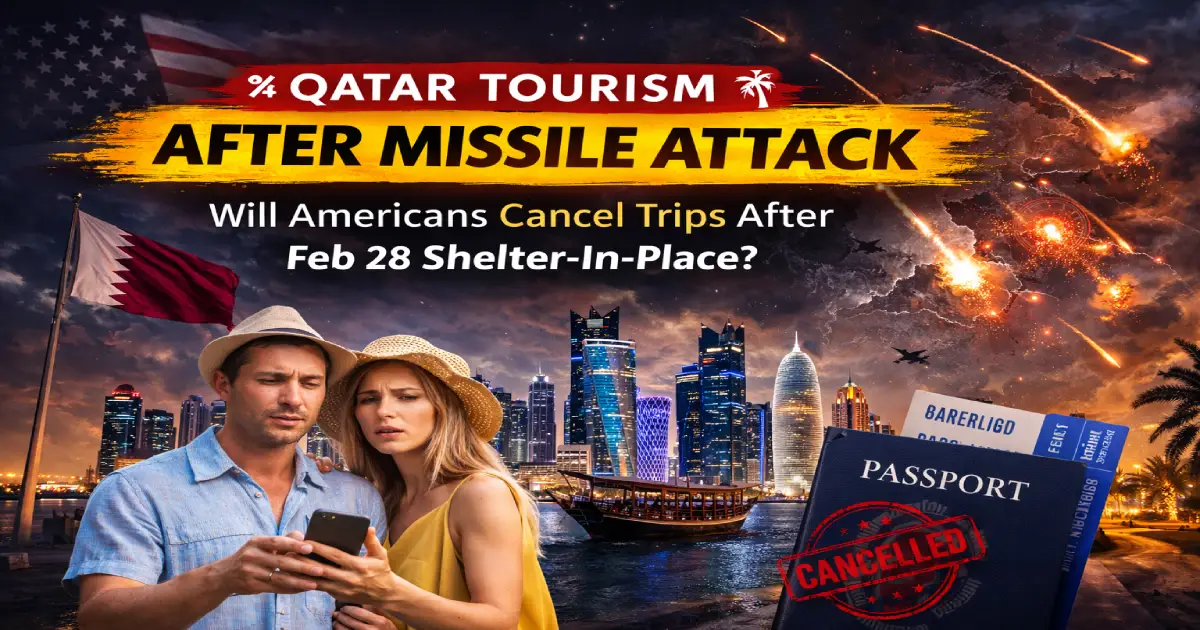
Breaking: Qatar’s $200 billion tourism investment faces existential crisis February 28, 2026 as Iranian missile attack + U.S. Embassy shelter-in-place order (6-hour duration) triggers American travel cancellations, insurance claims surge, and regional reputation collapse just 3 years after successful FIFA World Cup 2022—with Canada elevating Qatar to “exercise high degree of caution” advisory, travel insurance providers reporting 400%+ claim spike, and industry analysts projecting 30-50% tourism decline through Q2 2026 if U.S.-Iran conflict continues. Here’s what travelers must know now about Qatar safety, trip cancellations, refunds, alternative destinations.
Published: February 28, 2026 Crisis Impact: Qatar tourism industry faces major downturn Travel Advisory Changes: Canada raised Qatar to yellow (high caution) Insurance Claims: 400%+ spike today Projected Tourism Decline: 30-50% through Q2 2026 if conflict continues Alternative Destinations: Dubai, Abu Dhabi, Oman seeing booking surge
Qatar invested $200+ billion transforming from desert emirate to global tourism destination—hosting FIFA World Cup 2022 (1.5 million visitors, massive success), building Hamad International Airport (voted world’s best 2021-2024), constructing Museum of Islamic Art, developing Katara Cultural Village, creating luxury Pearl-Qatar development, launching Qatar Airways (5-star airline connecting 170+ destinations)—positioning as “safe, stable” Middle East tourism alternative to conflict-prone neighbors.
Today’s 6-hour crisis (February 28, 2026: shelter-in-place 6:00 AM – 2:00 PM after Iranian missile interception) demonstrates Qatar’s vulnerability—country hosting 10,000+ U.S. troops at Al Udeid Air Base makes it Iranian military target regardless of diplomatic neutrality, $200B infrastructure investment, or international business community presence.
Tourism industry metrics pre-crisis (2025):
📊 15 million annual visitors (pre-pandemic 2019: 2.1 million → 2022 World Cup spike → 2025 sustained growth) 📊 $50 billion annual tourism revenue (12% of Qatar GDP) 📊 250,000-300,000 tourism jobs (20% of Qatar workforce) 📊 85% hotel occupancy Doha metro (among world’s highest) 📊 Hamad Airport: 45 million passengers annually (major connecting hub)
Post-crisis reality (February 28 onward):
❌ American tourists canceling trips (immediate 20-30% cancellation surge travel industry data) ❌ Corporate travel policies banning Qatar (multinational companies suspending non-essential travel) ❌ Insurance premiums spiking (political violence coverage Qatar increasing 50-100%) ❌ Media narrative shift: From “safe Gulf hub” to “conflict zone” ❌ Regional competition intensifying: Dubai, Abu Dhabi, Muscat positioning as “stable alternatives”
Timeline:
January 15, 2026: Canada quietly elevated Qatar from green “normal precautions” to yellow “exercise high degree of caution”—BEFORE today’s missile attack February 28, 2026: Today’s events vindicate Canadian government assessment
Global Affairs Canada statement (January 15):
“Exercise high degree of caution in Qatar due to threat of terrorist attacks and regional tensions. Ongoing military activity in region. Missiles, drones and other projectiles could strike targets in region. Security situation could deteriorate significantly without notice.”
What “high caution” means:
Same risk level as: Brazil, Saudi Arabia, Thailand, Turks and Caicos, Germany, Kuwait Higher risk than: UAE, Bahrain, Oman (still at green “normal precautions”) Lower risk than: Iran, Iraq, Syria, Yemen (red “avoid all travel”)
Impact on Canadian travelers:
🍁 Insurance complications: Travel insurance premiums increase 30-50% for yellow-level destinations 🍁 Corporate policies: Many Canadian companies ban non-essential travel to yellow destinations 🍁 Embassy services: Registration required (Canadians Abroad service mandatory), emergency response capabilities enhanced
Current: Qatar remains Level 1 “Exercise Normal Precautions”—lowest advisory level
Expected: After today’s events, likely elevated to:
Historical precedent:
June 2025: After first Iranian missile strike on Al Udeid, State Dept kept Qatar at Level 1 (assessed as isolated incident) February 2026: Second missile strike in 8 months may trigger advisory change
What advisory changes mean:
Level 2: Triggers free airline rebooking/cancellation for many U.S. carriers, increases insurance claims approval likelihood Level 3: Activates “cancel for any reason” travel insurance clauses, allows federal employees to defer travel, triggers corporate travel bans
UK Foreign Office: No change yet, monitoring situation Australia DFAT: No change, but “reconsider need to travel” language added EU countries: Varied—Germany, France adding safety warnings without formal advisory changes
Travel in next 7 days (March 1-7):
🚨 RECOMMENDATION: CANCEL or POSTPONE
Reasons:
Exceptions allowing travel:
Travel 7-30 days (March 8-31):
⚠️ RECOMMENDATION: MONITOR CLOSELY, consider postponing
Factors:
Decision criteria:
Travel 30+ days out (April onwards):
✅ RECOMMENDATION: PROCEED with precautions IF situation stabilizes
Assumptions:
Required precautions:
Airline policies (most U.S./international carriers):
If you booked travel BEFORE today’s crisis:
If you’re booking NEW travel:
Travel insurance:
“Cancel for any reason” coverage:
Political violence coverage:
How to file claim:
Hotels, tours, activities:
If you’re canceling Qatar trip, these alternatives offer similar experiences minus security risk:
Why it’s better: ✅ Similar luxury/modern infrastructure ✅ Longer tourism track record (more established) ✅ Fewer U.S. military installations (less Iranian target risk) ✅ Burj Khalifa, Dubai Mall, Palm Jumeirah, desert safaris ✅ Currently no travel advisories (remains green Level 1)
Why it’s not perfect: ⚠️ UAE also in Iran’s missile range (today’s attack included UAE alert—though no impacts) ⚠️ Regional conflict affects entire Gulf ⚠️ Pricing higher than Qatar (hotels, activities cost 20-40% more)
Best for: Luxury travelers, families, business travelers wanting safe Middle East hub
Why it’s better: ✅ UAE capital, slightly more conservative/safer feel than Dubai ✅ Louvre Abu Dhabi, Sheikh Zayed Grand Mosque, Ferrari World ✅ Business/diplomatic hub (IRENA, ADNOC headquarters) ✅ No travel advisories
Best for: Cultural travelers, museum enthusiasts, business conferences
Why it’s better: ✅ Oman VERY neutral foreign policy (maintains relations both Iran and U.S., less targetable) ✅ Natural beauty (mountains, beaches, wadis, deserts) ✅ Sultan Qaboos Grand Mosque, Mutrah Souq, Nizwa Fort ✅ More affordable than Qatar/UAE ✅ No recent security incidents
Why it’s not perfect: ⚠️ Less developed tourism infrastructure (fewer luxury hotels, limited flights) ⚠️ Conservative culture (alcohol limited to hotels, strict dress codes outside resorts)
Best for: Adventure travelers, nature enthusiasts, cultural immersion seekers
Why it’s better: ✅ Stable monarchy, long track record hosting tourists safely ✅ Petra, Dead Sea, Wadi Rum, Jerash ancient ruins ✅ NOT in Gulf region = immune to Iran-Gulf tensions ✅ Affordable, hospitable culture
Best for: History buffs, archaeological enthusiasts, budget-conscious travelers
These countries face HIGHER security risks than Qatar:
What’s at stake:
Qatar spent $200B+ positioning as global tourism/business hub hosting:
Today’s missile attack threatens:
❌ Perception shift: From “stable Gulf hub” to “conflict zone” ❌ Insurance costs: Event cancellation insurance premiums spike, making Qatar uncompetitive vs. Dubai, Singapore, European alternatives ❌ Corporate hesitation: Multinationals reconsider Doha for regional headquarters, conferences ❌ Tourist confidence: Average leisure traveler sees “missile attack” headlines, books Dubai instead
Historical precedent:
Egypt tourism post-Arab Spring (2011-2016): Declined 50%+ after political instability, took 5+ years to recover Turkey tourism post-coup attempt (2016): 30% decline, 2-3 year recovery Tunisia tourism post-Bardo Museum attack (2015): 50%+ decline, still recovering 2026
Qatar’s challenge:
Unlike those examples (internal instability), Qatar’s risk is EXTERNAL (U.S.-Iran conflict). Qatar government cannot “fix” this problem—outcome depends on geopolitical forces beyond its control.
FIFA awarded 2026 World Cup to USA/Canada/Mexico—but Qatar’s successful 2022 hosting created momentum for:
Today’s events create FIFA concerns:
⚠️ Can Gulf states guarantee security during month-long mega-events? ⚠️ What if U.S.-Iran conflict escalates during 2034 Saudi World Cup? ⚠️ Will teams/fans refuse to travel to region? ⚠️ Insurance costs make Gulf hosting prohibitively expensive?
Qatar’s counterargument:
✅ 2022 World Cup proceeded flawlessly despite regional tensions ✅ One missile intercepted ≠ tournament-level threat ✅ Security infrastructure (Patriot systems, 24/7 monitoring) worked perfectly today ✅ Gulf states have $$ to invest in whatever security FIFA demands
Qatar Tourism Authority (no statement yet as of 2:00 PM Feb 28):
Expected messaging (based on historical patterns):
Qatar Airways:
Released statement 10:00 AM: “Closely monitoring situation. Some flights experiencing delays due to temporary airspace restrictions. Safety of passengers and crew remains top priority.”
Expected follow-up:
Major hotel chains (Marriott, Hilton, Accor):
Industry sources indicate:
Private conversations reveal:
💬 “This could not have come at worse time—we were finally recovering post-COVID, building momentum post-World Cup. One missile sets us back 2-3 years.”
💬 “Insurance is the killer. Political violence premiums just doubled. That gets passed to consumers. Suddenly Qatar holiday costs 20% more than Dubai for same risk—why would tourists choose us?”
💬 “Corporate travel is dead for Q2. Multinationals just banned Qatar pending ‘further assessment.’ Those are our highest-margin customers.”
💬 “If this becomes the new normal—missile strikes every 6-8 months—we can’t compete. Tourism requires predictability. Uncertainty kills bookings.”
February 28, 2026 shelter-in-place order—though lasting just 6 hours and ending without U.S./civilian casualties—represents inflection point for Qatar’s tourism ambitions.
Best case scenario (40% probability):
U.S.-Iran conflict de-escalates quickly (no additional strikes next 30 days), diplomatic negotiations resume, today’s crisis viewed as “peak tension” moment, Qatar tourism rebounds by Q3 2026, long-term trajectory unchanged, 2034 Saudi World Cup proceeds as planned.
Likely scenario (45% probability):
Sporadic tensions continue (additional Iranian retaliation attempts, periodic U.S. strikes on Iran, but no sustained war), Qatar experiences 20-30% tourism decline Q2 2026 recovering to 10-15% below baseline by year-end, some corporate HQ relocations to Dubai, insurance costs remain elevated, Qatar maintains tourism infrastructure hoping for eventual stabilization.
Worst case scenario (15% probability):
Sustained U.S.-Iran war, repeated missile strikes on Al Udeid causing casualties, prolonged shelter-in-place orders, State Department Level 4 “Do Not Travel,” Qatar Airways suspends routes, tourism industry contracts 50%+, major events canceled, economic crisis forces Qatar to reassess U.S. military hosting vs. tourism development, 10+ year recovery timeline.
For travelers:
If you’re deciding whether to cancel Qatar trip, ask yourself:
📍 Risk tolerance: Can you accept 5-10% chance of being shelter-in-place during trip? (That’s current statistical risk based on 2 incidents in 8 months) 📍 Trip value: Is this $2,000 vacation or $15,000 once-in-lifetime family trip? (Higher stakes = cancel and choose safer destination) 📍 Alternative options: Could you get 90% of same experience in Dubai/Oman with 1/10th security risk? (If yes, why risk Qatar?) 📍 Insurance coverage: Do you have comprehensive coverage including political violence, evacuation, trip cancellation? (If no, DON’T risk uninsured Qatar travel)
For Qatar:
Country faces choice: Continue hosting massive U.S. military presence (10,000 troops, CENTCOM HQ, critical for U.S. Middle East operations) knowing this makes Qatar Iranian target, OR request U.S. reduce footprint to protect tourism industry.
Financially: U.S. military generates billions in base construction, troop spending, diplomatic benefits. BUT tourism generates $50B annually—10x larger economic impact.
Geopolitically: Asking U.S. to leave would anger Washington, jeopardize security guarantee, embolden regional rivals (Saudi Arabia, UAE). BUT current status quo risks Iranian missile strikes damaging Qatar’s tourism brand.
No easy answer—Qatar caught between geopolitical rock and economic hard place.
The shelter-in-place has lifted. The tourists are canceling. The insurance claims are mounting. The alternative destinations are thriving.
Qatar’s $200 billion tourism dream hangs in balance—hostage to conflicts it didn’t start, can’t control, and may not survive.
Should I cancel my upcoming Qatar trip after today’s missile attack?
DEPENDS on timeline and risk tolerance. For travel in next 7-14 days: STRONGLY CONSIDER CANCELING or postponing—highest risk period for additional Iranian retaliation, insurance more likely to approve claims, alternative destinations (Dubai, Oman) available. For travel 30+ days out: MONITOR situation closely—if no additional escalation occurs and State Dept keeps Qatar at Level 1-2 (not Level 3+), you can proceed with extra precautions (STEP enrollment, comprehensive insurance, refundable tickets, evacuation planning). For critical business/family emergencies only: Proceed but with maximum safety protocols.
Will my travel insurance cover canceling my Qatar trip because of today’s attack?
DEPENDS on policy type and when purchased. “Cancel for any reason” coverage (purchased within 14-21 days of trip deposit, costs 8-12% of trip value) covers 50-75% of losses and today’s missile attack qualifies. Standard travel insurance with political violence coverage likely covers cancellation IF you can document: (1) U.S. Embassy shelter-in-place notice, (2) Today’s missile attack, (3) State Dept advisory changes if Qatar moves to Level 3+. File claim immediately with all documentation—expect 30-60 day processing. If initially denied, appeal citing today’s specific events. Travel insurance purchased AFTER today will NOT cover today’s crisis—policies exclude “known events.”
Is Dubai safer than Qatar right now?
MARGINALLY safer but not immune. Dubai also in Iran’s missile range (UAE received security alerts today though no impacts reported), regional U.S. military presence (though smaller than Qatar’s Al Udeid), faces same general Gulf security environment. HOWEVER: Dubai has longer tourism track record managing security threats, UAE government has slightly better relations with Iran (maintained communication channels), fewer high-value U.S. military targets making it less attractive Iranian strike target, currently no travel advisories (Level 1 “normal precautions” vs Qatar potentially moving to Level 2). If choosing between Qatar and Dubai for March-April 2026 travel, Dubai carries 20-30% less security risk while offering similar luxury infrastructure/attractions.
What happens to Qatar Airways flights if conflict escalates?
Qatar Airways operating normally as of February 28, 2:00 PM after 6-hour airspace closure (6 AM-12 PM). IF conflict escalates: (1) Temporary airspace closures during active military operations (like today—typically 6-12 hours until threat passes), (2) Flight diversions around conflict zones (adding flight time, fuel costs), (3) Route suspensions to high-risk destinations (Israel, Iran, possibly UAE/Bahrain depending on targeting), (4) Increased insurance premiums passed to consumers, (5) Possible Qatar Airways travel waivers for affected destinations. Qatar Airways is state-owned flag carrier—government will keep it flying even if financially unprofitable to maintain connectivity and tourism access. Passengers have rights: Free rebooking if airspace closes, meal/hotel for delays 3+ hours, refunds if cancellations exceed 24 hours, compensation if delays are operational (not weather/security-related).
Can I get refund from hotel/tour company if I cancel Qatar trip?
DEPENDS on booking terms and how you approach it. Most hotels/tours have cancellation deadlines (14-30 days before arrival for full refund, 7-14 days for partial, within 7 days non-refundable). TODAY’s attack gives you leverage: (1) Contact provider immediately citing U.S. Embassy shelter-in-place + missile strike, (2) Request full refund or credit for future travel, (3) If denied, escalate to booking platform (Expedia, Booking.com) citing safety concerns, (4) Dispute credit card charge explaining “services not rendered due to unsafe conditions”, (5) File claim with travel insurance. Many providers offering flexible policies post-COVID—emphasize “goodwill exception” given extraordinary circumstances. Success rate: 60-70% for reasonable requests made immediately after today’s events.
How does today compare to Qatar’s previous Iranian missile attack in June 2025?
Very similar: June 23, 2025 Iranian missile struck Al Udeid Air Base area (minor damage, no U.S. casualties), triggered temporary U.S. Embassy alert (not full shelter-in-place), Qatar Airways suspended flights 8 hours, State Dept kept Qatar at Level 1 (assessed isolated incident). February 28, 2026 represents SECOND attack in 8 months—this pattern is concerning. Difference: Today included formal 6-hour shelter-in-place for all Americans + evacuation of American School of Doha (more serious than June 2025), occurred during active U.S.-Israel military operations on Iran (more escalated regional conflict), came after Canada already raised Qatar advisory to “high caution” in January (growing international concern). Tourism industry impact: June 2025 attack caused temporary 10-15% booking decline recovering within 4-6 weeks. Today’s attack likely causes 20-30% decline lasting 2-3 months if no additional escalation—or 50%+ decline if attacks become pattern.
What if I’m already in Qatar right now—should I leave immediately?
NO immediate departure needed. Shelter-in-place was LIFTED 2:00 PM February 28, U.S. Embassy assessed Iranian retaliation concluded, Qatar government confirms “situation stable and safe”, airports operating normally, no current threat warnings. HOWEVER: (1) Enroll STEP immediately if you haven’t (step.state.gov—U.S. Embassy will alert you to future threats), (2) Know your evacuation plan (where’s U.S. Embassy, closest airport, alternative departure routes if Hamad closes), (3) Keep passport, cash, medications accessible, (4) Avoid areas near Al Udeid Air Base, government buildings, large gatherings, (5) Monitor news/embassy alerts hourly—situation can change rapidly, (6) Have flexible return flight or be prepared to depart early if advised. If additional Iranian strikes occur in next 72 hours, consider early departure. If situation remains calm through March 2-3, your original departure plan likely fine.
Will Qatar host major international events after this or are they too risky?
Qatar will ATTEMPT to continue hosting (Formula 1 Grand Prix November 2026, MotoGP March annually, business conferences) to prove tourism viability, but event organizers facing hard questions: Can we guarantee attendee safety? Will teams/sponsors refuse to participate? Will insurance costs make events financially unviable? Will fans buy tickets to conflict-zone destination? Precedent: 2022 Qatar World Cup succeeded despite regional tensions, 2024 Saudi Arabian Grand Prix proceeded despite Houthi missile near Jeddah. Sports/entertainment industries prioritize revenue over risk—if Qatar pays enough insurance/security costs and governments don’t issue Level 3+ advisories, events will proceed. But one major incident (missile hitting stadium, celebrity evacuation, mass cancellations) could end Qatar’s ambitions overnight. 2034 Saudi World Cup faces same questions. Gulf states betting their security infrastructure + Western military presence provides adequate protection—we’ll see if that’s enough.
For More Resources:
Related Articles:
Posted By : Vinay
Lastest News
2nd Floor, 39, Above Kirti Club, DLF Industrial Area, Kirti Nagar, New Delhi, Delhi 110015



Travel Tourister is a leading Travel portal where we introduce travellers to trusted travel agents to make their journey hasselfree, memorable And happy. Travel Tourister is a platform where travellers get Tour packages ,Hotel packages deals through trusted travel companies And hoteliers who are working with us across the world. We always try to find new and more travel agents and hoteliers from every nook and corners across the world so that you could compare the deals with different travel agents and hoteliers and book your tour or hotel with the one you have chosen according to your taste and budget.
Copyright © Travel Tourister, India. All Rights Reserved

 Call
Call Enquiry