Published on : 13 Jan 2026
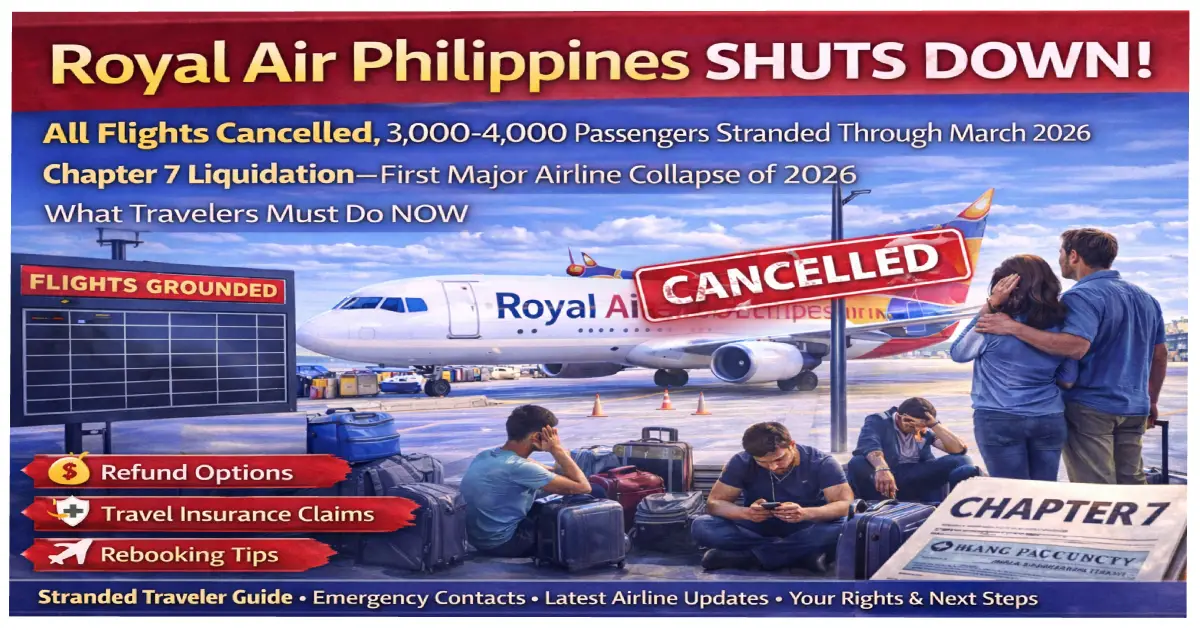
Breaking: Royal Air Philippines cancelled ALL commercial flights on January 4, 2026—just nine days ago. Between 3,000 and 4,000 passengers holding tickets through March 2026 are now stranded with invalid bookings. The airline’s website promises refunds and “hopes to resume flights,” but industry experts say Chapter 7 liquidation is inevitable. Here’s everything you need to know if you’re affected.
Published: January 13, 2026 Shutdown Date: January 4, 2026 (9 days ago) Passengers Affected: 3,000-4,000 with bookings through March 2026 Routes Cancelled: ALL domestic and international flights Key Loss: ONLY direct Taipei-Boracay route eliminated Liquidation Status: Chapter 7 expected (financial collapse confirmed)
On January 4, 2026—less than two weeks ago—Royal Air Philippines abruptly cancelled every single commercial flight on its schedule. Passengers with bookings from January through March 2026 (the furthest date Royal Air allowed advance bookings) suddenly found themselves holding worthless tickets.
The airline’s website now displays a generic message: “We are working on providing refunds and hope to resume flights at an unspecified date in the future. Thank you for your patience and understanding. We eagerly anticipate welcoming you aboard soon.”
Industry insiders call this message “fantasy.” Royal Air faces insurmountable financial problems, intense competition from Philippine Airlines and Cebu Pacific, and a collapsed customer base after geopolitical tensions between China and the Philippines destroyed its tourism-dependent business model.
What’s Gone:
✈️ ALL commercial flights cancelled effective January 4, 2026 ✈️ 3,000-4,000 passengers holding tickets through March stranded ✈️ Taipei-Boracay direct service eliminated (ONLY carrier on route) ✈️ Domestic routes to Caticlan, Tagbilaran, Puerto Princesa, Cebu cancelled ✈️ International routes to Taiwan, Cambodia, China eliminated ✈️ Fleet grounded: 3 Airbus A320s, 1 Airbus A321 sitting idle
Royal Air Philippines launched in 2002 as a cargo and charter airline—flying freight and occasional private charters around the Philippines and Southeast Asia. For 15 years, it quietly operated in this niche without mainstream attention.
Royal Air received commercial passenger licensing in 2017 and flew its inaugural passenger flight in 2018 between Cebu and Macau. The airline quickly expanded domestic routes:
Royal Air’s strategy centered on ONE demographic: Chinese and South Korean tourists visiting Philippine beach resorts. The airline launched international routes to:
The crown jewel? Taipei to Boracay (Caticlan) nonstop service—the ONLY direct flight between Taiwan and the Philippines’ most famous beach destination. This route alone accounted for significant passenger volume, particularly Taiwanese tourists flocking to Boracay’s white sand beaches.
Royal Air Philippines is owned by Lanmei Group (also called Lancang-Mekong Group), a Cambodia-registered private enterprise backed by Chinese civil capital. The group’s founder and chairman is Li Kun, former president of Shenzhen Airlines.
Li Kun’s vision: capture Southeast Asia’s budget travel market using investments from Chinese aviation firms. His target customers: mainland Chinese and Korean tourists traveling to Philippine beach resorts.
This ownership structure became a liability when geopolitical tensions between China and the Philippines intensified in 2024-2025.
Royal Air’s collapse resulted from multiple compounding failures:
The Problem: Philippines-China relations deteriorated sharply in 2024-2025 due to South China Sea territorial disputes. Chinese tourists—Royal Air’s PRIMARY customer base—stopped visiting the Philippines.
The Numbers:
Royal Air CEO Eduardo Novillas explained in a December 22, 2025 letter to travel agents: “The common explanation from our business partners is that the current interest of their locals to visit the Philippines is significantly low to obscure, and that they will contact Royal Air once the interest becomes healthy and heightened again.”
Translation: Chinese tourists aren’t coming back anytime soon.
While international routes suffered, domestic traffic COLLAPSED:
Why? Philippine Airlines and Cebu Pacific—both larger, better-capitalized carriers—aggressively expanded fleets and routes during Royal Air’s struggles. Passengers chose established brands over a struggling budget airline facing operational problems.
In the weeks before the January 4 shutdown, Royal Air passengers flooded social media with complaints:
The Irony: Just weeks before announcing the shutdown, Royal Air was STILL publicly posting recruitment advertisements for pilots, flight attendants, and ground staff—suggesting either organizational chaos or deliberate deception.
Royal Air entered commercial passenger service in 2018 with 4 aircraft. Meanwhile:
Philippine Airlines:
Cebu Pacific:
Royal Air’s 4-plane fleet couldn’t compete. Larger carriers offered more flights, better schedules, superior reliability, and comparable or lower fares.
Like all airlines, Royal Air faced:
But unlike larger carriers, Royal Air lacked:
The math stopped working. Revenue plummeted while fixed costs remained high. Bankruptcy became inevitable.
Between 3,000 and 4,000 travelers held Royal Air tickets for flights from January 4 through March 2026—the furthest advance booking window the airline offered.
Taipei-Boracay Route: Royal Air operated the ONLY direct flight between Taipei and Boracay’s Caticlan airport. Taiwanese tourists loved this convenience—no connections through Manila, no bus rides from Manila to Boracay. Direct flight, straight to paradise.
Estimated Impact: 2,000-3,000 Taiwanese passengers booked on Taipei-Caticlan flights from January-April 2026.
Alternative Options: ❌ NO direct replacement route exists ✅ Fly Taipei → Manila (Philippine Airlines, EVA Air, China Airlines) ✅ Domestic Manila → Caticlan (Philippine Airlines, Cebu Pacific, AirAsia) ✅ OR Manila → Kalibo (closer to Boracay, then bus/van)
Cost Impact: Direct Taipei-Boracay cost $150-250 roundtrip on Royal Air. Connecting via Manila costs $300-500+ with added travel time.
Filipinos flying between Manila, Cebu, and island destinations like Palawan and Bohol held 1,000-1,500 cancelled tickets.
Alternative Options: ✅ Philippine Airlines (higher fares) ✅ Cebu Pacific (similar budget airline) ✅ AirAsia (limited routes)
Problem: Royal Air offered some of the cheapest domestic fares. Alternatives cost 20-50% more, straining budgets for price-sensitive travelers.
Several hundred passengers booked on:
Alternative Options: ✅ Philippine Airlines ✅ Cebu Pacific ✅ International carriers (Singapore Airlines, Thai Airways, etc.)
If you’re one of the 3,000-4,000 affected travelers, here’s your action plan:
Method 1: Email
Method 2: Website Form
Reality Check: Royal Air’s website says refunds are “being processed,” but the airline lacks cash. Most passengers won’t receive refunds until:
Expected Timeline: Months to never. Don’t wait for Royal Air.
If you paid by credit card, file a chargeback dispute TODAY:
Process:
Success Rate: High for recent bookings (December 2025-January 2026). Lower for older bookings (September-November 2025).
Important: Credit card chargeback is your BEST and FASTEST option for recovering money. Do this BEFORE pursuing other methods.
If you purchased travel insurance (or your credit card includes trip protection):
What’s Covered:
✅ Trip Cancellation: Refund for non-refundable tickets if airline ceases operations ✅ Trip Interruption: Reimbursement for extra costs to reach destination via alternative flights ✅ Missed Connections: Coverage if Royal Air cancellation caused you to miss connecting flights
What’s NOT Covered:
❌ Basic policies: Many basic travel insurance policies exclude airline bankruptcies ❌ “Known events”: Royal Air’s struggles were publicized in December 2025; bookings made after might not qualify
How to Claim:
Don’t wait for refunds to book replacements. Prices increase as availability shrinks.
For Taipei-Boracay Travelers:
Option A: Manila Connection
Option B: Kalibo Connection
For Domestic Philippine Travelers:
Philippine Airlines:
Cebu Pacific:
AirAsia:
If credit card chargeback fails and Royal Air ignores refund requests:
Philippine Law: Passengers can sue airlines for breach of contract in small claims court (simplified process, no lawyer required).
Reality: Suing a bankrupt airline is largely futile. You’ll win a judgment but never collect money. Only pursue this if you have significant losses ($1,000+) and exhaust all other options.
Royal Air Philippines joins a disturbing list of airline failures in the past six months:
Icelandic Play (October 2025):
Braathens Aviation (Sweden, October 2025):
Eastern Airways (UK, November 2025):
Blue Islands (UK, November 2025):
Verijet (USA, 2025):
Ravn Alaska (USA, 2025):
Spirit Airlines (USA, August 2025):
Royal Air Philippines (January 4):
Dove Airlines (India, January 2026):
Common Threads:
✅ Budget/regional carriers with thin profit margins ✅ Heavy debt loads, limited financial reserves ✅ Post-pandemic demand never fully recovered ✅ Rising fuel costs, inflation, interest rates ✅ Competition from larger, better-capitalized airlines ✅ Limited route diversification (vulnerable to regional shocks)
Who’s Safe?
✅ Legacy carriers (American, Delta, United, British Airways, etc.) ✅ Well-capitalized budget airlines (Southwest, JetBlue, Ryanair, EasyJet) ✅ Government-backed flag carriers (Emirates, Singapore Airlines, etc.)
Who’s at Risk?
⚠️ Small regional carriers with 1-10 aircraft ⚠️ Ultra-low-cost carriers with razor-thin margins ⚠️ Airlines heavily dependent on ONE market or route ⚠️ Carriers in countries with economic/political instability
While Royal Air’s website claims it “hopes to resume flights,” industry experts predict Chapter 7 liquidation—total shutdown, asset sales, and permanent closure.
Definition: Liquidation bankruptcy where company ceases operations, sells all assets, and distributes proceeds to creditors.
Contrast with Chapter 11: Chapter 11 = reorganization bankruptcy where company continues operating while restructuring debt (like Spirit Airlines current situation).
Why Chapter 7 for Royal Air?
Step 1: Bankruptcy Court Appoints Trustee
Step 2: Asset Sales
Step 3: Creditor Priority When liquidation proceeds are distributed, creditors get paid in this order:
Reality: Passengers typically recover 0-30% of ticket value in airline liquidations. Secured creditors take most assets.
January-March 2026:
April-June 2026:
July-December 2026:
2027:
Royal Air’s shutdown eliminates the ONLY direct air link between Taiwan and Boracay—a significant blow to Philippine tourism.
Before Shutdown:
After Shutdown:
Economic Impact:
Possible Replacements:
Philippine Airlines:
Cebu Pacific:
Taiwanese Carriers (China Airlines, EVA Air):
Timeline: If replacement service launches, expect late 2026 or 2027—missing peak 2026 tourism season.
Royal Air Philippines’ January 4, 2026 shutdown marks the first major airline collapse of 2026—and likely won’t be the last. The 24-year-old carrier, which pivoted from cargo to commercial passenger service in 2017, bet everything on Chinese and Korean tourists visiting Philippine beaches. When geopolitical tensions between China and the Philippines destroyed that customer base in 2024-2025, Royal Air had no Plan B.
3,000-4,000 passengers holding tickets through March 2026 are now stranded. Most won’t receive refunds from Royal Air—the airline lacks cash and faces inevitable Chapter 7 liquidation. Credit card chargebacks offer the best (and fastest) path to recovering money.
The elimination of Taipei-Boracay direct service hurts both travelers and Philippine tourism. Taiwanese tourists face higher costs and longer travel times. Boracay’s economy loses a significant visitor segment. Whether Philippine Airlines or Cebu Pacific fill the gap remains uncertain.
For travelers, the lesson is brutal: small airlines with thin margins, limited routes, and dependence on ONE market are bankruptcy risks. Royal Air’s ownership by Chinese-backed Lanmei Group—which targeted Chinese tourists—created vulnerability when geopolitics shifted. Diversification matters. Financial reserves matter. Brand trust matters. Royal Air had none of these.
The airline industry’s post-pandemic shakeout continues. Play, Braathens Aviation, Eastern Airways, Blue Islands, Verijet, Ravn Alaska, and now Royal Air Philippines—all gone in six months. Spirit Airlines survives (barely) in Chapter 11. More collapses are coming as small carriers with weak balance sheets face rising costs, intense competition, and unforgiving economics.
If you’re holding a Royal Air ticket, act NOW: file credit card chargeback, contact travel insurance, book alternative flights. Don’t wait for Royal Air’s promised refunds—they’re not coming.
If you’re planning future travel, choose airlines carefully: legacy carriers and well-capitalized budget airlines offer stability. Avoid startups, ultra-low-cost carriers with one or two aircraft, and airlines heavily dependent on single routes or markets vulnerable to political/economic shocks.
Royal Air Philippines is dead. The only question is how long until it’s officially buried—and whether passengers recover any money before the gravediggers finish their work.
For More Resources:
Related Articles:
Posted By : Vinay
Lastest News
2nd Floor, 39, Above Kirti Club, DLF Industrial Area, Kirti Nagar, New Delhi, Delhi 110015



Travel Tourister is a leading Travel portal where we introduce travellers to trusted travel agents to make their journey hasselfree, memorable And happy. Travel Tourister is a platform where travellers get Tour packages ,Hotel packages deals through trusted travel companies And hoteliers who are working with us across the world. We always try to find new and more travel agents and hoteliers from every nook and corners across the world so that you could compare the deals with different travel agents and hoteliers and book your tour or hotel with the one you have chosen according to your taste and budget.
Copyright © Travel Tourister, India. All Rights Reserved

 Call
Call Enquiry