Published on : 07 Jan 2026
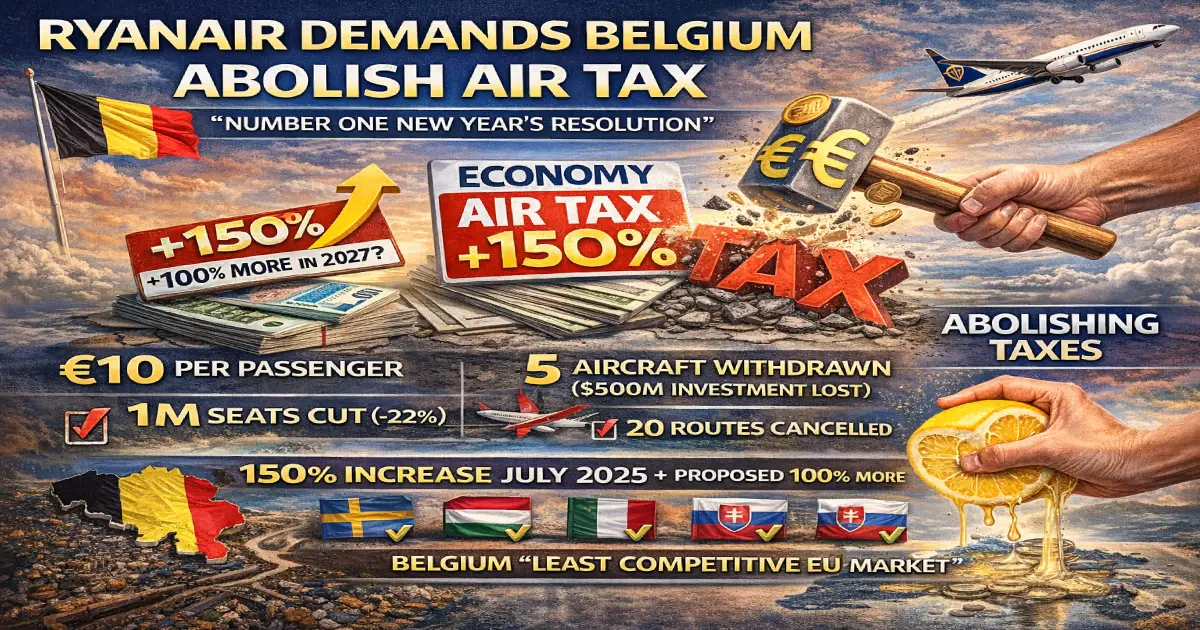
Breaking: Ryanair (Europe’s largest airline) demands Belgian Prime Minister Bart De Wever make abolishing Belgium’s “very high” air tax “number one New Year’s resolution” after government doubled tax to €10 per passenger effective 2027—following 150% increase July 29, 2025 (from €2 to €5) applied retroactively to all flights that date forward hitting passengers with unexpected charges already booked, Belgium now proposing ANOTHER 100% increase (€5 → €10) = cumulative 400% hike 18 months rendering Belgium “one of most expensive countries Europe air travel.” Ryanair retaliated December: cutting 1 million seats Brussels (-22% capacity), withdrawing 5 aircraft Brussels Charleroi base (US$500 million investment lost), cancelling 20 routes 2026/27 winter schedule, redirecting capacity to markets ABOLISHING taxes (Sweden eliminated entirely 2025, Hungary scrapped, Italy regional cuts, Slovakia eliminated, Germany reconsidering increases) proving Belgium’s tax policy competitively suicidal as neighboring countries chase growth through deregulation while De Wever government prioritizes short-term revenue over long-term economic damage. Michael O’Leary (Ryanair CEO) warns Belgium risks becoming “hopelessly uncompetitive” as Brussels Zaventem Airport operates 89% pre-COVID traffic (vs European average 95-100%), highest airport charges (+20% since pandemic), now adding punitive tax strangling recovery = triple-threat making Belgium unattractive airlines, passengers, tourism industry simultaneously while countries like Sweden seeing traffic SURGE post-abolition validating low-tax approach works.
Published: January 7, 2026 Belgium Tax Timeline: €2 (pre-July 2025) → €5 (July 29, 2025, +150%) → €10 (proposed 2027, +100% more) Ryanair Retaliation: 1M seats cut, 5 aircraft withdrawn, 20 routes cancelled Brussels Investment Lost: US$500 million Countries Abolishing Taxes: Sweden, Hungary, Italy (regional), Slovakia Belgium Airport Recovery: 89% pre-COVID (vs 95-100% European average)
January 2026 Statement:
Ryanair publicly pressures Belgian Prime Minister Bart De Wever: Make abolishing Belgium’s air tax your “number one New Year’s resolution.”
Why NOW:
Ryanair’s Message:
“This harmful tax, which increased by 150% last July, severely penalizes Belgium’s competitiveness compared to other EU countries such as Sweden, Hungary, Italy, and Slovakia, where governments are abolishing air taxes to boost traffic, tourism, and employment.”
Belgium’s “Eco-Tax”:
Federal Parliament Vote (July 18, 2025):
Retroactive Controversy:
Ryanair’s Criticism:
“This excessive tax hike, coupled with Brussels Zaventem’s already ludicrously high airport charges (which have risen 20+% since Covid), shows Brussels Zaventem to be the worst performing airport in Belgium and has yet to recover fully, operating at 89% of its pre-Covid traffic levels.”
De Wever Government Budget Plan:
Prime Minister Bart De Wever (X/Twitter, budget announcement):
“Today the labor, tomorrow the fruit.” (Translation: Short-term pain = long-term gain)
Ryanair’s Response (November 26, 2025):
“Prime Minister De Wever’s Govt is once again hammering ordinary Belgian passengers with another reckless aviation tax hike. Just months after increasing this tax by 150%, the Govt now plans to double it again to €10 from 2027. This hike will make flying even more expensive for hardworking Belgian families.”
December 2025 Announcement:
Ryanair responds to Belgium’s proposed €10 tax by slashing Brussels operations:
Before: ~4.5 million annual seats Brussels (Charleroi + Zaventem combined)
After: ~3.5 million seats (-22% reduction)
Impact:
Brussels Charleroi Base:
What “Based Aircraft” Means:
Withdrawal = Local Jobs Lost:
Total direct Ryanair jobs lost: ~800-1,000 (plus indirect jobs: catering, fuel, cleaning services)
Ryanair’s 2026/27 Winter Schedule:
Impact:
Ryanair’s Argument:
Belgium raising taxes while competitors ABOLISH = economic suicide.
Previous tax: SEK 60-400 (~€5-35) depending on destination
2025 decision: Completely abolished (zero tax)
Result (Preliminary Data):
Lesson: Abolition stimulates growth (long-term revenue > short-term tax collection)
Previous tax: ~€10 per passenger
Abolished: 2024-2025 (part of economic stimulus)
Result:
National tax exists: BUT regional governments (Sicily, Sardinia, etc.) offering REBATES/subsidies to airlines offsetting national tax
Result:
Previous tax: Modest passenger levy
Eliminated: 2024-2025
Result:
Current policy: Germany HAS air tax (€12-60 depending on distance)
2025 debate: Government considering INCREASES
Industry backlash: Lufthansa, Ryanair, others lobbying AGAINST—citing Belgium’s example as cautionary tale
Result (TBD): Germany may freeze/reduce tax vs increase (recognition tax harms competitiveness)
Belgium’s Position:
Ryanair’s Criticism (July 2025):
“Brussels Zaventem shows to be the worst performing airport in Belgium and has yet to recover fully, operating at 89% of its pre-Covid traffic levels.”
Pre-COVID (2019):
2024:
European Comparison:
Zaventem = LAGGING major European hubs.
1. HIGH AIRPORT CHARGES:
Result: Airlines avoid Zaventem, preferring cheaper alternatives (Charleroi, other EU hubs)
2. LIMITED LOW-COST PRESENCE:
Result: Zaventem caters business travelers (premium fares) but misses leisure/budget segment driving volume recovery post-COVID.
3. COMPETITION FROM CHARLEROI:
Result: Belgium has TWO airports competing for SAME catchment area—Zaventem loses price-sensitive travelers to Charleroi, but NOW Charleroi threatened by tax increases too (Ryanair cutting Charleroi capacity).
Justification:
Economic Damage > Revenue:
Example Math:
Scenario A (€2 tax, 4.5M passengers):
Scenario B (€10 tax, 3.5M passengers after cuts):
Ryanair argues: Belgium gaining €26M more tax revenue (€35M – €9M) but LOSING hundreds millions broader economy = false economy.
Before abolition (pre-2025):
After abolition (2025+):
Preliminary data (2025):
Lesson: Abolishing tax stimulates growth generating MORE total government revenue (via broader economy) than narrow aviation tax collected.
Belgium’s Risk:
Ignoring Sweden’s success = ideological stubbornness prioritizing environmental optics over economic pragmatism.
If De Wever abolishes tax:
Likelihood: Low—De Wever government committed budget deficit reduction, politically difficult reverse tax after announcing (looks weak).
If tax implemented 2027:
Likelihood: Moderate-High—De Wever’s coalition prioritizes fiscal discipline, environmental policy over aviation industry lobbying.
Possible middle ground:
Likelihood: Moderate—Compromise Belgian political tradition, possible if backlash intensifies.
1M fewer seats = higher fares:
Brussels residents:
€10 tax per passenger = noticeable:
Plus fare increases from reduced competition:
Total impact:
Short-term:
Long-term:
Ryanair’s demand Belgian Prime Minister Bart De Wever make abolishing Belgium’s air tax “number one New Year’s resolution” escalates months-long conflict following July 29, 2025 retroactive 150% tax increase (€2 → €5 per passenger applied all flights that date forward even pre-booked tickets) plus proposed ANOTHER 100% hike 2027 (€5 → €10) = cumulative 400% increase 18 months rendering Belgium “one of most expensive countries Europe air travel” per Europe’s largest airline, which retaliated December cutting 1 million Brussels seats (-22%), withdrawing 5 Charleroi-based aircraft (US$500M investment lost), cancelling 20 routes 2026/27 winter redirecting capacity to markets ABOLISHING taxes (Sweden eliminated 2025 seeing traffic surge +8-12%, Hungary/Italy regional/Slovakia scrapped taxes chasing growth) proving Belgium’s policy competitively suicidal.
Brussels Zaventem Airport recovery lagging European peers (89% pre-COVID traffic vs 95-100% continent-wide average) compounded by “ludicrously high” airport charges (+20% since pandemic per Ryanair) creating triple-threat: expensive airport fees + punitive passenger tax + weak traffic recovery = toxic combination strangling Belgium’s aviation/tourism competitiveness while neighbors like Netherlands (Amsterdam Schiphol 170km away), France (Paris CDG 300km), Germany (Cologne 200km) offering cheaper alternatives Belgian passengers/airlines choose instead, validating Ryanair CEO Michael O’Leary’s warning Belgium risks becoming “hopelessly uncompetitive” if De Wever proceeds doubling tax 2027.
Economic argument favors abolition despite De Wever government’s €9.2B budget deficit justification: Ryanair’s 1M seat cuts eliminate ~€150-200M annual tourism revenue (hotels, restaurants, transport, attractions), destroy 800-1,000 direct airline jobs + thousands indirect (catering, fuel, cleaning, airport services), reduce total tax collected as fewer passengers at higher rate generates LESS revenue than more passengers at lower rate (Sweden’s 2025 abolition preliminary data: +8-12% traffic growth, +€200-300M tourism spending, +2,000-3,000 jobs = broader economic gains exceed narrow aviation tax revenue lost), proving Belgium prioritizing short-term fiscal optics over long-term economic health = ideological environmental posturing despite aviation representing <3% Belgium’s carbon emissions while road transport (50%+) faces minimal equivalent taxation = policy incoherence.
Three scenarios ahead: (1) Belgium backs down abolishing tax = Ryanair restores capacity, tourism recovers, jobs saved BUT De Wever looks weak politically difficult after announcing budget plan (low likelihood), (2) Belgium proceeds €10 tax 2027 = Ryanair further cuts possibly complete Charleroi exit, other airlines follow reducing Belgium capacity, tourism collapses as travelers choose cheaper neighbors, thousands jobs lost, airports decline (moderate-high likelihood given coalition fiscal priorities), (3) Compromise freezing €5 without 2027 increase OR exempting low-cost routes OR gradual phase-in = split-difference Belgian political tradition (moderate likelihood if backlash intensifies).
For Belgian travelers, immediate impact: 1M fewer seats 2026 = higher fares (supply/demand), 20 cancelled routes = forced connections vs direct flights (+€50-100 cost, +2-4 hours time), longer-term 2027+ if €10 implemented: family of 4 pays €80 extra roundtrip PLUS €100-200 higher base fares (less competition without Ryanair low-cost pressure = oligopoly pricing Brussels Airlines/Lufthansa/Air France-KLM) = €180-280 annual increase moderate traveler, strategic response: book 2026 NOW before further cuts, use Charleroi while Ryanair remains, consider Amsterdam/Paris/Cologne alternative hubs (drive/train cheaper than Belgium’s punitive aviation taxation), lobby government if oppose policy recognizing Ryanair’s campaign benefits consumers even if airline’s tactics distasteful = their presence keeps legacy carriers honest preventing monopoly pricing.
Belgium’s aviation tax gamble tests fundamental question: Can small country unilaterally impose environmental levies without economic self-harm when surrounded by competitors pursuing opposite low-tax/no-tax strategies? Sweden’s 2025 abolition + Hungary/Italy/Slovakia eliminations suggest answer = NO, market forces punish unilateral action as airlines/passengers simply relocate to friendlier jurisdictions, leaving tax-imposing country with environmental virtue signaling BUT devastated tourism/aviation sectors generating LESS total government revenue than forgone aviation tax would have collected = false economy satisfying green ideology at expense economic reality, Belgium’s 2026-2027 period determines whether De Wever recognizes this lesson or persists ideological stubbornness until competitive damage irreversible.
Related Travel Tourister Coverage:
Published: January 7, 2026 Last Updated: January 7, 2026 at 1:00 PM ET Reading Time: 45 minutes
Posted By : Vinay
Lastest News
2nd Floor, 39, Above Kirti Club, DLF Industrial Area, Kirti Nagar, New Delhi, Delhi 110015



Travel Tourister is a leading Travel portal where we introduce travellers to trusted travel agents to make their journey hasselfree, memorable And happy. Travel Tourister is a platform where travellers get Tour packages ,Hotel packages deals through trusted travel companies And hoteliers who are working with us across the world. We always try to find new and more travel agents and hoteliers from every nook and corners across the world so that you could compare the deals with different travel agents and hoteliers and book your tour or hotel with the one you have chosen according to your taste and budget.
Copyright © Travel Tourister, India. All Rights Reserved

 Call
Call Enquiry