Published on : 07 Jan 2026
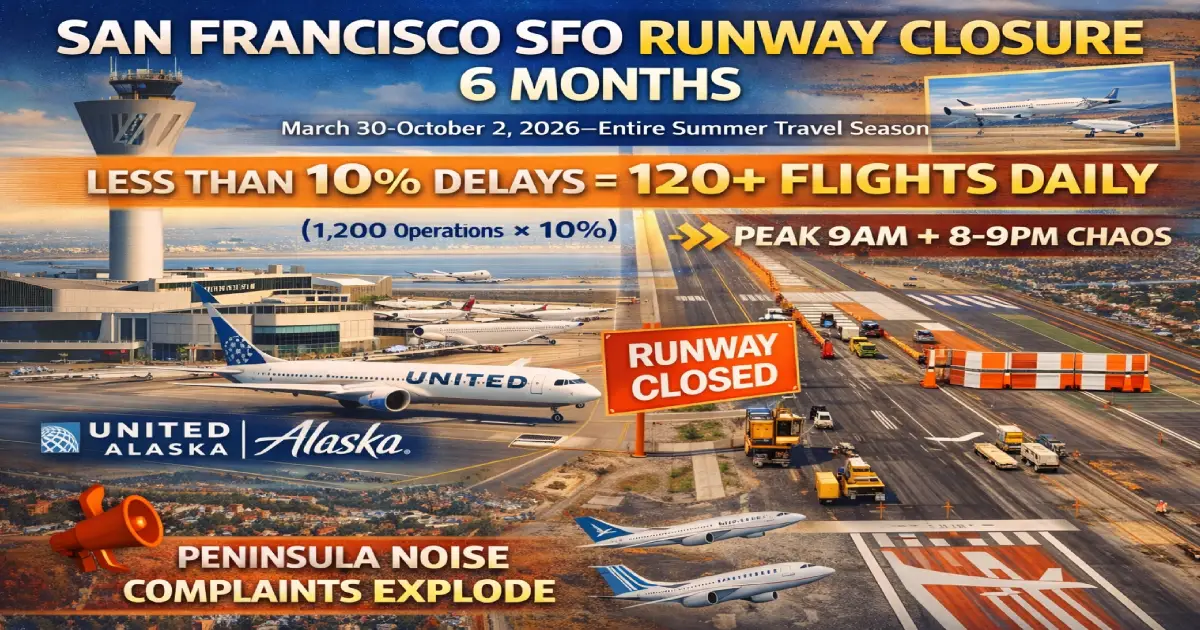
Breaking: San Francisco International Airport closes Runway 1R/19L for six months (March 30-October 2, 2026)—entire summer travel season affected—for $180 million repaving/taxiway/lighting upgrades, forcing ALL operations onto Runways 28L/28R (longer parallel pair) while Runway 1L becomes taxiway-only reducing ground congestion, SFO claims “less than 10% flights delayed averaging under 30 minutes” BUT math reveals 10% of 1,200+ daily operations = 120+ delayed flights per day minimum, peak hours 9:00 AM morning departures + 8:00-9:00 PM evening banks most affected = tight connections missed, upgrade confirmations lost, same-day roundtrips broken. United Airlines (SFO largest carrier, 400+ daily departures hub operations) plus Alaska Airlines (major West Coast presence 50+ SFO daily) bear brunt = their schedules compressed onto remaining runways creating congestion competitive disadvantage vs Delta/American smaller SFO footprints, Peninsula communities (South San Francisco, Millbrae, Foster City, Palo Alto) facing temporary departure noise increase = ongoing dispute escalates as residents complain aircraft overhead concentrating flight paths vs normal dispersed patterns Runway 1R departure traffic previously handled. Timing disastrous: March 30 start = spring break begins, continues through Memorial Day weekend, July 4th, Labor Day, entire summer = busiest travel season when SFO handles 55-60M passengers annually (peak May-September = 25-30M affected by closure), Oracle OpenWorld + Salesforce Dreamforce conferences fall within closure = corporate travel chaos, international long-haul connections (SFO gateway Asia-Pacific, Europe via United Star Alliance, domestic transcontinental premium) especially vulnerable as 30-minute delays compound into missed connections requiring overnight rebookings hotels vouchers = passenger nightmares SFO experienced 2023/2024 previous runway projects but THOSE shorter duration + off-peak timing vs 2026 six-month summer closure unprecedented recent history.
Published: January 7, 2026 Announcement Date: December 30, 2025 Closure Dates: March 30 – October 2, 2026 (6 months, 186 days) Runway Affected: 1R/19L (shortest runway, typically narrowbody departures) Cost: $180 million ($92.1M FAA funding, $87.9M SFO) SFO Claim: “Less than 10% flights delayed, under 30 minutes average” Reality: 10% × 1,200 daily ops = 120+ delays/day minimum
December 30, 2025 Announcement:
San Francisco International Airport confirmed Runway 1R/19L will close six months starting March 30, 2026—running through October 2, 2026—for complete repaving, taxiway improvements, lighting upgrades.
What’s Being Done:
Cost: $180 million total
Contractor: Granite Construction Company (awarded May 6, 2025)
Spring Break Starts:
Summer Travel:
Major Conferences:
Fall Travel:
SFO’s timing: Intentional or unavoidable?—Either way, WORST possible timing for travelers.
SFO’s Official Claim:
“SFO expects less than 10% of flights to be delayed as a result of the runway closure, with delays averaging less than 30 minutes.”
Let’s Do The Math:
SFO daily operations: ~1,200-1,300 flights (arrivals + departures combined)
10% of 1,200 flights = 120 delays per day
120 delays × 186 days (closure duration) = 22,320 total delayed flights
22,320 delays × average 150 passengers per flight = 3.35 MILLION passenger-delays
SFO Framing:
Reality:
SFO Admission:
“Delays most likely to occur during peak periods at 9:00am and 8:00pm – 9:00pm.”
Why Busy:
Runway congestion:
Impact:
Why Busy:
Runway congestion:
Impact:
SFO Hub Operations:
Impact:
Your United Article Connection:
United’s CEO “surprises” 2026 article (your previous article)—100+ aircraft deliveries, A321XLR, Polaris Studio—ALL undermined if SFO operational chaos causes delays, cancellations, passenger complaints eroding premium positioning United trying build.
SFO Operations:
Impact:
Your Alaska Article Connection:
Alaska’s transatlantic expansion (Seattle-Rome, London, Reykjavik—your article) depends on West Coast connectivity—SFO delays = missed connections SEA-SFO-transatlantic = customers choose United direct instead Alaska two-leg = competitive damage.
Delta SFO:
American SFO:
Competitive Advantage:
Delta/American BENEFIT from United/Alaska delays—passengers switch carriers to avoid SFO, choose LAX/LAX connections instead.
SFO Admission:
“Some surrounding communities may experience a temporary increase in departing aircraft overflight during the construction period.”
Translation:
South San Francisco:
Millbrae:
Foster City:
Palo Alto:
Resident Reactions (Speculation Based on Past Disputes):
SFO’s Plan:
What SFO Doesn’t Emphasize:
Weather Can Force Single-Runway Operations:
Result:
Domino Effect:
Historical Precedent:
2026 Risk:
6 months summer closure + fog season (June-August) = HIGH probability multiple single-runway days = delays FAR exceeding SFO’s “less than 10%” projection.
Why:
Strategy:
Connections:
Same-day roundtrips:
Oakland (OAK):
San Jose (SJC):
Sacramento (SMF):
SFO Website:
Airline Apps:
Priority:
Your Mileage May Vary:
2023: Runway 1L/19R Repaving:
2024: Runway 10R/28L Taxiway Upgrade:
2026: Runway 1R/19L Repaving:
SFO’s Confidence:
“Airport has recent experience managing runway closures, having completed comparable projects in 2023 and 2024 with minimal disruption.”
Counterargument:
2023/2024 projects off-peak timing + shorter duration ≠ comparable to 6-month summer closure. SFO extrapolating success from easier circumstances to harder challenge = questionable.
San Francisco International Airport’s six-month Runway 1R/19L closure (March 30-October 2, 2026) for $180 million repaving/taxiway/lighting upgrades coincides disastrously with peak summer travel season (May-September = 25-30M of SFO’s 55-60M annual passengers affected), forcing all operations onto Runways 28L/28R while Runway 1L becomes taxiway-only, SFO claims “less than 10% flights delayed averaging under 30 minutes” BUT math reveals 10% of 1,200+ daily operations = 120+ delayed flights per day minimum × 186 closure days = 22,320 total delays affecting 3.35 million passengers—NOT minor inconvenience SFO frames, substantial disruption compounded by peak hours 9:00 AM morning departures + 8:00-9:00 PM evening banks where delays highest = missed connections, broken same-day business trips, cascading cancellations as crew duty-time limits exhausted.
United Airlines (400+ daily SFO departures, largest carrier) + Alaska Airlines (50+ daily) bear disproportionate impact vs Delta/American smaller footprints = competitive disadvantage where United’s CEO “surprises” 2026 premium positioning (your article: 100+ planes, Polaris Studio, A321XLR) undermined by operational chaos passengers remember over product quality, Alaska’s transatlantic expansion (your article: Seattle-Rome, London, Reykjavik) threatened if SFO-SEA connection reliability tanks causing travelers choose United direct routes avoiding two-leg itineraries = strategic damage both carriers despite ambitious plans announced elsewhere.
Peninsula communities (South San Francisco, Millbrae, Foster City, Palo Alto) facing temporary departure noise increase as flight paths concentrate onto 28L/28R runways vs normal dispersion across 1R/28R = ongoing noise dispute escalates (Palo Alto sued SFO 2015, never fully resolved), residents complaining aircraft overhead every 2-3 minutes vs 5-6 normal = property value concerns, lawsuits threatened, city council meetings erupt as SFO prioritizes construction over quality of life = political pressure grows demanding compensation or accelerated completion (unlikely—$180M project requires full 6 months physically).
Fog season (June-August “June Gloom”) overlaps closure = HIGH probability weather forces single-runway operations multiple days when marine layer clouds reduce visibility requiring instrument-only approaches, SFO’s “less than 10%” delay projection assumes 2-runway operations (28L + 28R simultaneously usable)—single-runway days (28R only) render 1,200+ daily flights IMPOSSIBLE without massive ground stops nationwide (FAA halts departures bound SFO), diversions (planes rerouted Oakland/San Jose/Sacramento), cancellations (airlines preemptively cut flights avoid stranding passengers) = delays FAR exceeding 10%, potentially 30-50% flights affected worst days = summer vacation nightmares families remember for years.
Timing maximizes passenger impact: March 30 start = spring break begins immediately, continues through Memorial Day, July 4th, Labor Day, Oracle OpenWorld + Salesforce Dreamforce conferences (September = 100K+ corporate attendees on tight schedules cannot afford 30-minute delays missing meetings), international long-haul connections (SFO gateway Asia-Pacific via United Star Alliance, transcontinental premium via Alaska) especially vulnerable as 30-minute SFO departure delays compound into missed connections requiring overnight rebookings hotels vouchers = passenger nightmares costing airlines millions customer service recovery plus reputational damage social media amplifies (“Never flying through SFO summer 2026 again”).
For travelers, strategic response: Book summer travel NOW (before airlines adjust pricing anticipating reduced capacity, supply/demand = fare spikes), choose off-peak departure times (avoid 9 AM, 8-9 PM windows SFO admits highest delays), build 2-3 hour connection buffers vs normal 90-120 minutes (account for delays compounding), consider alternative airports (Oakland 20 miles east, San Jose 35 miles south, Sacramento 90 miles northeast = no closure issues BUT fewer destinations, less premium options = trade-offs), monitor schedules religiously (SFO website flysfo.com, airline apps push notifications = proactive rebooking if flight cancelled), elite status benefits amplified (United 1K, Alaska MVP Gold 75K/100K = priority rebooking, lounge access waiting delays, customer service lines faster = worth pursuing status if planning multiple SFO trips closure window).
Long-term benefits exist: Repaved runway safer, smoother landings, new LED lighting improves visibility, taxiway realignments increase throughput post-reopening = SFO infrastructure modernized benefiting operations 2027+—BUT short-term pain summer 2026 significant, SFO’s confidence (“minimal disruption based on 2023/2024 experience”) potentially misplaced given those projects off-peak timing + shorter duration vs 2026 six-month summer closure unprecedented recent history = passengers should prepare worst, hope for best, recognize SFO may be underestimating disruption extent prioritizing positive messaging over realistic warnings (airports hate scaring travelers away even when warnings warranted).
Related Travel Tourister Coverage:
Published: January 7, 2026 Last Updated: January 7, 2026 at 12:00 PM ET Reading Time: 45 minutes
Posted By : Vinay
Lastest News
2nd Floor, 39, Above Kirti Club, DLF Industrial Area, Kirti Nagar, New Delhi, Delhi 110015



Travel Tourister is a leading Travel portal where we introduce travellers to trusted travel agents to make their journey hasselfree, memorable And happy. Travel Tourister is a platform where travellers get Tour packages ,Hotel packages deals through trusted travel companies And hoteliers who are working with us across the world. We always try to find new and more travel agents and hoteliers from every nook and corners across the world so that you could compare the deals with different travel agents and hoteliers and book your tour or hotel with the one you have chosen according to your taste and budget.
Copyright © Travel Tourister, India. All Rights Reserved

 Call
Call Enquiry