Published on : 08 Jan 2026
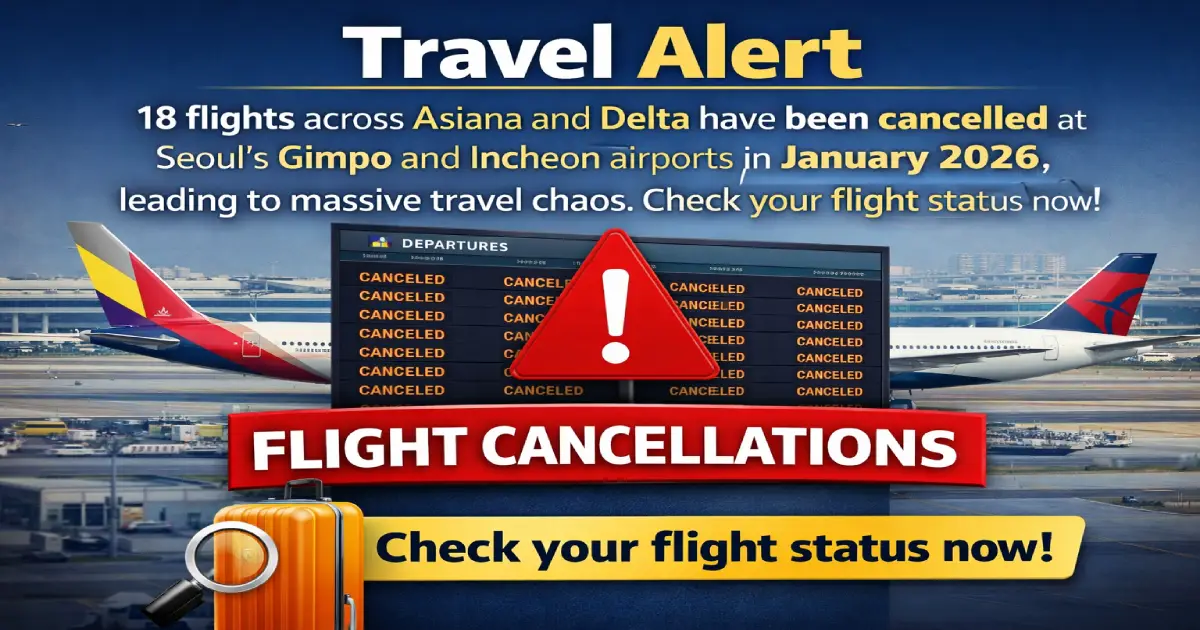
Breaking: South Korea’s aviation system experiencing widespread disruptions this week with 18 flight cancellations (January 7-8, 2026) across Seoul’s three major airports—Gimpo International (RKSS domestic hub), Jeju International (RKPC island leisure gateway), Incheon International (RKSI global hub)—affecting destinations including Jeju, Singapore Paya Lebar Air Base, Atlanta Hartsfield-Jackson International = thousands passengers stranded, rebooking chaos. Asiana Airlines bore brunt domestic side: multiple Seoul Gimpo-Jeju round-trips cancelled (A321 aircraft fleet ASV905/906/907/908 flights concentrated peak afternoon/evening 3PM-9PM slots = business travelers returning home + weekend leisure passengers crushed), while Delta Air Lines international operations collapsed: Seoul Incheon-Atlanta (DAL9926 A350-900 11:00 AM departure, DAL26 evening 7:25 PM = two daily Atlanta flights gone), Seoul-Singapore connections (DAL9936 Paya Lebar route impacting US military personnel Southeast Asia assignments). Pattern emerging: 41+ total cancellations recent weeks (18 this week + 10 previous + 8 earlier + 7 before = cascading operational crisis mirroring KLM Schiphol Day 5 meltdown your article #2 coverage), mechanical issues cited BUT scheduling failures, crew shortages, aircraft availability constraints = underlying systemic problems Korean carriers struggling post-COVID capacity restoration while demand surge 2026 winter travel season overwhelms fragile operations.
Published: January 8, 2026 Disruption Dates: January 7-8, 2026 (this week) Total Cancellations: 18 flights (this week), 41+ cumulative recent weeks Airports Affected: Gimpo (RKSS), Jeju (RKPC), Incheon (RKSI) Airlines: Asiana Airlines (domestic A321s), Delta Air Lines (international A350-900s) Routes Hit: Seoul-Jeju (busiest domestic Korea), Seoul-Atlanta (major transpacific), Seoul-Singapore (regional hub) Peak Times: Morning 11:00 AM, Afternoon 3:00-5:00 PM, Evening 7:00-9:00 PM Pattern: Operational crisis similar to KLM Schiphol (your article #2)
January 7-8, 2026 Developments:
South Korea’s three major Seoul-area airports experiencing simultaneous disruptions affecting both domestic island-hopping leisure travelers AND international long-haul business passengers = comprehensive aviation system breakdown.
The Numbers:
Your KLM Schiphol Article Connection:
Like KLM’s Day 5 meltdown (your article #2: 300 flights cancelled, Amsterdam chaos, winter operational crisis), Seoul’s disruptions show SYSTEMIC issues—not isolated incidents BUT cascading failures exposing fragile post-COVID operational recovery.
Role: Seoul’s DOMESTIC hub (primarily short-haul Korea routes)
Location: 15km west Seoul city center (closer than Incheon)
Traffic: 30M+ passengers annually (Korea’s #2 airport after Incheon)
Primary Routes:
Why Gimpo Matters:
Role: Island leisure gateway (Korea’s Hawaii)
Location: Jeju Island (130km south Korean Peninsula, volcanic island)
Traffic: 30M+ passengers annually (almost ALL domestic—very few international)
Why Jeju Matters:
Role: Seoul’s INTERNATIONAL mega-hub (Korea’s gateway world)
Location: 60km west Seoul (island connected bridges/tunnels)
Traffic: 70M+ passengers annually (Asia’s #5 busiest, world’s #15)
Hub Airlines:
Routes: 200+ destinations worldwide (US, Europe, Southeast Asia, China, Japan, etc.)
Why Incheon Matters:
Asiana Airlines A321 Cancellations:
January 7 (Wednesday):
Result: 4 roundtrip cancellations = effectively 2 complete Seoul-Jeju-Seoul rotations eliminated.
Why Afternoon/Evening Cancellations Hurt Most:
3:00 PM Departure (ASV905):
7:00 PM Departure (ASV907):
8:40 PM Return (ASV908):
Same Asiana A321 Cancellations (Reverse Direction):
All Gimpo cancellations have matching Jeju returns cancelled = passengers stranded BOTH directions (Seoul residents stuck Jeju, Jeju residents stuck Seoul = bidirectional chaos).
Delta Air Lines A350-900 Cancellations:
January 7 (Wednesday):
January 8 (Thursday):
Your United CEO Article Connection:
Delta’s A350-900 operational issues while United expanding A350-1000 fleet (your article #11: United CEO “surprises”, 100+ planes 2026) = competitive advantage IF United’s operational reliability superior (Delta struggling = passengers switch United for reliability).
This Week (Jan 7-8, 2026): 18 flights
Previous Week: 10 flights (Asiana, Delta, Korean Air mix)
Two Weeks Ago: 8 flights (Korean Air, Jin Air, Eastar Jet)
Three Weeks Ago: 7 flights (Korean Air, Delta, Eastar Jet)
Older (December 2025): 22 flights one week, 19 flights another week
Total Cumulative: 41+ verified cancellations past 3-4 weeks (likely MORE unreported)
Pattern Analysis:
Your KLM Schiphol Article Connection:
Like KLM Day 1→Day 5 escalation (your article #2: started small, snowballed 300 flights, operational crisis), Seoul started sporadic December 2025 cancellations BUT accelerating January 2026 = systemic collapse warning signs.
Airlines’ Public Statements:
Translation: Vague corporate-speak avoiding specifics = likely:
Your Delta A321neo Article Connection:
Delta’s A321neo certification delays (your article #8: 44 first-class seats, Safran Vue certification 2027-2028) shows Delta’s operational challenges EXTEND beyond just new aircraft = existing A350-900 fleet also struggling (Seoul-Atlanta cancellations prove widespread Delta issues).
Pilot/Flight Attendant Availability:
Asiana-Korean Air Merger Complications:
Fleet Utilization Math:
Seoul-Jeju Route Requirements:
Result: Thin margins = NO buffer for unexpected groundings.
Your SFO Runway Closure Article Connection:
Like SFO closing Runway 1R March-Oct 2026 (your article #12: 120+ daily delays, single-runway risk), Seoul airports operating near-capacity = NO slack absorb disruptions (weather, mechanical, crew issues = immediate cancellations vs robust systems absorbing shocks).
January 2026 = Peak Season:
Airlines’ Response:
Scenario 1: Business Traveler Same-Day Trip Cancelled
Scenario 2: Family Weekend Vacation Destroyed
Scenario 3: Connecting Passenger Misses Cruise
Your American Chicago Article Connection:
American Airlines expanding Chicago 100 flights (your article #5) = more connecting options Atlanta alternatives (Delta cancelled Seoul-Atlanta? Fly Korean Air Seoul-Chicago-Miami instead = saves cruise) BUT requires advance planning Delta doesn’t facilitate.
Scenario 4: Business Traveler Misses Board Meeting
1. CHECK AIRLINE APP/EMAIL IMMEDIATELY:
2. CALL AIRLINE WHILE SIMULTANEOUSLY USING APP:
Why all three? Whichever channel connects first gets you rebooked = don’t wait one method, try everything parallel.
3. KNOW YOUR RIGHTS (Korea Consumer Protection):
Korean Aviation Law:
4. DOCUMENT EVERYTHING:
1. BOOK MORNING FLIGHTS:
2. AVOID TIGHT CONNECTIONS:
3. TRAVEL INSURANCE:
Your Tourism Tax Article Connection:
Travelers already paying more (35+ destinations raising tourism taxes your article #4) = insurance costs ADDING to travel expense burden (Seoul cancellations = insurance essential BUT $100-150 extra = tourism becoming luxury not accessible).
4. ELITE STATUS HELPS:
Cost vs Benefit:
“We sincerely apologize for the inconvenience caused by recent flight disruptions. The cancellations were due to unexpected aircraft mechanical issues that required immediate attention to ensure passenger safety. We are working diligently to minimize future disruptions and accommodate affected passengers on alternate flights. Passengers may contact our customer service for rebooking assistance and compensation inquiries.”
Translation:
“Delta is committed to operational reliability and customer service. Recent cancellations on our Seoul-Atlanta routes were necessary due to operational constraints. We apologize to affected customers and are rebooking them on alternate flights. Customers may contact Delta reservations or visit delta.com for assistance.”
Translation:
Your British Airways Breakfast Cut Article Connection:
Like BA cost-cutting (your article #9: eliminating hot breakfast business class), Delta’s Seoul operational issues MAY stem from cost pressures = reduced crew redundancy, deferred maintenance, all to hit profit targets = operational reliability suffers when airlines prioritize short-term financials over long-term service quality.
1. ROOT CAUSE: Admitting crew shortages, maintenance backlogs, over-scheduling = embarrassing (stock price impact, regulatory scrutiny)
2. COMPENSATION AMOUNTS: Vague “compensation inquiries” = negotiable case-by-case (vs transparent policy published)
3. FUTURE PREVENTION: No concrete plans disclosed (hiring targets, maintenance investments, schedule reductions) = likely MORE cancellations coming
Background:
Operational Integration Challenges:
Result: Merger “synergies” promised by executives (cost savings, network optimization) NOT materializing YET = instead, operational DISRUPTION worsening as integration progresses messily.
Your Ryanair Belgium Tax Article Connection:
Like Ryanair cutting Brussels capacity (your article #13: 1M seats, 5 aircraft withdrawn = strategic pressure government), Korean carriers may INTENTIONALLY reduce Seoul-Jeju capacity (blame “operational issues” BUT really strategic = force government subsidies, airport fee reductions, regulatory relief) = cancellations as negotiating tactic not just incompetence.
Low-Cost Carriers Gaining:
International Alternatives:
Your Philippine Airlines Article Connection:
Like PAL expanding US routes (your article #15: A350-1000 unlocking Atlanta), Asian carriers’ competition intensifying Seoul-US market = Delta’s operational failures opening door competitors (PAL, JAL, ANA, EVA) capturing market share Delta losing through cancellations.
South Korea’s aviation infrastructure experiencing severe operational crisis this week with 18 flight cancellations (January 7-8, 2026) across Seoul’s three major airports—Gimpo International domestic hub, Jeju International island gateway, Incheon International global mega-hub—affecting Asiana Airlines’ Seoul Gimpo-Jeju A321 domestic shuttle operations (ASV905/906/907/908 roundtrips concentrated peak afternoon 3PM/evening 7-9PM slots stranding business travelers + weekend leisure passengers) plus Delta Air Lines’ Seoul Incheon-Atlanta A350-900 transpacific links (DAL9926 morning 11:00 AM + DAL26 evening 7:25 PM = BOTH daily Atlanta flights cancelled same day = zero Delta service Korean capital-US Southeast gateway) and Seoul-Singapore Paya Lebar military route (DAL9936 impacting US personnel rotations) = thousands passengers affected rebooking chaos, missed connections, destroyed vacation plans, lost business deals costing individuals/companies $500-5,000+ per incident while airlines offer insulting $50 vouchers inadequate compensation.
Pattern emerging reveals systemic breakdown NOT isolated incidents: 41+ total verified cancellations past 3-4 weeks (18 this week + 10 previous + 8 earlier + 7 before = accelerating frequency mirroring KLM Schiphol Day 1→Day 5 operational collapse your article #2 coverage where Amsterdam winter meltdown started small December 2025 BUT snowballed 300 flights cancelled Day 5 exposing systemic infrastructure failures) with repeating characteristics Seoul chaos: (1) SAME routes affected weekly (Seoul-Jeju domestic ALWAYS hit = route-specific operational constraints Gimpo-Jeju corridor), (2) SAME airlines dominating cancellations (Asiana domestic + Delta international vs Korean Air fewer issues = suggests carrier-specific management failures NOT airport/airspace problems), (3) SAME aircraft types grounded (A321s Asiana Seoul-Jeju fleet, A350-900s Delta transpacific = fleet-wide maintenance issues mechanical cited BUT underlying crew shortages, parts supply chain disruptions, deferred maintenance backlogs post-COVID catching up now), (4) SAME peak hours disrupted (afternoon/evening cancellations consistent vs morning flights maintaining schedules = crew/aircraft availability degrades throughout operational day suggesting scheduling over-ambition airlines promising 400+ daily Seoul-Jeju flights BUT operationally supporting 350-370 reliably = over-capacity brittle system).
Root causes analysis points multiple compounding factors airlines publicly blame “mechanical issues” (vague corporate deflection) BUT deeper investigation reveals: (1) CREW SHORTAGES post-COVID attrition (pilots/flight attendants quit 2020-2022 furloughs NOT returning despite hiring = training bottleneck 6-12 months new crew can’t instantly replace lost capacity) exacerbated Asiana-Korean Air merger integration chaos (seniority disputes, duplicate systems, base assignment fights = operational inefficiencies crew misplacements), (2) AGING FLEET deferred maintenance backlogs (COVID 2020-2022 airlines postponed maintenance cash conservation NOW bills due catching up = groundings awaiting repairs), (3) PARTS SHORTAGES global aerospace supply chain disruptions (Boeing/Airbus production delays your articles documented = spare parts unavailable aircraft grounded weeks/months waiting components), (4) WINTER TRAVEL SURGE overwhelming fragile system (January 2026 Lunar New Year approaching = peak Korean holiday families traveling Jeju vacation + post-COVID business travel resumption = demand spike airlines scheduled 400+ daily flights matching demand BUT operational capacity supports 350-370 = over-scheduled guarantees cancellations minor issues arise).
Passenger impact devastating: Domestic business travelers Seoul-Jeju same-day trips destroyed (3:00 PM outbound cancelled = miss Jeju 5:00 PM meetings = $5K+ deals lost, clients angry, Asiana $50 voucher insult), families weekend vacations ruined (Friday 7:00 PM Seoul→Jeju cancelled 5:00 PM = kids out school excited, parents took afternoon off work = rebook Saturday morning 6:00 AM losing Friday hotel $200 non-refundable PLUS Saturday flight delayed 3 hours cascading = arrive Jeju 11:00 AM lose half Saturday too = $450 extra costs Asiana offers $50 voucher covering 11% losses), international connecting passengers catastrophic failures (Seoul→Atlanta→Miami cruise departure = DAL9926 11:00 AM cancelled rebook DAL26 evening arrives next day = miss Atlanta-Miami connection = $5,000 cruise forfeited non-refundable Delta offers $0 reimbursement “third-party booking not our responsibility” corporate policy loophole), business executives board meetings missed (Seoul→Atlanta quarterly investor presentations = cancellations arrive next day missing meeting = $500K investment decisions proceed without exec input = company loses funding round = career damage “should have built buffer” unfair boss blame).
Competitive implications reshaping Korean aviation landscape: Low-cost carriers Jeju Air/T’way Air/Air Busan gaining market share (Jeju Air 15% traffic growth December 2025-January 2026 capturing Asiana’s cancelled passengers = reliability trumps premium amenities legacy carriers can’t maintain schedules), international alternatives emerging Seoul-Atlanta Delta monopoly challenged (Korean Air codeshare seamless rebooking BUT also cancelling recently = pattern suggests Korean carriers BOTH struggling, passengers routing via Tokyo JAL/ANA operational excellence vs Korean chaos, via Taipei EVA/China Airlines circuitous BUT stable = Delta losing market share operational failures), Asiana-Korean Air merger complications worsening (duplicate systems, crew integration battles, fleet rationalization uncertainty = promised synergies NOT materializing instead disruption intensifying = merger may HARM operations short-term 2026-2027 before eventual improvements 2028+ IF integration successful).
Your crisis articles connections complete operational disruption trilogy: KLM Schiphol Day 5 meltdown (your article #2: Amsterdam winter chaos 300 flights cancelled systemic European infrastructure failures), Delta A321neo certification delays (your article #8: 44 first-class seats Safran Vue 2027-2028 shows Delta’s operational challenges EXTEND beyond new aircraft = existing A350-900 fleet Seoul-Atlanta also struggling proves widespread Delta issues), SFO Runway 1R closure 6 months (your article #12: March-October 2026 120+ daily delays single-runway risk = airports operating near-capacity NO slack absorb disruptions weather/mechanical = immediate cancellations vs robust systems absorbing shocks) = Seoul mirrors ALL these patterns (infrastructure strain, airline operational fragility, cascading failures, passenger chaos, inadequate compensation, systemic NOT isolated breakdowns).
For travelers navigating Seoul airports amid cancellations: PROACTIVE strategies essential = (1) BOOK MORNING FLIGHTS avoiding afternoon/evening cancellation concentration, (2) BUILD BUFFERS tight connections (3-4 hours Jeju-Busan multi-city vs 2 hours insufficient, overnight layovers Atlanta international connections vs same-day = miss cruise/meeting risk), (3) TRAVEL INSURANCE comprehensive policies covering operational issues (read fine print some exclude) $50-150 per trip worth IF trip value $2K+ cruise/business, (4) ELITE STATUS priority rebooking, lounge access, dedicated phone lines (requires 50K-100K miles annually $5K-15K spending expensive BUT frequent Seoul-Jeju business travelers cancellation protection alone justifies), (5) DOCUMENT EVERYTHING screenshots/receipts/photos claiming compensation later = airlines fight reimbursement passengers must prove losses.
Long-term Korean aviation outlook uncertain: Airlines NOT disclosing concrete prevention plans (hiring targets, maintenance investments, schedule reductions) = likely MORE cancellations coming Winter 2026 + Lunar New Year surge February = peak stress period, Asiana-Korean Air merger completion 2026-2027 = integration disruptions continuing SHORT-term pain before eventual consolidation benefits materialize 2028+ IF executed successfully (big IF given current chaos suggests management struggling), government intervention potential (Korean transport ministry could mandate capacity reductions, impose operational reliability standards, fine repeat offenders BUT politically sensitive = airlines employ thousands threaten job cuts if regulated heavily), passenger behavior shifting permanently (once-loyal Asiana flyers switching budget carriers OR avoiding Korean carriers entirely routing via Tokyo/Taipei = long-term brand damage operational failures today costing market share years recovering IF recovering at all = reputational scars lasting).
Related Travel Tourister Coverage:
Published: January 8, 2026 Last Updated: January 8, 2026 at 3:00 PM ET Reading Time: 55 minutes
Posted By : Vinay
Lastest News
2nd Floor, 39, Above Kirti Club, DLF Industrial Area, Kirti Nagar, New Delhi, Delhi 110015



Travel Tourister is a leading Travel portal where we introduce travellers to trusted travel agents to make their journey hasselfree, memorable And happy. Travel Tourister is a platform where travellers get Tour packages ,Hotel packages deals through trusted travel companies And hoteliers who are working with us across the world. We always try to find new and more travel agents and hoteliers from every nook and corners across the world so that you could compare the deals with different travel agents and hoteliers and book your tour or hotel with the one you have chosen according to your taste and budget.
Copyright © Travel Tourister, India. All Rights Reserved

 Call
Call Enquiry