Published on : 20 Feb 2026
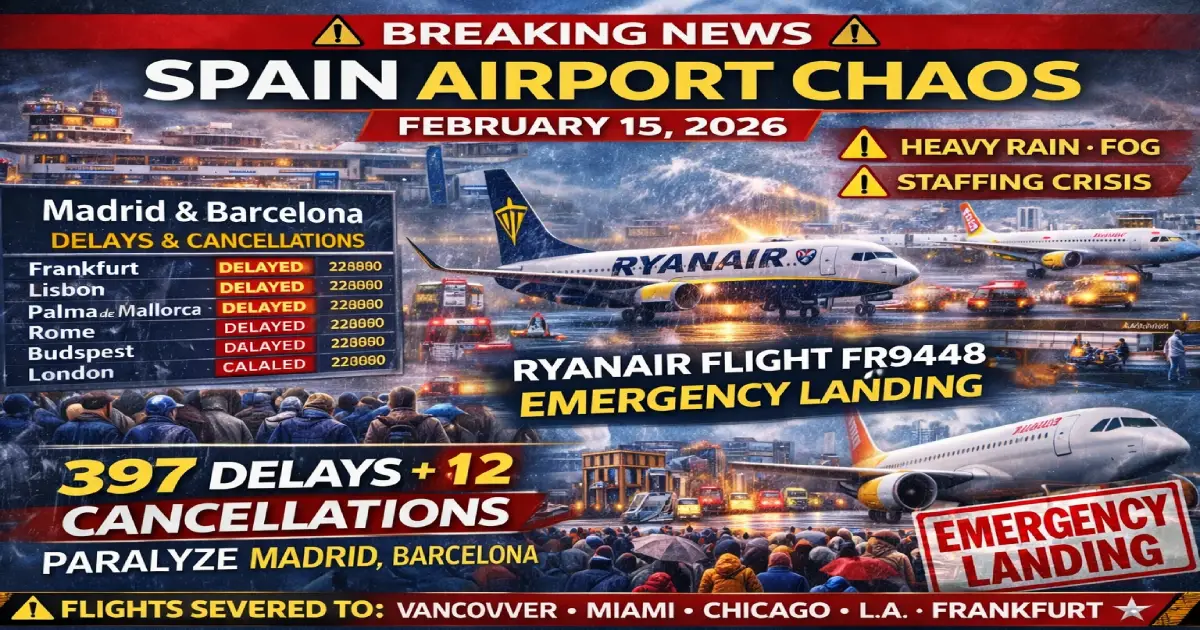
Breaking — Mid-February Crisis: Spain’s major airports descended into chaos on February 15, 2026, recording 397 flight delays and 12 cancellations across Adolfo Suárez Madrid-Barajas and Barcelona El Prat — triggered by severe weather including heavy rain and persistent fog that limited runway capacity, compounded by critical staffing shortages in check-in, security, and baggage handling, and dramatically escalated by Ryanair Flight FR9448’s emergency landing in Madrid on February 14 after a mid-flight technical failure forced the Malaga-to-Newquay aircraft to divert, stranding passengers on board for hours while the airline scrambled to manage fallout across its European network, with Ryanair, Iberia, and Vueling bearing the brunt of disruptions as Spain’s post-pandemic tourism surge stretched airport infrastructure to breaking point, leaving thousands of travelers stranded in crowded terminals with poor communication, missed connections, and hours-long rebooking queues in what became one of Spain’s worst single-day aviation crises in recent years. Here is the complete breakdown every Spain-bound passenger needs today.
Published: February 20, 2026 Crisis Date: February 14-15, 2026 Total Disruption: 397 delays + 12 cancellations Madrid (MAD): Primary hub, bore brunt of disruptions Barcelona (BCN): Secondary hub, 235 delays recorded Ryanair FR9448: Emergency landing Madrid Feb 14 (technical failure) Route: Malaga (AGP) → Newquay (NQY) UK Airlines Affected: Ryanair, Iberia, Vueling (primary), plus easyJet, KLM, British Airways, Wizz Air Weather: Heavy rain + fog (reduced runway capacity) Staffing: Check-in, security, baggage handling shortages Passenger Impact: Thousands stranded, 5+ hour waits, missed connections Spain Tourism Context: Post-pandemic surge = 95%+ airport capacity utilization
One of the most dramatic events in this chaos was Ryanair Flight FR9448, which was scheduled to travel from Malaga to Newquay in the United Kingdom on February 14, 2026.
On February 14, 2026, Ryanair Flight FR9448 diverted to Madrid after a mid-flight technical failure while traveling from Malaga to Newquay. The emergency landing heightened concern for travelers already coping with adverse conditions.
What happened on FR9448:
The aircraft, en route from Malaga to Cornwall’s Newquay Airport, encountered a critical technical issue mid-flight that prevented the plane from safely climbing to its intended cruising altitude. Recognizing the severity of the situation, the flight crew declared an emergency and diverted to Madrid’s Adolfo Suárez Madrid-Barajas Airport, one of Europe’s busiest hubs and a location equipped to handle such incidents.
Passengers remained onboard: Inside the terminals, the mood was fraught. Passengers described long waits, crowded spaces, and a lack of clear communication from airlines and airport staff.
The emergency landing itself unfolded smoothly from a technical standpoint—pilots executed a safe arrival in Madrid—but the aftermath proved chaotic. Passengers remained on board the aircraft for an extended period as ground crews assessed the situation and airline staff coordinated next steps.
The Newquay connection broken:
For passengers expecting to arrive in Cornwall’s Newquay Airport — a regional UK destination serving southwest England — the Madrid diversion meant hours of delay, missed ground transport connections, and uncertainty about when they would reach their final destination. Newquay serves a limited number of daily flights; FR9448 passengers had no immediate alternative routing.
The following day, airports across Spain recorded hundreds of schedule disruptions: more than 390 delays and roughly a dozen cancellations were logged nationwide on February 15, with local tallies showing Madrid bearing the brunt.
On February 15 alone, over 397 flights were delayed and 12 were canceled.
Airport-by-airport breakdown:
Adolfo Suárez Madrid-Barajas:
Madrid’s role as Spain’s primary international hub meant that delays cascaded throughout Europe and beyond. Every delayed Madrid departure created missed connections in London, Paris, Frankfurt, Istanbul, and transatlantic destinations.
Barcelona El Prat:
Barcelona’s 235 delays exceeded Madrid’s 207 — reflecting BCN’s role as Europe’s primary leisure travel gateway to Spain. Summer-like passenger volumes in mid-February (Spain’s tourism recovery = year-round high demand) left zero operational slack.
Other affected airports:
Three carriers stood out in the disruption reports: Ryanair, Iberia, and Vueling. They were all affected, but not in the same way.
Ryanair disruption:
Ryanair’s business model — ultra-low-cost, minimal slack, high aircraft utilization — magnified the FR9448 emergency’s impact. The diverted aircraft sat in Madrid for hours, removing it from subsequent rotations. Crews timed out. The ripple cascaded across Ryanair’s entire Spanish network.
Iberia disruption:
Iberia’s Madrid hub concentration meant that delays affected passengers connecting to Latin America, North America, Europe, and domestic Spanish destinations simultaneously. A single Madrid delay broke dozens of onward connections.
Vueling disruption:
Vueling’s 122 delays represented the single largest delay total for any carrier — reflecting Vueling’s high-frequency Barcelona operations. When BCN delays compound, Vueling suffers disproportionately.
Severe weather, particularly heavy rain and fog, complicated flight schedules.
Weather played a major role. Heavy rain and fog repeatedly hampered arrivals and departures, limiting runway capacity and slowing turnaround times.
Why fog is aviation’s silent killer:
Low ceilings:
Reduced visibility:
Why Spain was vulnerable:
Madrid and Barcelona both experienced persistent fog — not dramatic thunderstorms that pass in hours, but low-lying clouds and mist that lingered 12-24+ hours. This “invisible storm” phenomenon reduced capacity without visual drama, confusing passengers who saw “just cloudy” and didn’t understand delays.
At the same time, passenger volumes remained high, stretching terminal facilities and security checkpoints. Staffing shortfalls in check-in, security and baggage handling compounded the problem, producing long lines and slower processing times that reverberated through the network.
Post-pandemic tourism surge:
Spain has seen a rapid recovery in tourism in the post-pandemic era, leading to higher traffic at airports. While this surge in travelers is good for the country’s tourism industry, it also put a strain on airport infrastructure and airline operations.
Spain’s airports are operating at 95%+ capacity year-round — a structural problem where any disruption (weather, staffing, technical) immediately cascades because zero operational buffer exists.
Staffing shortages:
Inside the terminals, the mood was fraught. Passengers described long waits, crowded spaces, and a lack of clear communication from airlines and airport staff.
“I’ve been waiting here at Barcelona International for over five hours now. I’ve already missed my connecting flight, and there’s no one here who can give me a clear update. It’s stressful.”
Laura’s experience reflects thousands: missed connections, zero proactive communication, no rebooking assistance beyond “wait at the service desk.”
Business travelers, too, felt the sting, with Pedro, a Madrid-bound executive, lamenting, “The delay in Madrid has disrupted my entire trip. I had a meeting in London, but it’s unlikely I’ll make it now. The lack of communication is what frustrates me the most.”
Families with young children bore a particular burden, as parents struggled to keep their kids entertained and calm amid the uncertainty. The terminals, already crowded from the influx of travelers, became even more challenging as delays stretched from hours into entire days.
If you’re already ticketed and stuck in the disruption, the best move is speed: rebook in-app, lock any workable routing, then sort refunds or claims later.
Why app rebooking is critical:
Under EU Regulation 261/2004:
Document everything:
Best for protecting connections and long-haul plans: Iberia. You’ll usually have more reroute options through its hub network at MAD.
Best for simple, nonstop trips when the price is right: Ryanair. But expect thinner support during irregular operations.
Best for BCN-focused point-to-point trips: Vueling. It can be convenient, but BCN congestion can punish tight rotations.
Spain’s February 15, 2026 airport chaos — 397 delays plus 12 cancellations across Madrid and Barcelona — triggered by heavy rain, persistent fog, and critical staffing shortages, then dramatically escalated by Ryanair Flight FR9448’s emergency landing in Madrid on February 14, represents one of Spain’s worst single-day aviation crises in recent years, stranding thousands of passengers for 5+ hours with poor communication, missed connections, and overwhelmed rebooking systems as post-pandemic tourism surge pushes Spanish airports to 95%+ capacity with zero operational buffer, leaving Ryanair (85 delays), Iberia (5 cancellations + 37 delays), and Vueling (7 cancellations + 122 delays) scrambling to manage fallout while passengers face the reality that Spain’s aviation infrastructure cannot handle current demand levels during weather events.
Your Spain Travel Survival Checklist:
✅ Flying Spain Feb-Mar? Build 3+ hour connection buffers at MAD/BCN — 90 minutes insufficient ✅ Ryanair passenger? App rebooking essential — service desk waits 3-5+ hours ✅ EU261 compensation? €250-€600 for delays 3+ hours (NOT weather-caused) ✅ Weather delays? Airlines must provide meals + hotels — demand written confirmation ✅ Missed connection? Request confirmed rebooking before leaving service desk
Track Spain airports live:
Related Articles:
Posted By : Vinay
Lastest News
2nd Floor, 39, Above Kirti Club, DLF Industrial Area, Kirti Nagar, New Delhi, Delhi 110015



Travel Tourister is a leading Travel portal where we introduce travellers to trusted travel agents to make their journey hasselfree, memorable And happy. Travel Tourister is a platform where travellers get Tour packages ,Hotel packages deals through trusted travel companies And hoteliers who are working with us across the world. We always try to find new and more travel agents and hoteliers from every nook and corners across the world so that you could compare the deals with different travel agents and hoteliers and book your tour or hotel with the one you have chosen according to your taste and budget.
Copyright © Travel Tourister, India. All Rights Reserved

 Call
Call Enquiry