Published on : 12 Mar 2026
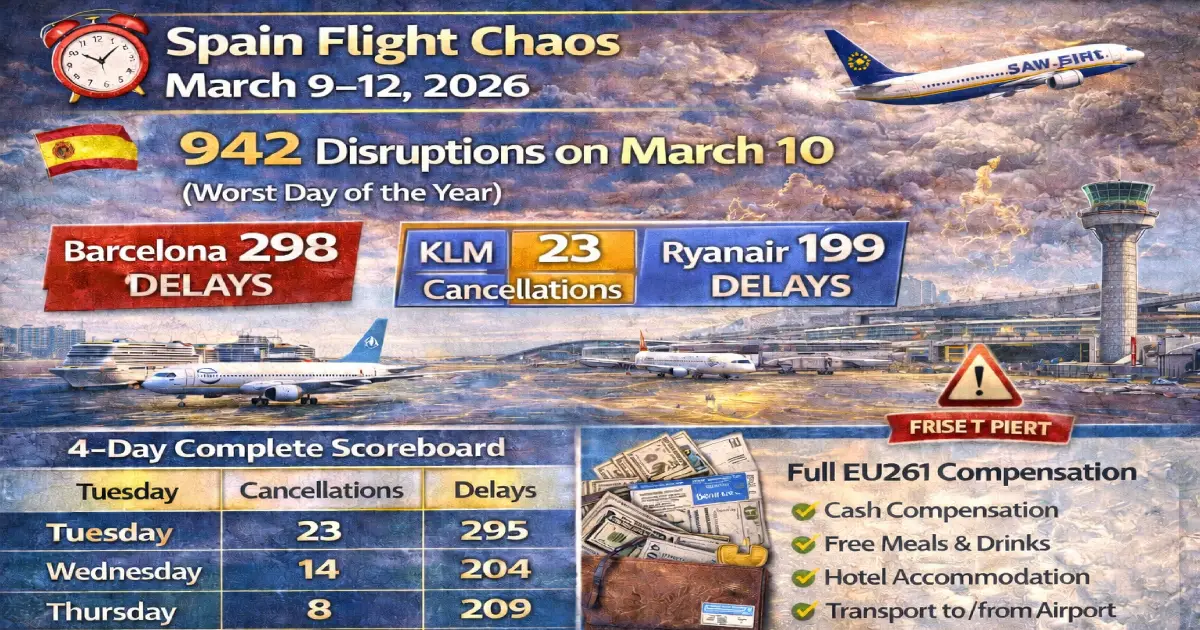
Breaking: Spain has suffered its worst four consecutive days of aviation disruption in 2026. March 10 alone recorded 942 disruptions across five airports — 56 cancellations and 886 delays — the highest single-day total in Spain this year. Barcelona leads all European airports for delays. KLM is the worst carrier for cancellations. Ryanair has the highest delay count of any airline. Here is the complete four-day scoreboard, airport by airport and airline by airline, plus the full EU261 guide telling you exactly what every affected passenger is owed.
Published: March 12, 2026 Crisis Period: March 9–12, 2026 — four consecutive disruption days Worst Single Day: March 10 — 942 total disruptions (56 cancellations + 886 delays) Airports Affected: Barcelona–El Prat (BCN) | Adolfo Suárez Madrid–Barajas (MAD) | Málaga–Costa del Sol (AGP) | Valencia (VLC) | Bilbao (BIO) | Alicante (ALC) | Seville (SVQ) March 10 worst airport: Madrid — 19 cancellations + 315 delays March 10 second worst: Barcelona — 21 cancellations + 298 delays March 10 worst airline by cancellations: KLM — 23 cancellations nationwide March 10 worst airline by delays: Ryanair — 199 delays nationwide March 10 second worst delays: Vueling Airlines — 16 cancellations + 158 delays March 10 third worst delays: Iberia — 5 cancellations + 86 delays Today (March 12): 20 cancellations + 200 delays — Madrid 4 cancels/95 delays, Barcelona 11 cancels/45 delays, Valencia 2 cancels/14 delays, Málaga 1 cancel/22 delays, Alicante 2 cancels/24 delays Europe-wide context (March 10): 333 cancellations + 2,396 delays across 15 major hubs — Spain contributed the largest single national share Europe-wide context (March 11): 190 cancellations + 821 delays across 20 airports — 14 countries affected Cause 1: Middle East airspace closure — Gulf carriers Qatar, Emirates, Etihad grounded or severely reduced — rerouting pressure through Spanish hubs Cause 2: Atlantic weather fronts — gusty winds, heavy rain, low cloud constraining runway capacity at Madrid and Barcelona Cause 3: Network cascade — aircraft and crew out of position from weekend Brussels/Lufthansa disruption flowing through European rotation chains EU261 Max Compensation: €600 for flights over 3,500km delayed 4+ hours (airline fault) Duty of Care: ✅ Owed unconditionally after 2-hour wait — meals, hotel, transport — regardless of cause Fixed Compensation: ❌ NOT owed for extraordinary circumstances (Middle East crisis, weather) ✅ OWED for airline-caused delays Free Claims: AENA complaints → airline directly → AESA (Spain’s aviation regulator) → AirHelp/ClaimCompass/AirAdvisor (fee-based, not required) Worst day in Spain 2026: March 10 — 942 disruptions across 5 airports
Spain is not suffering an isolated disruption. It is absorbing three simultaneous pressure waves from different directions — and doing so with an aviation system already running at near-capacity after record 2025 passenger numbers.
Most coverage of Spain’s disruption this week reads the same: a list of cancellation numbers with a vague reference to the “Middle East crisis.” What none of it explains is why Spain specifically has been hit harder than comparable European countries, why the disruption has persisted across four consecutive days, and what the interaction between the three causes means for any passenger booked on a Spanish airport flight in the next seven days.
Barcelona–El Prat and Madrid–Barajas are two of Europe’s most heavily connected airports to Gulf carriers. Qatar Airways operates multiple daily flights from Barcelona and Madrid to Doha, connecting onwards to the entire Asia-Pacific, Indian Subcontinent, and East Africa network. Emirates connects both cities to Dubai with multiple daily A380 services. Etihad connects Madrid to Abu Dhabi.
When all three Gulf carriers contracted to near-zero global operations from February 28, the impact on Spanish airports was disproportionate. Qatar Airways, Iberia, Air Europa Express, Avianca, American Airlines, and more faced widespread cancellations and delays — with 19 cancellations and 408 delays reported at Madrid and Barcelona airports. Every Gulf carrier cancellation at BCN or MAD removes an aircraft that was supposed to turn around and depart as the next inbound — disrupting the rotation chain for all subsequent flights.
Airlines operating via Gulf hubs have been particularly affected, triggering knock-on issues for services into Spanish cities. Qatar Airways, for example, has had to reroute and retime flights linking Doha with Barcelona and Madrid, adding extra time in the air and tightening already-stretched aircraft rotations.
The families returning from winter-sun holidays in the Canary Islands and North Africa are the most visible victims of this dynamic — stuck in Barcelona and Madrid as missed connections wiped out same-day onward options to regional cities.
A sequence of Atlantic weather fronts has unsettled operations across Western Europe in recent days, with gusty winds, heavy rain and low cloud periodically constraining runway use and approach patterns at airports including Paris Charles de Gaulle, Madrid and parts of Germany.
Madrid Barajas is particularly exposed to Atlantic weather — its flat plateau location means westerly systems arrive without the buffering effect of terrain. When approach minimums are hit at Barajas, aircraft in the stack must either divert or hold — both outcomes propagating delays through the afternoon and evening departure banks. Barcelona’s coastal geography makes it sensitive to wind direction changes — the airport’s parallel runway system loses half its capacity when crosswind limits are breached.
Ryanair and easyJet, both heavily exposed to Spain’s sun-and-city routes, have had to juggle rotations as delayed inbound aircraft from the weekend collide with already busy weekday timetables.
The cascade mechanism is straightforward: an aircraft that was late arriving into Brussels on March 11 (due to the national strike) or into Frankfurt (due to the Lufthansa pilot walkout) was supposed to operate the next day’s rotation from those airports to Spain. When the inbound aircraft never arrives, the Spanish outbound departure has no plane. One cancelled Brussels–Barcelona sector becomes a delayed Barcelona–Málaga sector becomes a late Málaga turnaround back to Barcelona. The cascade travels south and amplifies through Spain’s dense short-haul network.
That wave of disruption spilled into 10 March and is still echoing through today’s schedules as aircraft and crews work their way back into position.
On 9 March 2026, flight operations in Spain were disrupted across Barcelona–El Prat, Adolfo Suárez Madrid–Barajas, Málaga–Costa del Sol and Valencia, with 21 cancellations and 447 delays. Airlines affected included Iberia, Qatar Airways, Vueling Airlines, Ryanair, Lufthansa and Air Europa.
Airport breakdown (March 9):
✈️ Barcelona: 13 cancellations + 175 delays ✈️ Madrid: 7 cancellations + 164 delays ✈️ Málaga: 1 cancellation + 77 delays ✈️ Valencia: 0 cancellations + 31 delays
Airline breakdown (March 9):
✈️ Qatar Airways: 7 cancellations + 1 delay — concentrated at Barcelona and Madrid ✈️ Vueling Airlines: 0 cancellations + 97 delays — highest delay count ✈️ Ryanair: 44 delays across Barcelona, Málaga, Valencia ✈️ easyJet: 37 delays at Barcelona, Málaga, Valencia ✈️ El Al: 2 cancellations + 2 delays (Tel Aviv services ceased)
At Málaga–Costa del Sol, passengers on delayed evening services described long lines at airline counters and vending machines running low on stock as crowds built up. In Valencia, travelers on disrupted low-cost flights to European city-break destinations were offered rebooking several days later or refunds that did little to address immediate accommodation and transport needs.
This is the headline number. Madrid–Barajas (19 cancellations, 315 delays), Barcelona–El Prat (21 cancellations, 298 delays), Málaga (6 cancellations, 143 delays), Valencia (6 cancellations, 97 delays), and Bilbao (4 cancellations, 33 delays) recorded 56 cancellations and 886 delays.
Airport breakdown (March 10):
✈️ Madrid: 19 cancellations + 315 delays — worst individual airport ✈️ Barcelona: 21 cancellations + 298 delays — highest cancellation count ✈️ Málaga: 6 cancellations + 143 delays — leisure route concentration ✈️ Valencia: 6 cancellations + 97 delays ✈️ Bilbao: 4 cancellations + 33 delays — ALL cancellations KLM
Airline breakdown (March 10):
KLM led cancellations with 23 flights cancelled nationwide, while Vueling Airlines (16 cancellations, 158 delays), Ryanair (3 cancellations, 199 delays) and Iberia (5 cancellations, 86 delays) were the largest contributors to overall disruption.
✈️ KLM: 23 cancellations — worst cancellation airline — including ALL Bilbao flights ✈️ Ryanair: 3 cancellations + 199 delays — highest delay count of any airline ✈️ Vueling Airlines: 16 cancellations + 158 delays — Barcelona/Málaga/Valencia concentrated ✈️ Iberia: 5 cancellations + 86 delays — Madrid hub cascades ✈️ easyJet: Multiple delays across all major airports ✈️ Air France: Significant delay rates at Madrid and Barcelona
The March 10 Europe-wide context: European aviation buckled under the weight of a multi-layered crisis on March 10, 2026, as 333 flights were cancelled and 2,396 more were delayed across the continent’s major hubs. Spain contributed the largest single national share of that total.
Europe-wide on March 11: 190 flight cancellations and 821 delays across 20 major airports spanning the UK, Germany, France, Spain, Turkey, Italy, Greece, and beyond.
Spain’s March 11 figures: 20 cancellations + 200 delays across five airports.
✈️ Madrid: 4 cancellations + 95 delays ✈️ Barcelona: 11 cancellations + 45 delays ✈️ Málaga: 1 cancellation + 22 delays ✈️ Valencia: 2 cancellations + 14 delays ✈️ Alicante: 2 cancellations + 24 delays
Airline breakdown (March 11): Lufthansa experienced 7 cancellations and 7 delays, making it the airline with the most cancellations. Qatar Airways reported 5 cancellations and 1 delay. Iberia recorded 27 delayed flights, primarily at Madrid. Vueling Airlines experienced 25 delays. Ryanair recorded 2 cancellations and 16 delays.
Today’s Spain figures confirm disruption is continuing as the Brussels general strike and Lufthansa Frankfurt/Munich pilot walkout feed additional displaced passengers and mispositioned aircraft into the Spanish network.
✈️ Madrid: 4 cancellations + 95 delays ✈️ Barcelona: 11 cancellations + 45 delays ✈️ Valencia: 2 cancellations + 14 delays ✈️ Málaga: 1 cancellation + 22 delays ✈️ Alicante: 2 cancellations + 24 delays
Today’s worst airlines: Ryanair recorded 2 cancellations and 16 delays. Lufthansa experienced 7 cancellations and 7 delays. Qatar Airways reported 5 cancellations and 1 delay. Iberia recorded 27 delays, primarily at Madrid. Vueling Airlines experienced 25 delays.
Barcelona El Prat has experienced several episodes of serious disruption over the past two years. Passengers again described departure boards dominated by red cancellation notices and long queues for airline service desks.
Barcelona is Vueling’s primary base — the airline runs hundreds of daily movements through El Prat. When Vueling’s rotation chain breaks, the disruption is amplified by the sheer density of its Barcelona operation. The airport is also heavily exposed to Qatar and Emirates cancellations on its Middle East long-haul bank. Barcelona experienced the highest overall cancellations (21) and 298 delays on March 10, with Vueling and KLM accounting for the majority of operational impact.
Practical advice for BCN passengers today: ✈️ Allow 3 hours before departure — check-in queues elevated ✈️ Vueling and KLM passengers: check your app before leaving for the airport ✈️ Use T1 (international) or T2 (domestic/Vueling) depending on your carrier — Vueling uses T2 exclusively
Madrid Barajas, Spain’s busiest airport and Iberia’s main hub, also faced a heavy operational load as airlines worked to reroute customers off cancelled services and secure spare seats on remaining flights. The sheer scale of Madrid’s daily operation means even a relatively small proportion of delayed flights can translate into thousands of disrupted journeys.
Madrid is Spain’s intercontinental gateway — its disruption cascades globally. When Iberia’s Madrid hub is delayed, flights to Latin America (LATAM, Avianca, Aerolíneas Argentinas, Azul), the US (American), and the Middle East (Emirates, Qatar, Etihad) are all affected.
Practical advice for MAD passengers today: ✈️ Terminal 4 (T4) handles most international carriers — allow 3.5 hours for international ✈️ Iberia and Iberia Express: check app — 27-delay figure confirms ongoing rotation issues ✈️ Connections through MAD to Latin America: highest risk category today
Málaga encountered prolonged evening queues, while Valencia passengers on low-cost services faced limited rebooking availability. Málaga is the UK’s most popular Spanish airport — Ryanair, easyJet, Jet2, and TUI all operate significant schedules. The 143-delay figure on March 10 — against only 6 cancellations — indicates the airport is running severely late rather than cutting flights outright.
Practical advice for AGP passengers today: ✈️ Ryanair and easyJet passengers: check departure time — AGP delays predominantly evening ✈️ UK leisure passengers (Jet2, TUI, easyJet): monitor your specific flight, not just the general airport status
Both airports serve the Costa Blanca and Valencia regions — predominantly low-cost leisure routes to the UK, Germany, and Northern Europe. Valencia passengers on low-cost services faced limited rebooking availability and, in some cases, refunds with travel delayed by days. With high early spring demand, alternative seating was scarce.
Spain is an EU member state. EU Regulation 261/2004 applies in full to all flights departing any Spanish airport and to flights arriving into Spain on EU-based carriers.
| Flight Distance | Delay at Destination | Compensation |
|---|---|---|
| Under 1,500km (e.g. BCN–London, MAD–Paris) | 3+ hours | €250 |
| 1,500–3,500km (e.g. MAD–New York, BCN–Cairo) | 3+ hours | €400 |
| Over 3,500km (e.g. MAD–Buenos Aires, BCN–Singapore) | 4+ hours | €600 |
Fixed compensation is not owed when delay or cancellation is caused by extraordinary circumstances — events outside the airline’s control that could not have been avoided.
Confirmed extraordinary circumstances in current Spain disruption: ✈️ Middle East airspace closure — confirmed extraordinary circumstance ✈️ Atlantic weather fronts — confirmed extraordinary circumstance ✈️ Brussels national strike overflow (indirect network cascade) — likely extraordinary
When fixed compensation IS owed: ✈️ Airline-caused delays — crew scheduling failures, IT systems, aircraft maintenance ✈️ If the airline cancelled with less than 14 days’ notice without offering a rebooking within defined windows
The key test: Ask your airline for the specific cancellation or delay reason code. “Operational reasons” without a specific extraordinary cause is NOT a valid extraordinary circumstance claim. Challenge it.
Even when extraordinary circumstances exempt an airline from paying fixed compensation, duty of care is unconditional.
Triggered after a 2-hour wait for short-haul, 3-hour wait for medium-haul:
✈️ Meals and refreshments — reasonable to the waiting time ✈️ Two phone calls, emails, or fax messages ✈️ Hotel accommodation if an overnight stay becomes necessary ✈️ Transport between hotel and airport
What to do at the airport:
The words to use: “Quiero un reembolso completo en efectivo bajo el Reglamento CE 261/2004, Artículo 8(1)(a).” (In English: “I am requesting a full cash refund under EU Regulation 261/2004 Article 8(1)(a).”)
✈️ Never accept a voucher unless you specifically want one ✈️ Refund must be processed within 7 days to original payment method ✈️ Applies to all carriers operating from Spanish airports
If your flight is delayed over 2 hours: ✈️ Ask the gate agent for a meal voucher immediately — you are owed this unconditionally ✈️ Do not leave the airport without getting written confirmation of the delay from the airline ✈️ Screenshot your flight status on the airline app with timestamp
If your flight is cancelled: ✈️ Your airline must offer: full cash refund OR rebooking on next available flight ✈️ Request cash — not a voucher ✈️ Ask for hotel accommodation if the next available flight is next day ✈️ Keep every receipt: meals, transport, hotel, phone calls
If you missed a connection at Barcelona or Madrid: ✈️ If both flights were on the same booking: the airline is responsible for getting you to your final destination ✈️ If you had two separate bookings: you bear the risk — the airline of the delayed first flight owes you nothing for the missed second flight ✈️ For separate bookings: purchase “travel disruption” cover in your insurance going forward — a lesson most passengers learn the hard way
Real-time flight status links: ✈️ Barcelona airport: bcnairport.es/en/passengers/flights ✈️ Madrid airport: aena.es (select Adolfo Suárez Madrid-Barajas) ✈️ Málaga airport: aena.es (select Málaga Costa del Sol) ✈️ Iberia: iberia.com/us/information/status ✈️ Vueling: vueling.com/en/flight-status ✈️ Ryanair: ryanair.com/en/us/useful-info/flight-status ✈️ easyJet: easyjet.com/en/flight-status
Spain has absorbed its worst four consecutive days of aviation disruption in 2026 — and the worst single day, March 10’s 942 disruptions across five airports, is a number that reflects not a single catastrophic event but the compounding of three simultaneous pressures: the Middle East airspace closure eliminating Gulf carrier rotations, Atlantic weather fronts degrading runway capacity, and the Brussels and Lufthansa strike cascades mispositing aircraft across the European network.
Today’s problems in Spain did not occur in isolation. Airlines and analysts point to a tightly stretched European aviation system in which weather disruptions, air traffic control constraints or geopolitical tensions in one region rapidly cascade across national borders.
The disruption is easing — today’s 220 total disruptions are less than a quarter of March 10’s peak. But the network has not fully recovered. Aircraft and crews are still working their way back into position. The Brussels strike aftermath, Lufthansa’s 48-hour walkout, and the ongoing Middle East rerouting will continue feeding into Spanish airport operations through the weekend.
EU261 protects you throughout. Duty of care — meals, hotel, transport — is owed unconditionally regardless of cause. Fixed compensation depends on whether your airline can demonstrate extraordinary circumstances. Check your specific situation, keep every receipt, and file your claim directly with AESA before engaging a fee-based claims service.
Check your flight status before leaving home. Request your meal voucher at the gate. And if your flight is cancelled — request cash, not a voucher.
For More Resources:
Related Articles:
Posted By : Vinay
Lastest News
2nd Floor, 39, Above Kirti Club, DLF Industrial Area, Kirti Nagar, New Delhi, Delhi 110015



Travel Tourister is a leading Travel portal where we introduce travellers to trusted travel agents to make their journey hasselfree, memorable And happy. Travel Tourister is a platform where travellers get Tour packages ,Hotel packages deals through trusted travel companies And hoteliers who are working with us across the world. We always try to find new and more travel agents and hoteliers from every nook and corners across the world so that you could compare the deals with different travel agents and hoteliers and book your tour or hotel with the one you have chosen according to your taste and budget.
Copyright © Travel Tourister, India. All Rights Reserved

 Call
Call Enquiry