Published on : 12 Mar 2026
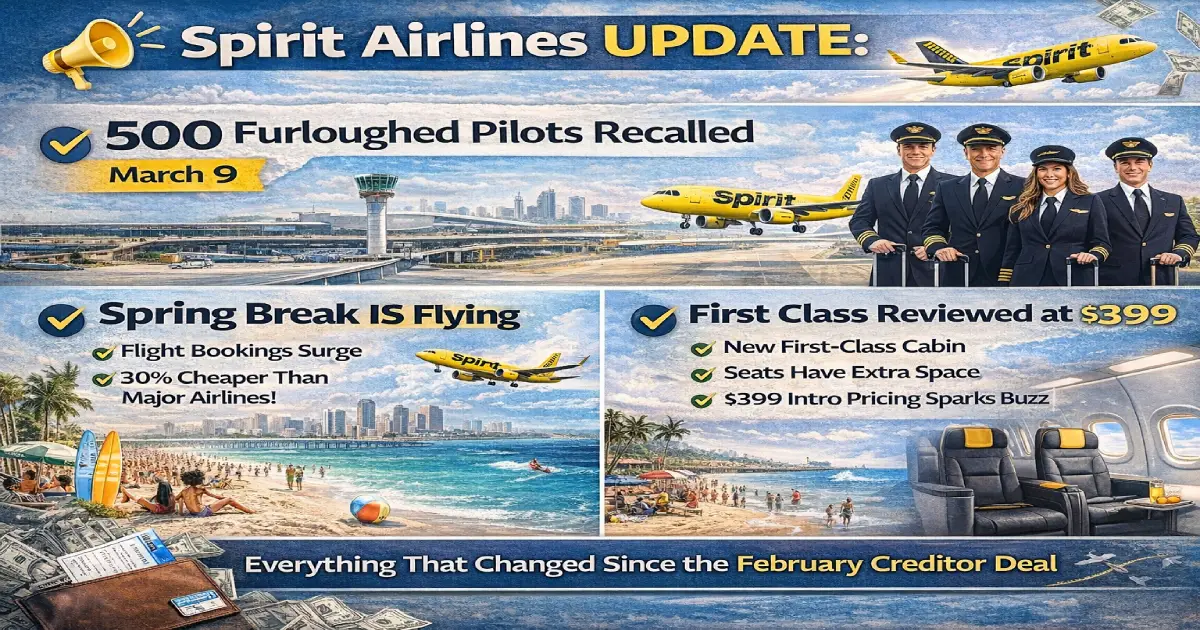
Update: On February 25, this site published the original Spirit Airlines creditor deal story — debt slashed to $2.1 billion, fleet cut to 94 aircraft, Spirit First Class confirmed. Three weeks later, the airline has recalled 500 furloughed pilots, confirmed Spring Break operations are intact, and Business Traveller has published the first independent first-class review. Here is everything that has changed since February 25 — and exactly what it means for your Spirit booking right now.
Published: March 12, 2026 UPDATE TO: Spirit Airlines SURVIVES: Creditor Deal, Exits Bankruptcy Spring 2026 (February 25) Pilot Recall Notices Sent: March 9, 2026 Pilots Recalled: ~500 — involuntarily furloughed between September 1, 2024 and November 1, 2025 Why recalled NOW: Pilot attrition “higher than forecast” — internal memo to employees confirmed by AirGuide and Simple Flying Flight Attendants: Also recalled in a separate wave — confirmed by AirGuide Spring Break Status: ✅ Spirit IS flying Spring Break — pilots returning under CBA timelines Bankruptcy Exit Timeline: Late spring or early summer 2026 — unchanged Debt: $7.4 billion → $2.1 billion (cut of $5.3 billion) Fleet: 214 aircraft → 94 aircraft post-restructuring Fleet Cost Savings: ~$550 million annually — 65% cut from pre-bankruptcy levels Total Cost Reduction Target: ~$850 million annually Airports Exited Since August 2025: 18 destinations — Milwaukee, Phoenix, Rochester, St. Louis, Minneapolis among them Hub Focus (surviving routes): Fort Lauderdale (FLL) | Orlando (MCO) | New York area (JFK/LGA/EWR) | Detroit (DTW) Routes being cut entirely: Tuesday and Wednesday services on lower-demand routes Latin America: Some trimming confirmed — “softer demand in certain VFR segments” per CEO Spirit First Class Reviewed: ✅ Business Traveller LAX→FLL flight review published — $399 one-way Big Front Seat: 36-inch pitch, 20-inch width, 2×2 configuration — confirmed in review Premium Economy: 32-inch pitch — confirmed Standard Economy: 28-inch pitch (unchanged — still the tightest in US aviation) Competitor comparison (LAX→FLL/MIA same day): JetBlue Even More Space $288 | American Basic Economy $209 | American Domestic First $1,234 | Spirit First $399 Capacity share by August 2026: ~2.4% domestic — vs Frontier ~4% (analyst John Grant, Aerospace Global News) Merger possibility: CEO Dave Davis: “We’ll have a lot of options in front of us” — Frontier deal still possible post-exit Stock reaction to creditor deal: Spirit Aviation Holdings surged 21% — from penny-stock territory Shares on recall day (March 9): Gained in after-hours trading
The February 25 article covered everything announced at the U.S. Bankruptcy Court hearing: the creditor deal, the $5.3 billion debt cut, the 94-aircraft fleet target, the hub focus, and the Spirit First Class strategy. Three developments have occurred since that article was published that passengers and travel planners need to know.
Spirit Airlines confirmed it issued recall notices to approximately 500 pilots on March 9. This is not a routine staffing move. The reason given in an internal company memo — reported by AirGuide and Simple Flying — explains the urgency: “Pilot attrition has been higher than forecast, making precise alignment between staffing and the reduced schedule more challenging.”
Many pilots left for positions at other airlines during Spirit’s restructuring period. When an airline enters Chapter 11, pilots face career uncertainty and most have the qualifications to move. Those who were furloughed between September 2024 and November 2025 took jobs elsewhere rather than waiting. Now, as Spirit prepares to exit bankruptcy with a confirmed 94-aircraft operation, it needs more pilots than it currently has — and the only pool to draw from quickly is the pool it already trained and certified.
Recalled pilots who accept the notice will return to duty in the timeframe detailed in the Collective Bargaining Agreement. That timeframe typically runs four to eight weeks from notice date — meaning the bulk of returning pilots will be on the line by late April or May, directly supporting Spirit’s late spring exit and peak summer schedule.
What this means for passengers: Spirit is not about to collapse its schedule. The recall is a forward-looking stabilisation move — adding crew depth for the post-bankruptcy operation. Spirit IS flying Spring Break. As the airline noted in its own statement, the recalls will not arrive in time to support the Spring Break and Easter period — but that means the existing crew is covering the current schedule without the recalled pilots. Spring Break operations are confirmed intact.
Business Traveller published the first independent review of Spirit First Class on an LAX→FLL service. The review is the most detailed passenger-experience document available for the new Spirit and changes how this article’s audience should think about the carrier.
The key facts from the review:
✈️ Ticket price: $399 one-way LAX→FLL in Spirit First — $130 premium over the $269 Premium seat ✈️ Competitor context: JetBlue Even More Space on the same route: $288. American Domestic First (standard recliner, not lie-flat): $1,234. Spirit First at $399 sits between these — above JetBlue’s extra legroom, dramatically below American’s domestic first ✈️ The cabin: Two rows of 2×2 Big Front Seats up front, 36-inch pitch, 20-inch width, matte black with yellow stitching — wide and comfortable but non-reclining ✈️ Check-in: Smooth through Spirit’s app — Priority 1 boarding lane included in the fare worked as advertised ✈️ The aircraft: An Airbus A320ceo, ten years old but described as spotless ✈️ Load factor: The five-hour flight was completely full — proof that bankruptcy has not scared off passengers on core routes ✈️ The verdict: Spirit First is not competing with lie-flat business class. It is competing with domestic extra-legroom products — and at $399 against American’s $1,234 recliner, it wins on value
The economics the review reveals are telling. JetBlue and network carrier Basic Economy fares have eroded the price advantage Spirit once had at the low end of the market. Spirit’s response — building upward toward a genuine premium tier rather than racing downward on price — is the correct strategic response to that competitive reality.
CEO Dave Davis confirmed to CNBC that Spirit will trim flying on low-demand days, cutting loss-making Tuesday and Wednesday services and increasing aircraft utilisation during peak travel periods. This is a structural change to how Spirit operates — not a temporary measure.
What this means in practice:
✈️ If you fly Spirit on Tuesday or Wednesday on a route that touches FLL, MCO, DTW, or New York-area airports — your route likely survives at reduced frequency ✈️ If you fly Spirit on Tuesday or Wednesday on a route that does NOT touch those four hubs — check your specific route carefully. It is the highest-risk category for elimination ✈️ Weekend and Monday/Thursday/Friday flying is where Spirit’s schedule concentrates — these are the days with the strongest demand and the highest load factors ✈️ Peak travel periods (school holidays, Spring Break, summer) are Spirit’s priority — the carrier will concentrate its capacity where revenue is strongest
Spirit’s strategy is unambiguous. CEO Dave Davis: “Much of the airline’s focus will be on flying to destinations from its major Florida airports, Fort Lauderdale and Orlando, as well as from the New York area and Detroit. Flights that don’t touch those airports will be an even smaller part of the network.”
✈️ Fort Lauderdale (FLL) → Anywhere: Core hub — maximum protection ✈️ Orlando (MCO) → Anywhere: Core hub — maximum protection ✈️ New York JFK/LGA/EWR → FLL/MCO/DTW: High-frequency leisure corridors — protected ✈️ Detroit (DTW) → FLL/MCO: Core hub connections — protected ✈️ Caribbean and Central America from FLL/MCO: Leisure VFR routes — largely protected ✈️ Peak-day (weekend + Mon/Thu/Fri) frequencies: Priority allocation
✈️ Any route not touching FLL, MCO, DTW, or New York area — explicitly flagged as “an even smaller part of the network” ✈️ Tuesday and Wednesday departures on thin routes — being cut ✈️ Latin America routes not via FLL: “Some trimming” confirmed — softer VFR demand cited ✈️ 18 airports already exited: Milwaukee (MKE), Phoenix (PHX), Rochester (ROC), St. Louis (STL), Minneapolis, Chattanooga (via restructuring) and 12 others
Industry analyst John Grant of JG Aviation Consultants has provided the clearest market-position assessment: with a projected domestic capacity share of around 2.4% by August 2026 — compared with Frontier’s roughly 4% — Spirit will be a marginal player in the total US market.
This is the honest context for every claim about Spirit’s “comeback.” The airline that once operated 214 aircraft and served over 80 US cities will emerge with 94 aircraft, 18 fewer destinations, no Tuesday/Wednesday flying on thin routes, and a domestic share smaller than Frontier’s. It is survival, not resurgence. It is a viable niche carrier built around Florida leisure travel, New York price-sensitive passengers, and Detroit regional demand — not the national low-cost competitor it once aspired to be.
For the routes Spirit does fly, here is how the new pricing tiers compare to competitors on the same corridors:
| Fare Tier | Spirit | JetBlue | American | Delta |
|---|---|---|---|---|
| Basic / Value | From $39–$79 | From $49–$99 | From $49–$89 | From $59–$99 |
| Extra Legroom | Premium: $269 (32″ pitch) | Even More Space: $288 | Main Cabin Extra: $209+ | Comfort+: $99+ |
| First / Business | Spirit First: $399 (36″ pitch, 2×2) | Mint (lie-flat): $1,901 | Domestic First: $1,234 | First (recliner): $799+ |
The value proposition that now exists:
Spirit First at $399 on a five-hour domestic flight occupies a gap in the US market that nothing else fills cleanly. JetBlue’s Even More Space ($288) offers extra legroom but no cabin separation and standard 33-inch seats. American Domestic First at $1,234 gives you a recliner and a meal — not a lie-flat — for three times the price of Spirit First. For leisure travellers who want a wide, comfortable seat on a domestic long-haul without paying $1,200, Spirit First is genuinely competitive.
The standard Economy comparison is less flattering. Spirit’s 28-inch pitch standard economy remains the tightest in mainstream US aviation. On a five-hour flight, 28 inches is uncomfortable in a way that 30 or 31 inches (the industry norm) is not. If you are booking Spirit in standard Economy for a long domestic sector — know what you are buying.
If your Spirit flight is this Spring Break (March 14 – April 15):
✈️ Spirit IS operating Spring Break — confirmed. Do not cancel pre-emptively ✈️ Check your specific flight status at spirit.com — the 500 recalled pilots are not yet back on line, so existing crew is covering the schedule ✈️ Spirit’s operational reliability has improved during bankruptcy — smaller fleet, focused network, reduced schedule complexity means fewer cascade failures ✈️ Allow normal airport arrival time — Spirit is not currently experiencing elevated cancellation rates
If your Spirit flight is on a Tuesday or Wednesday (any date):
✈️ Check your specific booking at spirit.com or spirit’s app within the next 30 days ✈️ Tuesday/Wednesday cuts are being implemented on thin routes — if your route touches FLL, MCO, DTW, or New York area, it is more protected ✈️ If notified of a cancellation: Spirit must offer full cash refund or rebooking under DOT regulations — request cash, not a credit voucher
If you are considering booking Spirit post-bankruptcy exit (summer 2026):
✈️ Book routes that touch FLL, MCO, DTW, or New York area — these are the protected core ✈️ Avoid routes that do not touch those four hubs — higher risk of frequency reduction or elimination ✈️ Consider Spirit First ($399 range) for domestic long-haul — the Business Traveller review confirms it is a genuine product at a competitive price ✈️ Do not book Spirit for connections or time-critical travel — Spirit does not interline with other airlines, meaning a missed Spirit flight cannot be protected on another carrier
If you had a Spirit booking on a route to an exited city:
Spirit has already exited 18 destinations. If your booking was to Milwaukee, Phoenix, Rochester, St. Louis, Minneapolis, or any of the other 12 exited airports — Spirit should have already notified you and offered a refund. If you have not been notified and have a booking to an exited city, contact Spirit at 1-855-728-3555 or spirit.com/manage-travel and request a full cash refund under DOT regulations.
Spirit’s legal counsel Marshall Huebner said at the February bankruptcy hearing: “This emergence will allow Spirit to do many things from a position of strength and stability, including to consider potential industry transactions.”
CEO Dave Davis was more direct: “We’ll have a lot of options in front of us.”
The only realistic merger partner in US aviation for a post-bankruptcy Spirit is Frontier Airlines — the deal that was attempted and abandoned in 2022 when Spirit chose the (ultimately blocked) JetBlue offer. With Spirit emerging at 94 aircraft and 2.4% domestic share, and Frontier at roughly 4% share, a combined carrier at 6–7% would have the scale to compete more meaningfully with Southwest at 15%+ domestic share.
No merger discussions are confirmed. Spirit management is focused on the bankruptcy exit. But the question is not whether a Frontier-Spirit combination is possible — it is whether the two carriers’ networks and cultures can be made to work after two failed prior attempts.
Spirit Airlines is not dead. It is not the airline it was. Debt cut by $5.3 billion, fleet halved from 214 to 94 aircraft, 18 airports exited, Tuesday and Wednesday thin-route flying eliminated, Latin America trimmed. What remains is a Florida-focused, peak-period, leisure-market carrier with a genuine premium product — Spirit First at $399 — that independent reviewers confirm is competitive on value.
The 500 pilot recalls sent March 9 signal that Spirit has more confidence in its exit timeline than any court filing can convey. Recalling furloughed pilots costs money and creates contractual obligations. An airline that was not serious about emerging would not make that commitment three weeks before Spring Break begins.
Spring Break is confirmed. The late-spring bankruptcy exit is on track. Spirit First is real and reviewed. The question is not whether Spirit survives — it is whether 94 aircraft and 2.4% domestic capacity share is enough to matter in a market where Southwest, Delta, United, and American will not make room without a fight.
If your route touches Fort Lauderdale, Orlando, Detroit, or New York — Spirit is flying it. Book with your eyes open on pitch, and consider Spirit First if $399 makes sense for your journey.
For More Resources:
Related Articles:
Posted By : Vinay
Lastest News
2nd Floor, 39, Above Kirti Club, DLF Industrial Area, Kirti Nagar, New Delhi, Delhi 110015



Travel Tourister is a leading Travel portal where we introduce travellers to trusted travel agents to make their journey hasselfree, memorable And happy. Travel Tourister is a platform where travellers get Tour packages ,Hotel packages deals through trusted travel companies And hoteliers who are working with us across the world. We always try to find new and more travel agents and hoteliers from every nook and corners across the world so that you could compare the deals with different travel agents and hoteliers and book your tour or hotel with the one you have chosen according to your taste and budget.
Copyright © Travel Tourister, India. All Rights Reserved

 Call
Call Enquiry