Published on : 08 Jan 2026
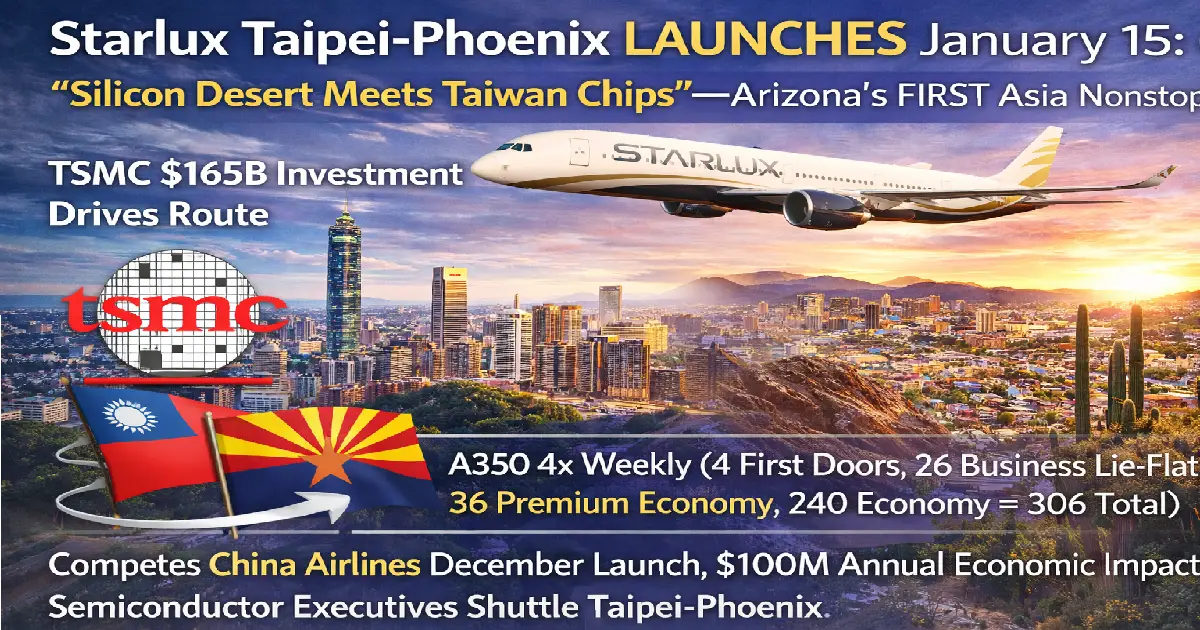
LAUNCHING IN 7 DAYS: Starlux Airlines’ Taipei (TPE)-Phoenix (PHX) inaugural January 15, 2026 = Arizona’s FIRST-EVER nonstop Asia connectivity (NO Phoenix-Asia service existed historically = Alaska/Oregon/Washington West Coast monopolized transpacific, Phoenix forced connecting LAX/SFO adding 3-5 hours) driven by TSMC’s $165 billion Phoenix semiconductor investment (“Silicon Desert” nickname emerging = Phoenix joining Austin/San Jose as US tech hub) creating business travel demand Taiwan executives ↔ Arizona factories daily commute justifying 3× weekly launch (Tuesday/Thursday/Sunday), expanding 4× weekly March 2026 (adding Saturday). Airbus A350-900 configured luxury 306 total seats (4 First Class suites WITH privacy doors = Starlux’s flagship product, 26 Business Class lie-flat reverse herringbone, 36 Premium Economy deep recline 38″ pitch, 240 Economy 32″ pitch = spacious vs industry 31″) featuring signature Starlux service (gourmet dining, amenity kits, premium entertainment = “luxury for everyone not just elite” brand positioning). Flight time 13-14 hours nonstop Taipei-Phoenix (vs current LAX connection 16-18 hours total = saves 3-5 hours eliminating layover), schedule optimized semiconductor executives (evening TPE departure arrives morning PHX = workday available, evening PHX return arrives afternoon TPE+1 = minimal lost time). Competes China Airlines’ December 2025 Phoenix launch (EVA Air’s competitor = Starlux third Taiwan carrier entering market proving demand strong enough support THREE carriers = unprecedented Phoenix-Asia capacity explosion 2025-2026). Economic impact projected $100M annually Phoenix (tourism + business travel combined), airport incentives $4M supporting route = government recognizing TSMC investment requires robust air connectivity infrastructure matching Silicon Valley’s San Francisco/San Jose transpacific dominance.
Published: January 8, 2026 LAUNCHING: January 15, 2026 (7 DAYS from publication!) Historic First: Arizona’s FIRST nonstop to Asia EVER Route: Taipei Taoyuan (TPE) ↔ Phoenix Sky Harbor (PHX) Distance: ~6,800 miles (10,944 km) Flight Time: 13-14 hours nonstop Frequency: 3× weekly launch (Tue/Thu/Sun), 4× weekly March 2026 (+Saturday) Aircraft: Airbus A350-900 (306 seats: 4 First, 26 Business, 36 Premium Economy, 240 Economy) Catalyst: TSMC $165 billion Phoenix investment = semiconductor executive shuttle demand Competition: China Airlines launched December 2025, EVA Air considering Economic Impact: $100M+ annual Phoenix economy
January 15, 2026 Inaugural Flight:
Starlux Airlines’ Phoenix-Taipei service debuts = Arizona aviation history milestone (NO previous Phoenix-Asia nonstop service = West Coast cities monopolized transpacific decades).
Glenn Chai (CEO, Starlux Airlines):
“We are honored to launch the first nonstop flight connecting Arizona and Asia. As the fifth largest city in the U.S., Phoenix presents tremendous potential for both business and leisure travel. From its rich tourism offerings to its emergence as a hub for innovation and technology, the city continues to attract global attention—especially with the influx of leading tech companies. TSMC’s presence has further encouraged the development of surrounding industries and deepened the exchange between Taiwan and Phoenix.”
Kate Gallego (Mayor, Phoenix):
“Phoenix’s first non-stop flight to Asia reflects the incredible strides we’ve made with our local economy, and our emergence as an international city. TSMC’s historic investment in Phoenix has brought thousands of high wage jobs and boosted our reputation as a semiconductor hub, and now it’s helping increase air service demand.”
What TSMC Does:
Phoenix Investment Details:
Why Phoenix?
“Silicon Desert” Nickname:
YOUR AMERICAN CHICAGO ARTICLE CONNECTION:
Like American expanding Chicago hub (your article #5: 100 flights ORD = hub intensification), Phoenix becoming aviation hub driven by SPECIFIC industry (semiconductors) justifying international expansion = industry-specific route development (vs generic leisure tourism driving most transatlantic).
January 15 – March 2026 Launch (3× Weekly):
Outbound (Taipei → Phoenix):
Return (Phoenix → Taipei):
March 2026+ Expansion (4× Weekly):
Why These Times Perfect Semiconductor Executives:
Evening TPE Departure (11:55 PM):
Midnight PHX Return (12:05 AM):
Result: Minimal lost work time both directions = executives productive both cities.
Airbus A350-900 Specifications:
Seat Specifications:
Service:
YOUR JETBLUE MINI MINT ARTICLE CONNECTION:
Like JetBlue adding domestic first class (your article #7: Mini Mint June 2026 = budget carrier premium transformation), Starlux = “luxury for everyone” positioning (premium product accessible pricing vs ultra-luxury Emirates/Singapore = Starlux middle ground affordable premium).
Seat Specifications:
Comparison Global Competitors:
| Airline | Business Seat | Doors? | Screen Size |
|---|---|---|---|
| Starlux | Collins Aerospace | No (high shell) | 24 inches |
| Singapore | Older B/E Diamond | No | 18 inches |
| Cathay Pacific | Reverse herringbone | No | 18 inches |
| EVA Air | Staggered | No | 18 inches |
| China Airlines | Reverse herringbone | No | 18 inches |
Starlux advantage: Larger screens (24″ vs industry 18″) = better entertainment long-haul.
Seat Specifications:
Pricing (Estimates):
Seat Specifications:
Launch Date: December 2025 (1 month BEFORE Starlux)
Frequency: 3× weekly (same as Starlux initial)
Aircraft: A350-900 (similar Starlux)
Configuration: ~300 seats (business + premium economy + economy, NO first class)
China Airlines Advantage:
China Airlines Disadvantage:
Advantage:
Disadvantage:
Status: Considering Phoenix route (NOT confirmed yet)
If launches: Would be THIRD Taiwan carrier = unprecedented Phoenix-Taiwan capacity
Rationale: EVA Air = Taiwan’s other major carrier (alongside China Airlines, Starlux) = can’t afford ignore market if competitors succeed
Market Reality:
THREE Taiwan carriers Phoenix = either:
Prediction: Two carriers survive long-term (Starlux + China Airlines OR EVA), one exits.
1. TSMC EXECUTIVES:
2. TSMC ENGINEERS:
3. SUPPLIERS:
4. US TECH COMPANIES:
YOUR PHILIPPINE AIRLINES ARTICLE CONNECTION:
Like PAL’s Manila-Atlanta diaspora focus (your article #15: 4M Filipino-Americans VFR traffic), Starlux’s Phoenix route = BUSINESS travel focus (semiconductor executives vs family visits) BUT same principle: identify SPECIFIC demand source (diaspora vs industry) and tailor route.
While semiconductors = PRIMARY driver, tourism = SECONDARY revenue:
Attractions:
Demographics:
Attractions:
Demographics:
Phoenix Sky Harbor Airport Study:
Airport Incentives:
YOUR HAWAIIAN $600M ARTICLE CONNECTION:
Like Hawaiian’s $600M investment (your article #10: premium lounge, A330 suites, infrastructure), Phoenix’s $4M Starlux incentives = GOVERNMENT investing air connectivity recognizing TSMC’s $165B requires robust international access = public-private partnership (government supports airlines, airlines support economy).
Founded: 2018 by K.W. Chang (former EVA Air chairman)
First Flight: January 2020 (launched right before COVID = terrible timing!)
Fleet: 28 aircraft (all Airbus: A321neo, A330neo, A350-900 = modern, efficient)
Routes: 29 destinations (Taiwan, Japan, Southeast Asia, US West Coast, NOW Phoenix)
Philosophy: “Luxury accessible” (NOT ultra-luxury Emirates $20K first class, NOT budget Scoot cramped, BUT middle-ground premium $3K-5K business attainable professionals)
Strategy: Focus US West Coast (shorter flight times vs East Coast = cheaper operations, Asian diaspora concentrated California/Washington)
YOUR INDIGO INDIA-GREECE ARTICLE CONNECTION:
Like IndiGo expanding internationally A321XLR (your article #17: Delhi/Mumbai-Athens first Indian carrier Greece), Starlux = newer carrier (founded 2018) aggressively expanding challenging established carriers (China Airlines, EVA Air decades operating) = upstart disrupting status quo premium positioning.
Starlux Website: www.starlux-airlines.com
Pricing (Launch Promotions Likely):
Taipei Taoyuan (TPE):
Phoenix Sky Harbor (PHX):
Entertainment:
Meals:
Wi-Fi:
Starlux Airlines’ Taipei-Phoenix inaugural January 15, 2026 (LAUNCHING 7 DAYS!) = Arizona aviation milestone establishing state’s FIRST-EVER nonstop Asia connectivity ending decades West Coast transpacific monopoly (Phoenix historically forced LAX/SFO connections adding 3-5 hours = Starlux’s 13-14 hour nonstop saves time eliminating layover hassles, missed connections, baggage issues) driven by TSMC’s $165 billion Phoenix semiconductor investment creating “Silicon Desert” phenomenon (Phoenix joining Austin/San Jose as US tech hub = semiconductor manufacturing concentration rivaling Taiwan/South Korea) generating business travel demand justifying 3× weekly launch (Tuesday/Thursday/Sunday), expanding 4× weekly March 2026 (adding Saturday) Airbus A350-900 configured luxury 306 total seats (4 First Class suites WITH privacy doors = Starlux flagship product beating Singapore/Cathay Pacific regional competitors, 26 Business lie-flat reverse herringbone, 36 Premium Economy 38″ pitch deep recline, 240 Economy 32″ pitch = +1″ vs industry standard 31″ acknowledging 13-14 hour transpacific requires comfort not cramming).
Route timing optimized semiconductor executive shuttle: Evening 11:55 PM Taipei departure arrives 9:25 PM Phoenix same day (crosses International Date Line = sleep onboard overnight, arrive evening check-in hotel, FULL workday next morning Phoenix fab), return midnight 12:05 AM Phoenix arrives 6:35 AM+1 Taipei (sleep overnight onboard, arrive morning Taipei office full workday = minimal lost time both directions), frequency 3-4× weekly enables weekly Taiwan ↔ Arizona rotations TSMC C-suite executives, biweekly middle management, monthly engineers rotating assignments = consistent high-yield business class demand (First $7K-10K, Business $3,500-5,500 roundtrip = premium revenue offsetting lower economy load factors off-peak seasons).
Competition intensifying: China Airlines launched December 2025 (1 month head start capturing initial TSMC corporate contracts BUT Starlux counters superior product = First Class doors 32″ 4K screens vs China Airlines lacks first class entirely, Business Class 24″ screens vs China Airlines 18″, Premium Economy 38″ pitch vs 36″, Economy 32″ vs 31″ = across ALL cabins Starlux more spacious justifying premium pricing $100-300 higher per ticket passengers willingly pay comfort 13-14 hour flights), EVA Air considering launch (would be THIRD Taiwan carrier Phoenix = unprecedented capacity Taiwan-Arizona 9-12× weekly combined IF all three operate suggesting either demand exceptionally strong TSMC alone supporting OR overcapacity leading consolidation 12-24 months one carrier exits/reduces frequencies = market dynamics testing period 2026-2027 determines long-term survivors).
Economic projections Phoenix: $100M+ annual impact (airport study estimates direct airline operations + indirect tourism spending + induced ripple effects), government incentives $4M supporting route (marketing funds, fee waivers, gate priority = Phoenix recognizing TSMC’s $165B investment requires robust international air connectivity infrastructure matching Silicon Valley’s San Francisco/San Jose transpacific dominance 50+ daily Asia flights vs Phoenix’s historic ZERO making air access critical competitive factor attracting future tech investments beyond semiconductors), tourism secondary market (Grand Canyon, Sedona, Monument Valley = Taiwanese families road trips, retirees mild winters, young couples Instagram-worthy landscapes) complementing primary business travel BUT VFR minimal (no significant Taiwanese diaspora Phoenix unlike California 500K+ Chinese/Taiwanese = route relies business + leisure NOT visiting friends/relatives unlike your PAL Manila-Atlanta 4M diaspora or American PHL-Budapest 1.5M Hungarian-Americans = different demand dynamics requiring sustained corporate/tourism traffic vs baseline VFR reliability).
Your expansion articles connections completing tech-driven aviation theme: Alaska Seattle-Rome historic first (your article #3: leisure/tourism driving route vs Phoenix semiconductors = business driving route = contrasting demand sources both valid), IndiGo India-Greece A321XLR (your article #17: aircraft technology enabling thin routes vs Starlux widebody serving SPECIFIC industry = different strategies similar pioneering spirit), American Philadelphia-Budapest (your article #18: diaspora VFR traffic 1.5M Hungarian-Americans vs Phoenix minimal diaspora = semiconductor executives replacing family visits as demand anchor proving multiple route justifications beyond traditional leisure/VFR models), Philippine Airlines Manila-Atlanta A350-1000 (your article #15: Asian carrier expanding US = parallel Starlux BUT PAL targets diaspora, Starlux targets semiconductors = Asian carriers’ US strategies diversifying), JetBlue Mini Mint premium transformation (your article #7: budget carriers adding premium cabins = Starlux “luxury accessible” similar philosophy premium democratization NOT ultra-luxury Emirates inaccessible masses), United CEO A321XLR thin routes (your article #11: Newark-Edinburgh narrowbody vs Starlux Phoenix widebody = aircraft selection matching market size 200-250 daily passengers Phoenix justifies 306-seat A350 vs Edinburgh’s 150 narrowbody adequate), Hawaiian $600M investment (your article #10: airline infrastructure spending = parallel Phoenix government $4M incentives recognizing air connectivity enables economic development TSMC-driven), your American Chicago 100 flights (article #5: hub intensification = Phoenix becoming semiconductor hub requiring aviation infrastructure expansion supporting industry clustering effects).
For travelers, Starlux Phoenix route represents LUXURY option previously unavailable: Southwest US historically lacked premium transpacific service (Alaska/United West Coast focus Seattle/SFO/LAX = Phoenix residents forced connections adding hours OR drove LAX 6 hours = Starlux eliminates both inconveniences), First Class $7K-10K roundtrip WITH doors 32″ 4K screens = justified 13-14 hour flights IF budget allows (vs China Airlines NO first class = Starlux exclusive market segment), Business Class $3,500-5,500 competitive China Airlines similar pricing BUT superior product (24″ screens, newer seats, premium service = worth choosing Starlux IF prices equivalent), Premium Economy $1,400-2,000 = sweet spot leisure travelers unwilling pay business BUT wanting comfort (38″ pitch leg rests deep recline 8″ vs economy 32″ pitch = significant difference 13+ hours, families 2 adults + 2 kids = $5,600-8,000 total premium economy vs $11,000-15,000 business = $5,400-7,000 savings justifies premium economy upgrade many middle-class families), Economy $800-1,200 competitive BUT 32″ pitch vs industry 31″ = Starlux MORE comfortable same price category (travelers should compare Starlux 32″ vs China Airlines 31″ IF prices similar = choose Starlux extra inch legroom free).
Operational risks acknowledged: January 15 inaugural = week away BUT weather concerns (Phoenix winter mild BUT Taipei January = occasional cold fronts, typhoons rare winter BUT rain/fog possible = flight delays potential first weeks ironing operational kinks), load factor uncertainty (3× weekly launch = conservative capacity BUT March expansion 4× weekly suggests Starlux confident demand sustainable, breakeven load factor typically 75-80% = 230-245 passengers of 306 seats required profitability, semiconductor executives alone ~50-80 passengers per flight estimate = remaining 150-195 seats must fill leisure/tourism = marketing challenge Taiwan promoting Arizona tourism Americans promoting Taiwan reciprocally), competition China Airlines 1-month head start captured low-hanging fruit (early TSMC contracts, corporate travel managers’ initial bookings = Starlux must aggressively market superior product convince switchers), alliance constraints (Starlux NOT SkyTeam/Star Alliance/Oneworld = limited codeshare partners vs China Airlines SkyTeam Delta connections = Starlux relies bilateral deals Alaska, American, JAL = weaker network effects disadvantage business travelers needing onward connections beyond Phoenix/Taipei).
Long-term sustainability depends TSMC Phoenix success: IF TSMC fabs ramp production 2026-2027 as planned (10,000+ employees hiring, chip output increasing = business travel sustained/grows supporting Starlux daily flights eventually), BUT IF TSMC delays/underperforms (water issues, permitting problems, workforce shortages = fab operations slower than expected = business travel demand drops = Starlux forced reduce frequencies 2× weekly OR exit entirely), broader semiconductor industry Phoenix clustering critical (Intel expanding, other companies following TSMC = ecosystem develops = more companies, more executives, more demand vs TSMC alone = single-point failure risk IF TSMC disappoints entire route collapses), tourism growth required offset business volatility (leisure travelers smoothing demand fluctuations business cycles = economic downturns reduce corporate travel BUT tourism resilient = balanced portfolio necessary long-term viability Starlux Phoenix route vs pure business route high-risk).
Phoenix aviation transformation underway: From Sun Belt regional airport (historically Southwest dominated, leisure-focused Vegas/California beaches) to international gateway (“Silicon Desert” emerging = Phoenix’s identity shift tech hub requiring global connectivity = Starlux Phoenix = harbinger more Asia routes coming 2026-2030 potentially Japan/Korea/Singapore following IF TSMC success validates market), airport infrastructure upgrades needed (Terminal 4 international gates currently 2-3 = adding Starlux + potential EVA Air + future carriers = capacity constraints requiring expansion Phoenix Sky Harbor studying $1B+ international terminal upgrade = government recognizing aviation infrastructure lagging tech sector growth must catch up), competitive landscape evolving (Delta hub Phoenix domestic strength BUT lacks transpacific = American/United West Coast hubs dominate Asia = Delta potentially launching Tokyo/Seoul Phoenix 2027-2028 IF sees Starlux/China Airlines success = competitive response protecting Phoenix hub position).
Related Travel Tourister Coverage:
Published: January 8, 2026 Last Updated: January 8, 2026 at 6:00 PM ET Reading Time: 50 minutes
Posted By : Vinay
Lastest News
2nd Floor, 39, Above Kirti Club, DLF Industrial Area, Kirti Nagar, New Delhi, Delhi 110015



Travel Tourister is a leading Travel portal where we introduce travellers to trusted travel agents to make their journey hasselfree, memorable And happy. Travel Tourister is a platform where travellers get Tour packages ,Hotel packages deals through trusted travel companies And hoteliers who are working with us across the world. We always try to find new and more travel agents and hoteliers from every nook and corners across the world so that you could compare the deals with different travel agents and hoteliers and book your tour or hotel with the one you have chosen according to your taste and budget.
Copyright © Travel Tourister, India. All Rights Reserved

 Call
Call Enquiry