Published on : 29 Dec 2025
TRENDING: Tourism accounts for 8% of global emissions as conscious travelers demand carbon-neutral hotels, sustainable aviation fuel, and regenerative tourism experiences
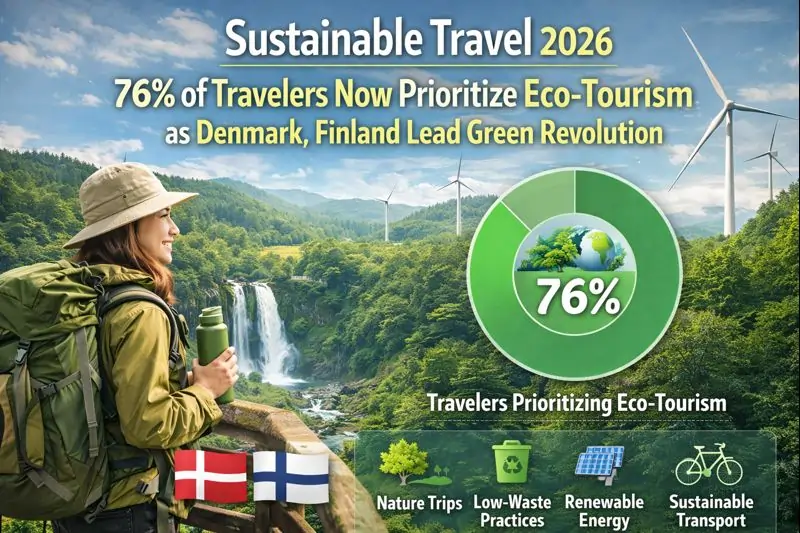
Published: December 29, 2025 Source: UN Tourism, Sustainable Travel International, Multiple Industry Reports Key Finding: 76% of travelers consider sustainability when planning trips Top Green Destinations: Denmark, Finland, Switzerland lead rankings
Seventy-six percent of travelers now consider sustainability when planning trips according to comprehensive industry research, marking a fundamental shift from niche eco-tourism to mainstream travel priority as the sector reckons with its sobering reality—tourism contributes 8% of global carbon emissions while threatening fragile ecosystems, overburdening communities, and littering destinations with plastic waste.
The dramatic evolution reflects growing climate awareness particularly among Millennials and Gen Z who dominate travel demographics and increasingly ask: “Is this experience empowering local people—or exploiting them?” before booking trips. Their values-driven approach transforms mere vacation planning into ethical decision-making where carbon footprints, community impact, and environmental practices determine destination choices alongside traditional factors like cost and activities.
“Travellers expect more than just a ‘nice view’—they want destinations that walk the talk on climate and community,” explains travel sustainability expert Renee Miller. “Adopting eco-travel doesn’t mean sacrificing experience—it means deeper connection and long-term value.”
Denmark’s carbon-neutral Copenhagen, Finland’s Helsinki leading sustainable urban design, and efforts like Dominica’s new whale reserve signal what experts call a “step-change” toward tourism as force for good rather than environmental destruction as the industry faces projected emissions reaching 6.5 billion metric tons by 2025—a 44% increase from 2013 baseline.
Environmental Ranking: Consistently tops clean country indices Signature Achievement: Copenhagen targeting carbon neutrality Key Infrastructure: Bike-first city design, renewable energy, efficient waste systems
Why Denmark leads: “Denmark consistently tops environmental rankings through clean urban planning, renewable energy use and efficient waste systems, making it a benchmark destination for sustainable travel in Europe,” confirm multiple independent sustainability assessments.
Copenhagen’s sustainable attractions:
Copenhill: Ski slope built atop waste-to-energy plant symbolizes innovative sustainability—tourists literally ski on power plant converting trash to electricity while maintaining air quality.
Practical sustainable tourism:
Budget: $150-250/day mid-range sustainable travel including bike rentals, eco-hotels, organic dining.
Environmental Quality: World’s cleanest living environment Natural Assets: Pristine forests, drinkable tap water, minimal pollution Sustainable Innovation: Helsinki model green travel city
Why Finland excels: “Finland’s pristine forests, drinkable tap water and low pollution levels create one of the world’s cleanest living environments, offering travellers quiet landscapes, fresh air and carefully protected natural ecosystems,” according to environmental destination rankings.
Helsinki sustainable highlights:
Finnish Lapland sustainable tourism:
Practical tips:
Environmental Ranking: Exceptional air quality, clean water, pristine landscapes Infrastructure: World-class public transport reducing car dependency Regulation: Strict environmental laws protecting ecosystems
Why Switzerland works: “With strict environmental laws, excellent recycling systems and clean public transport, Switzerland maintains an impressive balance between alpine landscapes, freshwater lakes and immaculately managed cities,” confirm sustainability experts.
Swiss sustainable travel advantages:
Zurich green city:
Cost reality: Switzerland expensive—expect $200-350/day including accommodation, transport, meals. However, Swiss Travel Pass makes train travel affordable and encourages low-carbon tourism.
Renewable Energy: 54% of energy from renewables (primarily hydropower, wind) Urban Innovation: Stockholm and Gothenburg leading green city design Transportation: Extensive rail network, electric buses
Swedish sustainability:
Stockholm green features:
Gotland island: Wind energy leader, sustainable agriculture, bicycle-friendly, slow travel philosophy.
Environmental Legacy: First country to grant legal personhood to nature (Whanganui River) Conservation: 30% of land protected in national parks and reserves Carbon Goals: Targeting carbon neutrality by 2050
Why New Zealand innovative:
Practical sustainable tourism:
Challenges: Long-haul flights to reach New Zealand create significant carbon footprint. Consider extended stays (2-3 weeks minimum) to justify emissions, purchase carbon offsets, or explore cruise alternatives with lower per-person emissions.
Achievements: 98% renewable energy, carbon negative since 2016, biodiversity hotspot Model: Eco-lodges, wildlife conservation, reforestation programs Goal: Carbon neutral by 2021 (achieved), plastic-free by 2026
Costa Rican eco-tourism leadership:
Practical experiences:
Budget: $100-200/day possible with eco-lodges, local food, bus transport—excellent value for sustainability.
Environmental Commitment: Electric vehicles dominating (highest EV adoption globally) Energy: 98% electricity from hydropower Tourism Management: Strict regulations preventing overtourism
Norwegian sustainable practices:
Bergen and fjords:
Cost: Expensive ($200-350/day) but worthwhile for pristine nature access with environmental protection.
Energy: 85% from renewable sources (geothermal and hydropower) Nature Protection: Strict access rules protecting fragile ecosystems Innovation: Carbon capture technology pilot programs
Icelandic sustainability:
Challenges: Iceland experiencing overtourism straining infrastructure. Practice responsible tourism:
Certification: Slovenia Green destination certification covering entire country Achievements: Ljubljana European Green Capital 2016 Nature: 60% forest coverage, clean rivers, protected Julian Alps
Slovenian sustainability:
Practical:
Budget: Affordable for Europe ($75-150/day) with strong sustainability infrastructure.
Philosophy: Gross National Happiness over GDP Carbon: Only carbon-negative country (absorbs more CO2 than produces) Tourism: High-value, low-impact model (daily tariff requirement)
Bhutanese model:
Why it works: High tariff limits visitor numbers while ensuring tourism revenue directly benefits communities, infrastructure, and conservation. Every tourist pays for their environmental impact while experiencing Himalayan culture authentically.
Practical: Book through licensed tour operators only (required), respect Buddhist culture, support local handicrafts, follow guide’s environmental guidance.
Emission Breakdown:
“Tourism is responsible for 8% of the world’s carbon emissions. Along with the construction process, tourism development emits carbon through the clearing of natural areas,” confirms Sustainable Travel International.
Alarming projections: Tourism emissions could reach 6.5 billion metric tons by 2025—a 44% increase from 2013, equivalent to 13% of current global greenhouse gas emissions.
Best Carbon Calculators:
Sustainable Travel International:
Goodwings:
Joro and Ecolytiq:
Example calculations:
Quality offset criteria:
Recommended offset projects:
Cost: $10-30 typically offsets one ton CO2. Average international flight generates 1-4 tons per passenger depending on distance and class.
Beyond offsetting: Reduction more important than offsetting. Choose direct flights (take-offs/landings most carbon-intensive), fly economy (business class has 3x footprint per passenger), pack light (every kg adds fuel burn), fly less frequently but stay longer.
Major carriers investing heavily in SAF—fuel made from sustainable sources (waste oils, agricultural residues, algae) reducing lifecycle emissions up to 80% versus traditional jet fuel.
Airlines leading SAF adoption:
Air France:
Iberia:
Lufthansa:
United Airlines:
Current challenges: SAF availability limited, costs 2-5x conventional jet fuel, passenger willingness to pay premium unclear.
2026 reality: SAF comprises <1% of global jet fuel but growing. Expect gradual increase but conventional fuel dominates near-term. Choose airlines committed to sustainability when possible.
Recognized eco-certifications:
Green Key:
EarthCheck:
LEED Certification:
Green Globe:
Nordic Swan Ecolabel:
Key features:
Red flags:
“Luxury properties are responding with regenerative agriculture programs, zero-waste spa treatments, and even ‘sleep tourism’—where eco-lodges built around circadian wellness help travelers reconnect while maintaining minimal environmental impact,” reports sustainable luxury travel analysis.
High-end sustainable resorts:
Cost: Sustainable luxury comparable to conventional luxury ($400-1000+/night) but environmental and social impact dramatically different.
Priority order (lowest to highest carbon):
When flying unavoidable:
“Going beyond offsetting, some operators now offer carbon-negative trips—where your travel actively removes more CO₂ than it emits,” reports latest sustainable tourism analysis.
Regenerative tourism principles:
Examples:
Finding opportunities:
“Apps like Goodwings, Joro, and Ecolytiq help you calculate and offset your carbon footprint in real time, while GreenGo and FairTrip guide you to certified eco-accommodations and responsible tour operators,” confirms tech-enabled sustainable travel analysis.
Essential sustainable travel apps:
Carbon tracking:
Sustainable dining:
Green accommodation:
Eco-conscious route planning:
Packing optimization:
The evolution from niche eco-tourism to mainstream sustainability priority—76% of travelers now considering environmental impact—represents fundamental transformation in how humans explore the world. Tourism’s sobering 8% contribution to global emissions and projected growth to 6.5 billion metric tons demands urgent action from industry and individual travelers alike.
Denmark’s carbon-neutral Copenhagen, Finland’s pristine Helsinki, Switzerland’s protected Alps, and Costa Rica’s renewable energy leadership demonstrate that sustainable tourism isn’t sacrifice—it’s enhancement. These destinations prove environmental stewardship creates better experiences: cleaner air, protected nature, thriving local cultures, and authentic connections impossible in overtouristed, exploited destinations.
Key takeaways for 2026 sustainable travelers:
✓ Choose green destinations (Denmark, Finland, Switzerland, New Zealand, Costa Rica lead) ✓ Calculate carbon footprint using tools like Sustainable Travel International calculator ✓ Offset unavoidable emissions through certified programs (Gold Standard, VCS) ✓ Fly less, stay longer (biggest single impact: reduce flight frequency) ✓ Take trains over planes when feasible (10x lower emissions) ✓ Stay at certified properties (Green Key, EarthCheck, LEED) ✓ Eat local, seasonal, plant-based (lower carbon footprint) ✓ Support community tourism (local guides, family businesses, artisans) ✓ Choose regenerative experiences (conservation volunteering, restoration projects) ✓ Use sustainable travel apps (Goodwings, HappyCow, GreenGo, FairTrip)
Sustainability isn’t perfection—it’s progress. Even small changes create ripple effects. Refusing plastic bottles, walking instead of driving, supporting local businesses, staying longer in fewer places, and choosing certified sustainable operators transforms tourism from extractive exploitation into regenerative relationship.
As travel behaviour specialist Dr. Lina Moretti notes: “The best trips will be the ones we take responsibly.” When 76% of travelers prioritize sustainability, the message is clear: tourism’s future lies not in choosing between travel and environment, but in ensuring travel actively benefits the places and communities that make journeys meaningful.
For More Resources:
Related Travel Guides:
Final Reflection: Every journey shapes not just the traveler but the destination. In 2026, conscious travelers recognize their power to drive positive change through choices—where they go, how they travel, where they stay, what they eat, and how they engage with communities. The question isn’t whether you can afford to travel sustainably, but whether you can afford not to.
Posted By : Vinay
Lastest News
2nd Floor, 39, Above Kirti Club, DLF Industrial Area, Kirti Nagar, New Delhi, Delhi 110015



Travel Tourister is a leading Travel portal where we introduce travellers to trusted travel agents to make their journey hasselfree, memorable And happy. Travel Tourister is a platform where travellers get Tour packages ,Hotel packages deals through trusted travel companies And hoteliers who are working with us across the world. We always try to find new and more travel agents and hoteliers from every nook and corners across the world so that you could compare the deals with different travel agents and hoteliers and book your tour or hotel with the one you have chosen according to your taste and budget.
Copyright © Travel Tourister, India. All Rights Reserved

 Call
Call Enquiry