Published on : 12 Feb 2026
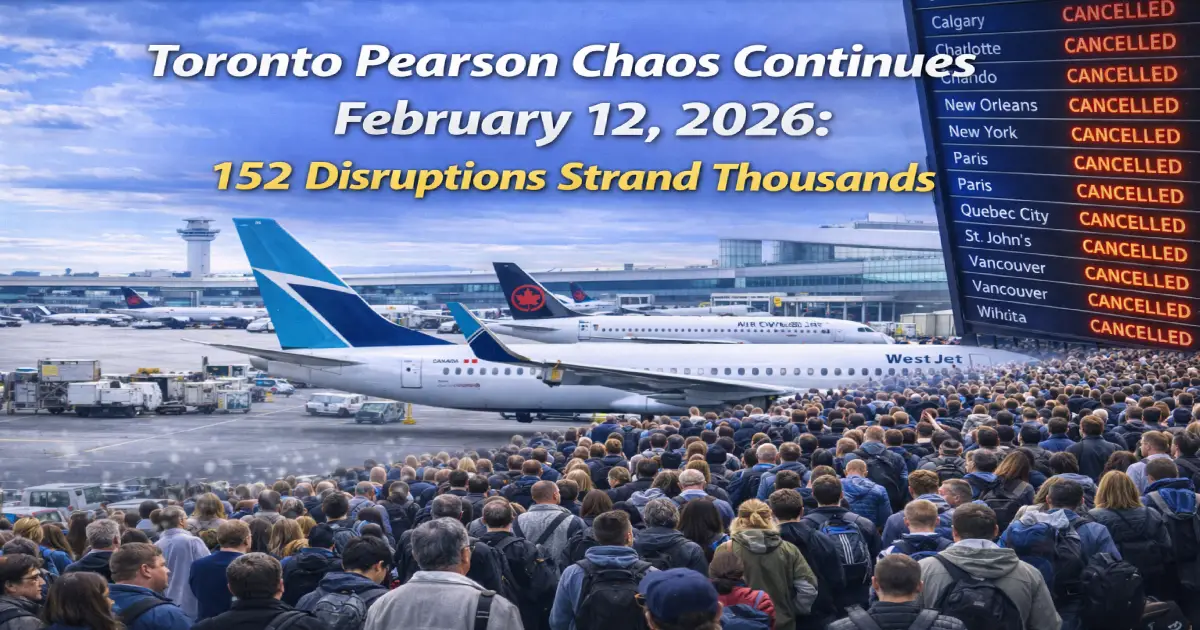
Breaking: Toronto Pearson International Airport’s operational nightmare extends into day four as 19 cancellations and 133 delays strand thousands of passengers across U.S., Caribbean, and domestic routes—with Air Canada, WestJet, and Jazz Aviation accounting for 17 of 19 total cancellations despite clear weather conditions. Here’s everything you need to know now.
Published: February 12, 2026 Event Status: ACTIVE (day 4 of ongoing crisis) Total Disruptions: 152 flights (19 cancellations + 133 delays) Airport Impact: 15% of scheduled operations disrupted Passengers Affected: 10,000-15,000 estimated Weather: Clear skies, -2°C (NO weather excuse)
Toronto Pearson International Airport (YYZ)—Canada’s busiest aviation hub—enters fourth consecutive day of chaos with 152 total disruptions (19 cancellations + 133 delays) despite perfect weather conditions, confirming operational failures rather than meteorological causes are driving the crisis.
The airline breakdown reveals concentrated problems: Air Canada leads with 7 cancellations and 54 delays (61 total disruptions = 40% of all Pearson chaos), WestJet follows with 6 cancellations and 19 delays, Jazz Aviation contributes 4 cancellations and 9 delays, and Air Canada Rouge adds 2 cancellations and 21 delays—meaning Canada’s three major carrier groups (Air Canada family + WestJet) account for 17 of 19 total cancellations (89%) while other carriers (British Airways, Porter, Qatar, EVA Air, United, American, Delta) experience delays but minimal cancellations.
U.S. routes bear disproportionate impact with 50 delays and 7 cancellations affecting Boston, Newark, LaGuardia, Los Angeles, Chicago, Denver, San Francisco, Tampa, and Fort Lauderdale connections—disrupting transborder business travel, connecting flights, and American passengers transiting through Toronto to Canadian destinations or international hubs.
Caribbean and Mexico leisure routes face severe disruption: Cancun, Punta Cana, Montego Bay, Los Cabos, Cozumel, Puerto Escondido all logged significant delays, while Cuba-specific routes (Jardines del Rey, Juan Gualberto Gomez airports) show abnormally high cancellation ratios suggesting targeted operational decisions rather than random weather impacts.
Key Numbers:
✈️ 19 cancellations + 133 delays = 152 total disruptions ✈️ Air Canada: 7 cancellations, 54 delays (40% of all Pearson chaos) ✈️ WestJet: 6 cancellations, 19 delays ✈️ Jazz Aviation: 4 cancellations, 9 delays ✈️ Air Canada Rouge: 2 cancellations, 21 delays ✈️ U.S. routes: 50 delays + 7 cancellations ✈️ Weather: Clear, -2°C (NO meteorological excuse)
February 9, 2026: Arctic cold snap (-34°C wind chill) triggers 62 cancellations, 232 delays = 294 total disruptions. Legitimate weather emergency creates operational backlog.
February 10-11, 2026: “Recovery period” sees 21 cancellations, 185 delays persist despite improving weather. Airlines claim “lingering effects” from February 9 cold.
February 12, 2026 (TODAY): Clear weather, -2°C conditions produce 19 cancellations, 133 delays = 152 disruptions. NO weather excuse remains—this is pure operational failure.
Cumulative impact (Feb 9-12):
Critical observation: February 12 disruption rate (15% of operations) exceeds industry baseline (2-3%) by 5-7x despite perfect weather, proving Toronto Pearson/Air Canada operational crisis is systemic, not meteorological.
Today’s numbers: 7 cancellations, 54 delays Market share: Operating ~50% of Pearson flights Disruption percentage: 61 disruptions = 40% of all Pearson chaos despite 50% market share
Air Canada’s 61 disruptions (7 cancellations + 54 delays) represent disproportionate failure rate—airline operating half of Pearson’s flights but generating 40% of disruptions, indicating operational problems beyond simple volume effects.
Major cancellations today:
ACA400: Toronto-Montreal widebody flagship domestic route—cancelled for SECOND time in four days (also cancelled February 9, 10). Canada’s two largest cities repeatedly disconnected by airline’s largest domestic service = unacceptable for business travelers, government officials, connecting passengers.
ACA181/182: Toronto-Los Angeles widebody round-trip—morning departure 181 and evening return 182 both cancelled, severing critical transborder route for Canadian travelers heading to Southern California and connecting to Asia-Pacific flights via LAX hub. Passengers with onward connections to Hawaii, Tokyo, Sydney faced 24+ hour delays.
Domestic disruptions: Multiple Toronto-Halifax, Toronto-Calgary, Toronto-Vancouver flights cancelled or delayed 2-6 hours, creating cascading network problems where Toronto delays trigger Montreal delays which cascade to Halifax delays—hub-and-spoke model vulnerability on full display.
U.S. connection failures: 50 delays and 7 cancellations involved U.S. routes, meaning American travelers transiting through Toronto or U.S. passengers connecting from Canada faced rebooking nightmares. Many discovered Air Canada won’t automatically rebook on competitor airlines (United, American, Delta) despite APPR/DOT regulations requiring “next available flight on any carrier.”
Today’s numbers: 6 cancellations, 19 delays Market share: Operating ~15-20% of Pearson flights Disruption concentration: Calgary hub also affected (21 cancellations, 66 delays system-wide)
WestJet’s problems extend beyond Toronto—airline facing system-wide operational crisis with Calgary hub (airline’s largest base) reporting 21 total cancellations and 66 delays across entire network, indicating corporate-wide operational fragility rather than isolated Toronto issues.
Impact routes:
Toronto-Calgary: Critical business/family connection repeatedly disrupted Toronto-Vancouver: Western Canada gateway affected Toronto-U.S. cities: New York, Los Angeles, Chicago connections hit
Why WestJet struggling:
Post-pandemic debt obligations limiting operational reserves Crew shortage issues (similar to Air Canada) Fleet constraints (operating at near-maximum capacity leaves no buffer for disruptions) Winter operational challenges (Canadian airline infrastructure struggles with predictable seasonal weather)
Today’s numbers: 4 cancellations, 9 delays Operating model: Regional feeder for Air Canada Express Route impact: Short-haul domestic connections to smaller Canadian cities
Jazz Aviation operates smaller aircraft (Bombardier CRJ, Dash 8) serving communities like Thunder Bay, Sudbury, Timmins, Windsor, Sault Ste. Marie—meaning Jazz cancellations disproportionately affect isolated communities with limited alternative transportation.
Why Jazz hit hard:
Smaller aircraft more vulnerable to operational issues (crew shortages affect proportionally more flights) Thin margins = minimal operational reserves Tight schedules = no buffer for delays Regional airports have fewer alternative carriers
Today’s numbers: 2 cancellations, 21 delays Operating focus: Leisure/vacation routes to Caribbean, Mexico, Europe Peak season impact: February = winter sun getaway peak demand
Rouge operates Air Canada’s leisure routes using higher-density seat configurations and lower-cost operations model—but today’s 2 cancellations + 21 delays hit vacation travelers hardest during peak February winter escape season.
Affected destinations:
Caribbean: Cancun, Punta Cana, Montego Bay, Cuba routes Mexico Pacific Coast: Los Cabos, Puerto Vallarta, Puerto Escondido Central America: Costa Rica
Passenger impact type: Families losing non-refundable resort days, couples missing cruise departures, spring breakers with forfeited hotel payments = high emotional + financial damage despite “only” 2 cancellations.
Affected U.S. cities:
Los Angeles (LAX): Toronto-LA widebody cancelled (ACA181/182), disrupting transborder travel and Asia-Pacific connections LaGuardia (LGA): Multiple delays affecting New York metro business travelers Newark (EWR): Delays creating cascading problems for United passengers Chicago (ORD): Midwest hub connections disrupted Denver (DEN): Mountain West gateway affected San Francisco (SFO): West Coast tech corridor travel hit Tampa (TPA): Florida winter destination delays Fort Lauderdale (FLL): South Florida leisure routes affected
Cross-border implications:
U.S. Department of Transportation (DOT) jurisdiction applies to flights touching U.S. soil, meaning Air Canada/WestJet face both Canadian APPR regulations AND U.S. DOT passenger rights requirements—creating dual compliance obligations and higher compensation exposure for U.S. route failures.
American travelers increasingly frustrated with Canadian airline reliability—many now booking United/American/Delta for cross-border travel despite higher fares, viewing extra cost as “reliability insurance” against Air Canada operational chaos.
Cancun (CUN): Multiple delays affecting Mexico’s #1 beach destination during peak winter season Punta Cana (PUJ): Dominican Republic all-inclusive resort gateway disrupted Montego Bay (MBJ): Jamaica tourism affected Los Cabos (SJD): Baja California luxury destination delays Cozumel (CZM): Cruise port connections missed Puerto Escondido (PXM): Pacific Coast boutique destination hit
Cuba-specific crisis:
Jardines del Rey (CCC): High cancellation ratio suggests targeted operational decisions Juan Gualberto Gomez (VRA): Abnormal disruption pattern
Why Cuba routes disproportionately affected:
Cuba jet fuel crisis (February 10-March 11, 2026: ALL 9 Cuban airports running dry, 400+ weekly flights cancelled/suspended)—airlines may be proactively cancelling Cuba routes due to fuel unavailability at Cuban airports rather than Toronto operational issues, though airlines not transparently communicating this distinction to passengers.
Toronto-Montreal: Flagship domestic route repeatedly cancelled (ACA400) Toronto-Halifax: Maritime Provinces connection disrupted Toronto-Calgary: East-West transcontinental link affected Toronto-Vancouver: Coast-to-coast service hit Toronto-Ottawa: Capital corridor business travel impacted
Regional impacts:
Maritime Provinces (Nova Scotia, New Brunswick, PEI, Newfoundland) face isolation when Halifax routes cancel—limited alternative transportation (no VIA Rail to many destinations, 8-18 hour driving distances)
Thunder Bay, Sudbury, Timmins, Windsor, Sault Ste. Marie communities served primarily by Jazz Aviation face complete connectivity loss when regional flights cancel
Today’s Toronto weather (7:00 AM EST):
🌡️ Temperature: -2°C (28°F) ☁️ Conditions: Cloudy (no precipitation) 💨 Wind: 15 km/h (light) 👁️ Visibility: 10+ km (excellent) ❄️ Runway conditions: Clear (no ice, snow)
Comparison to February 9 legitimate emergency:
🌡️ Temperature: -20°C (-4°F) 💨 Wind chill: -34°C (-29°F) ❄️ Conditions: Life-threatening cold, frozen de-icing equipment ⚠️ Environment Canada: Extreme Cold Warning active
Critical distinction:
February 9 = Legitimate weather emergency → Airlines exempt from cash compensation under APPR “exceptional circumstances” clause
February 12 = Perfect weather → Operational failure → Airlines MUST provide cash compensation ($400-1,000 CAD) for delays 3+ hours
Why this matters for passengers:
If your flight was disrupted February 12 and airline claims “weather delay,” that’s FALSE and you’re entitled to compensation. Document weather conditions (screenshot weather.gc.ca, take photos of clear skies), include in compensation claim, escalate to Canadian Transportation Agency if denied.
Because today’s disruptions are operational (confirmed by clear weather, -2°C, no precipitation), Air Canada, WestJet, Jazz, and Rouge face FULL APPR obligations:
✅ Compensation for delays 3+ hours:
3-6 hours: CAD $400 6-9 hours: CAD $700 9+ hours: CAD $1,000
✅ Rebooking obligations:
Next available flight on ANY airline (not just your original carrier) If Air Canada’s next flight is 6+ hours away but United has flight in 2 hours, airline MUST book you on United Fare difference absorbed by airline Equivalent or better cabin class
✅ Meals and accommodation:
$15 breakfast vouchers $20 lunch/dinner vouchers Hotel accommodation for overnight delays (when available) Ground transportation to/from hotel If hotel vouchers sold out, airline must reimburse self-booked “reasonable” accommodation ($100-150/night 3-star airport hotel)
✅ Communication requirements:
Status updates every 30 minutes Proactive notification of delays/cancellations Clear explanation of passenger rights
❌ What airlines will try to avoid:
Claiming “weather delay” despite clear conditions (document actual weather to dispute) Refusing competitor rebooking (insist on APPR compliance) Limiting hotel reimbursement (keep receipts, appeal if denied) Denying meal vouchers (request explicitly, document refusal)
Immediate actions (at airport):
Follow-up actions (within 30 days):
Toronto-Los Angeles widebody cancellation (ACA181):
Michael Zhang (Toronto resident, technology consultant traveling to LA for client meeting): “Woke up 4:00 AM for 7:00 AM departure. Checked Air Canada app 5:30 AM—flight showing ‘On Time.’ Arrived airport 5:45 AM, checked bags, cleared security. At gate 6:30 AM, agent announces flight cancelled. No explanation. No apology. Just ‘check your app for rebooking.’ App kept crashing. Waited in line 90 minutes at service desk. Agent offered rebooking… on TOMORROW’s flight. I have client presentation this afternoon 2:00 PM LA time. Missing it costs my company $50,000+ contract. I specifically asked about United flight leaving 11:00 AM—agent said ‘we can only book Air Canada.’ I showed her APPR regulations on my phone requiring competitor rebooking. She called supervisor… supervisor approved United rebooking but claimed ‘this is exception, not normal policy.’ That’s a LIE. APPR legally requires competitor rebooking. I made my meeting with 30 minutes to spare—but only because I knew my rights and fought for 45 minutes. How many other passengers accepted tomorrow’s rebooking because they didn’t know they could demand United flight today?”
Cancun vacation nightmare:
Sarah & David Morrison (Vancouver family with two children ages 8, 11, traveling Toronto-Cancun for week-long resort vacation): “We booked Cancun all-inclusive package 6 months ago. $8,000 total (flights + resort). Non-refundable. Air Canada Rouge flight AC1876 delayed… 2 hours… 4 hours… 6 hours. We have resort check-in 3:00 PM Cancun time, paid activities scheduled starting tomorrow morning. After 6 hours, agent announces flight cancelled entirely. Rebooking offered… February 14 (two days away). We lose 2 of 7 vacation days we paid for. Resort won’t refund missed nights—they say that’s between us and airline. Air Canada offers $15 meal vouchers and says ‘file claim after trip for possible compensation.’ POSSIBLE? APPR says we get $700-1,000 CAD per person for 6+ hour delays if operational cause. That’s $2,800-4,000 for family of four. Plus we’re out $600 for two lost resort nights. Air Canada acting like they’re doing us a favor by rebooking us—but they DESTROYED our vacation and they’re legally required to compensate us. We’ll be filing CTA complaint the minute we get home.”
Regional isolation:
Tom Henderson (Thunder Bay resident returning from business trip, Jazz Aviation flight AC7842 cancelled): “I live in Thunder Bay. Jazz Aviation is the ONLY airline flying Thunder Bay-Toronto direct. My flight today cancelled—no explanation except ‘operational reasons.’ Agent offers rebooking… tomorrow afternoon. I have work tomorrow morning. I asked about Porter, WestJet, anything—agent says ‘no other airlines fly this route.’ So I’m stuck. I can drive home—18 hours. Or wait 27 hours for tomorrow’s flight and miss work. Either way I lose. This is the problem with regional Canada—when Jazz cancels, you have ZERO alternatives. And they know it. So they cancel whenever convenient for them, knowing passengers have no leverage.”
February 9 legitimate weather emergency created operational backlog—aircraft in wrong cities, crews hitting duty time limits, maintenance backlogs accumulating. However, professional airlines recover from weather disruptions within 24-48 hours.
Timeline expectation vs. reality:
Industry standard recovery: 48-72 hours max Air Canada/WestJet reality: Day 4 and counting
Root causes of extended crisis:
Pilots and flight attendants hitting maximum duty hours during February 9 chaos now require mandatory rest periods before returning to service—but airlines operating with thin crew reserves (cost-cutting measure) means insufficient backup crews available to fill gaps.
Compounding factors:
Flu season peak = elevated sick calls Crew attrition = pilots/flight attendants leaving for better conditions at Delta, United, Emirates Duty time violations = crews can’t legally fly even if willing Positioning problems = crews in wrong cities, takes 24+ hours to reposit
ion
Cold weather mechanical issues (hydraulic failures, de-icing equipment problems, avionics glitches) during February 9 created maintenance queue that’s taking days to clear.
Deferred maintenance: Airlines defer “non-critical” repairs during normal operations to maximize aircraft availability—but when multiple aircraft need simultaneous attention after weather event, maintenance capacity overwhelmed.
Air Canada operates hub-and-spoke network where Toronto is central node—meaning Toronto disruptions cascade across entire system. When Toronto-Halifax flight delayed, that aircraft supposed to operate Halifax-Montreal is also delayed, which delays Montreal-Toronto, which delays Toronto-Vancouver… one disruption creates 5-10 downstream impacts.
Network fragility: Tight scheduling leaves zero buffer for recovery. Airlines schedule flights assuming perfect operations—when disruption occurs, entire network requires 48+ hours to rebalance.
Legacy Canadian carriers (Air Canada, WestJet) prioritize cost efficiency over operational resilience:
Minimal crew reserves (expensive to maintain idle crews) Tight aircraft utilization (planes flying 14-16 hours/day leaves no maintenance windows) Aggressive scheduling (30-40 minute turns impossible during disruptions) Infrastructure underinvestment (Toronto Pearson de-icing capacity inadequate for major weather events)
Result: When disruption occurs, system lacks resilience to recover quickly.
Toronto Pearson’s problems reflect broader Canadian aviation challenges:
Toronto Pearson capacity: Operating near maximum during peak periods—when disruption occurs, limited spare capacity to absorb displaced flights
Montreal-Trudeau expansion: Delayed due to funding disputes between federal government, Quebec provincial government, airport authority
Aging technology: Air traffic control systems operated by Nav Canada require modernization—current technology dates to 1990s
Air Canada customer service agents: 5,826 workers (Unifor Local 2002) can legally strike February 28—just 16 days away Air Canada mechanics: Contract expires March 31 WestJet multiple groups: Various work groups negotiating 2026 contracts
Union demands: Higher wages, predictable scheduling, improved staffing levels, better working conditions—all cost money airlines claim they can’t afford while maintaining profitability
APPR enforcement: Canadian Transportation Agency has 18-24 month backlog processing complaints—airlines know enforcement is slow, reducing compliance incentive
Fines rare: When airlines violate regulations, fines are small ($5,000-25,000 per incident) versus millions in saved operational costs from violations
Consumer advocacy: Underfunded, understaffed, limited power to compel airline behavior changes
Canadian airports designed for historical weather patterns—but climate change creating more frequent extreme events (polar vortex, ice storms, heavy snow) that overwhelm existing infrastructure
Investment gap: Modernizing airports to handle new climate reality requires billions in capital—but cost-benefit analysis unclear when extreme events only occur 5-10 days/year
Within 6 hours:
✅ File airline claim online (details fresh in memory) ✅ Screenshot boarding pass, cancellation notice, weather conditions ✅ Organize receipts in dedicated folder ✅ Email yourself detailed timeline with timestamps
Within 30 days:
✅ Submit formal compensation claim to airline ✅ File CTA complaint if initially denied ✅ Dispute credit card charge if appropriate ✅ Contact travel insurance (trip interruption coverage)
For flights February 13-28 (before potential customer service strike):
⚠️ Book first flight of day (6:00-8:00 AM departures have highest on-time probability—aircraft/crews pre-positioned overnight)
⚠️ Allow extended connection times (3+ hours minimum for domestic connections, 4+ hours for international)
⚠️ Purchase trip insurance with “cancel for any reason” coverage (5-7% of trip cost, covers up to 75% of non-refundable expenses)
⚠️ Build arrival buffers (arrive 1-2 days before critical events like weddings, cruises, business meetings)
⚠️ Pack essentials in carry-on (medication, chargers, one change of clothes) in case bags delayed
For travel February 28-May 31 (potential strike window):
🚨 AVOID Air Canada entirely for critical trips—5,826 customer service agents can strike starting February 28, with actual strike possible April-May after conciliation
🚨 Consider alternative airlines:
🚨 Alternative airports:
For all Toronto Pearson travel through March:
📱 Sign up for airline alerts (text/email notifications for schedule changes) 📱 Download airline apps (faster rebooking than phone/desk) 📱 Check flight status 24h, 12h, 6h, 2h before departure 📱 Monitor @TorontoPearson Twitter for real-time updates
February 12, 2026 marks day four of Toronto Pearson operational crisis—and there’s NO weather excuse anymore.
Clear skies, -2°C temperature, no precipitation means today’s 152 disruptions (19 cancellations + 133 delays) are purely operational failures by Air Canada, WestJet, Jazz Aviation, and Air Canada Rouge.
For passengers:
You deserve compensation. APPR requires $400-1,000 CAD per person for operational delays 3+ hours. File claims aggressively. Document clear weather. Don’t accept airline denials.
Demand competitor rebooking. If Air Canada’s next flight is 6+ hours away but United/Porter/WestJet has earlier option, airline MUST book you on competitor. Know your rights. Insist on compliance.
Avoid Toronto Pearson if possible for critical travel through March. Operational fragility + looming labor crisis + infrastructure constraints = high disruption risk.
For Air Canada/WestJet:
Operational crisis is self-inflicted. Thin crew reserves, tight scheduling, deferred maintenance, infrastructure underinvestment create fragility. Cost-cutting prioritized over operational resilience.
Customer trust eroding. Four days of chaos, inadequate communication, resistance to passenger rights compliance = reputation damage that takes years to repair.
Labor negotiations critical. Customer service agents strike threat (16 days away) + mechanic contract expiration (47 days) + ongoing operational failures = potential perfect storm in March-April.
For Toronto Pearson:
Infrastructure investment urgent. Capacity constraints, aging technology, inadequate de-icing equipment require billions in upgrades—but government/airport authority/airlines dispute who pays.
Hub concentration risk. 50% of Canadian air traffic flowing through single choke point (Toronto) creates systemic vulnerability—but alternative hubs (Montreal, Vancouver, Calgary) lack capacity to absorb overflow.
For Canadian aviation:
System-wide crisis brewing. Labor unrest across multiple carriers, infrastructure strain, regulatory enforcement gaps, climate vulnerability converging to create most turbulent period in Canadian aviation history.
Travelers warned: February-May 2026 carries abnormally high disruption risk. Plan accordingly. Know your rights. Fight for compensation. Consider alternative airlines/airports/transportation modes.
The Toronto Pearson chaos will eventually resolve—weather disruptions always do. But the pattern it reveals—operational fragility, cost-cutting consequences, regulatory gaps, infrastructure inadequacy—persists long after flights return to normal.
Canada’s aviation system is sending distress signals. Travelers should listen.
How many flights were cancelled versus delayed today at Toronto Pearson?
19 flights were outright cancelled, with 133 experiencing significant delays, creating 152 total disruptions representing approximately 15% of Toronto Pearson’s scheduled operations—far exceeding the 2-3% industry baseline for normal operations.
Why is this still happening four days after the February 9 cold snap?
Professional airlines recover from weather disruptions within 24-48 hours. Air Canada and WestJet’s extended crisis (day 4 and counting) indicates systemic operational problems: thin crew reserves (pilots/flight attendants hitting duty time limits with insufficient backups), aircraft maintenance backlogs (cold weather mechanical issues taking days to clear), and hub-and-spoke vulnerability (Toronto disruptions cascading across entire network). The weather emergency ended February 9—current chaos is operational failure.
Will I get cash compensation for my disrupted flight today?
YES, if your delay was 3+ hours and cause was operational (not weather). Today’s conditions (clear skies, -2°C, no precipitation) mean NO weather excuse exists—all disruptions are operational = compensation required. APPR mandates CAD $400 (3-6hr delay), $700 (6-9hr), or $1,000 (9+hr). File claim with documentation proving clear weather (screenshot weather.gc.ca, photos of clear skies). If airline denies claiming “weather,” escalate to Canadian Transportation Agency with weather evidence.
Can Air Canada force me to wait until tomorrow instead of rebooking me on United today?
NO. Canadian Air Passenger Protection Regulations require airlines rebook passengers on next available flight on ANY airline, not just original carrier. If Air Canada’s next flight is 6+ hours away but United has flight in 2 hours, Air Canada MUST book you on United at Air Canada’s expense. Gate agents may claim “we can only book Air Canada” but this violates APPR. Politely insist: “APPR requires you check ALL airlines. Please check United, Porter, WestJet, American, Delta for earlier options.” If agent refuses, demand supervisor and document refusal for CTA complaint.
Should I avoid Toronto Pearson for upcoming travel?
For travel through March 2026: YES, if possible, especially for critical trips (weddings, cruises, business meetings). Toronto Pearson faces: (1) Ongoing operational crisis (day 4 of chaos despite clear weather), (2) Looming Air Canada customer service strike threat (5,826 agents can strike starting February 28—just 16 days away), (3) Infrastructure constraints (capacity operating near maximum, limited resilience), (4) Multiple carrier problems (Air Canada, WestJet, Jazz all experiencing disruptions simultaneously). Consider alternative routes (Montreal-Trudeau, Billy Bishop Toronto City Airport, Hamilton International) or alternative airlines avoiding Toronto hub entirely.
What happens if Air Canada customer service agents actually strike February 28?
If Unifor Local 2002 (representing 5,826 customer service agents) cannot reach agreement by February 28 and exhausts conciliation process (60 days) followed by cooling-off period (21 days), strike could legally occur April-May 2026. Impact would be catastrophic: No check-in staff at airports, no call center rebooking, reduced baggage services, massive flight cancellations (operationally impossible without customer service agents). Air Canada would likely implement proactive cancellations days before strike (similar to August 2025 flight attendant pre-strike cancellations). Avoid booking Air Canada March-June 2026 for any critical travel.
Why did Caribbean and Cuba routes get cancelled more than other destinations?
Two factors: (1) Air Canada/WestJet operational decisions to cancel lower-priority leisure routes while protecting higher-yield business routes (Toronto-New York, Toronto-Chicago preserved while Cancun, Punta Cana cancelled), (2) Cuba jet fuel crisis (February 10-March 11, 2026: ALL 9 Cuban airports running dry, 400+ weekly flights suspended system-wide) may have prompted proactive Cuba cancellations due to fuel unavailability at Cuban airports—though airlines not transparently communicating this distinction to passengers. If your Cuba flight cancelled today, ask agent specifically whether cause is “Toronto operations” or “Cuba fuel unavailability”—different causes trigger different compensation rights.
What should I do if I’m at Toronto Pearson right now with a cancelled flight?
Immediate action sequence: (1) Open airline app, attempt self-rebooking BEFORE joining service desk line (app typically faster than 90+ minute desk waits). (2) Join desk line as backup while app processes. (3) When reaching agent, demand check of ALL airlines (United, WestJet, Porter, American, Delta)—use script: “APPR requires next available flight on any airline. Please check competitors, not just Air Canada.” (4) Get written cancellation reason (operational vs. weather—affects compensation). (5) Request hotel voucher, meal vouchers, ground transportation if no same-day rebooking available. (6) If vouchers unavailable, self-book “reasonable” accommodation ($100-150/night 3-star airport hotel), keep ALL receipts. (7) Screenshot everything—boarding pass, cancellation notice, gate displays, weather conditions. (8) File compensation claim within 30 days.
Is Toronto Pearson worse than other Canadian airports right now?
Yes. While Montreal-Trudeau also experiencing disruptions (18 cancellations, 85 delays today), Toronto Pearson’s 152 disruptions (19 cancellations + 133 delays) represent higher absolute numbers and concentration of Air Canada operational failures. Calgary, Vancouver, Halifax all reporting moderate delays but minimal cancellations, suggesting Toronto-specific operational crisis rather than Canada-wide weather emergency. Toronto Pearson’s status as Canada’s busiest hub (50% of national traffic) means disruptions here cascade nationwide—making it current epicenter of Canadian aviation chaos.
For More Resources:
Related Articles:
Posted By : Vinay
Lastest News
2nd Floor, 39, Above Kirti Club, DLF Industrial Area, Kirti Nagar, New Delhi, Delhi 110015



Travel Tourister is a leading Travel portal where we introduce travellers to trusted travel agents to make their journey hasselfree, memorable And happy. Travel Tourister is a platform where travellers get Tour packages ,Hotel packages deals through trusted travel companies And hoteliers who are working with us across the world. We always try to find new and more travel agents and hoteliers from every nook and corners across the world so that you could compare the deals with different travel agents and hoteliers and book your tour or hotel with the one you have chosen according to your taste and budget.
Copyright © Travel Tourister, India. All Rights Reserved

 Call
Call Enquiry