Published on : 13 Feb 2026
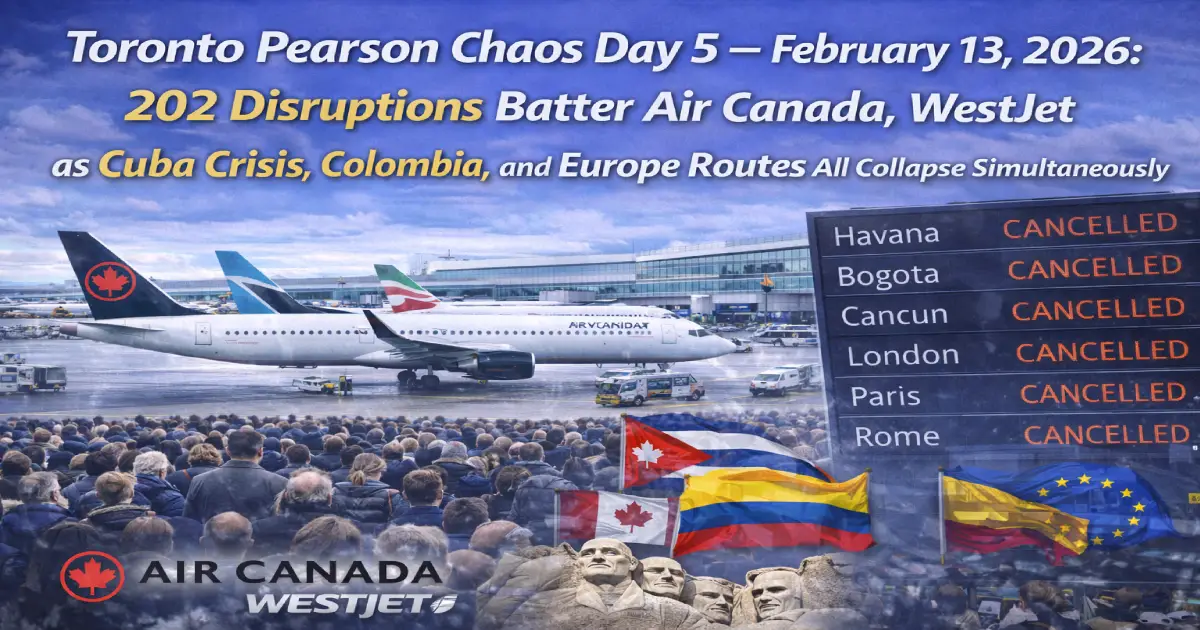
Breaking: Toronto Pearson International Airport has entered its fifth consecutive day of major operational disruption on February 13, 2026 — recording 190 delays and 12 cancellations across Air Canada, WestJet, Endeavour, Avianca, Air China, Porter Airlines, Jazz, and Air Canada Rouge in a relentless winter chaos sequence that has now produced over 900 cumulative disruptions since February 9, with today’s chaos spanning destinations across Canada, the United States, Cuba, Colombia, Hong Kong, and Europe — compounded by the ongoing Cuba jet fuel crisis that has grounded ALL Cuban routes from Canada until at least March 11, WestJet’s 5-cancellation surge representing a 6x spike over its recent daily average, and a 50% delay rate on Qatar Airways flights through YYZ that is breaking Middle East–North America connections with precision timing two days before Presidents Day weekend. Here is the complete Day 5 breakdown and what every affected passenger must do right now.
Published: February 13, 2026 Day: Day 5 of continuous Toronto Pearson major disruption (Feb 9–13) Today’s Total Disruptions: 202 (190 delays + 12 cancellations) Air Canada: 73 delays + 2 cancellations (largest delay share) WestJet: 26 delays + 5 cancellations (6x cancellation spike) Other Carriers: Endeavour Air, Avianca, Air China, Porter, Jazz (ACA), Air Canada Rouge, American Airlines, Qatar Airways all affected Destinations Broken: Canada, USA, Cuba, Colombia, Hong Kong, Europe Cuba Status: ALL Canadian Cuba flights suspended — zero jet fuel at 9 airports until March 11 5-Day Cumulative Disruptions: 900+ total (Feb 9–13) Days to Presidents Day: 1 day Unifor Strike Deadline: 15 days (February 28)
Before breaking down today’s Day 5 chaos, every affected passenger deserves to see the full scale of what Toronto Pearson has endured in the past week — because today’s disruptions are not isolated. They are the fifth act of an ongoing aviation catastrophe:
| Day | Date | Cancellations | Delays | Total | Primary Cause |
|---|---|---|---|---|---|
| Day 1 | Feb 9 | 62 | 232 | 294 | Arctic cold −34°C wind chill, de-icing failure |
| Day 2 | Feb 10 | 21 | 187 | 208 | Cuba crisis erupts, cold persists |
| Day 3 | Feb 11 | 19 | 133 | 152 | Network recovery attempt fails, Cuba deepens |
| Day 4 | Feb 12 | 13 | 195 | 208 | Cascading crew fatigue, national airspace pressure |
| Day 5 | Feb 13 | 12 | 190 | 202 | Cuba crisis ongoing, Colombia, Europe, Presidents Day surge |
| 5-Day Total | Feb 9–13 | 127 | 937 | 1,064 | Compound multi-factor operational collapse |
Over 1,000 flight disruptions in five days at Canada’s largest airport. Not a weather event. Not a single strike. A compound systemic failure revealing the structural fragility of Canadian aviation in winter 2026.
Air Canada alone had 73 delays and 2 cancellations today, making it one of the most affected airlines at Toronto Pearson across Canada, the United States, Cuba, Colombia and Europe.
Air Canada’s dominance of today’s disruption numbers is structural, not accidental. As Canada’s flag carrier and Toronto Pearson’s largest single operator — running approximately 400+ daily movements at YYZ — Air Canada’s delay rate today represents roughly 18% of its YYZ operation experiencing significant disruption. That sounds manageable in isolation. In the context of five consecutive days of elevated disruption, it represents a carrier whose operational buffers — crew rest pools, aircraft positioning reserves, maintenance flexibility — are approaching exhaustion.
Air Canada routes most disrupted today at YYZ:
Air Canada Cuba context: Air Canada has now suspended ALL Cuba flights indefinitely. Air Canada said it made the decision “following advisories issued by governments regarding the unreliability of the aviation fuel supply at Cuban airports,” adding that it would dispatch empty flights southbound to pick up about 3,000 travellers to bring them home. “It is projected that as of Feb. 10 aviation fuel will not be commercially available at the island’s airports,” Air Canada said.
Every Cuba-bound seat on Air Canada’s winter schedule is now being redistributed — passengers rebooking to Mexico, Dominican Republic, and Jamaica are filling aircraft that were already operating at near-capacity, creating secondary congestion on non-Cuba Caribbean routes.
WestJet’s 5 cancellations today represent the single most alarming data point in today’s disruption picture. For context: WestJet averaged fewer than 1 cancellation per day at YYZ on Days 2–4 of this chaos sequence. Five cancellations today represents a sharp operational deterioration.
WestJet follows closely with 26 delays and 5 cancellations at Toronto Pearson today, with disruptions extending across Canada, the United States, Cuba, Colombia, and Europe.
Why WestJet is spiking today:
WestJet is simultaneously managing three operational pressures at once. First, its Cuba repatriation operation — WestJet, along with Sunwing Vacations, has begun an “orderly wind down” of winter operations to Cuba, sending empty aircraft to Cuba to support the organized return of guests currently vacationing in Cuba. “All aircraft dispatched to Cuba will carry sufficient fuel to safely depart without reliance on local fuel availability,” the airline stated. Running empty ferry flights to Cuba while simultaneously trying to operate a full YYZ schedule depletes aircraft and crew that would otherwise be available for domestic and US routes.
Second, WestJet is absorbing rebooking demand from cancelled Cuba passengers — thousands of WestJet Vacations and Sunwing customers are calling to rebook onto alternative Caribbean destinations. Call centre staff and airport agents are processing abnormal rebooking volumes simultaneously with normal operational demands.
Third, WestJet’s 26 delays today reflect the same cascade dynamics afflicting Air Canada — five consecutive days of disruption have depleted crew rest buffers and aircraft positioning precision across WestJet’s entire YYZ network.
WestJet Cuba update: WestJet has implemented flexible policies for Cuba passengers, including free cancellations and date changes without penalty. Its Cuba winter operations are being wound down completely, with a tentative restart date of April 26.
Porter Airlines, operating out of Toronto Billy Bishop Airport (YTZ) rather than Pearson, is also recording delays today — unusual for a carrier that typically benefits from Billy Bishop’s smaller, less congested environment. Porter’s delay appearance today reflects the city-wide aviation strain affecting all Toronto-area operations simultaneously, as ground crews, air traffic management staff, and support services are shared across both airports.
Jazz Aviation, operating as Air Canada Express on regional feeder routes, is experiencing delays across its YYZ network today. Jazz operates the critical short-haul connections that feed Air Canada’s longhaul departures — Halifax, Ottawa, London (Ontario), Sudbury, Thunder Bay. When Jazz delays, Air Canada passengers miss connections to transatlantic and transborder mainline services.
International carriers such as Avianca have also been affected at Toronto Pearson today, with disruptions impacting flights across Colombia and beyond.
Avianca’s YYZ–Bogotá (BOG) and YYZ–Medellín (MDE) services are experiencing significant disruption today. These routes are critical for the large Colombian diaspora community in Toronto — Canada’s third-largest Latin American immigrant group — as well as for business travellers connecting through Bogotá to wider South America. Avianca’s disruption at YYZ is particularly painful because it offers limited rebooking alternatives from Toronto: the only meaningful alternative routing to Colombia from YYZ is through a US hub connection (Air Canada via Miami, or American via JFK/MIA).
Air China is among the international carriers facing disruptions at Toronto Pearson today, with impacts extending to destinations across Canada and beyond.
Air China’s YYZ–Beijing–Hong Kong service is experiencing delays today — disrupting the critical Canada–Asia corridor that serves Toronto’s large Chinese-Canadian community and business connections to the Asia-Pacific. Air China passengers delayed at YYZ today face a compounding problem: missing the Beijing connection means an automatic 24-hour delay before the next available YYZ–PEK departure.
Today’s most striking single airline statistic belongs to Qatar Airways. Qatar Airways is seeing a 50% delay rate for its flights through Toronto Pearson today.
Qatar operates its YYZ service as a premium long-haul connector — the aircraft carries passengers from Toronto to Doha (DOH), where they connect onward to destinations across the Middle East, South Asia, East Africa, and beyond. A 50% delay rate on Qatar at YYZ means roughly half of all passengers booked on today’s Qatar departure are experiencing significant disruption — with the downstream consequence that missed Doha connections cascade across Qatar’s entire global network, affecting passengers travelling onward to Mumbai, Dubai, Nairobi, Islamabad, and dozens more destinations.
The Cuba jet fuel crisis — which your website broke first on February 10 — is directly contributing to today’s YYZ disruption picture in ways that are not immediately obvious.
Cuba’s nine international airports — including Havana, Varadero, Santa Clara, Holguin, Santiago de Cuba, and Cayo Coco — have no Jet A1 fuel available until March 11, 2026. The shortage stems from the US oil blockade cutting off Venezuela’s fuel exports to Cuba following Trump’s geopolitical pressure campaign.
How Cuba creates Day 5 Toronto chaos:
Aircraft displacement: Air Canada and WestJet were running 16+ and 27,700+ weekly seats to Cuba respectively from YYZ during peak winter season. Air Canada operates an average of 16x-weekly flights to four Cuban destinations from Toronto Pearson and Montreal during winter season. Those aircraft — Boeing 737s and Airbus A320-family jets — are now being redeployed to alternative routes or sitting idle awaiting assignment. Idle aircraft at YYZ mean gate congestion and slot confusion.
Repatriation missions consuming resources: Air Canada said it would dispatch empty flights southbound to pick up about 3,000 travellers currently in Cuba. Each empty ferry flight to Cuba consumes a YYZ gate slot, crew duty hours, fuel, and ground handling time — resources diverted from the normal schedule.
Rebooking avalanche: Thousands of cancelled Cuba passengers are simultaneously attempting to rebook onto Mexico, Dominican Republic, and Jamaica alternatives. Every rebooking interaction — app, phone, airport desk — adds to the transaction load on Air Canada and WestJet’s systems, slowing down service for ALL passengers, not just Cuba-affected ones.
The domino effect in numbers: Cuba crisis has effectively removed 49,000+ weekly seats from YYZ’s Caribbean capacity. Those passengers are competing for the remaining Mexico/Dominican Republic/Jamaica seats — driving load factors to 95%+ on alternatives and making rebooking harder for every single disrupted passenger at YYZ today.
With Toronto Pearson in its fifth consecutive day of major disruption, the timing of the looming Air Canada Unifor Local 2002 contract deadline on February 28 carries new urgency.
Today’s disruptions are concentrated at Toronto Pearson, where delays were recorded locally, alongside additional cross-border impacts. Airlines most affected include Air Canada, WestJet, Jazz Aviation, and Air Canada Rouge, with broader ripple effects seen across carriers.
The 5,826 Unifor customer service agents who represent Air Canada’s frontline passenger-facing workforce — the people processing rebookings, managing delay queues, providing baggage assistance — are currently working through the single most operationally demanding week of winter 2026. Five consecutive days of 190+ disruptions at YYZ means these agents have been managing extraordinary passenger volumes, fielding abuse from stranded travellers, processing Cuba crisis rebookings, and working extended duty hours.
Their contract expires in 15 days.
The operational stress of this week is precisely the environment that hardens union resolve heading into final bargaining. Agents who feel unsupported and overworked during a crisis period are less likely to accept a modest wage offer — and more likely to vote yes on strike action if talks fail.
For passengers, the February 28 deadline now carries compounding risk: If talks fail and work-to-rule begins, the airport that has just logged 1,000+ disruptions in 5 days will be processing those disruptions with agents operating at minimum contract pace, with no voluntary overtime, no schedule flexibility, and no goodwill buffer.
Senior consultant based in Toronto, originally booked Air Canada YYZ→BOG via Miami for Monday February 9 meetings.
Feb 9 (Day 1): Flight cancelled — extreme cold ground operations failure. Rebooked Feb 10. Feb 10 (Day 2): Flight delayed 3.5 hours — missed Bogotá connection, rebooked Feb 12. Feb 12 (Day 4): Flight delayed again (Avianca codeshare disruption) — arrived Bogotá 14 hours late.
Cost: Three hotels near YYZ (total CAD $640). Client meetings rescheduled twice. Lost one contract opportunity due to missed Monday pitch.
Air Canada compensation offered: CAD $75 travel credit per delay event = CAD $225 total against CAD $640 in documented out-of-pocket expenses. Under APPR, he was entitled to CAD $700+ for controllable cancellations. Filed formal complaint.
Newlyweds from Toronto booked Sunwing Vacations package: YYZ → Varadero, 10 nights all-inclusive, February 10–20. Total package value: CAD $6,800. Booking date: December 15, 2025 — well before the Cuba fuel crisis.
February 9: Sunwing activated flexible policy. Couple offered three options: rebook same resort different dates (no Cuba flights until April 26 minimum), switch to Dominican Republic (similar resort, CAD $200 upgrade), or full cash refund.
They chose: Dominican Republic rebook — different resort but similar all-inclusive product. Out-of-pocket premium: CAD $200. Lost: honeymoon in Cuba they had planned for a year.
WestJet/Sunwing processed their change within 24 hours — one of the few genuinely positive passenger service moments in this week’s chaos sequence.
Passenger flying YYZ → PEK → HKG (Air China codeshare) for Chinese New Year family reunion. Air China’s YYZ departure delayed today by 2 hours 40 minutes. Missed Beijing connection (90-minute transit window now impossible). Next YYZ–PEK: tomorrow February 14. Arrived Hong Kong 27 hours later than planned.
Air China compensation: Meal voucher at Beijing airport (CNY 100 = ~CAD $19). Hotel in Beijing covered. Flight rebooking on Air China: no charge.
Passenger’s reaction: “I missed the first night of Chinese New Year dinner with my parents. No voucher fixes that.”
Toronto Pearson’s five-day disruption sequence is not contained within its own terminals. Its effects radiate outward across North America:
Boston Logan (BOS): Boston Logan International Airport has seen 2 cancellations today, affecting passengers traveling between Boston and Toronto. Boston’s own 99-disruption day is directly connected to YYZ — Air Canada and Jazz cancellations between the two cities cut the BOS–YYZ corridor both ways.
US transborder routes: American Airlines recorded 3 delays at YYZ today. Republic Airways, operating as American Eagle feeder, is experiencing cascading issues on YYZ–US connections. Passengers connecting through YYZ to US destinations are experiencing downstream delays at Chicago, New York, Washington, and Dallas.
European connections: Air France, British Airways, and Lufthansa (now recovering from its February 12 strike) all have connections through YYZ. Today’s 190 delays mean European-bound passengers are missing transatlantic connections in both directions.
Caribbean leisure network: Qatar Airways’ 50% delay rate at YYZ sends disruptions rippling through Doha to every destination in Qatar’s network — effectively connecting Toronto’s chaos to Mumbai, Nairobi, and beyond.
The question every Toronto Pearson passenger is asking: when does this end?
The honest answer: not this weekend.
Friday February 13 (today): Current 190-delay baseline with Presidents Day surge building.
Saturday February 14 (Valentine’s Day): Peak Presidents Day outbound surge. WestJet and Air Canada operating at maximum winter schedule capacity. Cuba repatriation flights still running. Storm system developing over southern US tracking northeast. YYZ risk: HIGH.
Sunday February 15: Storm tracking toward Great Lakes. Potential precipitation at YYZ Sunday night. Risk: HIGH.
Monday February 16 (Presidents Day): Return surge. Storm potentially over Ontario. Italy airline strike simultaneously disrupting European connections. Risk: CRITICAL.
The 5-day cumulative exhaustion factor: Every consecutive day of disruption degrades the system further — crew duty hours consumed, aircraft positioning worsened, maintenance backlogs extended. Day 6 at YYZ (tomorrow, Valentine’s Day) is beginning from a weaker baseline than Day 1 did.
✅ Check the Air Canada app now — real-time status, self-service rebooking available 24/7. Day 5 means customer service phone queues are running 2–4 hours. App is your fastest path.
✅ Morning flights only — first YYZ departures of the day (6:00–8:30 AM) have the best on-time performance. Afternoon and evening slots inherit every upstream delay from earlier in the day.
✅ Cuba passengers: Your automatic full refund is being processed. Air Canada and Air Canada Vacations customers with scheduled trips to Cuba who experienced flight cancellations will automatically receive a full refund. Check your email for refund confirmation — if not received within 5 business days, call 1-888-247-2262.
✅ Know your APPR rights: Under Canada’s Air Passenger Protection Regulations, for controllable cancellations by Air Canada you are entitled to rebooking on the next available flight on any carrier — not just Air Canada — if the delay exceeds 3 hours. Do not let agents offer only Air Canada alternatives.
✅ Cuba passengers: WestJet has implemented flexible policies allowing travellers to adjust Cuba plans without penalty, with a tentative Cuba restart date of April 26. Call 1-888-WESTJET or use the app to rebook.
✅ Non-Cuba passengers: WestJet’s 26 delays + 5 cancellations today means 20–25% of its YYZ operation is disrupted. Check status 3 hours before departure minimum.
✅ Presidents Day weekend WestJet passengers: Add 45–60 minutes to normal airport arrival time through Monday February 16.
✅ Arrive 3 hours early minimum — Day 5 operational strain means check-in, security, and gate processes are running slower than normal across all terminals.
✅ Terminal reminder: Air Canada operates primarily from Terminal 1. WestJet, Porter, and international carriers use Terminal 3. Factor in inter-terminal transit time (15 minutes minimum) if connecting.
✅ NEXUS / CATSA Priority lanes — standard security at YYZ is running 50–80 minutes today. NEXUS and CATSA Plus lanes: 8–15 minutes. If you don’t have these, arrive even earlier.
✅ Passport validity — for international destinations, ensure your passport has 6+ months validity. Day 5 chaos has produced multiple cases of passengers only discovering passport issues at check-in when rebooking onto alternative carriers with different destination requirements.
Under APPR (Air Passenger Protection Regulations):
For controllable disruptions (not weather, not extraordinary circumstances):
Important Day 5 context: Airlines routinely classify Day 5 of a disruption sequence as “weather-related” to avoid compensation liability, even when the original weather event has passed and current disruptions are crew/aircraft cascades. If your delay on Day 5 is due to “crew unavailability” or “aircraft positioning” — not active weather — it is a controllable disruption and you are entitled to full APPR compensation.
File APPR claims at: CTA otc-cta.gc.ca
Toronto Pearson’s fifth consecutive day of major disruption — 190 delays and 12 cancellations on February 13, 2026 — brings the 5-day cumulative total to over 1,000 flight disruptions since the Arctic cold front struck on February 9. Air Canada’s 73 delays and WestJet’s alarming 5-cancellation spike today reflect not just weather aftermath but the structural compounding of the Cuba jet fuel crisis displacing 49,000+ weekly Caribbean seats, Avianca’s Colombia corridor breaking, Air China’s Hong Kong link disrupting, and Qatar Airways hitting a 50% delay rate as Middle East connections cascade — all while 5,826 Unifor customer service agents count down 15 days to their contract expiry on February 28. Presidents Day weekend begins tomorrow. The storm is tracking northeast. Day 6 starts from the weakest operational baseline of the entire sequence.
Day 5 Action Checklist:
✅ Air Canada Cuba passengers? Automatic full refund processing — check email, call if not received in 5 days ✅ WestJet/Sunwing Cuba passengers? Free rebook or cancel at westjet.com, Cuba restart April 26 ✅ Flying YYZ this weekend? Morning departures only, arrive 3 hours early, Terminal 1 vs 3 check ✅ Delayed 3+ hours (controllable)? APPR entitles you to CAD $400–$1,000 — do not accept only a meal voucher ✅ Colombia/Hong Kong/Middle East connections? 24-hour delay risk — identify alternatives now ✅ Unifor strike watch: Monitor unifor.org/aircanada — 15 days to contract expiry
Track YYZ live:
For More Resources:
Related Articles:
Posted By : Vinay
Lastest News
2nd Floor, 39, Above Kirti Club, DLF Industrial Area, Kirti Nagar, New Delhi, Delhi 110015



Travel Tourister is a leading Travel portal where we introduce travellers to trusted travel agents to make their journey hasselfree, memorable And happy. Travel Tourister is a platform where travellers get Tour packages ,Hotel packages deals through trusted travel companies And hoteliers who are working with us across the world. We always try to find new and more travel agents and hoteliers from every nook and corners across the world so that you could compare the deals with different travel agents and hoteliers and book your tour or hotel with the one you have chosen according to your taste and budget.
Copyright © Travel Tourister, India. All Rights Reserved

 Call
Call Enquiry