Published on : 05 Mar 2026
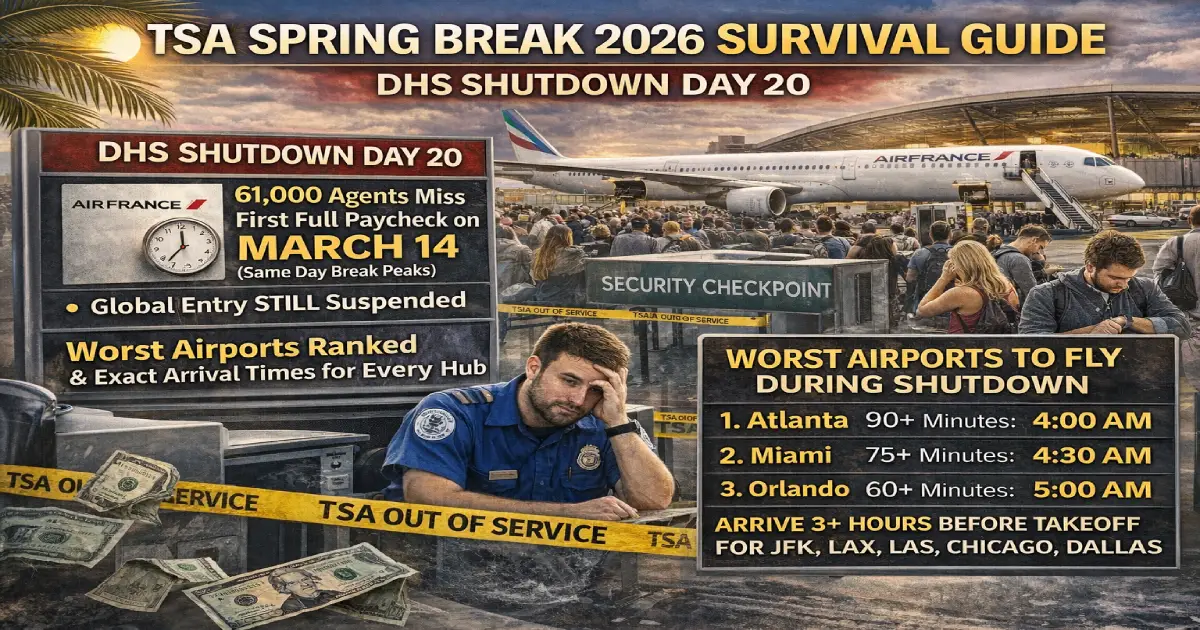
Published: March 5, 2026 DHS Shutdown: Day 20 — began February 14, 2026 at 12:01 AM EST Shutdown Status: No deal. No vote scheduled. Congress on recess. TSA Financial Cliff: March 14, 2026 — first full missed paycheck for 61,000 TSA officers Spring Break Peak Travel: March 14–22, 2026 — these two events converge on the SAME DATE TSA PreCheck: ✅ OPERATIONAL — reinstated after brief February 22 suspension Global Entry: ❌ STILL SUSPENDED — halted at all US airports since February 22 TSA Attrition (Oct–Nov 2025): 1,110 officers separated — 25%+ increase over prior year Passengers Per Peak Day: 3 million screened by TSA — Spring Break adds surge Industry Loss Estimate: $6–14 billion in permanent losses if shutdown continues through Spring Break (CBO + US Travel Association) DHS Secretary Noem: “Shutdowns have real world consequences — it endangers our national security” TSA Acting Administrator McNeill: “Higher callouts can result in longer wait times, leading to missed or delayed flights” Most Dangerous Convergence Date: Saturday, March 14 — first missed paycheck + peak return travel begins World Cup at Risk: June 11–July 19 — TSA surge staffing plans now compromised
Here is the number that should be on every American traveller’s radar right now: March 14. That is the date 61,000 TSA officers — who have been working without reliable pay since February 14 — will miss their first full paycheck. It is also, by an extraordinary coincidence of the academic calendar, the date that Spring Break 2026 peaks across most major US school districts. TSA Acting Administrator Ha Nguyen McNeill has already told Congress exactly what happens next: “Higher callouts can result in longer wait times at checkpoints, leading to missed or delayed flights.” This guide tells you what to do about it — airport by airport, hour by hour, programme by programme — so that your Spring Break 2026 does not become a casualty of a political standoff over immigration policy that has nothing to do with your holiday.
Most Spring Breaks face one disruption factor. Spring Break 2026 faces four simultaneously — and all four hit the same narrow window between March 14 and March 22.
Threat 1 — DHS Shutdown / First Missed TSA Paycheck (March 14) Just as the FBI and Department of Homeland Security are bracing for possible terrorist attacks on the United States, federal security officers at the nation’s airports are working without pay. In times of war, heightened security at home is fundamental. Yet, with a shutdown currently affecting the TSA, workers tasked with safeguarding air travel will be without pay — and perhaps staying home or seeking other jobs.
Previous funding lapses show that widespread disruptions tend to build gradually as unpaid workers begin calling out or seeking other jobs. Acting TSA Administrator Ha Nguyen McNeill said the agency’s experience during the last 43-day shutdown demonstrated how quickly strain on the workforce can spill over into airport operations. “Many TSA officers work paycheck to paycheck trying to support themselves and their families. During a shutdown, the ability to pay for rent, bills, groceries, child care, and gas just to get to work becomes very challenging, leading to increased unscheduled absences as a shutdown progresses.”
Threat 2 — TSA Workforce Already Depleted Before This Shutdown This is the hidden compounding factor. Around 1,110 TSOs separated from TSA in October and November 2025, a more than 25% increase in TSO separations from the same time period in 2024. Many TSOs that left attributed their separation due to the uncertainty, stress, missed paychecks, and financial hardships of the government shutdown. Right now, the Agency is focused on surge staffing in March, April, and May, to be prepared for Spring Break, summer, and World Cup travel. Those surge staffing plans are now compromised by this new shutdown.
Threat 3 — Middle East Crisis Adding Rerouting Workload Every international flight that previously routed through Dubai, Doha, or Abu Dhabi is now either cancelled or rerouting via alternative corridors — many of which add connections through US hubs including JFK, ORD, and LAX. The rerouting surge adds hundreds of daily international passengers to US hub security queues who were not in those queues two weeks ago. O’Hare is today’s worst performer precisely because of this effect.
Threat 4 — Global Entry Still Suspended The agency is making some changes to at least one trusted traveler program, temporarily halting the Global Entry program. Earlier this week, the Department of Homeland Security announced it would also suspend the popular TSA PreCheck program but then reversed that decision. Global Entry has not been reinstated. Every returning international traveller who previously used Global Entry is now in the standard CBP queue — adding significant pressure to international arrival halls at every major US gateway airport.
Understanding why March 14 is the single most dangerous travel day of Spring Break 2026 requires understanding the paycheck calendar.
February 14: DHS shutdown begins. TSA officers classified as essential — must continue working with no pay guarantee.
February 28 (partial paycheck received): Transportation Security Administration workers received only a portion of their next paycheck. The reduced pay comes as the partial government shutdown continues. Many officers reported immediate financial hardship — payday loans, food bank visits, missed rent payments.
March 3 (reduced paycheck — Day 18): A second pay period reflecting the ongoing shutdown. Still a partial paycheck, not zero — but the financial pressure on 61,000 households accelerating.
March 14 (FIRST FULL MISSED PAYCHECK): TSA paychecks due to be issued on March 3 could see agents getting reduced pay depending on the length of the shutdown. Agents would not be at risk of missing a full paycheck until March 17. Based on the payroll cycle, the effective missed-paycheck date for most officers is March 14–17.
What happens when a paycheck is zero, not just reduced: Historical data from the 2025 shutdown — the longest in US history at 43 days — shows call-out rates rise sharply in the first week after a full paycheck is missed. Officers who managed to stretch savings through partial-pay periods are no longer able to do so. The choice becomes: drive to work or pay for childcare with money you don’t have.
March 14 is also the first Saturday of peak Spring Break. Saturday outbound travel is the single highest-volume travel day of the Spring Break window. The convergence is not bad luck — it is a mathematical certainty based on when DHS funding lapsed (February 14) and when Spring Break falls (March 14+).
Not all airports will be equally affected. The risk is highest where spring break passenger concentration is greatest, TSA staffing is thinnest relative to volume, and a single absence has disproportionate queue impact. Here is the official ranking for Spring Break 2026, based on historical wait time data, current shutdown pressure, and Spring Break destination concentration:
1. Orlando International (MCO) — Spring Break Ground Zero MCO is the undisputed highest-risk airport for Spring Break 2026. Theme park traffic from Walt Disney World, Universal, and SeaWorld makes MCO the single most Spring Break-concentrated major airport in the US. Orlando International Airport ranks as one of the worst airports for holiday travel based on wait times. MCO also has the unique feature of being heavily staffed with officers who service leisure travellers — a workforce category that is more likely to seek alternative employment if paychecks stop.
MCO survival tip: MCO Reserve — a free programme allowing travellers without TSA PreCheck to reserve a time slot for standard security screening. Book a slot at MCO’s website before you arrive. This is MCO-specific and genuinely reduces wait times. If you have TSA PreCheck, use it — MCO PreCheck lanes are the clearest path through this airport during Spring Break.
Best arrival time: 3 hours before domestic departure. 3.5 hours for international. Worst times: Saturday 06:00–10:00 AM and Sunday 16:00–20:00 PM (return travel peak). TSA PreCheck status: ✅ Operational. Use it.
2. Fort Lauderdale-Hollywood (FLL) — South Florida Overflow FLL is the budget carrier capital of the South Florida market — Spirit, Frontier, Southwest, and JetBlue all operate heavily here. Spring Break traffic is extreme. Fort Lauderdale-Hollywood International Airport ranks among the worst airports for security wait times during peak travel. FLL’s checkpoint configuration is not designed for surge volume — it has fewer security lanes per passenger than Miami, creating bottleneck conditions under any strain.
Best arrival time: 2.5 hours domestic. Avoid the 07:00–09:00 first-bank departure window — this is when FLL hits maximum checkpoint congestion on Spring Break Saturdays. FLL vs MIA tip: If you have flexibility on departure airport for South Florida, Miami International (MIA) has more security lanes and handles surge better, despite being a larger airport.
3. JFK International (JFK) — International Rerouting Surge JFK does not operate as a single terminal, and TSA wait times differ significantly across its terminals. Security lines tend to be longest during early-morning and late-afternoon departure waves, especially at terminals handling international traffic. JFK is also absorbing the largest share of Middle East crisis rerouting traffic — passengers who were connecting through Dubai and Doha are now routing through JFK on alternative itineraries.
On the not-so-positive side of the rankings was New York JFK, where the average wait time was around 40 minutes. That 40-minute baseline is under normal conditions. During Spring Break + shutdown + Middle East rerouting surge, double it.
JFK terminal strategy: Terminal 4 (Delta, international carriers) and Terminal 7 (British Airways) are historically the most congested. Terminal 2 (Delta domestic) and Terminal 8 (American) have shorter checkpoint queues on average. Best arrival time: 3 hours domestic, 3.5 hours international minimum.
4. Chicago O’Hare (ORD) — Hub Cascade Multiplier Chicago O’Hare International Airport ranks among the worst airports for holiday travel based on security line waits. O’Hare’s role as both a United and American hub means it absorbs cascading delays from across the system. When the first bank of morning departures backs up, it propagates through every rotation all day. On Spring Break Saturday, ORD regularly sees 200+ delays.
ORD insider tip: Terminal 2 at O’Hare airport has shorter lines, so you can always go through the line at one terminal and then get to your terminal once you’re past security. If your airline is in Terminal 1 or 3, still consider entering through Terminal 2 — all terminals connect after security via the underground walkway. Best arrival time: 2.5 hours domestic, 3 hours international.
5. Los Angeles International (LAX) — Worst International Gateway Los Angeles International Airport ranks among the five worst airports for security wait times, with a significant percentage of waits exceeding 60 minutes. LAX has been undergoing terminal reconstruction for years and checkpoint configurations are non-optimal. The Tom Bradley International Terminal (TBIT) is the most congested, particularly for Asia-Pacific routes now rerouting away from Gulf connections.
LAX tip: The newly opened Terminal 9 (for smaller carriers) has significantly shorter wait times. United’s Terminal 7/8 complex is better than Delta’s Terminal 2/3 during peak hours. Best arrival time: 3 hours domestic, 3.5 hours international.
Newark (EWR): Newark Liberty International Airport ranked among airports with the longest security wait times, with an average of 23.1 minutes under normal conditions. The worst time is Monday from 12–1 PM, which can see 60-minute waits. Under shutdown pressure, expect 45–90 minutes during Spring Break peak.
Miami (MIA): Heavy Spring Break concentration but more checkpoint lanes than FLL. Better than FLL but still high-risk. Arrive 2.5 hours early.
Nashville (BNA): Nashville International Airport ranks among the worst airports for security wait times. BNA has been overwhelmed by Nashville’s tourism explosion — spring break traffic from college towns across the South converges here. BNA has fewer TSA officers than airports of comparable passenger volume.
Houston IAH: Major international gateway with significant Middle East rerouting exposure. United’s hub. 2.5 hours minimum.
Austin (AUS): Austin-Bergstrom International Airport ranks among the worst airports for security wait times. Despite multiple expansion phases, AUS consistently underperforms on checkpoint throughput. 2.5 hours.
Atlanta (ATL): Atlanta: Domestic with checked bags — arrive 2–2.5 hours before departure. Peak risk times: early morning departure banks, Sundays, holiday weekends. ATL benefits from its checkpoint design — multiple entry points across concourses allow load balancing. The Plane Train means you can enter at any concourse checkpoint and still reach your gate. ATL typically performs better than its size suggests during Spring Break.
Dallas-Fort Worth (DFW): Large checkpoint footprint, well-staffed relative to volume. 2 hours minimum for domestic.
Denver (DEN): Denver International Airport is among airports where crowding can lead to extended wait times during peak travel periods. 2 hours domestic, 2.5 hours international.
Charlotte (CLT): American hub, well-operated. 2 hours domestic.
Minneapolis (MSP): MSP consistently outperforms larger hubs on TSA wait times. 2 hours domestic.
Smaller airports with fewer screeners actually handle relative absences better because they have lower absolute passenger volume. Even if one officer calls out, the proportional impact is smaller than at a hub where 10 call out simultaneously.
Salt Lake City (SLC), Portland (PDX), Raleigh (RDU), Indianapolis (IND), Columbus (CMH), Kansas City (MCI): All of these consistently outperform major hubs on TSA wait times. If you have a choice of routing, these airports are your Spring Break friends.
The shutdown has changed the trusted traveller landscape significantly. Here is the current status of every programme and what it means for Spring Break.
PreCheck is fully operational. DHS announced it would suspend the popular TSA PreCheck program but then reversed that decision. At this time, TSA PreCheck remains operational with no change for the traveling public. As staffing constraints arise, TSA will evaluate on a case by case basis and adjust operations accordingly.
What PreCheck gives you:
Cost: $78 for 5 years ($15.60/year). Many credit cards cover this fee — Chase Sapphire Reserve, Amex Platinum, Capital One Venture X all include up to $100 TSA PreCheck/Global Entry credit.
If you don’t have PreCheck: Apply now — TSA is offering appointments. Processing times are currently 2–7 days for conditional approvals. If your Spring Break departure is March 14+, you have time. Apply at tsa.gov/precheck.
PreCheck lane warning during shutdown: TSA has stated it will “evaluate on a case by case basis” whether to dedicate officers to PreCheck lanes if staffing is critically low. At very high-pressure moments — peak Spring Break Saturday morning — a checkpoint supervisor may temporarily consolidate lanes. If this happens, your PreCheck lane status temporarily merges with standard. This is rare but possible under today’s conditions. Arrive early regardless.
CLEAR is a private biometric identification service — it is NOT a TSA programme and is completely unaffected by the DHS shutdown. CLEAR uses fingerprints or iris scans to verify your identity at a dedicated kiosk, then escorts you directly to the front of the TSA queue.
“If you have both CLEAR and TSA PreCheck, that’s the best, so you have the option of whichever line is shorter,” advises travel journalist Amber Gibson, who takes more than 100 flights a year. “Certain credit cards will waive the fee.”
The CLEAR + PreCheck stack: CLEAR gets you to the front of the identity verification queue. PreCheck gets you through the fastest screening lane. Combined, this is the closest thing to a guaranteed under-10-minute security experience at any US airport. For Spring Break 2026 with the TSA shutdown, this combination is more valuable than any other year.
CLEAR cost: $189/year. United MileagePlus members: $109/year. Delta SkyMiles members: $109/year. American Express Platinum card: complimentary CLEAR Plus membership. If your credit card covers it — activate it before March 14.
CLEAR availability: 50+ US airports including MCO, LAX, JFK, ORD, ATL, DFW, DEN, MIA, FLL, SEA, SFO, BOS, LAS. Check clearme.com/locations.
Global Entry has been suspended since February 22, 2026. This means:
What this means practically: If you are returning from Mexico, the Caribbean, Europe, or anywhere international during Spring Break, your customs experience will be longer than you are used to. Budget extra time between landing and leaving the terminal. Domestic connections post-international arrival are at elevated risk. Build at least 2 hours of buffer between an international arrival and any domestic connection.
Note: CLEAR expedites the domestic departure security process — it does NOT replace Global Entry for international arrivals. These are two separate systems. CLEAR helps you get through security leaving the US. Global Entry (currently suspended) helped you return faster. Right now, only the departure side can be expedited.
Renewal applications: Global Entry renewals are also paused. If your Global Entry was due for renewal, it will not process until the programme reinstates. Your PreCheck component of Global Entry remains valid — you can still use PreCheck lanes domestically.
These are not general travel tips. These are specific adaptations for Spring Break 2026 under DHS shutdown + Middle East disruption + Global Entry suspension conditions.
Under normal Spring Break conditions, 2 hours domestic / 3 hours international is standard guidance. Under 2026 conditions:
| Flight Type | Recommended Arrival |
|---|---|
| Domestic, MCO/FLL/LAX/JFK/ORD/EWR | 3 hours before departure |
| Domestic, all other major hubs | 2.5 hours before departure |
| Domestic, smaller regional airports | 2 hours before departure |
| International departure, any airport | 3.5 hours before departure |
| International return (customs) | Build 60+ minutes extra for CBP queue |
“You may look online and it says two-and-a-half hours. Now it’s two-and-a-half hours before your flight and you haven’t left for the airport yet.” Passengers should also pay close attention while packing since prohibited items are likely to prolong the screening process.
Under normal conditions, a borderline item in your carry-on (say, a full-size sunscreen, a snow globe, or a wrapped gift) might get waved through. Under shutdown conditions with TSA officers under financial stress and high call-out rates, supervisors will direct officers to run by-the-book. Items that would normally be passed through will be flagged. Bags will be opened. Queues will back up.
Items to put in checked bags this Spring Break — not carry-on:
“One of the biggest time wasters is passengers who inadvertently hold up the line because they aren’t aware of the TSA liquid limit,” says former TSA officer Caleb Harmon-Marshall, who worked for TSA in Atlanta and Miami for eight years.
If your checkpoint backs up and you risk missing your flight, your airline can in many cases hold the gate — but only if they know you are on the way. Airline apps now have “I’m on the way, please hold” notifications. Enable push notifications so you receive real-time flight status updates. If your flight is delayed — even 30 minutes — it may change which security lane you need to target.
Download the MyTSA app (tsa.gov) — check current wait times before leaving for the airport. Note: The MyTSA app normally shows real-time wait times, but it may not function optimally during shutdowns when IT staff are furloughed. Use it as a guide but also check your specific airport’s website for checkpoint status.
Every major airport has a primary checkpoint (where everyone queues) and secondary checkpoints that most casual travellers do not know about.
If your specific flight is delayed more than 2 hours and the delay is within the airline’s control (crew or mechanical, not weather), request a meal voucher at the gate — this is your legal right under DOT regulations.
The critical distinction: TSA delays are government-caused — they are NOT within the airline’s control. If your flight misses its departure window because TSA checkpoint was backed up and you missed your boarding, airlines will generally not compensate beyond rebooking. Document everything: photograph the TSA queue length, note the time, keep all receipts.
What is covered: If your delay is due to aircraft mechanical issues, crew scheduling, or airline-caused reasons — the DOT now requires airlines to automatically rebook you and provide meal vouchers and hotel for overnight delays. This is separate from the TSA queue issue.
Travel insurance: Most travel insurance does NOT cover government shutdowns because they are “known events” once they begin. If you purchased your travel insurance after February 14 (when the DHS shutdown started), the shutdown is a known event and unlikely to be covered. If you purchased before February 14 — check your policy wording carefully.
This is unusual advice for a travel guide — but it is genuinely relevant this Spring Break.
“AFGE members are tired of being forced on this roller coaster every time their elected officials fail to do their jobs,” said Everett Kelley, president of the American Federation of Government Employees. “During a shutdown, the ability to pay for rent, bills, groceries, child care, and gas just to get to work becomes very challenging.”
Many TSA employees are already struggling financially, concerned about how they’ll afford their March housing costs and day care. “You’re going to see TSA officers in food bank lines in a couple of days,” said one union official.
The person waving you through security this Spring Break has been working without pay for 20+ days, may have taken out a payday loan to cover rent, and is still showing up to do a genuinely difficult job under impossible conditions. A simple acknowledgement of their situation costs nothing and creates a measurably better interaction for everyone in the queue. Hostile, impatient behaviour makes checkpoints slower — not faster.
For the first time since COVID-19, having a contingency plan for your Spring Break departure is genuinely necessary — not paranoid.
Minimum contingency:
The best contingency is departing the day before. If your budget allows, flying out March 13 (Friday evening) instead of March 14 (Saturday) is the single most effective thing you can do to avoid the convergence of the first missed TSA paycheck and peak Spring Break travel.
The White House and Democrats have been negotiating reforms to the agency’s immigration enforcement operations after two US citizens were fatally shot by federal immigration agents in Minneapolis in January. Senate Democrats are demanding changes before they’ll support appropriating more money for DHS.
The political dynamic:
A bipartisan “pay TSA while negotiating” bill is the most likely near-term resolution — but Congress is on recess and no vote is scheduled. The most optimistic scenario: a standalone TSA pay bill passes before March 14. The most likely scenario based on current trajectory: the shutdown continues through at least the first week of Spring Break.
“The Department of Homeland Security needs to be operating at full capacity right now,” said Rep. August Pfluger, a Texas Republican, urging Congress to fund the department promptly.
The military context adds another dimension: Just as the FBI and Department of Homeland Security are bracing for possible terrorist attacks on the United States, federal security officers at the nation’s airports are working without pay. In times of war, heightened security at home is fundamental. With Operation Epic Fury ongoing and elevated domestic threat assessments, the pressure on Congress to resolve this is growing — but so is the partisan intransigence.
Right now, the Agency is focused on surge staffing in March, April, and May, to be prepared for Spring Break, summer, and World Cup travel. Those World Cup staffing plans are built on a workforce that was already depleted by 1,100+ separations in the fall of 2025 and is now working through a second unpaid-work shutdown. If this shutdown is not resolved before June, the FIFA World Cup — which begins June 11, 2026, with matches across 16 US host cities — will face the same TSA staffing pressures as Spring Break, but with international visitors who have never navigated US airport security and longer average queues.
The World Cup risk is 97 days away. If you are planning to attend World Cup matches, purchase travel insurance now (before any further shutdown escalation makes it a “known event”), and build your travel plans around the assumption of extended checkpoint wait times at Atlanta (ATL), New York (METNY), Los Angeles (LAX), Dallas (DFW), Seattle (SEA), Miami (MIA), San Francisco (SFO), Boston (BOS), Kansas City (MCI), Houston (HOU), Philadelphia (PHL), and Vancouver/Toronto (Canadian host cities).
| Airport | Risk Level | Arrive Before | Best Tip |
|---|---|---|---|
| MCO (Orlando) | 🔴 Extreme | 3 hours | MCO Reserve + PreCheck |
| FLL (Fort Lauderdale) | 🔴 Extreme | 2.5 hours | MIA may be better choice |
| JFK (New York) | 🔴 High | 3 hours | Terminal 2 has shorter lines |
| ORD (Chicago O’Hare) | 🔴 High | 2.5 hours | Enter via Terminal 2 |
| LAX (Los Angeles) | 🔴 High | 3 hours | Terminals 3/6 faster than TBIT |
| EWR (Newark) | 🟠 High | 2.5 hours | Avoid Monday 12–1 PM |
| MIA (Miami) | 🟠 High | 2.5 hours | More lanes than FLL |
| BNA (Nashville) | 🟠 High | 2.5 hours | Arrive extra early |
| AUS (Austin) | 🟠 High | 2.5 hours | No shortcut — just arrive early |
| IAH (Houston) | 🟠 High | 2.5 hours | United hub — Middle East rerouting |
| ATL (Atlanta) | 🟡 Moderate | 2 hours | Any concourse entry works |
| DFW (Dallas) | 🟡 Moderate | 2 hours | Well-staffed relative to size |
| DEN (Denver) | 🟡 Moderate | 2 hours | Generally efficient |
| CLT (Charlotte) | 🟡 Moderate | 2 hours | American hub, good operations |
| SLC, PDX, RDU, IND | ✅ Lower | 90 min | Smaller airport advantage |
| Resource | Link / Contact |
|---|---|
| TSA PreCheck apply/renew | tsa.gov/precheck |
| CLEAR membership | clearme.com |
| MyTSA app (wait times) | tsa.gov/mytsa |
| TSA Wait Times (third party) | tsawaittimes.com |
| MCO Reserve (free time slot) | orlandoairports.net/mco-reserve |
| FlightAware (delays live) | flightaware.com/miserymap |
| TSA contact | 1-866-289-9673 |
| DOT Air Travel Complaint | airconsumer.dot.gov |
| US Travel Association | ustravel.org |
Posted By : Vinay
Lastest News
2nd Floor, 39, Above Kirti Club, DLF Industrial Area, Kirti Nagar, New Delhi, Delhi 110015



Travel Tourister is a leading Travel portal where we introduce travellers to trusted travel agents to make their journey hasselfree, memorable And happy. Travel Tourister is a platform where travellers get Tour packages ,Hotel packages deals through trusted travel companies And hoteliers who are working with us across the world. We always try to find new and more travel agents and hoteliers from every nook and corners across the world so that you could compare the deals with different travel agents and hoteliers and book your tour or hotel with the one you have chosen according to your taste and budget.
Copyright © Travel Tourister, India. All Rights Reserved

 Call
Call Enquiry