Published on : 03 Jan 2026
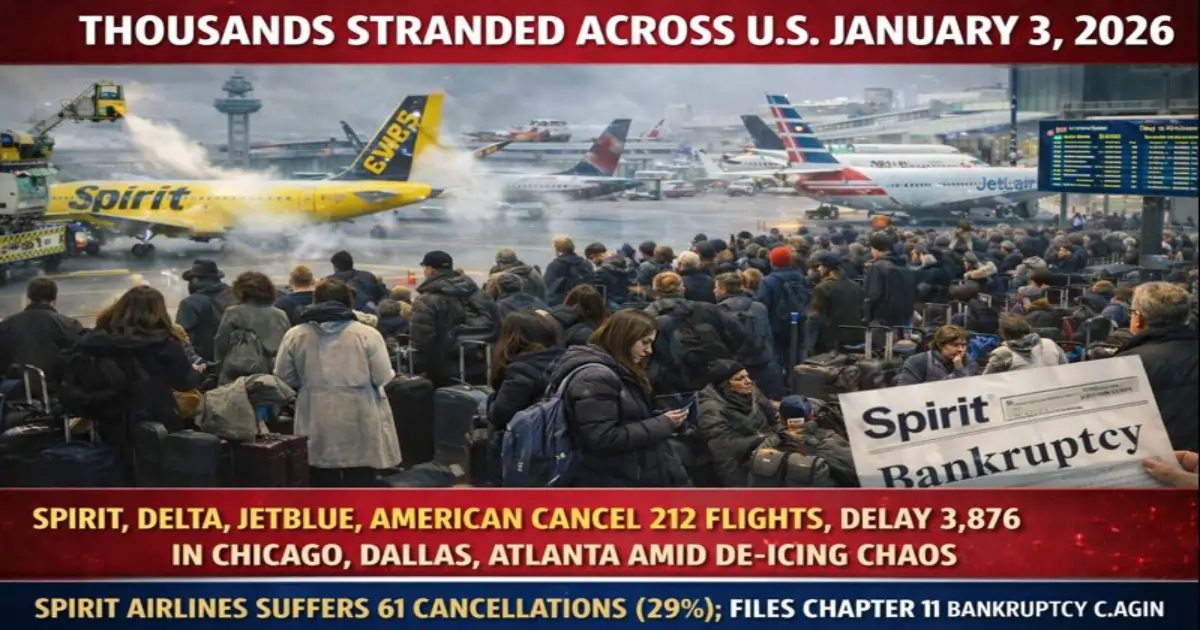
TRENDING: Thousands of US passengers stranded today January 3, 2026 as Spirit Airlines, Delta Air Lines, JetBlue Airways, SkyWest, American Airlines, and major carriers cancel 212 flights and delay 3,876 across key airports—with Atlanta Hartsfield-Jackson (ATL) leading disruptions at 28 cancellations + 182 delays, Fort Lauderdale-Hollywood (FLL) reporting 25 cancellations + 219 delays, Boston Logan (BOS) facing 20 cancellations, Detroit Metropolitan (DTW) experiencing 15 cancellations, while Los Angeles (LAX) suffers 14 cancellations + 188 delays and Miami (MIA) endures 12 cancellations + 170 delays as combination of high air traffic, winter weather de-icing procedures, low cloud ceilings, and air traffic control congestion creates perfect storm during post-holiday travel surge—with bankrupt Spirit Airlines hemorrhaging 61 cancellations (29% of total US cancellations) + 131 delays amid ongoing Chapter 11 bankruptcy restructuring (second filing August 2025), Phoenix Sky Harbor complete exit January 8, 365 pilot furloughs, fleet reductions, route cuts, cash depletion from $645M to $586M monthly as ultra-low-cost carrier collapses while American Airlines requests bankruptcy court notices eyeing asset acquisition
Published: January 3, 2026 Source: FlightAware Real-Time Data, FAA, Travel And Tour World, Multiple US Airports Total Disruptions: 212 cancellations + 3,876 delays (4,088 affected flights) Worst Hit Airline: Spirit Airlines (61 cancellations, 131 delays) Most Impacted Airports: Atlanta ATL, Fort Lauderdale FLL, Boston BOS, Detroit DTW, Los Angeles LAX, Miami MIA Primary Causes: Heavy air traffic, winter weather de-icing, low cloud ceilings, ATC congestion ANZ Impact: Australian/New Zealand travelers connecting through US hubs (LAX, Dallas, Chicago, Atlanta) face cascading delays disrupting Pacific-US-Europe routings
Thousands of US passengers face major travel disruptions today January 3, 2026 as Spirit Airlines, Delta Air Lines, JetBlue Airways, SkyWest, American Airlines, and other carriers cancel over 212 flights and delay 3,876 across several key airports—with Chicago O’Hare, Dallas-Fort Worth, Pittsburgh, Fort Myers, Asheville, Atlanta, Boston, Detroit, Los Angeles, Miami, and other cities particularly impacted as travelers scramble to find new flights or make alternative plans when cancellations and delays result from combination of factors including high air traffic congestion during post-holiday travel surge (peak January 2-5 return period when millions simultaneously depart), unpredictable winter weather conditions requiring aircraft de-icing procedures consuming 15-30 minutes per departure, low cloud ceilings forcing instrument approach spacing restrictions reducing arrival rates at major airports, and air traffic control staffing limitations during government funding uncertainties leaving passengers frustrated, uncertain about travel schedules, and stranded at airports while airlines struggle rebooking onto already-full flights.
According to latest FlightAware data published today, a staggering 3,876 delays and 212 cancellations have been reported within, into, or out of United States—severely impacting both passengers and airlines particularly across major airports and cities where hub operations amplify disruptions as single cancellation ripples through networks canceling dozens of connecting flights downstream creating cascading chaos when initial departure delays or cancellations trigger dominoes of missed connections, crew timeouts (pilots/flight attendants reaching maximum duty hours unable to operate subsequent legs), aircraft out of position (planes stranded at wrong airports unable to operate scheduled departures), and gate availability constraints at congested hubs operating near capacity limits where every delay compounds exponentially.
Spirit Airlines emerges as hardest-hit carrier with 61 cancellations (representing 29% of total US cancellations today) and 131 delays—reflecting ongoing operational chaos at bankrupt ultra-low-cost carrier that filed Chapter 11 bankruptcy protection second time August 29, 2025 just five months after emerging from first bankruptcy March 2025, as company hemorrhages cash (dropping from $645 million to $586 million unrestricted cash in single month November 2025), exits Phoenix Sky Harbor International Airport completely January 8, 2026, furloughs 365 pilots in Q1 2026 (initially 270 planned, expanded to 365), downgrades 170 captains to first officers, reduces fleet, cuts underperforming routes, and faces existential crisis while American Airlines reportedly requests bankruptcy court notices (December 5 filing) signaling interest in acquiring Spirit assets if liquidation proceeds rather than successful reorganization.
The effects of these disruptions being felt across multiple US airports, with some of busiest airports seeing highest levels of cancellations and delays creating ground chaos where passengers line check-in counters seeking rebooking, gate agents field questions from frustrated travelers, customer service phone lines jam with hour-long hold times, and social media explodes with complaints as airlines struggle managing operational meltdown during post-holiday peak when planes fly near 90% full capacity leaving minimal standby seats for accommodating displaced passengers who miss flights, face cancellations, or experience delays missing connections requiring overnight hotel stays, meal vouchers, and rebooking on next available flights potentially 12-24 hours later when airline schedules operate near maximum utilization.
Atlanta Hartsfield-Jackson International Airport—world’s busiest airport by passenger traffic (110+ million annually) and Delta Air Lines’ massive hub dominating 70% of airport operations—leads today’s disruption with 28 cancellations and 182 delays affecting thousands of passengers as Delta’s hub-and-spoke network amplifies impact when single mainline cancellation triggers cascading regional connection cancellations across spoke cities (Birmingham, Memphis, Nashville, Jacksonville, Charleston, Savannah, etc.) where passengers booked tight 60-90 minute connections arrive finding departures cancelled when inbound aircraft never materialized from Atlanta.
ATL Specific Challenges:
Fort Lauderdale-Hollywood International Airport—Spirit Airlines’ largest hub accounting for 30%+ of carrier’s total operations—reports 25 cancellations and 219 delays reflecting bankrupt carrier’s disproportionate chaos at primary base where Spirit operates 150+ daily departures under normal conditions but today faces operational meltdown as bankruptcy-driven cost cuts (reduced maintenance staff, deferred aircraft servicing, crew shortages from furloughs/departures to competitors) manifest in reliability crisis where planes go “out of service” with mechanical issues, crews unavailable due to understaffing, and maintenance delays compound creating snowball effect overwhelming Spirit’s diminished operational capabilities.
FLL Spirit Hub Breakdown:
Boston Logan International Airport faces 20 cancellations—with JetBlue Airways (Boston hub carrier operating 150+ daily flights, 30% of airport operations) bearing brunt as low cloud ceilings over Massachusetts coast force instrument approaches limiting arrival rates while de-icing requirements for aircraft parked overnight (Boston temperatures dropping to 15-25°F/-9 to -4°C January nights) consume 20-30 minutes per departure when ground crews spray Type I fluid (orange-colored propylene glycol removing existing ice/snow) followed by Type IV fluid (green-colored thickened glycol preventing ice reformation during taxi/takeoff) creating bottlenecks at limited de-icing pads where aircraft queue awaiting treatment before proceeding to runways for departure.
Detroit Metropolitan Wayne County Airport—Delta Air Lines’ secondary hub (after Atlanta) operating 450+ daily flights—reports 15 cancellations as winter weather conditions (snow, ice, below-freezing temperatures) require extensive de-icing operations consuming limited ground equipment, trained personnel, and de-icing fluid supplies when 200+ aircraft require treatment simultaneously during morning departure push (6:00-10:00 AM peak when business travelers, connecting passengers concentrate departures) overwhelming DTW’s de-icing infrastructure despite Michigan airport’s winter weather experience and specialized equipment designed for harsh Great Lakes climate.
Los Angeles International Airport experiences 14 cancellations and 188 delays—surprisingly high for typically weather-stable Southern California but reflecting air traffic congestion as post-holiday travel surge (January 2-5 peak when millions return from New Year vacations) overwhelms FAA air traffic control capacity managing one of world’s busiest airspaces where 1,800+ daily flights operate across LAX’s four parallel runways (configuration enabling simultaneous operations but requiring precise spacing, timing, and coordination that breaks down when volume exceeds controller capacity managing arrivals, departures, and overflights through crowded Los Angeles basin airspace shared with Burbank, Long Beach, Orange County, Ontario, and military installations).
Miami International Airport—American Airlines’ Latin American gateway and third-largest hub (after Dallas-Fort Worth, Charlotte) operating 350+ daily flights—reports 12 cancellations and 170 delays reflecting combination of domestic disruptions (passengers arriving Miami from cancelled flights elsewhere in system) and international complications (customs/immigration processing delays, foreign carrier coordination issues, weather impacts across Caribbean/Latin America affecting inbound flights to Miami) creating operational chaos where gate holds, tarmac delays, and air traffic congestion compound as MIA operates near capacity limits during peak winter season when leisure travel to/from Caribbean, Latin America, South America reaches annual maximum.
Spirit Airlines hemorrhages 61 cancellations—representing 29% of total US cancellations today despite operating only 5% of US domestic capacity—and 131 delays demonstrating operational collapse of bankrupt ultra-low-cost carrier as bankruptcy-driven cost cuts (crew furloughs, maintenance deferrals, vendor payment disputes, fleet reductions) erode reliability creating death spiral where cancellations/delays drive passenger defections to competitors, revenue plummets, cash burns accelerate, and operational performance deteriorates further as employees demoralized by bankruptcy uncertainty, furlough notices, and industry rumors of liquidation/asset sales reduce motivation, productivity, and commitment to service quality that Spirit’s already-thin business model requires for profitability.
Spirit’s Bankruptcy Timeline & Operational Crisis:
Spirit’s difficulties reflect broader ultra-low-cost carrier crisis where business model—relying on rock-bottom base fares ($50-100 ticket prices) plus extensive ancillary fees (baggage $35-100, seat selection $5-50, carry-on $40-65, beverages/snacks $3-15) for profitability—breaks down when legacy carriers (Delta, United, American) introduce basic economy fares matching ULCC pricing while maintaining superior reliability, network scope, frequent flyer programs, and customer service creating “good enough” low-cost alternative attracting price-sensitive travelers away from ULCCs whose only competitive advantage (price) evaporates when majors match fares.
Delta Air Lines—largest US carrier by revenue ($50+ billion annually), operating 5,000+ daily flights worldwide—reports 21 cancellations and over 300 delays concentrated at Atlanta (ATL), Detroit (DTW), Minneapolis (MSP), and Salt Lake City (SLC) hubs where Delta dominates local markets operating 60-70% of flights making airline-specific issues multiply airport-wide as hub-and-spoke network design (passengers funneling through hubs for connections rather than point-to-point direct service) amplifies single-city disruptions into system-wide chaos when Atlanta delays ripple through 200+ spoke cities where passengers booked tight connections miss onward flights requiring rebooking, overnight accommodation, and schedule adjustments cascading across multiple days.
JetBlue Airways cancels 22 flights and delays 300+ reflecting operational strain at New York JFK (primary hub), Boston Logan (secondary hub), and Fort Lauderdale (focus city) where carrier operates dense networks vulnerable to weather disruptions (de-icing at cold-weather Northeast bases, afternoon thunderstorms at Florida bases) and air traffic congestion at New York airspace (world’s most complex requiring precision coordination across three major airports—JFK, LaGuardia, Newark—plus Teterboro general aviation, military facilities, and helicopter routes creating three-dimensional airspace puzzle where single delay cascades system-wide).
SkyWest Airlines—largest US regional carrier operating 2,000+ daily flights as United Express, Delta Connection, American Eagle, Alaska-branded services under capacity purchase agreements where major airlines pay SkyWest per departure regardless of passenger load—reports 16 cancellations and nearly 300 delays reflecting regional aviation’s operational fragility where smaller aircraft (50-76 seat regional jets), shorter routes (under 500 miles typically), tight schedules (aircraft flying 6-8 segments daily vs 3-4 for mainline), and crew constraints (regional pilot shortage worse than mainline due to lower pay, quality-of-life issues) create vulnerability to disruptions magnified by hub concentration where 80% of regional flights operate as connections to/from major hubs making SkyWest delays directly impact mainline passenger connections.
Southwest Airlines—despite only 1 cancellation—suffers 395 delays demonstrating different operational challenge where point-to-point network design (passengers typically flying nonstop or single connection vs multiple connections through hubs) limits cancellation cascades but creates delay propagation as aircraft flying 6-8 daily legs accumulate minutes throughout day (initial 15-minute delay becomes 30 minutes by midday, 60 minutes by evening, 90+ minutes by final flight) when Southwest’s rapid turnaround model (25-30 minute gate turns vs 45-60 minutes for legacy carriers) lacks buffer for absorbing disruptions forcing delays rather than cancellations to maintain schedule integrity and avoid passenger rebooking complications.
American Airlines reports only 1 cancellation but massive 464 delays—highest absolute delay count today—reflecting operational philosophy prioritizing schedule completion over on-time performance as carrier’s extensive hub network (Dallas DFW, Charlotte CLT, Chicago ORD, Phoenix PHX, Philadelphia PHL, Miami MIA, Los Angeles LAX, New York JFK/LGA, Washington DCA/IAD) and global reach (350+ destinations worldwide) creates complexity where delays accumulate across system but cancellations avoided through crew swaps, aircraft substitutions, and schedule adjustments maintaining passenger bookings while sacrificing punctuality metrics that matter less to airline economics than completion factors (passengers actually flying vs refunded/rebooked causing revenue recognition issues, crew/aircraft utilization maximized).
January 2-5 represents busiest US domestic travel period of winter as millions simultaneously return home after extended New Year holidays—with December 27-January 5 encompassing primary vacation window when Americans take time off work, students enjoy school breaks, and families travel for celebrations creating compressed departure period when outbound traffic (December 27-31) reverses to inbound traffic (January 2-5) overwhelming airport/airline infrastructure designed for steady flows rather than bidirectional surges where capacity that handled outbound departures December 28-30 now processes inbound returns January 2-4 doubling effective volume in half the time.
Peak Travel Dynamics:
Winter weather conditions across US today—particularly Northeast, Midwest, and Upper Plains states experiencing below-freezing temperatures (15-30°F/-9 to -1°C) requiring aircraft de-icing procedures consuming 15-30 minutes per departure when ground crews apply glycol-based fluids preventing ice formation during taxi/takeoff, plus low cloud ceilings (1,000-2,500 feet above ground level) across multiple regions forcing instrument approach procedures requiring increased spacing between arriving aircraft reducing airport arrival rates from 60-80 per hour (visual conditions) to 40-50 per hour (instrument conditions) creating arrival delays rippling into departure delays as aircraft stuck at origin airports awaiting slot availability at destination congested airports.
De-Icing Process & Delays:
Low cloud ceilings force instrument landing system (ILS) approaches requiring greater separation between arriving aircraft—from visual spacing (2-3 nautical miles, 3-5 minute intervals) to instrument spacing (5-7 nautical miles, 7-10 minute intervals)—effectively reducing airport capacity 30-40% when weather deteriorates from visual flight rules (VFR, ceiling 3,000+ feet, visibility 5+ miles) to instrument flight rules (IFR, ceiling under 1,000 feet, visibility under 3 miles) creating arrival backlogs where aircraft hold in airspace awaiting landing slots, fuel considerations force diversions to alternate airports, and ground delays implemented (FAA ground stops/ground delay programs) holding departures at origin until destination capacity available.
Air traffic control congestion—exacerbated by government funding uncertainties affecting FAA staffing, training, and operations following 2025’s record-long government shutdown (January-February 2025 lasted 37 days surpassing previous 35-day record) creating controller fatigue, overtime mandates, and understaffing particularly at critical facilities (New York TRACON, Chicago TRACON, Atlanta ATCT, Los Angeles ARTCC) managing complex airspace where controller workload limits system capacity below theoretical runway/aircraft capabilities as human factors (attention, communication speed, decision-making under pressure) constrain throughput when traffic exceeds comfortable management levels.
ATC Challenges Today:
The sheer volume of affected flights today—4,088 total (212 cancellations + 3,876 delays)—represents approximately 18-20% of daily US flight operations (22,000-23,000 daily flights system-wide) demonstrating system-wide stress rather than isolated carrier/airport issues when nearly one-in-five flights experiences significant disruption (cancellation or 30+ minute delay qualifying as “delayed” by DOT standards) indicating fundamental capacity/demand mismatch where airline schedules, airport infrastructure, and ATC capabilities collectively inadequate for absorbing post-holiday surge volumes during simultaneous weather complications creating perfect storm overwhelming system resilience buffers that normally absorb routine disruptions.
Spirit Airlines filed second Chapter 11 bankruptcy protection August 29, 2025—just five months after emerging from first bankruptcy March 2025—admitting that debt restructuring alone (focus of first bankruptcy) proved insufficient when operational, competitive, and strategic issues required addressing beyond balance sheet fixes as ultra-low-cost business model fundamentally broken in post-pandemic environment where legacy carriers (Delta, United, American) successfully captured budget-conscious travelers through basic economy fares matching Spirit pricing while maintaining superior networks, reliability, frequent flyer programs, and customer service that Spirit’s bare-bones model cannot match.
“Since emerging from our previous restructuring, which was targeted exclusively on reducing Spirit’s funded debt and raising equity capital, it has become clear that there is much more work to be done and many more tools are available to best position Spirit for the future,” confirmed CEO Dave Davis announcing second bankruptcy filing—acknowledging that March 2025 emergence (successfully restructured $1.6 billion debt, raised equity capital, secured new financing) addressed symptoms rather than disease as Spirit’s core business model (ultra-low $50-100 base fares plus extensive ancillary fees for bags, seats, drinks, snacks generating 50%+ of revenue) breaks down when competitors offer “good enough” low fares without punitive fees attracting travelers who tolerate basic service but reject Spirit’s antagonistic “gotcha” fee structure where every aspect of flying costs extra creating customer frustration rather than value appreciation.
Spirit’s unrestricted cash dropped from $645 million to $586 million in November 2025 alone—representing $59 million monthly cash burn rate extrapolating to $700+ million annual depletion threatening exhaustion by late 2026/early 2027 if trends continue as bankruptcy protections (automatic stay preventing creditors from forcing payment, court oversight of expenditures, debtor-in-possession financing providing liquidity) temporarily stabilize carrier but cannot reverse fundamental unprofitability when every flight operated loses money (negative unit revenue vs unit cost margin) meaning more Spirit flies, more cash bleeds, and bankruptcy only delays inevitable liquidation versus enabling successful reorganization that bankruptcy process theoretically facilitates.
Spirit’s November 2025 Financial Snapshot:
Spirit Airlines announced plans to cease all operations at Phoenix Sky Harbor International Airport starting January 8, 2026—just five days from today—in significant move aimed at streamlining route network amid ongoing financial challenges as Florida-based budget carrier scales back presence at select US airports including Phoenix (one of four airports from which Spirit will stop flying) reflecting tough decisions forced by sluggish recovery, mounting losses exceeding $2.5 billion since 2020 pandemic, and adverse market conditions where leisure travel demand remains uneven, business travel permanently reduced by hybrid work normalization, and competitive pressures from legacy carriers’ basic economy offerings erode Spirit’s only advantage (price) leaving no differentiation justifying continued operations at marginal airports generating losses rather than profits.
Airports Spirit Exiting 2025-2026:
Spirit expanded pilot furlough plans from initial 270 announced October 2025 to 365 effective Q1 2026 (October 1 and November 1 implementation dates) plus downgrading 170 captains to first officers (reducing pay 30-40% from captain scales) to align with “projected flight volume for 2026” as bankruptcy restructuring forces capacity reductions, route eliminations, aircraft retirements, and operational shrinkage creating crew surplus when fewer aircraft flying fewer routes requires proportionally fewer pilots with furloughs/downgrades following previous job cuts before first bankruptcy filing (late 2024) and continuing cost-reduction spiral where reduced operations necessitate fewer employees who depart for competitors (United, Delta, American, Southwest actively hiring pilots), morale collapses among remaining crew uncertain about job security, and operational expertise erodes as experienced pilots leave replaced by junior inexperienced crews or not replaced at all creating safety, reliability, customer service deterioration.
American Airlines requested receipt of all bankruptcy proceeding notices December 5, 2025 court filing in Southern District of New York—including operating reports, plans of reorganization, and liquidation statements—signaling major competitor’s interest in acquiring Spirit assets if bankruptcy proceeds to liquidation rather than successful reorganization as American (world’s largest airline by fleet size, revenue, passengers) could benefit from Spirit’s Fort Lauderdale slots/gates (expanding American’s Florida presence competing with Delta/Southwest), Airbus A320neo aircraft (young fuel-efficient fleet attractive for American’s narrowbody modernization), pilot/crew talent (experienced airline professionals seeking stable employment), and route authorities (international routes to Caribbean/Latin America complementing American’s existing network).
What American Could Acquire:
Aviation analysts speculate American positioning for opportunistic acquisition if Spirit bankruptcy tips toward liquidation (Chapter 7 conversion) rather than reorganization (Chapter 11 emergence) as court-supervised asset sales could deliver valuable infrastructure, aircraft, talent at distressed prices (30-50% discounts vs market rates) benefiting acquirers while Spirit creditors (bondholders, lessors, vendors) accept partial recovery rather than total loss in liquidation scenario.
Today’s 212 cancellations and 3,876 delays (4,088 total affected flights) across US aviation system demonstrate fundamental fragility when post-holiday travel surge, winter weather complications, air traffic control congestion, and airline operational issues (particularly Spirit’s bankruptcy-driven meltdown) converge creating perfect storm overwhelming infrastructure designed for steady predictable flows rather than compressed surges, simultaneous disruptions, and cascading failures where single airport delay ripples through networks canceling hundreds of downstream connections as hub-and-spoke designs amplify localized problems into system-wide chaos affecting passengers nationwide.
Spirit Airlines’ 61 cancellations today—representing 29% of total US cancellations despite operating only 5% of domestic capacity—crystallizes ultra-low-cost carrier’s death spiral as second bankruptcy (August 2025, five months after emerging from first bankruptcy March 2025) reveals business model fundamentally broken in environment where legacy carriers match ULCC pricing through basic economy fares while maintaining superior reliability, networks, frequent flyer programs, and customer service that Spirit cannot compete against when only advantage (price) evaporates leaving antagonistic fee structure (bags $35-100, seats $5-50, carry-ons $40-65, beverages $3-15) driving customers away rather than attracting them as travelers prefer paying $20-30 extra for legacy carrier basic economy versus dealing with Spirit’s nickel-and-diming creating perception of poor value despite mathematically lower total costs when ancillary fees included.
For Australian and New Zealand travelers particularly—who frequently connect through major US hubs (Los Angeles LAX, Dallas DFW, Chicago ORD, Atlanta ATL) when routing from Oceania to Eastern US, Canada, Caribbean, Latin America, or Europe using Pacific-US-Atlantic connections—today’s disruptions demonstrate vulnerability of tight connection itineraries (60-90 minute domestic connections, 90-120 minute international connections) that work perfectly under normal operations but collapse during irregular operations when initial flight delays cause missed connections requiring rebooking onto next-day flights, overnight hotel accommodation at unfamiliar cities, and schedule adjustments cascading across multi-leg international journeys where single delay in Los Angeles ripples through Dallas connection, cancels Miami continuation, and disrupts Caribbean final destination arriving 24-48 hours late with cascading impacts on prepaid hotels, tours, activities, and vacation plans.
Key Takeaways for Travelers:
✓ Avoid Spirit Airlines (61 cancellations today, 29% of US total, bankruptcy operational meltdown) ✓ Build Connection Buffers (minimum 2-3 hour domestic connections, 3-4 hour international during peaks) ✓ Monitor Weather Forecasts (winter storms, de-icing delays affect Northeast, Midwest, Mountain West) ✓ Book Morning Flights (delays accumulate throughout day, earlier departures more reliable) ✓ Consider Direct Flights (eliminate connection risk, pay premium but reduce disruption exposure) ✓ Purchase Travel Insurance (cancel-for-any-reason coverage, trip delay/interruption protection) ✓ Check Real-Time Status (FlightAware, airline apps, airport websites for departure delays before leaving home) ✓ Pack Essentials in Carry-On (medications, valuables, change of clothes for overnight delays) ✓ Know Your Rights (DOT compensation rules for controllable delays/cancellations, meal vouchers, hotels) ✓ Join Frequent Flyer Programs (elite status, credit cards provide better rebooking, customer service access)
“Passengers stranded today face frustrating reality that US aviation system—despite technological advances, sophisticated scheduling, and decades of operational experience—remains vulnerable to perfect storms when multiple disruption factors converge simultaneously overwhelming infrastructure buffers, airline contingency plans, and air traffic control capacity designed for 95th percentile stress scenarios but failing when 99th percentile events occur during compressed post-holiday travel peaks where millions simultaneously travel creating demand surge that airports, airlines, ATC collectively cannot absorb when weather, staffing, and bankruptcy operational meltdowns compound,” confirms aviation analysis. “Spirit’s 61 cancellations today provide preview of what liquidation looks like—operational collapse, customer abandonment, employee demoralization, and cascading failures where every flight becomes risk, every delay potential cancellation, and every passenger questions whether booking Spirit saves money versus guarantees missed connections, cancelled vacations, and travel nightmares worth far more than $50 fare discount versus reliable legacy carriers whose basic economy products match Spirit pricing without operational chaos.”
For today’s travelers: Check flight status before departing for airport, build extra time for connections, avoid Spirit Airlines entirely, and prepare contingency plans when delays/cancellations occur. US aviation system remains stressed through January 5—brace for continued disruptions.
For More Resources:
Related Travel Guides:
Final Reflection: January 3, 2026 flight chaos—212 cancellations, 3,876 delays affecting 4,088 flights and tens of thousands of passengers—exposes uncomfortable truth about US aviation system vulnerability when routine operational stresses (post-holiday travel surge, winter weather, air traffic congestion) combine with extraordinary corporate failures (Spirit’s bankruptcy operational meltdown) creating perfect storm that sophisticated scheduling algorithms, weather forecasting technology, and decades of airline operational experience cannot prevent or quickly resolve. Spirit Airlines’ 61 cancellations representing 29% of national total despite operating merely 5% of US capacity crystallizes ultra-low-cost carrier’s death spiral where bankruptcy protections provide temporary liquidity but cannot reverse fundamental business model failure when legacy competitors offer “good enough” low fares without punitive ancillary fees driving passengers away from Spirit’s antagonistic nickel-and-diming toward Delta, United, American basic economy products that cost $20-30 more but include carry-on bags, advance seat selection, and operational reliability worth premium during travel disruptions where Spirit passengers face worst rebooking prospects (limited partner airlines, few alternative routing options, minimal hotel/meal compensation, poor customer service during chaos) versus legacy carrier passengers accessing sophisticated rebooking systems, extensive partner networks, and premium customer service during irregular operations. For travelers, today’s chaos provides preview of January 2-5 post-holiday period where system operates at or beyond capacity limits leaving zero margin for absorbing disruptions when every delay cascades, every cancellation overwhelms rebooking capacity, and every passenger becomes potential viral complaint amplifying airline reputational damage through social media posts documenting hours-long customer service queues, overnight airport camping, and missed connections disrupting vacations, business meetings, family reunions worth far more than airline tickets passengers paid for reliable transportation but received chaos instead.
Posted By : Vinay
Lastest News
2nd Floor, 39, Above Kirti Club, DLF Industrial Area, Kirti Nagar, New Delhi, Delhi 110015



Travel Tourister is a leading Travel portal where we introduce travellers to trusted travel agents to make their journey hasselfree, memorable And happy. Travel Tourister is a platform where travellers get Tour packages ,Hotel packages deals through trusted travel companies And hoteliers who are working with us across the world. We always try to find new and more travel agents and hoteliers from every nook and corners across the world so that you could compare the deals with different travel agents and hoteliers and book your tour or hotel with the one you have chosen according to your taste and budget.
Copyright © Travel Tourister, India. All Rights Reserved

 Call
Call Enquiry