Published on : 03 Mar 2026
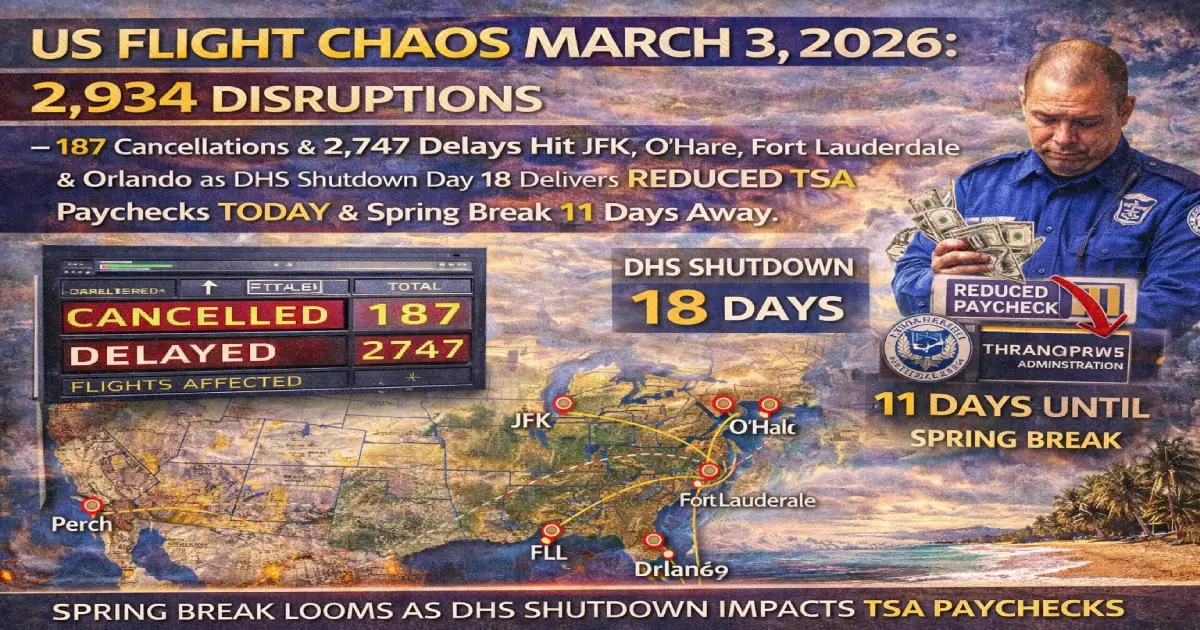
🔴 LIVE — Tuesday March 3, 2026 | DHS Shutdown Day 18 | Spring Break: 11 Days Away
Today is the day TSA agents stop being paid properly.
Not fully unpaid — not yet. But as of the payroll processing that ran overnight, approximately 61,000 Transportation Security Administration officers working without a DHS appropriations agreement are receiving reduced paychecks on Tuesday March 3 — the first concrete financial impact of the DHS shutdown on the frontline workers who screen every passenger at every one of America’s 440 commercial airports.
TSA paychecks due to be issued on March 3 could see agents getting reduced pay depending on the length of the shutdown — agents would not be at risk of missing a full paycheck until March 17.
That date — March 17 — is three days into Spring Break. The collision course has been set.
Against this backdrop, the US aviation system is recording 2,934 total disruptions today — 187 cancellations and 2,747 delays across major airports nationwide. The disruptions are being driven by the familiar combination of domestic operational pressure, weather ripple effects, and the emerging cascade from the Middle East airspace crisis now hitting US carrier international routes. Southwest Airlines leads the delay count with 374 delays. Delta recorded 168 delays alongside 10 cancellations. JFK recorded 21 cancellations and 175 delays. Chicago O’Hare recorded 12 cancellations and 219 delays.
It is, by the standards of this extraordinary winter, a manageable but pressured day. The question nobody in US aviation can fully answer is: what happens when “manageable” meets “61,000 workers who just got their first reduced paycheck”?
| Airport | Cancellations | Delays | Total |
|---|---|---|---|
| JFK International (JFK) | 21 | 175 | 196 |
| Chicago O’Hare (ORD) | 12 | 219 | 231 |
| Fort Lauderdale (FLL) | 16 | 174 | 190 |
| Orlando International (MCO) | 14 | 160 | 174 |
| Washington D.C. (DCA/IAD/BWI) | 11 | 148 | 159 |
| Other US Airports | 113 | 1,871 | 1,984 |
| US TOTAL | 187 | 2,747 | 2,934 |
| Airline | Cancellations | Delays |
|---|---|---|
| Southwest Airlines | 4 | 374 |
| Delta Air Lines | 10 | 168 |
| United Airlines | 18 | 162 |
| American Airlines | 22 | 157 |
| Spirit Airlines | 14 | 121 |
| SkyWest | 31 | 98 |
| Republic Airways | 28 | 87 |
21 cancellations | 175 delays
JFK is today’s worst-performing New York metro airport by total disruption count. The airport serves as a primary gateway for transatlantic and Caribbean routes — both categories now under elevated pressure from the Middle East crisis’s ripple effects on US carrier international operations. American, JetBlue, Delta, and United all operate significant JFK schedules, with morning European departures and afternoon Caribbean rotations bearing the heaviest load.
The Middle East crisis is creating a specific problem at JFK that most passengers are not anticipating: aircraft repositioning. Airlines that have suspended Gulf routes — particularly Delta’s Atlanta-Dubai and United’s Newark-Dubai services — are managing displaced widebody aircraft that were due to be in those rotations. Repositioning those aircraft takes time, creates scheduling gaps, and cascades into delays on domestic routes that share the same tail numbers.
12 cancellations | 219 delays
Chicago O’Hare is today’s highest-delay airport in the dataset. O’Hare’s position as both United Airlines’ largest hub and a major American Airlines hub makes it disproportionately sensitive to any systemic strain. Chicago O’Hare saw 12 cancellations and 219 delays today, with United and American both running significantly degraded afternoon schedules. O’Hare is also a primary connection point for international travellers arriving from Europe and connecting to domestic US destinations — European route delays driven by the Middle East crisis rerouting are cascading into O’Hare connection banks throughout the day.
16 cancellations | 174 delays
Fort Lauderdale has been one of the most persistently disrupted US airports throughout the 2026 winter crisis, and today is no exception. Fort Lauderdale reported 16 cancellations and 174 delays. FLL serves as JetBlue’s secondary Florida hub and handles enormous Spirit Airlines volume — both carriers are simultaneously managing the operational strain of today’s disruption and the financial pressure of the DHS shutdown environment, which elevates security checkpoint processing times and adds buffer minutes to every departure.
FLL is also one of the primary departure points for Caribbean cruise itineraries. Passengers with “fly-cruise” bookings — where they fly into Fort Lauderdale to board a ship the same day — face particular risk today. Any flight delay that causes a missed embarkation is typically not covered by cruise lines, which do not delay departures for air-delayed passengers.
14 cancellations | 160 delays
Orlando is the most Spring Break-sensitive airport in the United States. Millions of families fly into MCO for the Disney World, Universal, and SeaWorld theme park complex every March — making it uniquely exposed to the compounding risk of DHS shutdown disruptions during the exact weeks that volume peaks. Today’s 160 delays and 14 cancellations represent an above-average disruption day for MCO even by this winter’s standards.
Airlines serving MCO heavily — Southwest, Spirit, JetBlue, Delta — are all recording elevated delay rates today. Southwest alone recorded 374 delays nationally with only 4 cancellations, a pattern that indicates a system under sustained pressure running late across the board rather than outright cancelling services.
The three Washington metro airports — Reagan National, Dulles, and Baltimore-Washington — combined for approximately 159 disruptions today. Reagan National continues to carry elevated disruption risk as the airport where air traffic control staffing is most directly visible to the travelling public. During the 2025 shutdown, Reagan National was one of the first airports where TSA checkpoint closures were publicly observed. With reduced paychecks arriving today for the first time, the practical impact on checkpoint throughput will become clearer over the next 48–72 hours.
Today — Tuesday March 3, 2026 — is the first concrete financial pain point for 61,000 TSA officers who have been working without a DHS funding agreement since February 14.
The shutdown dynamic works like this: TSA agents are classified as essential workers and cannot stop working. But about 95% of TSA workers are deemed essential personnel and required to keep working without a deal in place. The payroll system, however, reflects the reality of the shutdown — and today’s reduced paychecks are the system’s first visible signal to the workforce that their financial situation is deteriorating.
Agents would not be at risk of missing a full paycheck until March 17. That is the date that matters most for airport operations. Here is why:
The timeline to full paycheck miss:
During past shutdowns, disruptions to air travel tended to build over time, not overnight. About a month into last year’s shutdown, for example, TSA temporarily closed two checkpoints at Philadelphia International Airport.
The current shutdown is 18 days old. If it reaches 30 days — which, absent a Congressional deal, it will do by March 16 — the US aviation system enters the operational territory that caused visible checkpoint closures in 2025. This time, Spring Break peak will be happening simultaneously.
Acting TSA Administrator Ha Nguyen McNeill told lawmakers that around 95% of TSA employees — roughly 61,000 people — are deemed essential and will be forced to work without pay. “We heard reports of officers sleeping in their cars at airports to save money on gas, selling their blood and plasma, and taking on second jobs to make ends meet,” she said of the last shutdown.
There is no resolution in sight. Congress remains deadlocked.
For passengers flying purely domestic US routes today, the Middle East connection may seem irrelevant. It is not. Here is the direct chain:
This is why aviation analysts refer to the US system as a “tightly coupled network.” When one major rotation is broken — even a single daily international service — the ripple propagates through dozens of domestic connections across multiple days.
The Middle East crisis has disrupted not just one route but dozens of international departures from every major US hub. The aggregate ripple effect on the domestic US network is now measurable and will persist for as long as Gulf airspace remains closed.
Spring Break 2026 begins in 11 days. Most US school districts are off the week of March 14–22. For American aviation, this represents the second-busiest travel week of the year after Thanksgiving — approximately 40 million passengers take to the skies in the three weeks spanning March 7 to March 31.
The convergence of threats is unprecedented:
Threat 1 — DHS Shutdown / TSA financial strain: If the shutdown continues to March 17, TSA officers miss their first full paycheck on the same day that Spring Break peak travel begins. Historical data shows callout rates rise sharply after missed paychecks. The 2025 shutdown is the most relevant recent analog because travel groups and airline advocates point to controller absences and capacity reductions as real operational outcomes when unpaid work persists. The 2025 shutdown lasted 43 days. The current one is 18 days old with no end in sight.
Threat 2 — Middle East crisis backlog: Even if Dubai, Doha and Riyadh begin genuine recovery this week, the aviation system will take 10–14 days to normalise. The full backlog clear will not complete before March 14 — meaning Spring Break begins on a system still recovering from the largest Gulf aviation shutdown since 9/11.
Threat 3 — US State Dept Worldwide Caution: The State Department issued a “Worldwide Caution” alert March 1, advising Americans to “exercise caution” and “follow instructions from the nearest embassy or consulate” when travelling internationally. This is the broadest-scope advisory the State Department issues. It does not restrict travel — but it creates uncertainty that affects booking confidence and raises questions for travellers considering international Spring Break trips.
Threat 4 — Italy ATC Strike March 7: Four days from now, Italy’s air traffic controllers walk out for 8 hours, putting 1,000–1,500 flights at risk across Rome Fiumicino, Milan Malpensa, Venice, and Naples. American travellers heading to Italy for Spring Break face the worst pre-peak disruption of any European destination.
The mathematical problem: Spring Break cannot be postponed. The kids are out of school on March 14 regardless of what is happening at TSA checkpoints. This is what makes 2026’s Spring Break uniquely dangerous from an operational standpoint — the travel surge will happen on whatever aviation system exists on March 14, disrupted or not.
Florida is the highest-volume Spring Break pre-cursor destination, and today’s disruption at FLL and MCO reflects elevated early-season demand meeting a constrained system. Allow 3 hours early arrival at the airport. Have your airline’s app downloaded and notifications enabled. If your specific flight is delayed more than 2 hours and the delay is within the airline’s control (crew or mechanical, not weather), request a meal voucher at the gate — this is your legal right under DOT regulations.
O’Hare and JFK are today’s worst performers. Minimum connection time recommended: 2 hours for domestic connections, 3 hours for international. Afternoon banks at O’Hare are running 30–60 minutes behind schedule systemwide. If you have a connection under 90 minutes at O’Hare today, contact your airline now to see whether a same-day earlier connection is available.
Global Entry and TSA PreCheck enrollment centers are operating on reduced hours at some locations due to DHS staffing pressures. Check your enrollment center’s current hours at tsa.gov before travelling to an appointment. Online renewal, however, remains fully functional.
Act in the next 48–72 hours. Every additional day of the DHS shutdown increases the probability that last-minute Spring Break seat availability will be constrained and that fares will rise. The window for securing reasonable fares on flexible domestic routes is closing.
Avoid all Middle East connections. The Emirates, Qatar Airways, and Etihad routings that many Americans use to reach Europe or South Asia via Gulf hubs are all disrupted. Fly direct or via non-Gulf hubs: London Heathrow, Frankfurt, Zurich, Amsterdam, Paris CDG, or Toronto are all fully operational.
If your flight is cancelled by the airline: You are entitled to a full refund — no voucher, no credit, a cash refund to your original payment method — for the cancelled portion of your ticket. This is US DOT policy, enforced regardless of the reason for cancellation. If the airline offers a voucher and you want cash, you are entitled to say no and request a cash refund.
If your flight is delayed over 3 hours (domestic) and it is within the airline’s control: Most major US airlines have now committed, under DOT agreement, to providing meal vouchers for delays of 3+ hours. Delta, United, American, Southwest, Alaska, JetBlue, and Frontier are all covered by this commitment. Spirit is not covered by the same agreement — check Spirit’s customer service policies separately.
If your delay requires an overnight stay: If the delay is within the airline’s control (not weather, not extraordinary circumstance), most major carriers now commit to providing hotel accommodation. Carry receipts for any expenses and submit them to the airline’s customer service portal within 30 days.
Weather delays — no compensation: If your delay is designated as weather-caused, no cash compensation is owed. However, most airlines will still rebook you on the next available flight at no charge, and many will provide meal vouchers as a goodwill gesture even when not legally required.
✅ Download your airline’s app and enable push notifications — real-time cancellation alerts arrive here first, before the airport departure board changes.
✅ Arrive at the airport earlier than usual — TSA checkpoint processing times are elevated due to reduced-pay staffing stress. Add 30–45 minutes to your normal pre-departure airport arrival time at major hubs.
✅ Check your connection time — if it is under 90 minutes at a major hub, call your airline now to inquire about earlier options. Today is not a day for tight connections.
✅ Know your seat on your rebooked flight — don’t accept a rebooking confirmation without confirming the specific new flight number, departure time, and seat assignment. Verbal confirmations from gate agents are not enough.
✅ Document everything — any delays, cancellations, meal voucher denials, or accommodation claims should be photographed and saved. US DOT online complaint submissions at transportation.gov take 30 days to process but are the primary accountability mechanism for airline passenger rights.
✅ If you are flying internationally via the Gulf — your itinerary is compromised. Contact your airline today and ask for free rerouting through an alternative hub. Do not wait for a cancellation email.
Posted By : Vinay
Lastest News
2nd Floor, 39, Above Kirti Club, DLF Industrial Area, Kirti Nagar, New Delhi, Delhi 110015



Travel Tourister is a leading Travel portal where we introduce travellers to trusted travel agents to make their journey hasselfree, memorable And happy. Travel Tourister is a platform where travellers get Tour packages ,Hotel packages deals through trusted travel companies And hoteliers who are working with us across the world. We always try to find new and more travel agents and hoteliers from every nook and corners across the world so that you could compare the deals with different travel agents and hoteliers and book your tour or hotel with the one you have chosen according to your taste and budget.
Copyright © Travel Tourister, India. All Rights Reserved

 Call
Call Enquiry