Published on : 27 Jan 2026
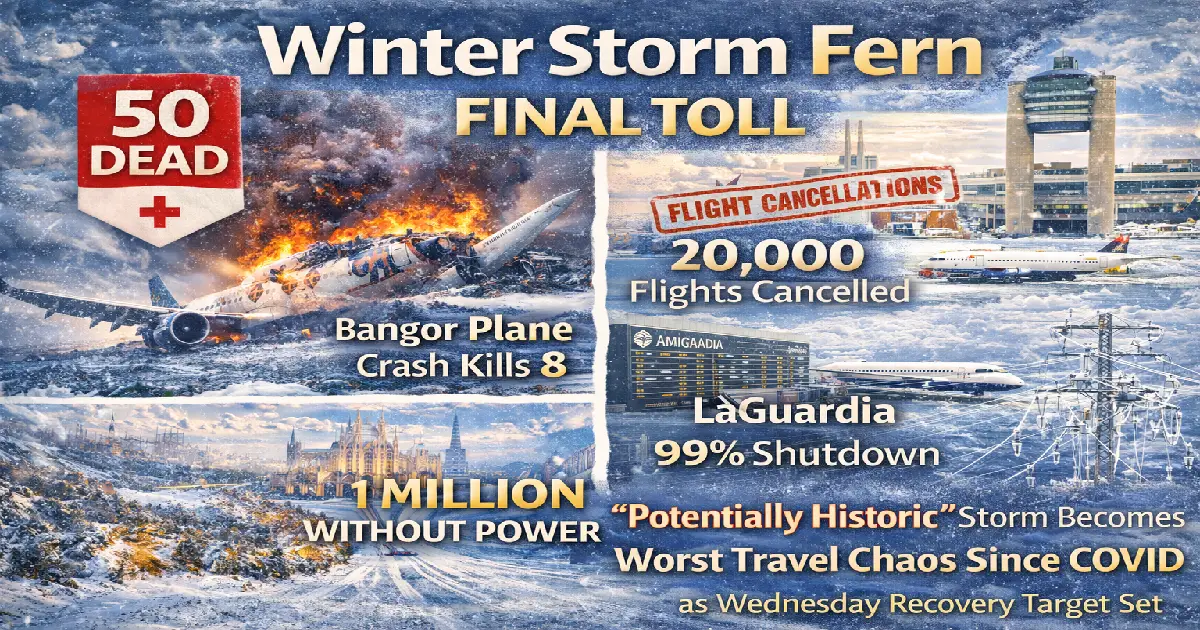
HISTORIC CATASTROPHE: Winter Storm Fern’s devastating three-day rampage (January 23-26, 2026) killed at least 50 people, cancelled 20,000 flights nationwide, triggered a fatal plane crash at Bangor killing all 8 aboard, shut down LaGuardia Airport (99% cancellations Sunday), Reagan National (99%), and left 1 MILLION customers without power from Texas to Maine. Transportation Secretary Sean Duffy says normal operations won’t resume until Wednesday January 29—making this the worst US travel disaster since the COVID-19 pandemic height in March 2020. Here’s the complete final toll, what went catastrophically wrong, and what travelers stranded across the country need to know RIGHT NOW.
Published: January 27, 2026 Storm Duration: January 23-26, 2026 (4 days of chaos) Death Toll: 50+ confirmed (still rising) Flights Cancelled: 20,000+ (Friday-Monday) Worst Single Day: 11,000+ cancellations Sunday January 25 (worst since COVID March 30, 2020) Airports Shut Down: LaGuardia 99%, Reagan National 99%, Atlanta 50%, Newark 74% Power Outages: 1 million+ customers (peak), 700,000 still without power Monday States Affected: 24 states under emergency declarations (Trump signed 12 federal emergency orders) People Under Alerts: 230 million Americans (2/3 of US population) Recovery Target: Wednesday January 29, 2026 (per Transport Secretary Duffy) Bangor Plane Crash: 8 dead (Bombardier Challenger 650 crashed during takeoff in storm) Toronto Record: 46cm (18 inches) snow = largest single-day snowfall since records began 1937
As Winter Storm Fern finally exits the Northeast Monday evening, January 27, the full scale of devastation becomes clear:
DEATHS: 50+ Confirmed (As of January 26)
❌ Bangor, Maine: 8 killed in plane crash (Bombardier Challenger 650 during takeoff) ❌ Louisiana: 2 hypothermia deaths (Caddo Parish), 1 carbon monoxide poisoning (DeSoto Parish) ❌ Mississippi: 2 deaths (66-year-old Jackson, 73-year-old Iuka—tree fell on mobile home) ❌ North Carolina: 1 hypothermia death (31-year-old Buncombe County), 400+ traffic accidents ❌ South Carolina: 2 extreme cold deaths (Greenwood, Laurens counties) ❌ Multiple States: 34 additional confirmed fatalities (causes: hypothermia, traffic accidents, carbon monoxide, falling trees/power lines)
Note: Death toll expected to rise as remote areas report in and delayed fatalities (hypothermia complications, heart attacks from snow shoveling) are confirmed.
FLIGHT CHAOS: 20,000+ Cancelled Friday-Monday
Daily Breakdown:
TOTAL: 20,000+ flights cancelled in 4 days
Worst-Hit Airports (Sunday January 25 Cancellation Rates):
| Airport | Cancellation Rate | Flights Cancelled |
|---|---|---|
| Reagan National (DCA) | 99% | Nearly entire schedule |
| LaGuardia (LGA) | 99% | 90%+ Sunday departures |
| Newark (EWR) | 74% | International/domestic mix |
| JFK (New York) | 74% | International priority flights only |
| Logan (Boston) | 60%+ | Northeast chaos |
| Hartsfield-Jackson (Atlanta) | 50% | 1,000+ flights (Delta hub paralyzed) |
| DFW (Dallas) | 45%+ | American Airlines hub destroyed |
| Charlotte (CLT) | 40%+ | American Airlines secondary hub |
Result: An estimated 2-3 million passengers stranded nationwide over the weekend—the largest single-event travel disruption since COVID-19 ground halt March 2020.
POWER OUTAGES: 1 Million+ Peak, 700,000 Still Dark Monday
Peak Outages (Sunday Morning): 1,000,000+ customers
States Hit Hardest:
By Monday Midday: 700,000 still without power (improvement but still catastrophic)
Why So Bad:
Ice storm in South caused 0.60 inches of ice accumulation in places like Toccoa, Georgia—enough to snap trees and power lines like matchsticks. Thousands of downed trees blocking roads prevented repair crews from reaching outage areas for 24-48 hours.
POLITICAL RESPONSE: Trump Signs 12 Federal Emergency Declarations
President Donald Trump approved federal emergency disaster declarations Saturday January 25 for:
What This Means:
Additional State Declarations:
BREAKING TRAGEDY: A Bombardier Challenger 650 business jet crashed during takeoff at Bangor International Airport (Maine) Sunday night January 25 around 7:45 PM, killing all 8 people aboard.
What Happened:
✈️ Aircraft: Bombardier Challenger 650 (private business jet) ✈️ Time: Approximately 7:45 PM Sunday, January 25, 2026 ✈️ Location: Bangor International Airport (BGR), Maine ✈️ Passengers: 8 total (7 passengers + 1 flight crew member) ✈️ Weather: Active Winter Storm Fern conditions (heavy snow, low visibility, icing) ✈️ Status: All 8 “presumed to be deceased” per authorities ✈️ Investigation: FAA and NTSB investigating
Initial Reports Confusion:
Airport Impact:
Context:
This crash occurred during the HEIGHT of Winter Storm Fern’s Northeast impacts—heavy snow, freezing temperatures, low visibility, and icing conditions. While cause remains under investigation, the timing during active storm conditions raises obvious questions about takeoff decision-making.
Meteorologists called Winter Storm Fern “potentially historic” even before it hit—and they were right. Here’s why:
2,000 Miles Long: Storm stretched from Mexico-US border to deep into Canada
Result: Impossible for airlines to reroute around—every major hub hit simultaneously.
230 Million People Under Alerts: Nearly 2/3 of US population
NWS Statement: “Around 300 million people under winter precipitation and/or cold warnings or advisories”—one of the highest counts in recorded history.
Most winter storms bring ONE primary hazard (snow OR ice OR wind). Fern brought ALL SIMULTANEOUSLY across different regions:
Southern States (TX, LA, MS, AL, GA, SC, NC):
Plains/Midwest (OK, KS, MO, IL, IN, OH):
Northeast (PA, NY, NJ, CT, MA, ME):
Canada (Ontario):
Peak Weekend Travel: Friday-Sunday January 23-25
Post-Holiday Fatigue: Airlines/airports already exhausted from December holiday travel + January 2/16/19 winter disruptions = no reserves left.
De-Icing Fluid Shortage: Airports ran OUT of de-icing fluid by Sunday
Runway Capacity Collapse:
Crew Duty Limits:
Sunday Impact:
Why So Bad:
Monday Recovery:
Sunday Impact:
Why So Bad:
Political Fallout:
Why Better Than LaGuardia:
But Still Terrible:
Why World’s Busiest Airport Struggled:
Delta’s Response:
Why American Airlines Hub Failed:
American’s Response:
HISTORIC: Toronto’s largest single-day snowfall since records began in 1937
Impact:
Why So Bad:
What They Did Right:
✅ Proactive Aircraft Positioning: Moved planes OUT of storm path 48 hours ahead ✅ Extra Flights Added: 6,200 additional seats (3,200 DFW, 3,000 Charlotte-Chicago) ✅ Early Change Fee Waivers: Issued travel alert January 22 (before storm hit) ✅ Hotel Vouchers: Proactively issued to stranded passengers ✅ App Performance: Delta app handled rebooking load without crashing
Cancellations: 1,307 Sunday (40% of schedule) = Lower than American/United %
Passenger Feedback: “Delta got me rebooked within 2 hours via app, hotel voucher came fast”
What Went Wrong:
❌ DFW Dependence: 50% of Sunday flights cancelled (hub paralysis = network collapse) ❌ Charlotte Also Hit: Secondary hub struggled = nowhere to reroute ❌ Crew Shortages: Couldn’t get pilots/FAs to airports on iced roads ❌ Customer Service Overload: Phone lines jammed, app slow
What They Did Right:
✅ Added 6,200 extra seats (3,200 DFW, 3,000 Charlotte) ✅ Issued travel alerts early ✅ Waived change fees
Cancellations: 1,471 Sunday (50% of mainline) = Highest % among Big 3
Passenger Feedback: “American cancelled my flight 6 times in 3 days, phone wait 4+ hours”
Challenges:
❌ Newark Hub Hit: 74% cancellations = major disruption ❌ Chicago Hub Struggled: Wind/snow combo reduced capacity ❌ Houston Issues: Ice in Texas affected IAH hub
What They Did Right:
✅ Proactive rebooking (app worked well) ✅ Hotel vouchers issued faster than competitors ✅ International flights prioritized (fewer transatlantic cancellations vs domestic)
Passenger Feedback: “United app let me rebook myself in 10 minutes, avoided phone hell”
Advantage:
✅ Point-to-Point Network: Less dependent on hubs = fewer cascade failures ✅ Smaller Regional Presence: Avoided worst Northeast airports
Disadvantage:
❌ No International Flights: Can’t reroute to alternate countries ❌ Assigned Seating Launch: January 27 (TODAY!) complicates recovery
Note: Southwest cancellations not separately reported in data, but network structure helped avoid American/United-level hub meltdowns.
Transportation Secretary Sean Duffy (Trump Administration) stated Monday that airlines expect “normal operations by Wednesday” January 29.
What This Means:
Monday January 27 (TODAY):
Tuesday January 28:
Wednesday January 29:
BUT: Any new weather system this week could delay recovery further.
Step 1: Rebook Immediately
Best Methods (in order):
DON’T: Wait in line at airport if you can rebook online/phone—you’re wasting precious time while seats fill up.
Step 2: Know Your Rights
Weather = “Act of God” = Airlines DON’T Owe Compensation
BUT airlines MUST:
✅ Rebook you on next available flight (their airline or partner) ✅ Provide meal vouchers if delay 3+ hours ✅ Provide hotel voucher if overnight (if you’re away from home) ✅ Waive change fees
What Airlines DON’T Have to Do:
❌ Pay cash compensation (EU-style passenger rights don’t apply to US weather delays) ❌ Upgrade you to business class ❌ Rebook you on competitor if they have seats (only partners)
Step 3: Check Credit Card Benefits
Many travel credit cards offer:
✅ Trip Delay Insurance: Reimburses hotels/meals if delayed 6+ hours ✅ Trip Cancellation Insurance: Refunds non-refundable bookings ✅ Baggage Delay: Reimburses essentials if bags delayed 6+ hours
Check Your Card:
File Claims Within 30-90 Days (check your card’s policy)
Book First Flight of Day:
Avoid Connections:
Build Buffer Days:
Check Status Obsessively:
700,000 Still Without Power Monday—Here’s Help:
Find Outage Info:
Warming Centers:
Generator Safety:
Food Safety:
Winter Storm Fern’s final toll—**50 dead, 20,000 flights cancelled, 1 million without power, Bangor plane crash—**makes it the worst US travel disaster since the COVID-19 pandemic height in March 2020.
The Numbers Don’t Lie:
What Went Wrong:
What This Means Going Forward:
For Airlines:
For Travelers:
For Infrastructure:
The Reality:
Climate change is making winter storms MORE EXTREME (but not necessarily “warmer”). Polar vortex destabilization sends Arctic air farther south. Warmer oceans create more moisture = heavier snow. Result: “Potentially historic” storms becoming the NEW NORMAL.
Until US invests billions in airport infrastructure, airlines rebuild crew reserves, and travelers adjust expectations for winter chaos, disasters like Winter Storm Fern will keep happening.
Winter Storm Fern killed 50, cancelled 20,000 flights, and reminded us: Mother Nature doesn’t care about your flight schedule. When she says “stay home,” LISTEN.
For More Resources:
Related Articles:
Posted By : Vinay
Lastest News
2nd Floor, 39, Above Kirti Club, DLF Industrial Area, Kirti Nagar, New Delhi, Delhi 110015



Travel Tourister is a leading Travel portal where we introduce travellers to trusted travel agents to make their journey hasselfree, memorable And happy. Travel Tourister is a platform where travellers get Tour packages ,Hotel packages deals through trusted travel companies And hoteliers who are working with us across the world. We always try to find new and more travel agents and hoteliers from every nook and corners across the world so that you could compare the deals with different travel agents and hoteliers and book your tour or hotel with the one you have chosen according to your taste and budget.
Copyright © Travel Tourister, India. All Rights Reserved

 Call
Call Enquiry