Published on : 26 Jan 2026
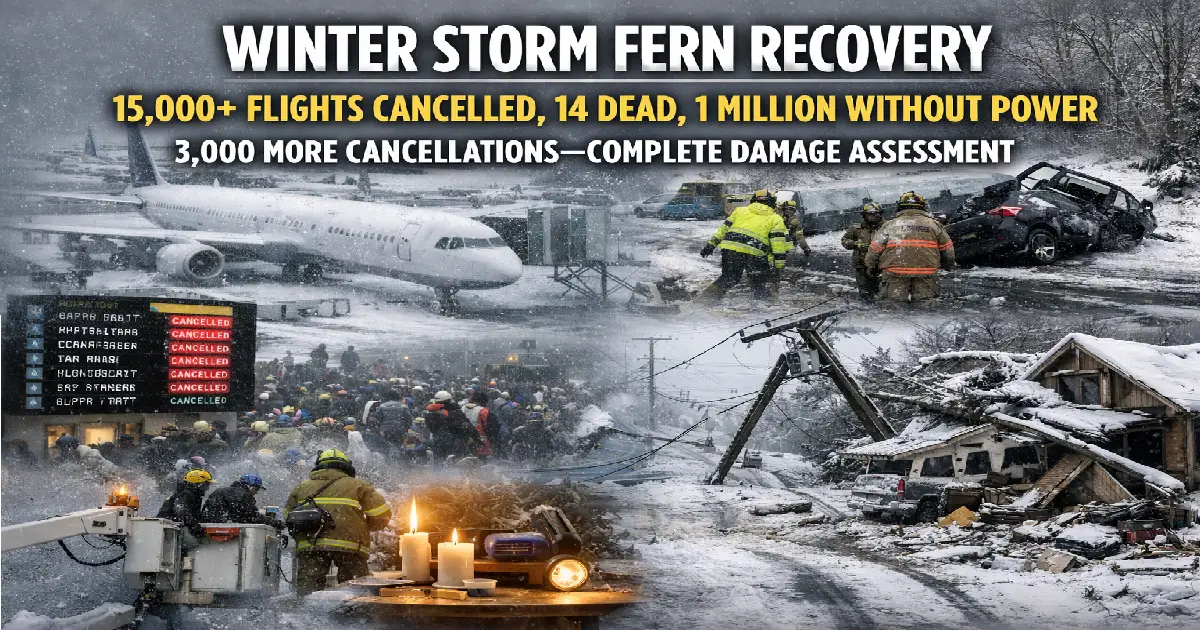
BREAKING UPDATE | Published: January 26, 2026, 8:00 AM EST | Updated: January 26, 2026, 10:30 AM EST
NATIONWIDE — Winter Storm Fern has officially become the deadliest and most disruptive winter weather event since the COVID-19 pandemic, with airlines cancelling over 15,000 flights across the weekend, at least 14 people confirmed dead, and more than 1 million customers still without power Monday morning as the storm’s aftermath cripples recovery efforts.
Sunday alone saw 11,400 flight cancellations—the highest single-day total since March 2020—while Monday is bringing an additional 3,000+ cancellations as airlines struggle to reposition aircraft and crews scattered across the frozen nation. Aviation analytics firm Cirium confirms this is “the highest experienced cancellation event since the pandemic.”
Current Crisis Status:
Death Toll Update: At least 14 people have died across multiple states due to storm-related incidents including vehicle accidents on icy roads, carbon monoxide poisoning from improper generator use, and hypothermia.
Timeline:
More than 11,400 flights were canceled Sunday as Winter Storm Fern reached its catastrophic peak, making January 25, 2026 the worst single day for flight cancellations since the COVID-19 pandemic began in March 2020.
Aviation analytics firm Cirium declared Sunday morning that “as of Sunday morning, the storm is the highest experienced cancellation event since the pandemic,” surpassing all previous winter weather disruptions including the February 2021 Texas freeze and December 2022 Southwest Airlines meltdown.
Airlines cancelled more than 15,000 U.S. flights over the weekend (Saturday + Sunday combined), affecting an estimated 1.8 million passengers and leaving hundreds of thousands stranded in airports from Dallas to Boston.
Weekend Breakdown:
Air travel disruptions will linger into Monday even after Winter Storm Fern cleared out, with airlines canceling more than 3,000 flights Monday as they work to recalibrate operations after the weekend’s historic collapse.
Monday Morning Status (10:30 AM EST):
Vikrant Vaze, a Dartmouth professor specializing in commercial aviation logistics, warned that “recovery from the storm cancellations and delays will take days if not longer,” as airlines face unprecedented aircraft and crew malposition challenges.
At least 14 people have died due to Winter Storm Fern as of Monday morning, with fatalities reported across multiple states from vehicle accidents on ice-covered roads, carbon monoxide poisoning, and hypothermia exposure.
Confirmed Deaths:
State emergency management agencies warn the death toll may rise as authorities access previously unreachable areas and complete welfare checks on isolated residents.
More than 1,005,641 customers across the United States were without electricity as of 2:14 PM EST Sunday, with Tennessee bearing the worst impact followed by Mississippi, Texas, Louisiana, Kentucky, Georgia, Virginia, and Alabama.
Power Outage Breakdown (Sunday 2:14 PM EST):
The Department of Energy issued an emergency order temporarily authorizing grid operator PJM Interconnection to run power generation facilities to help ensure electricity amid extreme temperatures and storm impact across the mid-Atlantic region, though operations may exceed environmental permit restrictions.
“As Winter Storm Fern brings extreme cold and dangerous conditions to the Mid-Atlantic, maintaining affordable, reliable, and secure power in the PJM region is non-negotiable,” U.S. Energy Secretary Chris Wright stated.
The Department of Energy also authorized the Electric Reliability Council of Texas (ERCOT) to run backup generators for the state, preventing a repeat of the February 2021 Texas power grid collapse.
Nearly 90% of Sunday flights were canceled at LaGuardia Airport in New York, with the facility closing Sunday afternoon and expected to reopen at 6 AM Monday.
LaGuardia Impact:
Ronald Reagan Washington National Airport experienced a near-total shutdown Sunday, with 99% of flights cancelled and airport officials posting: “ALERT: Airlines have canceled all flights at the airport today. Check with your airline for confirmation and rebooking options. Please stay home and off the icy roads.”
DCA Sunday Status:
More than 74% of flights at Newark Liberty International Airport and John F. Kennedy International Airport, which have more international flights, were also canceled for Sunday.
NYC Metro Airports Sunday:
Close to half the flights at Atlanta Hartsfield-Jackson International Airport, the world’s busiest, were canceled Sunday despite the city being outside the storm’s heaviest impact zone.
Atlanta Sunday:
Fort Worth, Texas-based American Airlines cancelled 1,471 mainline flights on Sunday, close to half of its schedule, according to FlightAware.
American Sunday Impact:
American said last week it was repositioning airplanes and increasing staffing at major airports to help soften the impact and “set the stage for a fast, safe recovery once conditions improve.”
Atlanta-based Delta scrubbed 1,307 flights Sunday, or 40% of its schedule, as ice crippled its Atlanta mega-hub and winter weather impacted operations across its network.
Delta Sunday Impact:
Southwest Airlines reported over 1,260 cancellations Sunday, with Nashville operations experiencing 100% shutdown and Dallas Love Field seeing 75%+ cancellations.
Southwest Sunday Impact:
United Airlines had about 900 Sunday cancellations, with Newark hub bearing the brunt of Northeast disruptions.
United Sunday Impact:
JetBlue had more than 570 cancelled flights, accounting for roughly 71% of its schedule for the day—the highest percentage cancellation rate among major carriers.
JetBlue Sunday Impact:
Even after the storm cleared Sunday evening, Monday brings continued chaos with 3,000+ cancellations as airlines face unprecedented aircraft and crew malposition challenges.
The Problem:
Monday’s Ripple:
Pilots and flight attendants have strict FAA duty limits:
When Sunday’s cancellations strand crews, they “time out” and cannot legally work Monday flights even if aircraft become available, creating Monday’s 3,000+ cancellations despite weather clearing.
NJ Transit suspended all bus and light rail services early Sunday morning, with rail service scheduled for a system-wide suspension at 2 PM Sunday.
NJ Transit Monday Status:
In New York City, the MTA has suspended all bus service, though subways continue to run on a modified schedule.
MTA Monday Status:
Northeast Corridor: Trains running with 2-4 hour delays Monday Long-Distance Routes:
Monday Forecast:
The Problem: Temperatures staying below freezing Monday-Tuesday means accumulated ice and snow won’t melt naturally, requiring extensive manual clearing operations at airports and delaying full recovery.
Snow:
Ice (The Real Killer):
CRITICAL ACTIONS:
Expect:
You’re Still At Risk:
Tuesday Outlook: Much improved but not normal. 500-800 cancellations expected vs Monday’s 3,000.
Rebooking Priority:
What Airlines Owe You:
However: Many airlines providing meal vouchers ($12-15) and hotel vouchers as customer service gestures.
All major carriers have extended travel waivers through end of January:
Extended Through: January 28 Covered Airports: 50+ locations Rebooking Deadline: January 31 Change Fee: Waived Fare Difference: Waived (same origin/destination)
Extended Through: January 28 Covered Airports: 40+ locations Rebooking Deadline: January 31 3,200 Extra Seats: Added at Dallas-Fort Worth for Monday recovery
Extended Through: January 29 Covered Airports: 42+ locations Rebooking Deadline: February 5
Extended Through: January 28 Covered Airports: 48+ locations Rebooking Window: 14 days from original travel
Two Active Waivers:
Preliminary industry estimates suggest airlines will lose $300-350 million from the weekend’s 15,000+ cancellations, making Winter Storm Fern one of the costliest weather events in aviation history.
Cost Breakdown:
Airline-Specific Losses:
These figures don’t include long-term reputational damage or customer loyalty impacts from the operational meltdown.
Winter Storm Fern officially ranks as the worst weather-related aviation disaster of the past decade.
Aviation industry experts warn recovery will extend well into the week despite weather improvements.
Vikrant Vaze, Dartmouth Professor (Commercial Aviation Logistics): “Recovery from the storm cancellations and delays will take days if not longer. The aircraft and crew malposition problems created by 15,000 cancellations cannot be solved quickly. We’re looking at Wednesday or Thursday before the system fully normalizes.”
Henry Harteveldt, Travel Industry Analyst: “This is the aviation equivalent of a major hurricane disruption. The 11,400 Sunday cancellations exceeded our worst-case projections. Airlines that cancelled preemptively on Saturday actually performed better than those who waited—another lesson from the 2022 Southwest disaster.”
Sara Nelson, Association of Flight Attendants President: “Our flight attendants are exhausted, stranded, and timing out on duty limits across the country. The ripple effects of Sunday’s chaos will impact Tuesday and Wednesday flights as well. Passengers need patience and understanding.”
“We will continue to monitor, and stay in touch with all States in the path of this storm. Stay Safe, and Stay Warm.”
“It’s going to be very, very cold. So we’d encourage everybody to stock up on fuel, stock up on food, and we will get through this together.”
“As Winter Storm Fern brings extreme cold and dangerous conditions to the Mid-Atlantic, maintaining affordable, reliable, and secure power in the PJM region is non-negotiable.”
Winter Storm Fern has officially become the deadliest and most disruptive winter weather event in U.S. aviation history since the COVID-19 pandemic began, with 15,000+ weekend flight cancellations, 14 confirmed deaths, over 1 million customers without power, and operational chaos continuing through Monday with 3,000+ additional cancellations.
For Travelers:
If you’re flying Monday, expect significant delays and last-minute cancellations despite weather improvements. Check flight status every hour, arrive 3 hours early, and have backup plans ready.
If you’re flying Tuesday-Wednesday, you’re not safe yet. Residual disruptions will continue through midweek as airlines struggle to reposition 7,500 displaced aircraft and reconstitute exhausted flight crews.
For Airlines:
The preemptive mass cancellation strategy prevented a Southwest 2022-style extended meltdown, but the 11,400 Sunday cancellations still represent the worst weather day since COVID. Recovery will test operational systems through Thursday, with $300+ million in losses and millions of frustrated passengers.
For the Aviation Industry:
Climate change continues producing more intense and unpredictable winter weather events. The system’s vulnerability to simultaneous ice storms in the South and snowstorms in the Northeast represents a growing operational and financial risk that may require fundamental infrastructure investments and policy changes.
Sunday, January 25, 2026: The day weather won and aviation lost. Badly.
Resources for Monday Travelers:
Related Coverage:
Posted By : Vinay
Lastest News
2nd Floor, 39, Above Kirti Club, DLF Industrial Area, Kirti Nagar, New Delhi, Delhi 110015



Travel Tourister is a leading Travel portal where we introduce travellers to trusted travel agents to make their journey hasselfree, memorable And happy. Travel Tourister is a platform where travellers get Tour packages ,Hotel packages deals through trusted travel companies And hoteliers who are working with us across the world. We always try to find new and more travel agents and hoteliers from every nook and corners across the world so that you could compare the deals with different travel agents and hoteliers and book your tour or hotel with the one you have chosen according to your taste and budget.
Copyright © Travel Tourister, India. All Rights Reserved

 Call
Call Enquiry