Published on : 14 Feb 2026
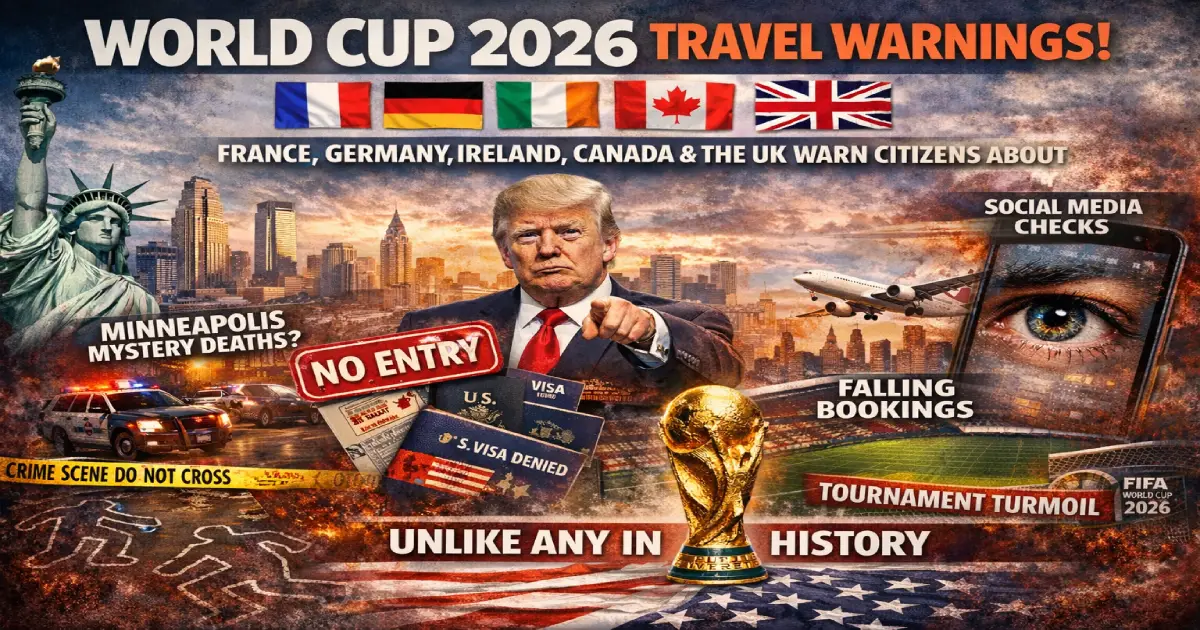
Breaking: In an unprecedented development that has no parallel in FIFA World Cup history, five major nations — France, Germany, Ireland, Canada, and the United Kingdom — have all issued updated travel advisories warning their citizens about travelling to the United States for the 2026 FIFA World Cup, with France explicitly urging citizens to avoid Minneapolis city centre following protests that resulted in the deaths of US citizens and protesters at the hands of ICE officers, Germany warning that demonstrations “could turn violent” involving migration and security authorities, Canada officially recommending fans fly rather than drive between US host cities and carry printed proof of match tickets at the border, the UK flagging “heightened security” and document validity concerns, and preliminary airline booking data for summer 2026 now showing international advance travel to the US trending lower than any comparable pre-World Cup period on record — while simultaneously Trump’s travel ban blocks fans from 39 countries, social media vetting of European visitors is being expanded, and four World Cup-qualified nations face complete fan blackouts from all US matches. Here is the complete guide every international fan planning a World Cup 2026 US trip must read today.
Published: February 14, 2026 World Cup Dates: June 11 – July 19, 2026 (118 days away) Countries Issuing US Travel Advisories: France, Germany, Ireland, Canada, United Kingdom — 5 nations Minneapolis Advisory Level: France — avoid city centre; Germany — demonstrations could turn violent Trump Travel Ban: 39 countries (expanded from 19 on January 1, 2026) World Cup Teams Fully Banned from US Matches: Haiti, Iran, Senegal, Ivory Coast — 4 teams World Cup Teams with Partial Restrictions: 12 additional nations including Brazil, Colombia, Morocco, Algeria Social Media Vetting: US expanding to all visitors including European visa-waiver countries International Bookings Trend: Advance summer 2026 US travel from Europe trending LOWER than previous years FIFA PASS System: Live since January 20, 2026 — priority visa appointments for ticket holders Canada/Mexico Alternative: Matches in both countries accessible without US entry requirements US Host Cities: New York, Los Angeles, Miami, Dallas, Atlanta, Houston, Boston, Seattle, Philadelphia, Kansas City, Minneapolis Canadian Host Cities: Toronto, Vancouver (11 matches — key alternative for banned fans)
France’s travel advisory was changed in January following protests in Minneapolis that led to two deaths of US citizens and protesters by ICE officers. The advisory urges French citizens to avoid the city center of Minneapolis, to avoid other types of gatherings, and to limit travel within the destination if necessary. “Local authorities are urging residents to avoid the city centre,” reads the advisory for Minneapolis. “It is advisable to stay informed and avoid all gatherings, limiting travel if necessary.”
France’s advisory is the most specific and the most alarming of the five nations’ warnings — because it names a World Cup host city explicitly and cites deaths. Minneapolis is set to host World Cup matches at US Bank Stadium. Minneapolis has received particular attention in updated advisories, with France modifying its travel guidance in January following protests in the city that resulted in fatalities.
The French Ministry of Foreign Affairs has also emphasised that all French citizens must ensure their travel documents are valid well in advance of departure, and that they remain vigilant in crowded areas — including football stadiums and fan zones — due to the potential for security incidents.
For French fans with Minneapolis World Cup tickets: The French government is not telling you not to attend the matches — it is telling you to avoid the city centre outside of match contexts, stay informed of local news, and be prepared to limit movement if unrest escalates. The advice is precautionary, not prohibitive. But it is government-issued and formally published.
Germany followed suit in January, noting that demonstrations in Minneapolis and other cities could turn violent, involving migration and security officials. The German warning encouraged citizens to stay away from crowds and monitor local news.
Germany’s advisory extends beyond Minneapolis to other World Cup host cities — acknowledging that immigration enforcement operations have been conducted in Los Angeles, Chicago, and Houston, all of which are also hosting World Cup matches. German tourists are specifically warned that “the overall burden of violent crime” in certain US areas warrants heightened awareness.
The French Ministry of Foreign Affairs, for example, has emphasised the importance of being aware of potential security risks in crowded areas, while also urging travelers to confirm the validity of visas and other necessary authorisations.
Impact on German bookings: Some Americans, particularly those planning multi-country European vacations in 2026, are reconsidering their travel plans. Many are either advancing their trips to 2025 or postponing until after the tournament to steer clear of the logistical challenges. Airline analysts have pointed out that even though these advisories do not directly alter policies, the tone of government language can influence how travelers perceive their trips. The same dynamic applies to German fans — government language matters even when it stops short of a formal Do Not Travel warning.
Ireland has issued formal guidance for Irish citizens attending World Cup matches in the United States, specifically naming the Twin Cities metropolitan area (Minneapolis–Saint Paul) as warranting heightened caution. Ireland’s advisory aligns with France and Germany in identifying the Minneapolis ICE enforcement context as a specific risk factor for European visitors — not just for undocumented immigrants, but for any foreign visitor in an environment where federal enforcement operations are actively ongoing.
Ireland’s World Cup advisory context is particularly significant because the Irish diaspora in the United States is enormous — an estimated 31 million Americans claim Irish ancestry, and Ireland’s match attendances at US sporting events consistently punch well above the nation’s population size. A formal Irish government advisory about US travel reaches a disproportionately large audience of Irish-Americans who might also be affected.
Canada’s World Cup advisory is the most practically detailed of the five nations — published directly by the Government of Canada at travel.gc.ca and containing specific operational guidance that goes beyond general caution.
Canadian authorities have reminded travelers to comply with entry requirements and suggested air travel as a smoother option compared to land crossings during peak event periods. Specifically: You should carry proof of match tickets and confirmed accommodations as border officers may request their verification.
Travel between Mexico and the US border should be made by air due to criminal activity and violence in border areas. If you decide to travel by land across the Mexico and United States border, be aware that the situation can be tense in the border area between the United States and Mexico and there may be a regional advisory to avoid non-essential travel to one of the border states.
Canada’s advisory also contains a critical warning for dual citizens: Canadians with dual citizenship from another country should travel to the US using the appropriate travel document.
What Canada’s advisory means in practice for World Cup fans:
France, Germany, Ireland, the United Kingdom, and other European nations have issued updated travel advisories for the US ahead of the 2026 FIFA World Cup due to rising security concerns, political tensions, and visa challenges. These advisories highlight issues such as overcrowded airports, skyrocketing airfare, and delayed flights.
The UK’s advisory specifically flags heightened security screening at US airports and entry points, the importance of ensuring all travel documents are valid well before departure, and awareness of local protests and law enforcement activity in host cities. British fans attending World Cup matches — particularly in Los Angeles (where Iranian-American communities have already organised demonstration events) and Minneapolis — are advised to monitor FCO travel updates closely in the weeks before their matches.
While the five-nation advisory story is February 2026’s new development, the underlying travel ban context has been building since June 2025 and is essential for any international fan planning a US World Cup trip.
On June 4, 2025, President Donald Trump issued a proclamation restricting or limiting the entry of nationals from 19 countries, mostly from the Middle East and Africa. On December 16, 2025, the administration expanded the list to 39 nations. Fans from each of these countries will largely be unable to attend any games in the US during next year’s tournament, unless they have a valid visa issued before June 9, 2025 for the original 19 countries, or January 1, 2026 for the additional 20 countries.
Haiti, Iran, Senegal, and Cote d’Ivoire are the four teams that were included in the June and December travel bans and have also qualified for the 2026 World Cup. In each case, B-2 tourist visas, which is how most fans would attend the World Cup, are prohibited.
Haiti qualified for the tournament for the first time in over 50 years. Yet due to the travel ban, most fans from the island will not be able to watch their team play in the US. Haiti’s US matches are scheduled — Haitian fans in the stadium will be almost exclusively Haitian-Americans already resident in the country. Fans travelling from Haiti itself face a near-total barrier.
Iran plays its first two matches against New Zealand and Belgium in Los Angeles — home to the largest Iranian-American community in the world. Beverly Hills Mayor Sharona Nazarian is an outspoken critic of the Iranian regime, and a big fan of Iran’s World Cup team. “For many, the team represents the people, and not the regime,” said Nazarian. “Seeing Iran play in the US brings pride, and also pain and hope and protest all at the same time.”
The exemption that doesn’t help fans: Notably, “any athlete or member of an athletic team, including coaches, persons performing a necessary support role, and immediate relatives, travelling to the World Cup” is exempt from the policy, according to the proclamation. Individuals who are diplomats, permanent residents of the US, or whose travel “would serve a United States national interest” are also exempt from the ban. Players and coaching staff from all 48 nations can travel. Their fans cannot.
In addition, 12 World Cup-qualified countries — Algeria, Brazil, Cape Verde, Colombia, Egypt, Ghana, Guatemala, Jordan, Morocco, Tunisia, Uruguay and Uzbekistan — have been hit with an indefinite ban on immigrant visa processing.
Critical distinction for fans from these 12 nations: The immigrant visa processing suspension does NOT automatically block tourist (B-2) visa applications. Those suspensions do not apply to tourist visas — meaning fans from the affected countries can still travel to the US for the World Cup as things stand. However, tourist visa demand from these 12 nations will spike dramatically as World Cup approaches — processing backlogs are already severe, and FIFA PASS priority appointments do not guarantee visa issuance.
Brazil specifically: Brazil is both one of the world’s largest football nations and subject to the visa processing suspension. Brazilian fans — who consistently travel in enormous numbers to World Cups regardless of location — face an exceptionally difficult path to US entry for summer 2026. A Brazilian fan who does not already hold a valid US visa and has not applied through FIFA PASS may simply run out of processing time before June 11.
The travel ban affects nations explicitly named by the Trump administration. But a separate and less-publicised development threatens fans from countries not on the ban list at all — including European nations whose citizens normally enjoy visa-free entry to the US under the Visa Waiver Program.
US immigration officials plan to start vetting the social media histories of foreign visitors soon, which critics of the proposal warn could discourage some from coming to the United States for the World Cup. The increased scrutiny would include visitors from visa-waiver countries generally considered close US allies.
Edward Alden at the Council on Foreign Relations explained: “That’s a lot of the Europeans, and there’s a real concern that could discourage people who normally travel pretty easily to the United States. News reports people are getting across the world about the deportation campaigns here in the United States have a lot of folks on edge. Navigating the State Department–Homeland Security bureaucracy to get into the country is not at all straightforward, and I think it’s likely to discourage a lot of fans.”
What social media vetting means for a British, French, or German fan:
Under the expanding programme, US border officials and visa officers can request access to social media profiles — Instagram, X (Twitter), TikTok, Facebook — as part of entry screening. Any post expressing criticism of US immigration policy, solidarity with undocumented immigrants, or protest activity could theoretically flag a visitor for additional scrutiny.
A British football fan who shared a post opposing Trump’s travel ban, attended an ICE protest in London, or posted content about Minneapolis may find themselves subject to prolonged secondary inspection at a US airport — even on a valid ESTA.
The chilling effect: Even if social media vetting does not ultimately result in entry denial for most European fans, the mere awareness that their profiles will be examined is changing behaviour. European travel advisors report clients asking whether they should make their profiles private before travelling to the US — a question that would have seemed absurd before 2025.
Preliminary airline booking data for the upcoming summer indicates that advance international air travel from Europe to the United States is trending lower compared to previous years. This shift comes despite large-scale events such as America250 celebrations and the 2026 FIFA World Cup on the horizon. International tourism to the United States saw declines throughout much of 2025, with a few exceptions such as Mexico.
The irony is historically significant: the 2026 FIFA World Cup, which should be generating the largest US inbound travel boom in decades, is instead presiding over a decline in European advance bookings. For context, the 1994 US World Cup — the last time the US hosted — generated a 7% spike in international tourism in the host year. Current data points in the opposite direction for summer 2026.
Airline analysts have pointed out that even though these advisories do not directly alter policies, the tone of government language can influence how travelers perceive their trips. For risk-averse individuals and families, the updates often result in a shift in booking habits. The mere mention of heightened security and travel disruptions can lead to delays in bookings or a preference for less busy travel periods, especially when it comes to transatlantic flights.
The downstream impact on US host cities:
Every international fan who chooses to watch their team’s US matches from a bar in their home country rather than travelling — due to advisory warnings, visa uncertainty, or social media vetting concerns — represents lost hotel revenue, lost restaurant spend, lost retail, lost transport. US host city tourism boards are watching these booking trends closely and have begun contingency planning for scenarios where international attendance falls significantly below FIFA’s projections.
For fans from banned countries or those deterred by the advisory warnings, the 2026 World Cup offers a partial solution that no previous tournament has provided: international travelers can attend matches in Canada or Mexico without facing US entry requirements.
Canada hosts 13 World Cup matches:
Canadian entry requirements are significantly less complex than US requirements. Fans from most nations can obtain an Electronic Travel Authorization (eTA) for CAD $7. Canadian visas are processing faster than US equivalents. Iranian, Haitian, Senegalese and Ivorian fans who cannot obtain US entry can legally watch their teams play in Toronto or Vancouver.
Mexico hosts 13 World Cup matches:
Mexico requires no visa for most nationalities — European, Canadian, and many South American and African passport holders can enter Mexico visa-free for up to 180 days. For fans from Brazil, Colombia, and Morocco who face uncertain US visa processing, Mexican match venues may be the most realistic path to seeing their national teams play.
The fan routing strategy: A Moroccan fan could fly Casablanca → Mexico City for group stage matches, then Casablanca → Toronto for any knockout stage matches in Canada — watching Morocco’s entire World Cup run without setting foot in the United States if the ban and visa uncertainty are not resolved.
The State Department launched the FIFA PASS, or Priority Appointment Scheduling System, on January 20, 2026. Houston explained: “It was a commitment by this administration to prioritize those who have FIFA World Cup 2026 tickets, ensuring that those who have purchased a ticket, who have made a financial commitment to attend the games, will be able to receive an appointment in time to travel to the United States and attend those games.”
The State Department has added 500 extra consular officers worldwide to vet FIFA PASS applicants, who will have appointments scheduled no later than the World Cup kickoff on June 11th. But that doesn’t guarantee they’ll be issued a tourist visa.
What FIFA PASS does:
What FIFA PASS does NOT do:
FIFA PASS application: Eligible ticket holders should visit travel.state.gov → Visas → FIFA World Cup 2026 PASS for current application details.
France explicitly names Minneapolis. Germany warns of violent demonstrations. ICE enforcement operations resulted in deaths in January 2026. Fans from France, Germany, Ireland, UK all face government advisory for this specific city.
Fan safety guidance for Minneapolis: Register with your home country’s embassy before travelling. Avoid city centre protests. Stay informed via local Minneapolis Star Tribune. Plan hotel accommodation outside city centre if concerned about unrest proximity.
Los Angeles hosted large-scale ICE enforcement operations in early 2026. Iranian-American community demonstrations are ongoing. LA is Iran’s first-match venue — heightened protest activity expected around match days.
MetLife hosts the World Cup Final on July 19. Maximum international visitor concentration. Heightened security screening at JFK, Newark, and LaGuardia. UK and German advisories specifically mention overcrowded airports and extended security times.
Significant immigration enforcement activity in Texas and Florida. Canada’s advisory specifically warns about the Mexico–US border regions (relevant for fans routing through Texas venues). Miami and Atlanta are lower direct advisory risk but subject to general elevated security guidance.
These cities have not been specifically named in European advisories. Standard heightened World Cup security measures apply but no city-specific government warnings issued as of February 14, 2026.
✅ You CAN travel to the US — advisories are warnings, not prohibitions ✅ Register with your embassy before departure — France (Ariane app), Germany (ELEFAND app), UK (FCDO travel tracker), Canada (Registration of Canadians Abroad) ✅ Carry printed ticket + hotel confirmation at every US border crossing — Canada specifically recommends this ✅ Fly between US host cities — do not drive, especially anywhere near the Mexico border ✅ Make social media profiles private before US travel — a precautionary step that takes 60 seconds ✅ Monitor FCO/MOFA/DFAT updates in the 2 weeks before your match dates — advisory levels can change
✅ US matches are inaccessible without a pre-January 1, 2026 visa — plan for Canada/Mexico venues ✅ Toronto + Vancouver: 13 matches — Canadian eTA is CAD $7, fast processing, open to most nationalities ✅ Mexico City + Guadalajara + Monterrey: 13 matches — visa-free for most nationalities ✅ Athletes and team staff ARE exempt — the ban does not affect players or coaching staff
✅ Tourist (B-2) visas are NOT suspended — you can still apply for a World Cup visit visa ✅ Apply through FIFA PASS immediately — priority appointments available at travel.state.gov ✅ Apply NOW — 118 days to kickoff, consular processing can take 60–90+ days ✅ Have Canada/Mexico backup plan — if US visa processing stalls, redirect to Toronto or Mexico City matches
✅ Passport validity: US requires 6 months beyond intended stay — check expiry TODAY ✅ ESTA (visa waiver countries): Apply at esta.cbp.dhs.gov — $21, valid 2 years ✅ Travel insurance: Buy comprehensive coverage including trip cancellation — World Cup ticket refund policies are extremely limited ✅ Book accommodation NOW — host city hotels for June/July 2026 are already selling out; Kansas City and Philadelphia are particularly tight ✅ Budget for price spikes: Host city accommodation prices running 3–5x normal rates during match weeks
Five nations — France, Germany, Ireland, Canada, and the United Kingdom — have now all formally warned their citizens about US travel ahead of the 2026 FIFA World Cup. France names Minneapolis explicitly, citing ICE-related deaths. Germany warns of violent demonstrations. Canada tells fans to fly rather than drive and carry their match tickets at the border. The UK flags heightened security and document concerns. And beyond advisory nations, Trump’s 39-country travel ban blocks fans from four qualified World Cup nations entirely — Haiti, Iran, Senegal, and Ivory Coast — while placing partial restrictions on 12 more including Brazil, Colombia, and Morocco. Social media vetting is expanding to European visa-waiver visitors. Advance international bookings for summer 2026 US travel are already trending downward. The 2026 FIFA World Cup will be the most geopolitically complex sporting event in modern history — and every international fan planning a US trip needs to understand the landscape today, 118 days before kickoff.
International Fan Action Checklist:
✅ France/Germany/Ireland/UK fan? Register with your embassy, monitor local advisory, carry tickets at border ✅ Canadian fan? Fly between US host cities, carry proof of tickets + accommodation ✅ Haiti/Iran/Senegal/Ivory Coast fan? US matches inaccessible — plan Canada (Toronto/Vancouver) or Mexico matches ✅ Brazil/Colombia/Morocco fan? Apply FIFA PASS NOW at travel.state.gov — 118 days to kickoff ✅ All fans: Check passport expiry (6 months beyond stay required), apply ESTA if eligible, book accommodation NOW ✅ Social media: Consider making profiles private before US travel ✅ Backup plan: Know which of your team’s matches are in Canada or Mexico in case US entry is complicated
Essential World Cup 2026 Links:
For More Resources:
Related Articles:
Posted By : Vinay
Lastest News
2nd Floor, 39, Above Kirti Club, DLF Industrial Area, Kirti Nagar, New Delhi, Delhi 110015



Travel Tourister is a leading Travel portal where we introduce travellers to trusted travel agents to make their journey hasselfree, memorable And happy. Travel Tourister is a platform where travellers get Tour packages ,Hotel packages deals through trusted travel companies And hoteliers who are working with us across the world. We always try to find new and more travel agents and hoteliers from every nook and corners across the world so that you could compare the deals with different travel agents and hoteliers and book your tour or hotel with the one you have chosen according to your taste and budget.
Copyright © Travel Tourister, India. All Rights Reserved

 Call
Call Enquiry