Published on : 02 Apr 2026
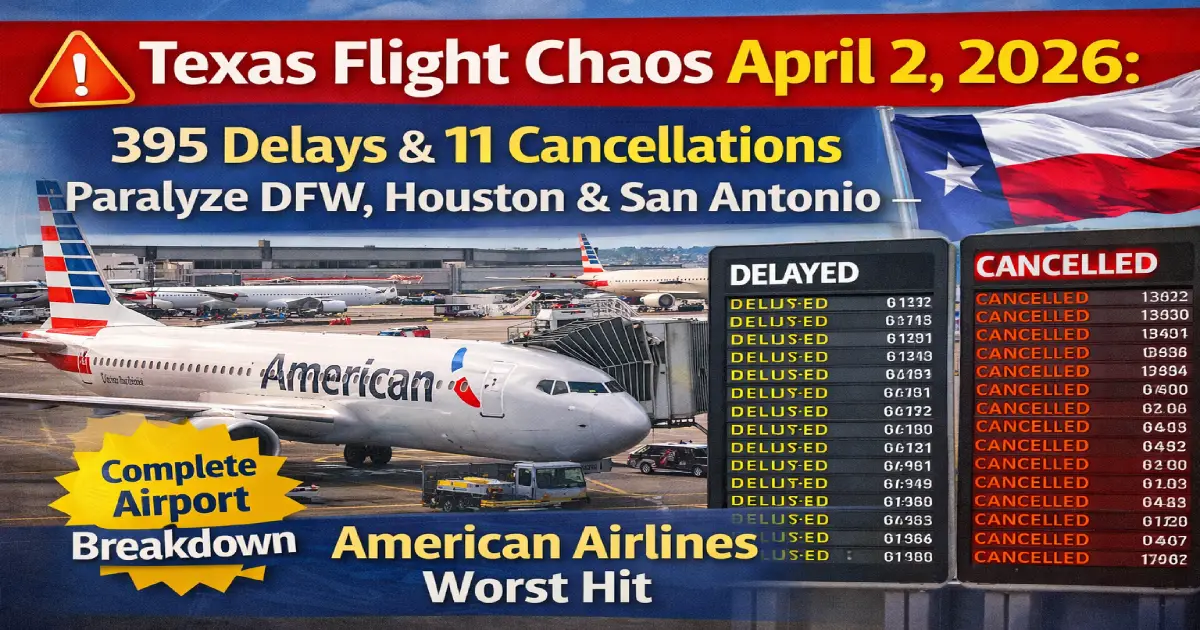
Breaking: Texas aviation has entered full-scale crisis mode on Thursday April 2, 2026. A combined total of 395 flight delays and 11 outright cancellations have been confirmed across Dallas Fort Worth International Airport, George Bush Intercontinental Houston, Dallas Love Field, and San Antonio International — snarling one of the busiest air corridors in the United States during peak Easter week travel. American Airlines, which operates DFW as its global super-hub, is the worst-hit carrier with 129 individual delays at DFW alone. Here is the complete airport-by-airport breakdown and everything stranded passengers need to do right now.
Published: April 2, 2026 Total Texas Disruptions: 395 delays + 11 cancellations Worst Airport: Dallas Fort Worth (DFW) — 202 delays, 1 cancellation Worst Carrier: American Airlines — 129 delays at DFW alone Houston Cancellations: 6 — highest in Texas today Cause: Spring weather + TSA staffing shortage + DHS shutdown Day 47 + spring break peak volume Passengers at Risk: Tens of thousands across Texas hub-and-spoke network
Texas has become the epicentre of US aviation chaos today as a perfect storm of spring weather, a 47-day DHS partial shutdown leaving TSA officers unpaid, and record Easter-week passenger volumes have converged to break the nation’s second-largest air corridor.
The disruption is not isolated to a single event. Flight-tracking data confirmed across multiple sources shows that Dallas Fort Worth, George Bush Intercontinental Houston, Dallas Love Field, and San Antonio International collectively absorbed 395 delayed and 11 cancelled flights as of today’s operational snapshot — making April 2, 2026 one of the worst single-day disruption tallies Texas has seen outside of a major winter storm.
This matters far beyond Texas. DFW and Houston IAH are not just regional airports — they are among the most critical connecting hubs in the global hub-and-spoke network. Passengers using these airports to connect from the East Coast to the West Coast, from Europe to Latin America, and from the Caribbean to Canada are all being caught in the cascading delays.
DFW is the worst-hit airport in Texas today and one of the worst-performing hubs in the entire US network. Processing approximately 75 million passengers annually and serving as American Airlines’ largest global base, DFW’s dysfunction today is sending shockwaves across hundreds of connecting routes.
Carrier breakdown at DFW:
✈️ American Airlines: 129 delays — worst single-carrier performance at any Texas airport today (12% of DFW’s total delayed traffic) ✈️ Envoy Air (AAL regional): 20 delays ✈️ PSA Airlines (AAL regional): 16 delays ✈️ United Airlines: 12 delays
The 129 American Airlines delays at DFW represent a systemic breakdown at the carrier’s home base. American operates more than 900 daily flights in and out of DFW, and with 90%+ load factors across its network this week, a delay cascade of this size means thousands of stranded connecting passengers with nowhere to go.
Most affected routes from DFW today:
Houston’s primary international hub is today’s cancellation leader across all Texas airports. Six flights have been scrubbed entirely — five of them operated by United Airlines, which runs IAH as a major transatlantic and Latin American gateway.
Carrier breakdown at IAH:
✈️ United Airlines: 52 delays + 5 cancellations — dominant disruption at this hub ✈️ Republic Airways: 2 cancellations ✈️ Mesa Airlines: 9 delays ✈️ CommuteAir: 9 delays ✈️ Spirit Airlines: 9 delays
United’s 5 cancellations at IAH are the most operationally damaging individual carrier performance today. When United cancels at Houston, it typically affects long-haul and international routes — including transatlantic services to London, Frankfurt, and Amsterdam, as well as connections to Central and South America. Passengers on these routes face the longest rebooking wait times and least availability.
Security crisis adding to IAH pressure:
Houston Hobby Airport and Bush Intercontinental have both been flagged by travel monitoring sources as experiencing the worst TSA security lines in Texas — with wait times reaching 45 to 90 minutes at peak departure banks. The partial DHS shutdown, now in its 47th consecutive day, has left thousands of TSA officers working without pay, driving absenteeism and checkpoint closures. Houston has been cited as among the hardest-hit Texas airports for TSA callouts.
Dallas Love Field, Southwest Airlines’ primary Dallas base, is carrying its share of today’s disruption with 51 delays and 2 cancellations.
Key points for Love Field travelers:
San Antonio is the smallest of today’s four disrupted Texas airports but its 2 cancellations and 31 delays reflect the knock-on effect of the DFW and IAH collapses filtering through the regional network.
Carrier breakdown at SAT:
✈️ Southwest Airlines: 13 delays ✈️ United Airlines: 6 delays ✈️ American Airlines: 4 delays
Most San Antonio delays are directly traceable to inbound aircraft arriving late from DFW or IAH. When hub flights arrive behind schedule, the turnaround for outbound San Antonio departures collapses, creating a secondary wave of disruption at this regional gateway.
Today’s Texas chaos is not the result of a single event. Three simultaneous pressures have combined to overwhelm one of the world’s most critical air corridors.
Unsettled spring weather tracking across the Dallas–Houston corridor has reduced arrival rates at both DFW and IAH. Even without a full-scale storm, scattered cloud layers and gusty southerly winds trigger instrument approach procedures that reduce DFW’s capacity from 120 arrivals per hour in clear conditions down to approximately 88 arrivals per hour — a 27% capacity reduction that translates directly into dozens of delayed inbounds stacking up in holding patterns.
When aircraft arrive late into DFW or IAH, they depart late. When they depart late, the aircraft and crew positioned for the next rotation are out of position. The ripple effect moves east, west, and internationally within hours.
The partial Department of Homeland Security shutdown has now entered its 47th consecutive day. TSA officers — classified as essential workers — are legally required to report to work without receiving pay. The financial strain has driven absenteeism to critical levels at major checkpoints.
What this means today:
The spring break and Easter travel surge is now in full effect. Airlines for America projects approximately 171 million passengers will fly between March 1 and April 30, 2026 — a record. Daily screening volumes have regularly surpassed 2.8 million travelers. Flights this week are operating above 90% capacity on most routes, meaning:
American is carrying the heaviest load today with 129 DFW delays and additional disruptions across its regional feeders (Envoy, PSA). The carrier will issue travel waivers for weather-impacted routes — check aa.com/travelinfo for your specific itinerary.
✅ Rebook through the American Airlines app first — skip the customer service counter queues ✅ If your delay exceeds 3 hours and is within American’s control (staffing/mechanical), request a meal voucher at any gate agent ✅ If cancelled, you are entitled to a full refund under DOT rules — or rebooking at no fee ✅ Terminals A and D at DFW are currently most congested — allow extra time
United’s 5 IAH cancellations are the most disruptive individual carrier event today. Long-haul and international passengers face the worst rebooking scenarios.
✅ Use the United app immediately — do not queue at the counter ✅ If cancelled for reasons within United’s control, document all hotel and meal expenses — United’s Contract of Carriage covers reasonable rebooking costs ✅ United’s 90-day compensation claim window — file before July 2, 2026 ✅ For IAH international departures: call United’s international line directly — it operates separately from domestic customer service and typically has shorter wait times
Southwest handles disruptions differently from legacy carriers — no assigned seats means rebooking flexibility is higher, but its no-interline policy means Southwest cannot rebook you onto another carrier.
✅ Download the Southwest app and enable push notifications now — it will rebook you automatically in many cases ✅ Southwest offers no-fee flight changes — use this proactively if your travel dates are flexible ✅ Love Field and SAT passengers: check whether DFW alternatives are available for your route
Regional carrier disruptions are often the most opaque — passengers do not always know they are flying on a regional operator. If your ticket says American Eagle, United Express, or similar, you are on a regional partner.
✅ Your rights are the same as mainline passengers — contact the marketing carrier (American or United) not the regional operator ✅ Regional aircraft are smaller and more frequently cancelled in challenging conditions — regional passengers have the highest chance of being stranded overnight today
Under US Department of Transportation rules — which were strengthened in 2024 and remain in force in 2026 — here is exactly what you are owed:
If your flight is CANCELLED:
✅ Full cash refund to original payment method — regardless of fare type ✅ Rebooking on next available flight at no charge ✅ For delays of 3+ hours caused by the airline (staffing, mechanical): meal vouchers required ✅ For overnight cancellations caused by the airline: hotel accommodation required
If your flight is DELAYED:
✅ Cash compensation is NOT automatically required for delays (unlike EU261 in Europe) ✅ Airlines are required to provide food/drink after 3 hours if delay is within their control ✅ You are entitled to a full refund if the delay is 3+ hours domestic / 6+ hours international and you choose not to travel
If weather is cited as the cause:
✅ Airlines can classify weather as an “extraordinary circumstance” — reducing cash compensation obligations ✅ However: duty of care (meals, accommodation) still applies if the airline had any operational contribution ✅ If your aircraft sat on the ground in clear conditions while yours was “weather-impacted” — document this and file a DOT complaint
File DOT complaints at: airconsumer.dot.gov — Keep all receipts for meals, hotels, and ground transport. Deadline is 2 years from travel date.
If you are at or heading to DFW, IAH, DAL, or SAT today, follow these steps immediately:
Step 1 — Check your flight status BEFORE leaving for the airport Use FlightAware, the airline’s official app, or flightaware.com. If your inbound aircraft is already delayed, your outbound will be too — and you do not want to be stuck at the airport for additional hours beyond what is necessary.
Step 2 — Arrive 3 hours early for domestic, 4 hours for international TSA lines at DFW and IAH are running 25–90 minutes depending on terminal and time of day. Arrival windows that worked last month are not sufficient today. Build in buffer.
Step 3 — Rebook through the app, not the counter Customer service queues at DFW can stretch across entire terminal concourses during major disruption events. Every airline now offers full rebooking functionality through their mobile apps — use it first.
Step 4 — Consider alternative Texas airports San Antonio (SAT) sits 80 miles south of Austin. Dallas Love Field (DAL) is 25 minutes from DFW. If your origin or destination is flexible, routing through a secondary Texas airport may offer shorter queues and better availability — particularly for Southwest passengers.
Step 5 — Travel carry-on only if possible Checked bag handling is slower during high-disruption days. Bags routed through delayed connections can arrive 24–48 hours after passengers. Travelling with carry-on only eliminates this risk entirely and gives you maximum flexibility to rebook across carriers if needed.
Step 6 — Use TSA PreCheck or CLEAR Even at today’s pressure levels, PreCheck and CLEAR lanes are significantly faster than standard security. If you have status on your frequent flyer account, priority boarding lanes also reduce the gate crowding that adds time to departures.
Step 7 — Document everything If you incur hotel, meal, or transport costs due to cancellation or delays within the airline’s control, keep every receipt. Both credit card travel protections and DOT regulations may entitle you to reimbursement — but you need documentation to file.
Today’s disruption is not a one-off. Texas aviation has been under persistent strain throughout 2026:
The pattern reveals a structural problem. DFW needs an estimated 50+ additional air traffic controllers to operate at full safe capacity — a staffing gap that takes months to years to close through the FAA training pipeline. American Airlines operates over 900 daily DFW flights against a controller workforce that cannot safely process that volume under adverse conditions. And the DHS shutdown, now approaching 7 weeks, has stripped TSA’s operational resilience precisely when record Easter-week volumes demand it most.
Until the government shutdown ends and TSA officers receive stable pay, the conditions driving today’s chaos will persist. Airlines for America projects the disruption risk will remain elevated through April and into summer 2026 as passenger volumes continue to climb.
If you are flying Texas between now and Easter Monday April 6 — arrive early, rebook proactively, and know your rights.
For More Resources:
Related Articles:
Posted By : Vinay
This article is provided for general informational purposes only and is based on information available at the time of publication. Travel advisories, airline schedules, airport operations, visa requirements, government regulations, and other travel-related information are subject to change without prior notice. While Travel Tourister makes reasonable efforts to verify information using official announcements, government publications, airline and airport communications, and other reliable sources, we cannot guarantee that all information remains complete, accurate, or up to date at all times. Readers should independently verify any information that may affect their travel plans with the relevant airline, airport authority, government agency, embassy, or other official source before making travel, financial, or other decisions. Travel Tourister shall not be liable for any direct or indirect loss, inconvenience, or damages arising from the use of or reliance on the information contained in this article. Nothing in this publication constitutes legal, immigration, financial, or professional travel advice. If you believe any information in this article is inaccurate or outdated, please contact our editorial team. We review all credible correction requests promptly and update our content whenever appropriate.
Lastest News
2nd Floor, 39, Above Kirti Club, DLF Industrial Area, Kirti Nagar, New Delhi, Delhi 110015



Travel Tourister is a leading Travel portal where we introduce travellers to trusted travel agents to make their journey hasselfree, memorable And happy. Travel Tourister is a platform where travellers get Tour packages ,Hotel packages deals through trusted travel companies And hoteliers who are working with us across the world. We always try to find new and more travel agents and hoteliers from every nook and corners across the world so that you could compare the deals with different travel agents and hoteliers and book your tour or hotel with the one you have chosen according to your taste and budget.
Copyright © Travel Tourister, India. All Rights Reserved

 Call
Call Enquiry