Published on : 18 May 2026
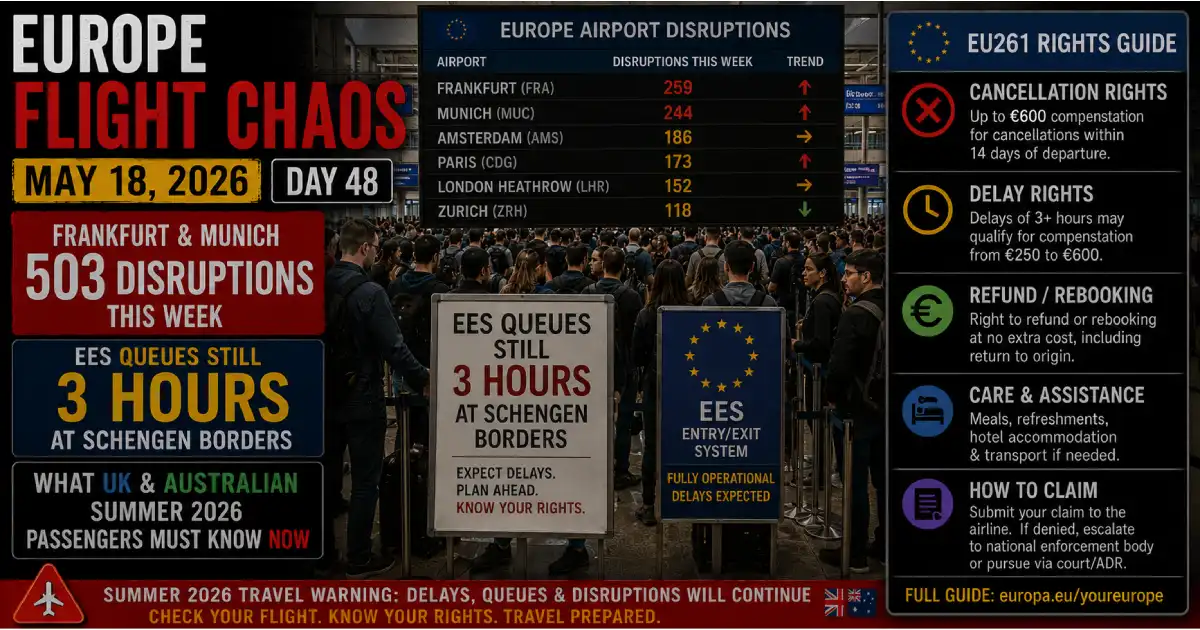
Breaking — May 18, 2026: Europe’s aviation system is entering summer 2026 in a state of compounding, multi-source disruption — and UK and Australian travellers are at the centre of it. This week alone: Frankfurt Airport and Munich Airport recorded 503 flight disruptions and 18 cancellations on May 13 — the latest surge in a pattern of German hub chaos that has been running since April’s Lufthansa pilot and cabin crew strikes. On May 18, fresh data confirms 4 more cancellations and 87 further delays at the same two hubs, with Lufthansa (85 delays), United Airlines, Air Canada, and Air France all in the disruption list. Paris Charles de Gaulle added 254 delays and 5 cancellations on May 14. London Heathrow, Gatwick, and Manchester lost 12 flights on May 13 across Emirates, British Airways, KLM, Ryanair, and Vueling. And overarching all of it — still, five weeks after full launch — the EU Entry/Exit System biometric border checks are producing queues of up to 3 hours at Schengen entry points, with Brussels reporting 3.5-hour peaks and 600+ missed flights in a single four-day period, and industry groups demanding emergency summer suspension before the worst is yet to come. Here is every confirmed number, every affected airport, every airline, every route, and the complete practical guide every UK, US, Canadian, and Australian traveller needs before flying into Europe this summer.
Published: May 18, 2026 — German hubs disrupted (May 13): Frankfurt (FRA) + Munich (MUC) = 503 total (485 delays + 18 cancellations) German hubs disrupted (May 18): Frankfurt (FRA) + Munich (MUC) = 91 total (87 delays + 4 cancellations) Paris CDG disrupted (May 14): 259 total (254 delays + 5 cancellations) UK airports disrupted (May 13): Heathrow + Gatwick + Manchester = 12 cancellations Airlines affected this week: Lufthansa · United Airlines · Condor · Air Dolomiti · KLM · Air France · British Airways · Emirates · Ryanair · Vueling · Air Canada EES queue status (May 18): 2–3 hours at Frankfurt, Amsterdam, Paris CDG, Rome · 3.5 hours peak at Brussels (now post-strike) EES status: Fully mandatory since April 10, 2026 · All 29 Schengen countries Who is affected by EES: All non-EU passport holders — UK 🇬🇧 · US 🇺🇸 · Australia 🇦🇺 · Canada 🇨🇦 · New Zealand 🇳🇿 · Japan · and 50+ other nationalities Routes broken this week: Berlin · Rome Fiumicino · Naples · Amsterdam · Keflavik · Washington Dulles · Ljubljana · Catania · Palermo · Bari · Munich ↔ Frankfurt · London ↔ Brussels · London ↔ Amsterdam · Dubai connections Passenger rights law: EU Regulation EC 261/2004 (EU261) — up to €600 per passenger UK law (UK-departing flights): UK Regulation 261 (UK261) — up to £520 per passenger Summer peak warning: Memorial Day equivalent EU summer rush begins June 1 · EES queues projected to worsen significantly through July–August
If you are flying into Europe this summer, you are flying into a system under simultaneous, multi-source stress — and most travellers do not know the full picture. The headlines have focused on individual events: the Finnair Helsinki strikes on May 16 and 19, the Brussels Airport shutdown on May 12, the Italian EasyJet walkout on May 11. Each of these has been reported individually. What has not been reported clearly is the cumulative picture: every one of these events is happening against a backdrop of structural German hub disruption, a still-malfunctioning biometric border system, and an airline network that — across Europe and the US — has not had a single fully normal operating week since the first of April.
For UK travellers, the numbers are particularly stark. Frankfurt Airport and Munich Airport were hit by fresh disruption on May 13, 2026, with 503 flights affected across the two German hubs, including 18 cancellations. The worst delays built during the morning and late-afternoon rush, leaving passengers dealing with long waits, missed connections, and rebooking lines. Lufthansa carried much of the knock-on effect, while United Airlines, Condor, and Air Dolomiti also appeared on delay and cancellation lists.
On the same week, on May 18 — today — leading transatlantic and domestic carriers including Lufthansa, United Airlines, Air Canada, and Air France suspended a total of 4 flights and triggered a massive wave of 87 flight delays across the country, with Frankfurt International Airport logging the highest delay count with 86 flights.
And at Europe’s borders — for the fifth consecutive week since the EU Entry/Exit System went live on April 10 — Brussels Airport reported 3.5-hour peak queues and over 600 missed flights in a single four-day period, while Portugal suspended EES operations at Lisbon, Porto, and Faro on April 11 due to excessive wait times before restarting in the afternoon.
This is not a series of isolated bad days. It is a pattern. And it is heading into the highest-demand travel period of the year.
Hundreds of travelers were stranded across Germany as a fresh wave of disruption rippled through Frankfurt and Munich airports, with publicly available tracking data indicating around 485 flight delays and 18 cancellations affecting services operated by Lufthansa, United Airlines, Condor, Air Dolomiti, and several other carriers.
A total of 18 departures were cancelled across Frankfurt and Munich, affecting a wide mix of domestic, European, and intercontinental routes. The disruption impacted destinations including Berlin Brandenburg, Keflavik, Ljubljana, Catania, Rome Fiumicino, Naples, Munich, Palermo, Washington Dulles, Amsterdam Schiphol, and Bari.
At Frankfurt specifically — Europe’s third-busiest airport by total passenger volume, and the primary transatlantic hub for Star Alliance carriers — the morning and late-afternoon banks were worst affected. United Airlines, which relies heavily on Lufthansa’s hubs for its joint-transatlantic network, was affected by delayed turnarounds and missed onward connections for passengers traveling between North America and destinations across Europe, the Middle East and Africa. Leisure carrier Condor and regional affiliate Air Dolomiti, both of which operate multiple services linking secondary European cities through Frankfurt and Munich, also appeared in tracking lists among the airlines facing disruption.
At Munich — Germany’s second hub and the primary gateway for Bavaria, Southern Europe connections, and Asian long-haul via the Lufthansa Group — nine departures were cancelled, creating a balanced mix of European and intercontinental disruptions. Unlike Frankfurt, Munich’s cancellations included long-haul services, adding a broader international dimension to the overall disruption pattern.
Today’s data confirms the disruption has not resolved. On May 18, 2026, leading global carriers — including Lufthansa, United Airlines, Air France, and Air Canada — suspended a total of 4 flights and triggered a massive wave of 87 flight delays across the country.
Air Canada at Munich recorded 1 cancelled flight representing 50% of its scheduled operations, while Air France also had 1 cancellation accounting for 9% of its flights. At Frankfurt, United Airlines reported 1 cancelled flight equating to 5% of its scheduled departures, and Lufthansa had 1 cancelled flight alongside 85 delayed flights.
Eighty-five Lufthansa delays in a single day at a single hub is not a minor operational figure. Lufthansa operates approximately 350–400 daily departures from Frankfurt. An 85-delay count means roughly one in four of their Frankfurt departures today is affected.
The recurring disruption pattern at Frankfurt and Munich is not random. Cabin crew and pilot strike actions in April prompted several days of significant disruption at Frankfurt and Munich, and although those strike windows have closed, the knock-on scheduling adjustments and aircraft rotations continue to ripple through May. In parallel, Lufthansa has been implementing a wide-ranging capacity reduction on short-haul services, linked to higher fuel costs and the retirement or restructuring of regional subsidiaries — thousands of flights being removed from the timetable through late 2026, particularly on thinner point-to-point routes that feed into the major hubs.
Airlines are still working with tight staffing margins in 2026 after several years of restructuring, which can leave schedules vulnerable when adverse weather or air-traffic-control restrictions intersect with already stretched operations. Spring weather systems moving across central Europe have periodically triggered air-traffic-control restrictions, slowing departures and arrivals and reducing the number of aircraft that can be handled per hour.
The codeshare cascade problem: Industry coverage indicates that disruptions at Frankfurt and Munich often ripple outward because many flights operate as codeshares. A cancellation by one airline can affect partner carriers sharing the same aircraft or time slots, leaving passengers on different ticket stocks facing similar delays, missed connections, or last-minute rerouting.
The disruption is not confined to Germany. Travel through Paris Charles de Gaulle Airport was heavily disrupted on May 14, 2026 after operational problems led to 254 delayed flights and 5 cancellations. Air France, KLM, Lufthansa, British Airways, and Delta Air Lines were among the carriers affected, with delays spreading from short-haul services to long-haul connections.
Paris CDG is the second-largest airport in Europe and the primary transatlantic hub for Air France-KLM and SkyTeam carriers. For UK passengers, CDG is a major connection point for long-haul flights to North America, Asia, and the Caribbean — as well as a primary Schengen entry point where EES biometric processing is adding queue time at exactly the moment when operational disruptions are reducing the time available for passengers to make connections.
The CDG specific risk for UK and non-EU passengers: Paris CDG is one of the airports where the Parafe e-gates — which use facial recognition — did not fully process UK or US passports at launch. Manual processing queues at CDG during the May 14 disruption day added an additional layer of delay on top of the operational cancellations. If your connection at CDG on May 14 was already tight, the EES border queue may have made it impossible.
A total of 12 flights from London Heathrow Airport, London Gatwick Airport, and Manchester Airport were cancelled on May 13, 2026, affecting Emirates, British Airways, KLM, Ryanair, and Vueling routes to Amsterdam, Brussels, Florence, and Dubai.
The May 13 UK cancellations are notable for three reasons:
1. Emirates to Dubai is affected. Following the UAE airspace restrictions imposed May 5 due to Iranian missile intercepts near Abu Dhabi and Dubai, Emirates had been gradually restoring its network. A May 13 UK-Dubai cancellation suggests the restoration remains incomplete and fragile.
2. Amsterdam and Brussels routes — the EES double-hit. Passengers booked London–Amsterdam or London–Brussels on May 13 faced both a flight disruption risk and, if they did make their flight, an EES biometric queue on arrival in the Schengen zone. Travellers transiting through Amsterdam Schiphol to onward Schengen connections faced the worst compound scenario: flight delay plus 2–3 hour EES queue plus missed connection.
3. The 12 cancellations span three UK airports — demonstrating that the disruption is not confined to Heathrow but is spread across the UK’s regional gateway network.
The EU Entry/Exit System went fully mandatory on April 10, 2026. It is now May 18 — 38 days later — and the queues at Schengen entry points are still running at 2–3 hours at major airports. This is not a teething problem. It is a structural failure that the aviation industry warned about, predicted, and is now living through.
The Entry/Exit System replaces manual passport stamping with digital records of every entry, exit, and refusal at Schengen borders. It applies to all non-EU travelers, including British citizens, entering any of the 29 participating countries for short stays of up to 90 days within a 180-day period. When crossing the border, travelers must submit biometric data, including facial scans and fingerprints, alongside their passport details. The data is stored for three years and checked again on departure.
This affects every British, American, Australian, Canadian, New Zealand, Japanese, and other non-EU passport holder entering the Schengen area — and it happens on every entry, with the heaviest processing burden on first-time users who have never been registered in the EES database before.
The EU’s new Entry/Exit System brought travel “chaos” to airport border control on April 10, with queues of up to three hours and reports of stranded passengers missing flights. At Milan’s Linate airport on one day, there were meant to be 156 passengers booked on an EasyJet flight to Manchester. After facing hours-long queues, only 34 passengers boarded the aircraft, leaving 122 behind in Italy, who watched their plane depart without them. In order to get home, one family spent more than £1,600 to take a connecting flight via Luxembourg, which would get them home 24 hours late.
The numbers across that first weekend were unprecedented in modern European aviation. The EU’s Entry/Exit System launch caused 4-hour airport queues on April 10, 2026, prompting airline groups to demand emergency processing flexibility, with significant flight disruptions and many passengers missing departures due to biometric processing delays.
The following airports have reported the most severe EES disruption and remain high-risk for UK and non-EU passengers in May 2026:
Brussels Airport (BRU): 3.5-hour peak queues and over 600 missed flights in a single four-day period — the airport has advised all non-Schengen passengers to arrive at least 3 hours before departure.
Lisbon Humberto Delgado Airport (LIS): Suspended EES in December 2025 and again on April 11, 2026, due to excessive queues — before restarting in the afternoon.
Frankfurt Airport (FRA): Europe’s fourth-busiest airport and a major UK/US transit hub, with significant third-country national traffic — queues running 2–3 hours at peak.
Amsterdam Schiphol (AMS): A major Schengen hub with 60+ million passengers annually — processing EES for arriving non-EU passengers at high volumes.
Palma de Mallorca (PMI): A major summer leisure destination — flagged for likely severe disruption during peak season starting in June.
Early rollout data shows border processing times increased by up to 70% at major airports, with queues reaching 2–4 hours on the first day of full deployment.
Despite European Commission claims of 70-second processing times, actual airport conditions show significant delays and technical failures affecting international travel schedules. ACI EUROPE Director General Olivier Jankovec and A4E Managing Director Ourania Georgoutsakou urged the European Commission and EU member states on April 10 to allow full EES suspensions when queues become excessive, and asked officials to extend both partial and full suspension options through the summer 2026 travel peak.
A joint statement from ACI EUROPE, Airlines for Europe, and IATA in February described a “complete disconnect” between EU confidence and conditions at airports, pointing to understaffing, technical failures, and low use of the Frontex pre-registration app.
The five weeks of EES data we now have tells a clear story: the system, as currently implemented, cannot handle peak-season passenger volumes at major European airports. What we have seen since April 10 is EES running at spring-shoulder-season volumes — not summer peak. June, July, and August will bring two to three times the daily passenger throughput through Schengen entry points at airports like Palma, Ibiza, Faro, Heraklion, Corfu, and Naples — airports with far less infrastructure, far fewer border officers, and far less physical space for queuing than Frankfurt or Amsterdam.
ACI EUROPE and Airlines for Europe stated that Europe’s reputation as an accessible destination for tourists and business travelers is now at stake. They also noted that air travel was already under pressure due to the ongoing situation in the Middle East.
Travel industry groups have advised passengers to allow extra time when arriving in Europe. The EES is closely connected to the upcoming European Travel Information and Authorization System (ETIAS), which will require visa-free travelers to apply online before visiting most EU countries — expected to launch later in 2026 — meaning non-EU passengers will face BOTH pre-travel authorisation requirements AND biometric processing at the border from later this year.
Based on data collected since the April 10 full rollout, here is the current risk rating for UK and non-EU passengers at the major European summer hubs:
| Airport | EES Queue Risk | Recommended Arrival Buffer | Notes |
|---|---|---|---|
| Brussels (BRU) | 🔴 Critical | +3 hours before departure | 3.5-hr peak queues confirmed. 600+ missed flights in 4 days. |
| Frankfurt (FRA) | 🔴 High | +90 minutes | High non-EU transit volume. Codeshare connections compound EES delays. |
| Paris CDG (CDG) | 🔴 High | +90 minutes | Parafe e-gates still not fully UK/US compatible. Manual queues building. |
| Lisbon (LIS) | 🟠 High | +90 minutes | Suspended EES twice already. Likely to be overwhelmed in summer peak. |
| Amsterdam Schiphol (AMS) | 🟠 High | +90 minutes | 60M+ annual passengers. EES processing at scale creates bottlenecks. |
| Rome Fiumicino (FCO) | 🟠 Medium-High | +75 minutes | Major UK-Italy route hub. EU261 complaints growing. |
| Palma de Mallorca (PMI) | 🟠 High (summer) | +90 minutes (July–Aug) | Flagged by industry as summer peak risk. Infrastructure limited. |
| Madrid Barajas (MAD) | 🟡 Medium | +60 minutes | Iberia operating smoothly but EES processing still adds time. |
| Barcelona El Prat (BCN) | 🟡 Medium | +60 minutes | Improving but monitor closely as summer volumes build. |
| Athens (ATH) | 🟡 Medium | +60 minutes | Greek island connections: factor EES time before onward domestic hops. |
| Milan Linate (LIN) | 🔴 High | +90 minutes | Site of the 122-passenger EasyJet stranding on Day 1. Processing still slow. |
| Helsinki (HEL) | 🟡 Low-Medium | +45 minutes | Schengen but lower volume. Strike risk separate from EES. |
Lufthansa is the anchor carrier of the Frankfurt and Munich hub disruption this week. The Lufthansa flight cancellations 2026 crisis emerged as one of the most significant disruptions for European air travel this year, with Germany’s largest carrier forced to cancel and delay hundreds of flights amid coordinated industrial action from pilots and cabin crew. The Vereinigung Cockpit (VC) union called a 48-hour strike affecting pilots, while the independent cabin crew union UFO staged walkouts at multiple German airports.
Those strikes closed, but their aftermath — aircraft out of position, crew at duty-hour limits, schedules running with zero slack — is still being felt in mid-May. Today’s 85 Lufthansa delays at Frankfurt alone is the downstream consequence of weeks of disruption on a carrier that operates one of the tightest hub schedules in Europe.
For Lufthansa passengers: Check flight status at lufthansa.com → My Bookings | 0371 945 9747 (UK)
EU261 rights: Lufthansa is an EU carrier operating from EU airports — full EU261 protections apply to all passengers regardless of nationality.
United Airlines operates its primary European hub at Frankfurt, running daily transatlantic services to Newark, Chicago, Houston, Washington Dulles, Denver, and Los Angeles. United Airlines, which relies heavily on Lufthansa’s hubs for its joint-transatlantic network, has been affected by delayed turnarounds and missed onward connections for passengers traveling between North America and destinations across Europe, the Middle East, and Africa.
For United passengers connecting via Frankfurt: The risk of a missed connection is elevated when Frankfurt is running 85+ delays. United’s policy: if a delay causes you to miss a connection on the same booking, United will rebook you at no charge.
United Airlines contact: united.com → My Trips | 1-800-864-8331 (US) | +44 845 607 6760 (UK)
Air France was among the five airlines disrupted at Paris CDG on May 14. Air France is an EU carrier — EU261 applies fully. For passengers routing London–Paris–onward (a common routing for Australia and New Zealand passengers via CDG), the May 14 disruption represents a compound risk: flight delay plus EES queue at CDG.
Air France contact: airfrance.com | 0800 022 0220 (UK freephone)
The May 13 cancellation of at least one Emirates UK-Dubai service is a flag for long-haul travellers. Emirates is operating under UAE airspace restrictions active until at least May 11, and the full restoration of its UK-Dubai schedule is still in progress. Passengers routing UK–Dubai–Australia, UK–Dubai–Southeast Asia, or UK–Dubai–East Africa should verify their Emirates flight status individually.
Emirates contact: emirates.com → Manage Booking | 0344 800 2777 (UK)
British Airways does not face EES processing on departure from UK airports (the UK is not in the Schengen area), but UK passengers flying BA into Schengen destinations face EES on arrival. BA has advised UK passengers flying into Schengen airports to allow additional time at passport control.
British Airways contact: ba.com → Manage My Booking | 0344 493 0787
A critical question is now moving through European consumer law at speed: if an EU border authority’s EES processing delay causes you to miss your departure flight, who pays?
The answer is legally contested, but the current position is:
The airline is not liable for cash compensation if the cause of your missed flight is attributable to the border authority — which is a government body, not the airline, and therefore classified as an “extraordinary circumstance.” This is the same principle that exempts airlines from cash compensation for ATC strikes.
The airline is still obliged to rebook you on the next available flight to your destination, under EU261 Article 8. They cannot simply refuse responsibility because border control caused the delay.
You may have a claim against the border authority or the relevant government body — but this is a more complex legal path that consumer rights organisations are currently pursuing on behalf of EES-affected passengers.
The practical advice: If you miss a departure because of an EES queue, document everything. Photograph the queue. Get a written confirmation of delay from airport staff if possible. Your claim is not necessarily dead — it is just being processed through a legal framework that is still being defined.
Finnair, and all airlines based in an EU country, are subject to the rules found in EU regulation EC 261/2004. Under the provisions of the EU261 law, you are entitled to compensation for a variety of flight disruptions as long as your flight is delayed by at least 3 hours at your final destination. The EU261 compensation amount is typically determined by the length of the delay and the distance of your flight, and in specific circumstances you could be entitled to as much as €600.
This applies to every carrier operating from Frankfurt, Munich, or Paris CDG — Lufthansa, Air France, KLM, United, Air Canada — for flights where disruption is within airline control.
EU261 compensation scale:
| Flight Distance | Delay ≥ 3 hours | Cancellation (<14 days notice) |
|---|---|---|
| Under 1,500km | €250 | €250 |
| 1,500–3,500km | €400 | €400 |
| Over 3,500km | €600 | €300–€600 |
For UK-departing flights: UK261 applies with near-identical amounts in pounds (£220 / £350 / £520).
Cash compensation does NOT apply when: The disruption is caused by extraordinary circumstances — including ATC restrictions, severe weather, or certain types of industrial action.
Care rights ALWAYS apply regardless of cause:
How to file an EU261 claim:
Five weeks of EES data, three weeks of German hub disruption data, Finnair strikes, Brussels shutdowns, and ongoing Middle East airspace rerouting have produced a clear set of practical lessons for every non-EU passenger flying into Europe this summer.
If you have a connecting flight at Frankfurt, Amsterdam, Paris CDG, or Rome within the Schengen zone, your old 60-minute connection time is no longer safe. The EES queue at entry is adding 45–90 minutes to processing at peak times. If your connection was booked with a 60-minute minimum connect time, change it. The airline will rebook you at no charge if the connection was sold as part of the same ticket and is now assessed as insufficient.
The Frontex pre-registration app — available at frontex.europa.eu — allows non-EU passengers to submit their biometric data before arriving at the Schengen border, reducing queue time. Take-up has been low because awareness has been low. Completing your pre-registration costs 15 minutes online. It can save you 90 minutes at the airport.
The standard 2-hour recommended arrival time was set before EES existed. Brussels Airport — operating in standard conditions — has now officially revised its recommendation to 3 hours for all non-Schengen passengers. Frankfurt and Amsterdam are moving toward similar guidance. Until the queues stabilise, treat 3 hours as your minimum.
If you are routing London–Frankfurt–Tokyo, your EES processing happens at Frankfurt — on the way IN to the Schengen zone. If you are routing London–Bangkok–Sydney via Frankfurt (unlikely but illustrative), your EES processing still happens at Frankfurt on arrival. Know which airport in your itinerary is your Schengen entry point, and add the appropriate buffer there.
Standard travel insurance policies written before April 2026 may not specifically cover EES-related missed flights. When purchasing or reviewing your policy for summer travel, specifically ask whether “border control delay” causing a missed departure is covered. Some specialist travel insurers have now added EES clauses — seek these out.
ETIAS — the European Travel Information and Authorisation System — launches approximately six months after EES, meaning it is expected later in 2026. When it launches, UK, US, Australian, Canadian, and New Zealand passport holders will need a pre-travel authorisation to enter the Schengen area — similar to the US ESTA or the UK ETA. Application costs approximately €7. Book your summer 2026 travel now, before ETIAS launches, to avoid the additional administrative step.
If you are connecting at Frankfurt or Munich for a long-haul flight and the disruption pattern we have seen in May 2026 continues into June, a same-day connection remains risky. Where possible, book an overnight at Frankfurt or Munich before your long-haul departure rather than a same-day connection. This eliminates the compounding risk of a short-haul delay cascading into a missed long-haul.
No article about European aviation disruption in May 2026 is complete without the Middle East airspace picture. As of May 15, 2026, more than 30 airlines are still cancelling or rerouting services across the Middle East, with Tel Aviv, Dubai, Doha, Riyadh, and Beirut among the hardest-hit routes after the conflict escalated on February 28, 2026. Major airline groups including Air France, KLM, Lufthansa Group, British Airways, Delta Air Lines, and Singapore Airlines continue to adjust schedules as they review security conditions. Some carriers are starting to restore limited flights, but many suspensions now stretch into summer or autumn, and several restart dates remain provisional.
For UK, Australian, and New Zealand passengers, this matters because: Finnair’s trans-polar Helsinki-Asia routing — now disrupted by IAU strikes — was already competing with Middle East hub routings. Emirates, now operating from Dubai with restricted UAE airspace, has been the default reroute option for passengers displaced from Helsinki. Qatar Airways via Doha has seen capacity surge as a reroute hub. All three of these options — Helsinki, Dubai, Doha — are simultaneously under pressure. The summer 2026 long-haul routing picture from Europe to Asia and Australasia has never been more complicated.
Posted By : Vinay
This article is provided for general informational purposes only and is based on information available at the time of publication. Travel advisories, airline schedules, airport operations, visa requirements, government regulations, and other travel-related information are subject to change without prior notice. While Travel Tourister makes reasonable efforts to verify information using official announcements, government publications, airline and airport communications, and other reliable sources, we cannot guarantee that all information remains complete, accurate, or up to date at all times. Readers should independently verify any information that may affect their travel plans with the relevant airline, airport authority, government agency, embassy, or other official source before making travel, financial, or other decisions. Travel Tourister shall not be liable for any direct or indirect loss, inconvenience, or damages arising from the use of or reliance on the information contained in this article. Nothing in this publication constitutes legal, immigration, financial, or professional travel advice. If you believe any information in this article is inaccurate or outdated, please contact our editorial team. We review all credible correction requests promptly and update our content whenever appropriate.
Lastest News
2nd Floor, 39, Above Kirti Club, DLF Industrial Area, Kirti Nagar, New Delhi, Delhi 110015



Travel Tourister is a leading Travel portal where we introduce travellers to trusted travel agents to make their journey hasselfree, memorable And happy. Travel Tourister is a platform where travellers get Tour packages ,Hotel packages deals through trusted travel companies And hoteliers who are working with us across the world. We always try to find new and more travel agents and hoteliers from every nook and corners across the world so that you could compare the deals with different travel agents and hoteliers and book your tour or hotel with the one you have chosen according to your taste and budget.
Copyright © Travel Tourister, India. All Rights Reserved

 Call
Call Enquiry