Published on : 07 Apr 2026
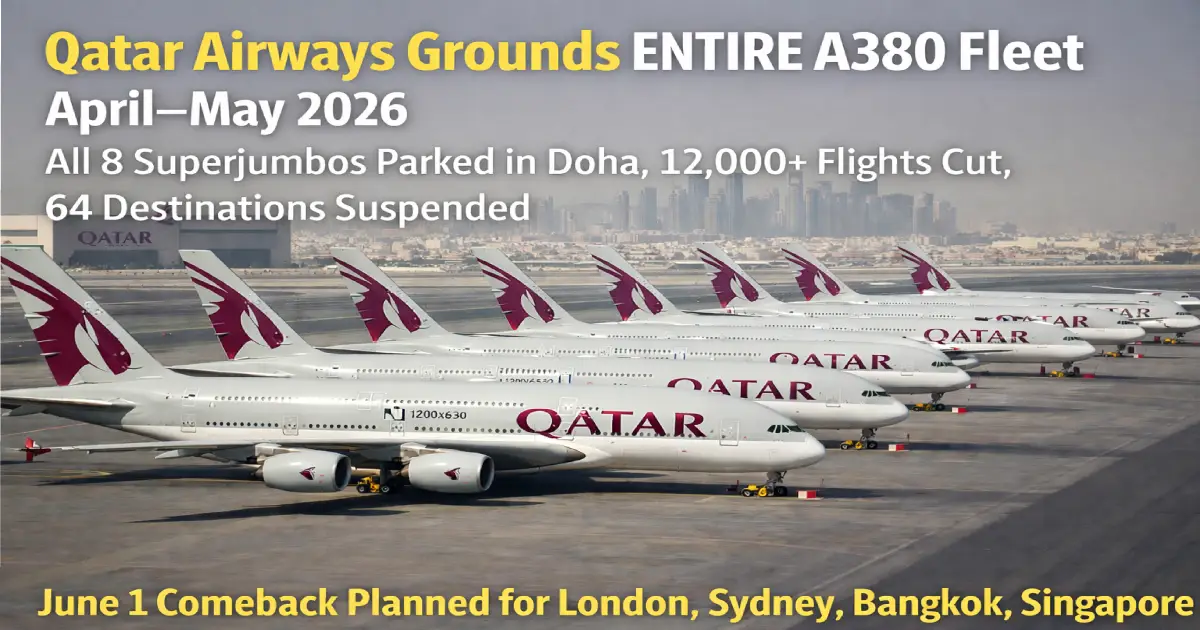
Breaking: Qatar Airways has grounded its entire operational Airbus A380 fleet for April and May 2026 — all eight active superjumbos are now sitting on the tarmac at Hamad International Airport in Doha. The Gulf carrier has cancelled more than 12,000 scheduled flights and suspended service to over 64 destinations as a result of ongoing regional disruptions linked to the Iran conflict. The grounding is the most significant capacity reduction in Qatar Airways’ recent history, and the largest A380 standdown since the COVID-19 pandemic. A planned return to service on June 1 targets five key long-haul routes — London Heathrow, Bangkok, Singapore, Paris CDG, and Sydney — but that timeline remains subject to change. Refund offers reportedly extending through July signal the airline may be preparing for a longer disruption than the current two-month window suggests. Here is everything affected passengers from the UK, Australia, and beyond need to know right now.
Published: April 7, 2026 Carrier: Qatar Airways (QR) — Doha, Qatar Fleet Grounded: All 8 operational Airbus A380 superjumbos — 100% of active fleet All Aircraft Location: Hamad International Airport (DOH), Doha Grounding Period: April–May 2026 (minimum) Flights Cut: 12,000+ scheduled flights removed from April–May schedule Destinations Suspended: 64 — spanning Africa, Asia, Europe, Middle East, North America Root Cause: Regional disruptions — Iran conflict airspace restrictions + soaring jet fuel costs Replacement Aircraft: Boeing 777 and Airbus A350 on surviving routes A380 Comeback Date: June 1, 2026 (subject to change) June 1 Return Routes: London Heathrow, Bangkok Suvarnabhumi, Singapore Changi, Paris CDG, Sydney Refund Window: Through July 2026 (signals potential extension beyond May) Data Sources: Cirium Diio, OAG schedule data, Simple Flying, Aviation A2Z, Flightradar24
Qatar Airways has grounded its entire active fleet of Airbus A380 aircraft and slashed more than 12,000 scheduled flights for April and May 2026, as ongoing regional disruptions force the Gulf carrier to significantly scale back operations. The airline has suspended service to over 60 destinations during the two-month period, marking one of the most substantial capacity reductions in its recent history. All eight operational Airbus A380s are now parked at Hamad International Airport in Doha.
This marks the first time Qatar Airways has grounded the A380 from service on such a large scale since the aircraft was first introduced on long-haul routes in 2013.
The grounding was not a sudden decision. Throughout late March and early April, a coordinated effort was made to return all active A380s to Doha. Aircraft such as A7-APC, which arrived from temporary storage in Teruel, and A7-APJ, which flew in from Paris CDG, are now positioned at Hamad International Airport. Several frames continued to operate commercially even after regional conflicts began, before the final decision for a total grounding was enacted.
The immediate cause is linked to regional instability and the ongoing war in Iran. The decision was revealed through data submitted to industry tracking platforms such as Cirium Diio and OAG.
The scale is historic. Qatar Airways’ A380 is a 517-seat, first-class-equipped superjumbo that serves as the flagship product on the airline’s highest-demand long-haul routes. By grounding the A380, the carrier is able to optimize its remaining fleet, which consists of more fuel-efficient twin-engine aircraft like the Boeing 787 and Airbus A350, offering greater flexibility in a market where passenger numbers are unpredictable.
Qatar Airways has suspended operations to 64 destinations worldwide. The decision stems from compounding pressures: regional airspace restrictions limiting routing flexibility through the Middle East, and unprecedented fuel costs driven by geopolitical conflict. Jet fuel costs have soared 34% year-over-year as of April 2026, eroding margins on already-tight regional services. The suspensions span multiple regions, with particular concentration in secondary markets and routes previously served with lower-frequency schedules.
For UK, Australian, and Indian passengers — the three audiences most directly exposed to this grounding — the impact falls primarily on:
🇬🇧 UK Passengers (Doha–London Heathrow): The QR–LHR route is one of Qatar Airways’ flagship connections. The A380 operated the 1:10AM departure from Doha — a schedule built for premium-cabin business travellers and UK-bound passengers connecting through Doha from South Asia, Southeast Asia, and Australia. That premium capacity is now replaced by Boeing 777 or A350 on operating services — fewer seats, no first class (on 777-300ER replacement routes), and reduced availability for Qsuite business class.
🇦🇺 Australian Passengers (Doha–Sydney): Qatar Airways used the A380 on its Sydney route, with the superjumbo serving one of its high-demand leisure and business markets. The Perth route had already switched from A380 to Boeing 777-300ER in late June 2025, with that configuration operating throughout 2026 — resulting in the loss of first class and nearly a third of total seats. Sydney passengers with Qatar A380 bookings for April–May now face aircraft changes, reduced capacity, and the loss of the first-class product.
🇮🇳 India–Europe Transit Passengers: All regional carriers feel the strain, reshaping Middle East stopovers essential for India-to-Europe itineraries. Qatar Airways suspending services to 64 destinations has amplified challenges for Gulf tourism recovery. Passengers routing through Doha from Indian cities to European destinations face reduced capacity and rebooking pressure across the entire Doha hub.
Despite the grounding, Qatar Airways has a clear — if conditional — redeployment plan. The latest schedule data suggests that Qatar Airways will fly the first-class-equipped, 517-seat A380s commercially on June 1, with five departures from Doha planned on that day.
The first service is due to leave Doha at 1:10AM to London Heathrow, followed by 2:30AM to Bangkok Suvarnabhumi, 2:35AM to Singapore Changi, 8:45AM to Paris CDG, and 8:05PM to Sydney.
| Route | A380 Frequency | Notes |
|---|---|---|
| Doha → London Heathrow (LHR) | Daily | 1:10AM departure |
| Doha → Bangkok (BKK) | Up to 10x weekly | Reduces to daily from November |
| Doha → Singapore Changi (SIN) | Daily | 2:35AM departure |
| Doha → Paris CDG | Daily | 8:45AM departure |
| Doha → Sydney (SYD) | Daily | 8:05PM departure |
All five routes are planned to operate daily through the remainder of 2026. Bangkok will see the highest frequency, with up to 10 weekly A380 flights planned, though this is set to reduce to daily from November onward.
Cirium data shows that Qatar Airways is planning 305 A380 departures from Doha across November and December 2026 combined. While this marks a recovery compared to the reduced summer schedule, it still reflects a 22% decline compared to the same period in 2025, when Bangkok alone saw three to four daily A380 departures.
Critical caveat: The June restart remains subject to change. Qatar Airways’ decision to extend refund offers through July has raised questions about whether disruptions could persist longer than currently anticipated. The June 1 date is a target, not a guarantee. Passengers with bookings from June onwards should monitor Qatar Airways’ schedule page closely.
Qatar Airways is not alone. The entire A380 market has contracted sharply amid the regional disruption.
Across all operators, scheduled two-way A380 flights in April and May 2026 total 12,449, a 7% week-over-week decline. Emirates accounts for a large share of that drop, with its A380 services falling 14% compared to the prior week. Etihad Airways recorded a smaller week-over-week decline of 2%, though its April–May 2026 schedule is still 16% below the same period in 2025. Singapore Airlines is the only non-Gulf carrier to reduce A380 services in this period, cutting 6% week-over-week after removing the type from its Dubai route.
Emirates has withdrawn the Airbus A380 from 15 routes, with overall A380 utilization declining 62% compared to pre-conflict schedules. The airline maintains a larger overall network but has aggressively reduced frequencies on unprofitable services.
For passengers who had booked Qatar A380 premium-cabin travel and are now looking for alternatives, Emirates’ own A380 reduction means the alternative market for comparable superjumbo experiences through the Gulf is significantly thinner than it would normally be at this time of year.
Log into your Qatar Airways account at qatarairways.com or the Qatar Airways app. Qatar Airways’ official website currently reflects schedule adjustments, urging passengers to check flight status and explore rebooking options. If your flight has been cancelled or your aircraft type has been changed, you will typically receive an email — but do not wait for that email. Check directly.
Qatar Airways is offering passengers flexibility with refund options, some extending through July 2026. Some passengers may be placed on Boeing 777, which is being used to replace the A380s on many affected routes.
Your three options as an affected Qatar passenger:
Option 1 — Accept the Rebooking: If Qatar has rebooked you onto a 777 or A350 on the same route, you can accept this. Note: you will likely lose first-class availability (the 777-300ER replacement does not have first class on most Qatar configurations). Check your new cabin class carefully.
Option 2 — Request a Free Date Change: Qatar is offering complimentary date changes within its standard rebooking window. If you can shift your travel to June or later when A380 service is planned to resume, request this via Qatar’s Manage Booking portal.
Option 3 — Full Refund: If your flight has been cancelled and you do not wish to travel on an alternative aircraft or date, you are entitled to a full cash refund of the fare paid. Refund eligibility applies for eligible bookings. Passenger action: update contact details in qatarairways.com or the Qatar Airways app to receive operational notifications.
If you plan to request a refund or later reimbursement, save screenshots of flight status notices, keep booking confirmations, and retain receipts for essential expenses you paid due to the disruption.
UK passengers (UK261): If you are departing from or arriving into a UK airport on a Qatar Airways-operated flight and your flight is cancelled, UK261 applies. You are entitled to: full refund or rerouting to final destination at earliest opportunity, duty of care (meals, accommodation) during wait, and potentially compensation of up to £520 depending on distance and delay — though airline-caused cancellations due to “extraordinary circumstances” (which the Iran conflict may qualify as) could limit cash compensation. Escalate disputes to the UK Civil Aviation Authority at caa.co.uk.
Australian passengers (Australian Consumer Law): Passengers flying on Qatar Airways-operated routes departing from Australia have rights under Australian Consumer Law and the airline’s own conditions of carriage. ACCC guidance at accc.gov.au. For flight cancellations, full refund is the baseline right.
EU passengers (EU261/2004): If your Qatar flight departs from an EU airport, EU261 applies. Same framework as UK261 — full refund, rerouting, duty of care, and potential compensation.
For UK passengers needing to travel through the Gulf in April–May, the available alternatives on comparable premium products are narrower than usual given the wider Gulf carrier capacity reductions. Practical alternatives:
The Iran conflict is the trigger. But industry analysts point to a longer-term trend that made grounding easier to justify.
Qatar Airways’ CEO had described the A380 as an aircraft the airline has long had reservations about. Speaking with Forbes in 2023, the carrier’s leadership said the only reason the A380 was still in operation was not because of its appreciation for the jet but rather because it is necessary given current market conditions. Had fleet renewal panned out as intended and demand hadn’t surged back as quickly as expected, a reliance on bringing the A380 back may not have eventuated.
The decision to park the fleet is a reflection of the cautious approach taken by the airline’s leadership. By grounding the A380, the carrier is able to optimize its remaining fleet, which consists of more fuel-efficient twin-engine aircraft like the Boeing 787 and Airbus A350, offering greater flexibility in a market where passenger numbers are unpredictable. The financial burden of operating four-engine jets is significant, and their temporary removal from the skies allows for better cost management during a crisis.
Qatar Airways’ winter 2026/2027 schedule indicates a significant reduction in overall A380 flight frequency — 305 A380 departures from Doha in November and December 2026, which is 22% fewer than in 2025. Even after the June return, the A380 era at Qatar Airways is clearly contracting. The superjumbo will fly fewer routes and fewer frequencies than it did before this crisis — regardless of when the Iran conflict resolves.
Qatar Airways’ entire A380 fleet — all eight active superjumbos — is grounded and parked in Doha. Over 12,000 flights have been cut. Sixty-four destinations are suspended. The airline’s flagship premium product, including its celebrated first-class Qsuite suites and iconic double-deck cabin, is unavailable for the next two months minimum.
The June 1 return is planned — targeting London Heathrow, Bangkok, Singapore, Paris CDG, and Sydney — but refund eligibility extending through July signals Qatar is hedging against a longer disruption.
If you have a Qatar Airways booking for April or May, act now. Check your booking, understand your three options (rebooking/date change/refund), document everything, and know your rights under UK261, EU261, or Australian Consumer Law. If you need to travel and cannot wait for June, Emirates, Etihad, Turkish Airlines, and Singapore Airlines are the most viable premium alternatives — though Gulf capacity is significantly tighter than usual across all operators.
The A380 will return to Qatar Airways. But it will return to fewer routes, lower frequencies, and a more constrained role than it had before April 2026.
For More Resources:
Related Articles:
Posted By : Vinay
This article is provided for general informational purposes only and is based on information available at the time of publication. Travel advisories, airline schedules, airport operations, visa requirements, government regulations, and other travel-related information are subject to change without prior notice. While Travel Tourister makes reasonable efforts to verify information using official announcements, government publications, airline and airport communications, and other reliable sources, we cannot guarantee that all information remains complete, accurate, or up to date at all times. Readers should independently verify any information that may affect their travel plans with the relevant airline, airport authority, government agency, embassy, or other official source before making travel, financial, or other decisions. Travel Tourister shall not be liable for any direct or indirect loss, inconvenience, or damages arising from the use of or reliance on the information contained in this article. Nothing in this publication constitutes legal, immigration, financial, or professional travel advice. If you believe any information in this article is inaccurate or outdated, please contact our editorial team. We review all credible correction requests promptly and update our content whenever appropriate.
Lastest News
2nd Floor, 39, Above Kirti Club, DLF Industrial Area, Kirti Nagar, New Delhi, Delhi 110015



Travel Tourister is a leading Travel portal where we introduce travellers to trusted travel agents to make their journey hasselfree, memorable And happy. Travel Tourister is a platform where travellers get Tour packages ,Hotel packages deals through trusted travel companies And hoteliers who are working with us across the world. We always try to find new and more travel agents and hoteliers from every nook and corners across the world so that you could compare the deals with different travel agents and hoteliers and book your tour or hotel with the one you have chosen according to your taste and budget.
Copyright © Travel Tourister, India. All Rights Reserved

 Call
Call Enquiry