Published on : 06 Jul 2026
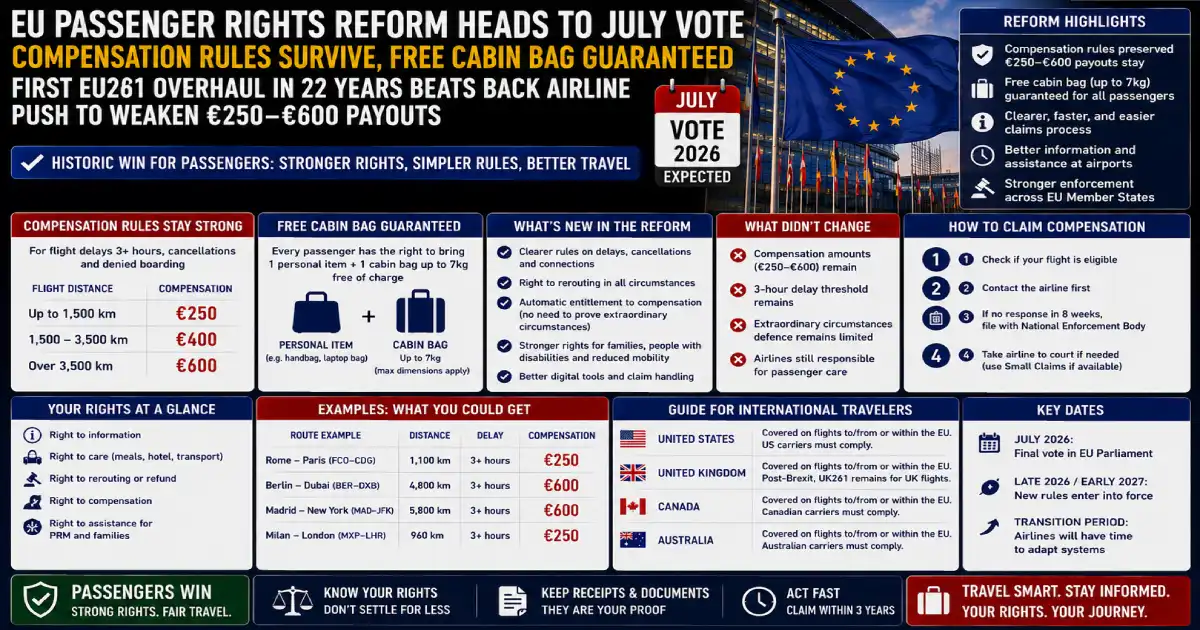
Published: July 6, 2026 — Monday (First EU261 Reform in 22 Years · Parliament Vote Expected This Month)
What’s being voted on: Formal European Parliament adoption of the provisional EU261 reform deal agreed June 15, 2026 Deal status: Provisional political agreement between European Parliament and Council; full Parliament plenary vote expected July 2026 Compensation structure: ✅ Unchanged — €250 (short-haul, up to 1,500km), €400 (medium-haul, up to 3,500km), €600 (long-haul) Delay trigger: ✅ Unchanged — 3 hours (airlines lobbied for 4–9 hours; rejected) New protection: Guaranteed free personal item + one bag under the seat in front, included in base fare Not guaranteed free: Larger overhead cabin trolley bag — budget airlines can still charge for this Rerouting rule: Airlines must offer an alternative flight within 3 hours of a cancellation, at their expense, in comparable conditions Also banned: “No-show” clauses, family-seating fees, charges for correcting minor booking-name typos Enforcement change: Airlines must tell you how to claim — but no automatic pre-filled claim forms or automatic payouts If adopted: Enters into force second half of 2027 — not immediate Industry reaction: IATA and Airlines for Europe call it insufficient reform; consumer groups call it a partial win Estimated cost to airlines: €8 billion/year currently; industry warns new rules could push this toward €15 billion/year
After 13 years of deadlock, the European Union is on the verge of passing its first overhaul of air passenger rights since the original EU261 regulation took effect in 2004. The full European Parliament is expected to vote this month on a provisional deal struck June 15 between Parliament negotiators and the Council of the EU — and for the millions of US, UK, Canadian and Australian travelers who fly into Europe every year, the headline news is what didn’t change. Airlines lobbied hard to stretch the compensation-triggering delay threshold from three hours to as much as nine; that effort failed. The €250–€600 compensation bands survive untouched. On top of that, passengers gain a guaranteed free cabin bag and a formal three-hour rerouting rule after cancellations. It’s not the sweeping win consumer groups originally pushed for, but it’s the most significant passenger-rights change in over two decades — here’s exactly what it means for your next flight to, from, or within Europe.
The single most contested issue in 13 years of negotiation was whether to raise the delay threshold that triggers cash compensation. Airlines for Europe argued the existing three-hour trigger costs the industry roughly €8 billion a year and pushed to extend it to four, six, or even nine hours — a change that would have disqualified a large share of currently compensable delays. European consumer advocacy groups and the European Parliament held firm, and the three-hour threshold survived fully intact in the final agreement.
| Flight Distance | Delay Threshold | Compensation |
|---|---|---|
| Up to 1,500 km (short-haul) | 3+ hours | €250 |
| 1,500–3,500 km (medium-haul) | 3+ hours | €400 |
| Over 3,500 km (long-haul) | 3+ hours | €600 |
These figures have not moved since 2004, and the reform does not adjust them for inflation — a point consumer advocates have flagged as a missed opportunity, given that ticket prices and airline profits have both risen substantially since the original amounts were set.
Every passenger will be guaranteed a small personal item — a handbag or small laptop bag that fits under the seat in front — plus a second bag, included in the base ticket price at no extra charge. This is a genuine change for budget-carrier passengers used to paying separately for any cabin allowance beyond a strict personal item.
However, the reform stops short of what consumer advocates originally pushed for: an initial draft would have mandated a free, standard-size overhead trolley bag (55×40×20cm, up to 7kg) included in every fare. That provision didn’t survive negotiations. Budget airlines retain the right to charge separately for a larger cabin bag placed in the overhead bin — only the smaller under-seat item is now guaranteed free.
Airlines, travel agents and booking search engines must now display the full ticket price — inclusive of the guaranteed cabin baggage allowance — at the very start of the booking process, rather than advertising a stripped-back base fare and adding baggage costs later in checkout.
After a cancellation or denied boarding, airlines must now offer an alternative flight within three hours — by a different route, a different airport, a partner airline, or even another mode of transport — at the airline’s own expense and in comparable travel conditions. Passengers cannot be pushed onto multiple connecting flights if they originally booked direct, and any resulting upgrade must be free. Passengers keep their compensation right for the original delay regardless of the rerouting.
| Area | Before Reform | After Reform |
|---|---|---|
| Delay compensation threshold | 3 hours | 3 hours (unchanged) |
| Compensation amounts | €250–€600 | €250–€600 (unchanged) |
| Cabin bag policy | Varied by airline, often chargeable | Personal item + 1 bag guaranteed free |
| Larger overhead trolley bag | Chargeable on budget carriers | Still chargeable — not mandated free |
| Fare display | Base fare shown, fees added later | Full price including baggage shown upfront |
| Rerouting after cancellation | No fixed timeframe | 3-hour rerouting offer required |
| Family seating fees | Common on budget carriers | Banned |
| No-show clauses | Allowed airlines to cancel return leg if outbound missed | Banned |
| Claim process | Passenger must self-file | Airline must provide claim instructions, but no auto-payout |
Two of the reform’s original, more ambitious proposals didn’t make the final text. First, an automatic, pre-filled compensation claim form that airlines would issue proactively — instead, airlines are only required to tell passengers how to claim, leaving the burden of actually filing on the traveler. Second, automatic payouts for qualifying delays — these were also dropped, meaning passengers must still actively pursue compensation rather than receiving it automatically when a flight qualifies.
Both the International Air Transport Association and the European Regions Airline Association have criticized the reform from the industry side, arguing it adds cost and complexity without meaningfully reducing delays. Consumer advocates, meanwhile, welcome the preserved compensation structure but note the reform leaves the core enforcement gap — airlines assessing their own “extraordinary circumstances” claims first — largely intact.
United States: If you fly to or within Europe, this reform affects you the same as EU residents — EU261 applies to any flight departing an EU airport, and any EU-airline flight arriving in the EU, regardless of your nationality.
United Kingdom: The UK maintains its own near-identical UK261 framework post-Brexit; watch for whether the UK mirrors these EU changes, since divergence could create different rules depending on whether your flight is EU- or UK-departing.
Canada: Canadian travelers connecting through European hub airports benefit from the same three-hour rerouting guarantee and free cabin bag rule on the European leg of a longer itinerary.
Australia & New Zealand: Long-haul travelers booking budget European carriers for the final leg of a multi-stop itinerary should note the free-bag rule applies only to the smaller under-seat item — a larger cabin trolley may still carry a separate charge on low-cost airlines.
| Stage | Date/Status |
|---|---|
| Provisional political agreement reached | June 15, 2026 |
| Full European Parliament plenary vote | Expected July 2026 |
| Formal Council adoption | Following Parliament approval |
| New rules enter into force | Second half of 2027, if adopted |
| Airlines’ system adaptation period | Between adoption and enforcement date |
Posted By : Vinay
This article is provided for general informational purposes only and is based on information available at the time of publication. Travel advisories, airline schedules, airport operations, visa requirements, government regulations, and other travel-related information are subject to change without prior notice. While Travel Tourister makes reasonable efforts to verify information using official announcements, government publications, airline and airport communications, and other reliable sources, we cannot guarantee that all information remains complete, accurate, or up to date at all times. Readers should independently verify any information that may affect their travel plans with the relevant airline, airport authority, government agency, embassy, or other official source before making travel, financial, or other decisions. Travel Tourister shall not be liable for any direct or indirect loss, inconvenience, or damages arising from the use of or reliance on the information contained in this article. Nothing in this publication constitutes legal, immigration, financial, or professional travel advice. If you believe any information in this article is inaccurate or outdated, please contact our editorial team. We review all credible correction requests promptly and update our content whenever appropriate.
Lastest News
2nd Floor, 39, Above Kirti Club, DLF Industrial Area, Kirti Nagar, New Delhi, Delhi 110015



Travel Tourister is a leading Travel portal where we introduce travellers to trusted travel agents to make their journey hasselfree, memorable And happy. Travel Tourister is a platform where travellers get Tour packages ,Hotel packages deals through trusted travel companies And hoteliers who are working with us across the world. We always try to find new and more travel agents and hoteliers from every nook and corners across the world so that you could compare the deals with different travel agents and hoteliers and book your tour or hotel with the one you have chosen according to your taste and budget.
Copyright © Travel Tourister, India. All Rights Reserved

 Call
Call Enquiry