Published on : 09 Apr 2026
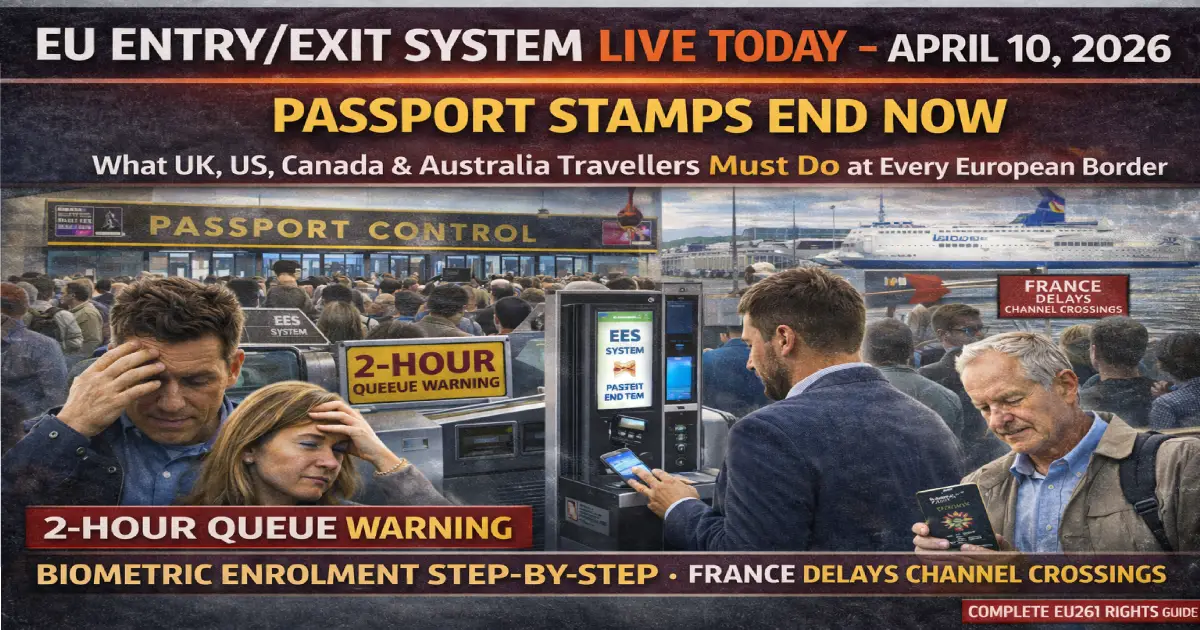
Breaking: The European Union’s Entry/Exit System — the most significant structural change to European border control in a decade — goes fully mandatory today, April 10, 2026, across all 29 Schengen countries. From this moment, the ink stamp in your passport is replaced by fingerprints, a facial scan, and a digital record that follows you every time you enter or leave Europe. No more stamps. No more counting by hand. The system is live — and the queues are already forming.
Airport associations ACI Europe and Airlines for Europe have issued a joint public warning: waiting times are now regularly reaching up to two hours at peak traffic times, with some airports reporting even longer queues.
But there is one major breaking development your readers need urgently. With less than a week to go before the EES became mandatory, French authorities quietly admitted that biometric registration will not be activated at Eurostar terminals, the Channel Tunnel shuttle in Folkestone/Coquelles, and cross-Channel ferry ports. Most travellers entering France from the United Kingdom will therefore continue to have their passports manually stamped for “a few more weeks.”
This creates a split system — airports in France are going live with EES today, but the UK–France Channel routes (Eurostar, Eurotunnel, Dover ferries) remain on manual stamps due to a last-minute software failure and infrastructure problem on the French side. If you are taking the Eurostar or Eurotunnel today, tomorrow, or this summer, this directly affects your crossing.
If you are flying into Europe, driving to France, or taking a ferry anywhere in the Schengen area today: here is every fact, every step, and everything you must do at the border.
Published: April 10, 2026 — EES Day One System Status: 🟢 FULLY LIVE — All 29 Schengen countries mandatory from today Phase: Progressive rollout complete — no more partial implementation Applies To: UK, US, Canadian, Australian and all non-EU/non-Schengen nationals Replaces: Manual passport stamping at all Schengen border crossing points Queue Warning: Up to 2 hours at peak airports — first-time enrolment adds processing time Breaking: France has delayed biometric EES at Channel crossings — Eurostar, Eurotunnel, Dover ferries still on manual stamps France Airports: Paris CDG and Lyon remain on course — airport EES live today Summer Flexibility: Member states can suspend EES for 90 days + 60-day extension to manage peak queues ETIAS: Still coming Q4 2026 — separate system, not today Ireland & Cyprus: EXEMPT — EES does not apply at Irish or Cypriot borders Children under 12: Exempt from fingerprints — facial scan still required
The Entry/Exit System (EES) is the EU’s new digital border management platform replacing the manual ink-stamp process that has governed Schengen travel since the 1990s. The system started a phased rollout on 12 October 2025 across 29 European countries, and becomes fully operational today, April 10, 2026. Passport stamps are replaced with digitally recorded entries and exits, along with biometric information such as facial images and fingerprints.
Data stored in the EES includes your personal details, biometrics — fingerprints and facial image — entry date, time and location, and refusals of entry. Data is retained for up to three years and then automatically deleted.
The EU’s justification is security and accuracy. Since the rollout, more than 24,000 people have been refused entry due to reasons including expired and fraudulent documents, or not being able to fully justify the reason for their visit. More than 600 people have also been identified as posing security risks to Europe.
For UK travellers — the largest single group affected — this is the most significant border change since Brexit. For UK citizens, who became third-country nationals after Brexit, the change marks the biggest practical shift in Schengen travel rules in decades. Every short-stay entry and exit is now recorded electronically alongside biometric data, replacing the visible ink stamps many British travellers have relied on to track their 90 days in any 180-day window.
This is the most urgent piece of information for UK travellers today — and it has received almost no mainstream coverage.
France’s Ministry of the Interior has postponed full biometric Entry/Exit System checks at juxtaposed UK–France border points — including Eurostar’s St Pancras terminal and the ports of Dover and Calais. The automated system was due to go live on April 10 but has been “paused for several weeks” because software integration tests failed and physical booth space is still inadequate.
The two specific blockers the French Ministry confirmed: software integration issues — the biometric scanning software has not passed final readiness checks — and infrastructure constraints, as physical booth space at Channel terminals is insufficient to accommodate EES processing volumes without causing unacceptable delays.
Starting April 10, French border police (Police aux Frontières or PAF) will begin manually registering car travellers in the EES at crossing points, though biometric data such as facial recognition and fingerprints will not be collected at the outset. Passport stamping will continue in the interim.
What this means for you right now:
| Crossing | EES Status Today | What Happens at Border |
|---|---|---|
| Eurostar (St Pancras → Paris/Brussels) | ❌ Biometrics DELAYED | Passport stamped manually — no fingerprints yet |
| Eurotunnel LeShuttle (Folkestone → Coquelles) | ❌ Biometrics DELAYED | Manual registration begins — no biometric data yet |
| Dover–Calais Ferries | ❌ Biometrics DELAYED | Passport stamped manually |
| Paris CDG Airport | ✅ EES LIVE | Biometric enrolment required |
| London Heathrow (departing to Schengen) | N/A — EES applies on EU entry, not UK departure | — |
| Amsterdam Schiphol | ✅ EES LIVE | Biometric enrolment required |
| Madrid Barajas | ✅ EES LIVE | Biometric enrolment required |
| Rome Fiumicino | ✅ EES LIVE | Biometric enrolment required |
| Frankfurt Airport | ✅ EES LIVE | Biometric enrolment required |
Critical implication for 90-day tracking: This delay does not suspend the 90/180-day Schengen limit. It merely removes automated enforcement at the border — meaning the compliance burden shifts entirely to travellers and employers. Manual passport stamps must be kept and counted manually.
Eurostar welcomed the decision, saying it averts potential 15-minute processing times per passenger that would have crippled peak-hour departures. No revised launch date for Channel crossings has been announced.
EES applies to you if you hold a passport from any country outside the EU and Schengen area and you are entering for a short stay (up to 90 days in any 180-day period).
Applies to: ✅ United Kingdom — post-Brexit, UK passport holders are full third-country nationals ✅ United States — all US passport holders ✅ Canada — all Canadian passport holders ✅ Australia — all Australian passport holders ✅ New Zealand — all NZ passport holders ✅ Any non-EU, non-EEA, non-Swiss passport holder on a short stay
Exempt: ❌ EU and EEA citizens (including EU member state nationals) ❌ Swiss nationals ❌ Long-term Schengen visa holders and residence permit holders ❌ Irish passport holders — Ireland is not in the EES system ❌ Cyprus — Cyprus is not yet in the EES system ❌ Diplomats and certain category cross-border workers ❌ Airline and ship crew
Children: Children under 12 don’t have to provide fingerprints, but still need to have a photo taken. All other ages must complete full enrolment including fingerprints.
If this is your first time entering Schengen since EES launched, here is precisely what you will experience at the border. The process varies slightly by airport and country but follows this sequence everywhere:
Step 1 — Follow signs for “Non-EU / All Passports” / “Third Country Nationals” Do not use the EU/EEA queue. This is the most common mistake made by UK travellers who previously used e-gates. You are now a third-country national. If you are travelling on a UK passport, when you arrive at your resort airport, follow the signs for “Non-EU / All Passports”. Do not use the EU/EEA queue unless you hold an EU/EEA passport.
Step 2 — At the kiosk or manned booth: scan your passport You will approach either a self-service EES kiosk (at major airports) or a manned booth. Hand over or scan your biometric passport. The machine or officer reads your chip data and creates your EES digital file.
Step 3 — Facial scan A camera captures your facial image. This takes approximately 5–10 seconds. You must remove glasses and face the camera directly. This applies to all ages including children under 12 (though children under 12 are exempt from fingerprints).
Step 4 — Fingerprint scan (adults and children 12 and over) You will be asked to place four fingers on a fingerprint scanner — typically four fingers of one hand. The scan takes approximately 10–15 seconds per hand. Travellers who refuse to provide biometric data will automatically be refused entry.
Step 5 — Questions from border officer As part of the border process when travelling to Europe, you may be asked questions that relate to the Schengen Border Code — such as where you are staying, your purpose of visit, whether you have travel insurance, and whether you have sufficient funds. This is not new — it has been applicable to UK citizens since Brexit. The introduction of EES means countries now have the option to ask these questions electronically. Have your hotel name and address ready.
Step 6 — Entry confirmed — digital record created The system cross-checks your data against the EES database, your 90/180-day remaining allowance, and your travel document validity. If all clears, you are admitted. No stamp. Your entry is now recorded digitally.
Total first-time processing time: Approximately 5–10 minutes per person at a manned booth. Self-service kiosks are faster — approximately 2–3 minutes once you are familiar with the process.
Returning visits — much faster: Once your data is registered, subsequent trips should be much quicker. The system will recognise your passport and match it with the biometrics already stored. You will often only need a photo check or a simple scan, making repeat entries more efficient than the first.
ACI Europe has said border checks are taking up to 70% longer in some locations, leading to waits of as long as three hours during peak travel times.
British travellers have reported hour to 90-minute long queues, with “no machines operating” and officers taking fingerprints and facial scans by hand.
Here is the practical guidance by crossing type:
| Border Type | Extra Time Needed | Recommendation |
|---|---|---|
| Major airports (CDG, AMS, FCO, FRA, MAD) — peak hours | 90–120 minutes extra | Arrive 3.5–4 hours before departure |
| Major airports — off-peak (early morning, late night) | 30–45 minutes extra | Arrive 2.5–3 hours before departure |
| Secondary airports (regional France, Spain, Italy) | 20–40 minutes extra | Arrive 2.5 hours before departure |
| Eurostar/Eurotunnel/Dover ferries (France) | No extra time today — still manual stamps | Normal arrival times |
| Land borders (road, coach) | Variable — 30–60 minutes | Check crossing-specific advice |
| Return to UK from Schengen | Same as above — EES records your EXIT too | Allow same buffer before your flight back |
We advise passengers to arrive at airports for a flight from Europe at least two hours before as a minimum, but also to check with their airline and airport. Industry travel groups are advising four hours for the busiest summer-peak airports.
The “Travel to Europe” mobile app allows eligible travellers to submit passport details and a facial image before arrival, in an effort to reduce time spent at border control. Travellers can download it from major app stores and begin the process up to 72 hours before their trip.
The Travel to Europe mobile app allows third-country travellers to pre-register biometric photos and passport data 72 hours before arrival to quicken border checks. However, it does not replace the required border control interview. Currently, it is available in Portugal and Sweden, with plans to expand the app across the EU.
How to use the app:
Important: The app is currently live in Portugal and Sweden. Check availability for your specific destination before relying on it to speed up your crossing.
This is the change that matters most for long-stay visitors, frequent travellers, and digital nomads.
The 90/180-day rule is now automated and non-negotiable. No more manually counting stamps, arguing about unclear entry dates, or relying on an officer’s discretion. The system tracks your remaining Schengen days in real time and flags overstays automatically. Four thousand overstays were detected in just six months of partial rollout. That number will be higher now that every crossing point is active.
What 90/180 means: You may spend a maximum of 90 days within any rolling 180-day window inside the Schengen Area. The EES now calculates this automatically — to the day, to the crossing point, without error.
What happens if you overstay: An automatic flag is raised the moment you attempt to exit or re-enter Schengen. You face possible fines, an entry ban from the Schengen Area for up to five years, and a refusal of entry note in your EES record.
The Channel crossing gap: If you are entering France via Eurostar, Eurotunnel, or ferry, your entry is being manually registered without biometrics today. However, the 90-day clock still starts on manual entry. Keep your passport stamp and count your days carefully until the French Channel crossings go biometric.
At airports (CDG, Orly, Nice, Lyon, Bordeaux, Nantes): EES live today — biometric enrolment required on first entry. Arrive 3.5–4 hours before departure at peak times. The delay applies only to Channel crossings for now — airports such as Paris-CDG and Lyon Saint-Exupéry say they remain on course for the April 10 switch-on.
At Channel crossings (Eurostar, Eurotunnel, Dover ferries): Manual stamps continue. No biometric data collected yet. French officials say software glitches and space constraints at juxtaposed controls make the six-minute enrolment process unworkable.
EES fully live. AMS is one of the most EES-ready airports in Europe after early adoption. Dedicated kiosks installed in departure and arrival halls. Pre-register via the Travel to Europe app if possible. Allow 90 minutes extra during peak hours.
EES live across all Spanish airports — Barajas (MAD), El Prat (BCN), Málaga (AGP), Palma (PMI), Alicante (ALC) and all others. Spanish authorities staggered their rollout carefully to avoid disruption. Expect longer queues at Palma and Málaga during peak summer weeks.
EES live at Fiumicino (FCO), Malpensa (MXP), Linate (LIN), Venice (VCE), Naples (NAP), and all others. Operators fear a “domino effect” if fixes are not in place quickly, because summer traffic will soon swell and any further slippage could push the entire rollout into the peak holiday period.
EES live. Germany has deployed EES kiosks at Frankfurt and Munich ahead of the deadline. Allow 60–90 minutes extra at peak times.
EES live. Lisbon Airport suspended the system briefly in December 2025 after queues exceeded five hours, and has since reintroduced it with additional border officers. In January 2026, 24 officers from the National Republican Guard were stationed at the airport to help ease pressure at border checkpoints. Portugal is also one of two countries supporting the Travel to Europe app — pre-register if flying into Lisbon or Faro.
EES live. Athens International is fully compliant. Island airports (Heraklion, Rhodes, Corfu, Santorini, Mykonos) should be live today, but smaller island terminals may face longer implementation timelines. Allow extra time at island airports.
Ireland is not part of the EES system. Travelling to Dublin or any Irish airport is not subject to EES regardless of your nationality. This exemption will continue indefinitely.
Cyprus is not yet part of the EES system. EES checks do not apply when entering Cyprus.
These are the errors that are already creating queue backlogs at active EES airports:
Mistake 1 — Using the EU e-gate queue (UK and non-EU travellers) The gates marked EU/EEA are not for UK or other non-EU passport holders. Using the wrong lane will not get you through faster — you will be redirected after losing your queue position.
Mistake 2 — Not having your hotel address ready Border officers and kiosk systems may ask for your accommodation address in the Schengen Area. Not having it ready adds several minutes to your processing time. Write it down before you reach the border.
Mistake 3 — Non-biometric passport If your passport does not have the small gold camera symbol on the cover, it is not biometric. You cannot use self-service kiosks and must use a staffed booth — which is significantly slower. If your passport is due for renewal, do it now.
Mistake 4 — Not counting 90-day compliance before travel The EES system knows exactly how many days you have spent in Schengen. Attempting to enter with less than one day of allowance remaining — or having already exceeded 90 days — will result in an automatic refusal and an entry denial note in your permanent EES record.
Mistake 5 — Assuming Channel crossings are digital If you are taking Eurostar, Eurotunnel, or a Dover ferry today, you will still get a manual stamp. Keep that stamp and count your Schengen days manually until France activates biometrics at Channel crossings — no revised date confirmed.
EES is only the first half of the new European border architecture. ETIAS is expected to launch between October and December 2026. It will require travellers from more than 60 visa-exempt countries to apply for authorisation before travelling. The authorisation is expected to be valid for three years or until the traveller’s passport expires. The current projected fee is €20.
ETIAS in simple terms: It is the European equivalent of the US ESTA or UK ETA. Before you book your flight to Europe, you will apply online, pay €20, and receive pre-travel clearance. It does not replace a visa — it applies to visa-exempt travellers (UK, US, Canada, Australia). It works alongside EES, not instead of it.
ETIAS is not live yet. You do not need it for any trip to Europe in 2026 unless the launch date is confirmed and announced for your travel period. Monitor for announcements in Q3 2026.
| Resource | URL / Contact |
|---|---|
| EU EES Official Information | ec.europa.eu/home-affairs/policies/schengen/border-management |
| Travel to Europe App (iOS) | Search “Travel to Europe” in Apple App Store |
| Travel to Europe App (Android) | Search “Travel to Europe” in Google Play Store |
| UK Government EES Travel Advice | gov.uk/guidance/entry-exit-system |
| ABTA EES Guide | abta.com (search EES) |
| US Government EES Advice | travel.state.gov |
| Australian Government Travel Advice | smartraveller.gov.au |
| Canadian Government Travel Advice | travel.gc.ca |
| Eurostar Border Info | eurostar.com/uk-en/travel-info/visa-and-passport |
| Eurotunnel LeShuttle Border Info | eurotunnel.com/uk/travel-info |
| 90/180-Day Schengen Calculator | eu.faqhelper.com/schengen-calculator |
| FlightAware (live airport delays) | flightaware.com |
The EU Entry/Exit System is fully live today, April 10, 2026. Passport stamps are over — replaced by fingerprints, facial scans, and a digital record that tracks every entry into and exit from the Schengen Area, enforces the 90/180-day rule automatically, and has already refused entry to over 24,000 people in six months of partial rollout.
The three things you must know today:
Ireland and Cyprus remain completely exempt from EES. Children under 12 are exempt from fingerprints but must still provide a facial scan.
Related Articles:
Latest News
Sources: European Commission DG Home Affairs, ACI Europe, Airlines for Europe (A4E), ABTA, French Ministry of the Interior / Police aux Frontières (PAF), Connexion France, Euronews, The Guardian, Biometric Update, ID Tech Wire — April 10, 2026
Posted By : Vinay
This article is provided for general informational purposes only and is based on information available at the time of publication. Travel advisories, airline schedules, airport operations, visa requirements, government regulations, and other travel-related information are subject to change without prior notice. While Travel Tourister makes reasonable efforts to verify information using official announcements, government publications, airline and airport communications, and other reliable sources, we cannot guarantee that all information remains complete, accurate, or up to date at all times. Readers should independently verify any information that may affect their travel plans with the relevant airline, airport authority, government agency, embassy, or other official source before making travel, financial, or other decisions. Travel Tourister shall not be liable for any direct or indirect loss, inconvenience, or damages arising from the use of or reliance on the information contained in this article. Nothing in this publication constitutes legal, immigration, financial, or professional travel advice. If you believe any information in this article is inaccurate or outdated, please contact our editorial team. We review all credible correction requests promptly and update our content whenever appropriate.
Lastest News
2nd Floor, 39, Above Kirti Club, DLF Industrial Area, Kirti Nagar, New Delhi, Delhi 110015



Travel Tourister is a leading Travel portal where we introduce travellers to trusted travel agents to make their journey hasselfree, memorable And happy. Travel Tourister is a platform where travellers get Tour packages ,Hotel packages deals through trusted travel companies And hoteliers who are working with us across the world. We always try to find new and more travel agents and hoteliers from every nook and corners across the world so that you could compare the deals with different travel agents and hoteliers and book your tour or hotel with the one you have chosen according to your taste and budget.
Copyright © Travel Tourister, India. All Rights Reserved

 Call
Call Enquiry