Published on : 03 Sep 2026
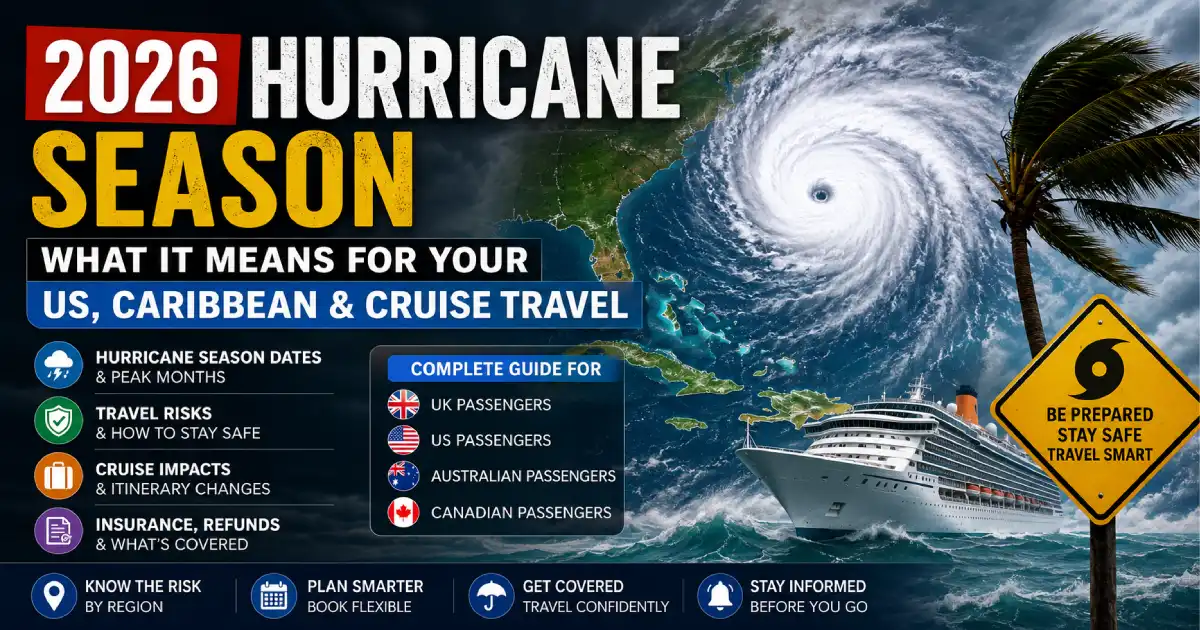
Tropical Storm Edouard made landfall on Tuesday September 1 near Johnson Bayou, Louisiana, with sustained winds of 60 mph — producing 2,510 flight disruptions across the United States in a single day and leaving Houston’s runways under active departure delays as this guide is published. AccuWeather is predicting 11 to 16 named storms for the 2026 Atlantic hurricane season, including four to seven hurricanes and two to four major hurricanes, which are Category 3 or higher. Edouard is the fifth named storm of the season — and with the climatological peak of hurricane season arriving right now in early September, every traveller with autumn bookings to the US, Caribbean, or a cruise destination needs to understand what this season means for their trip. The good news: the overall season has been more subdued than feared. With the climatological peak of hurricane season approaching in early September, NOAA’s prediction for below-normal activity in the Atlantic basin remains — with forecasters updating the number of expected named storms to 7–13, of which 2–6 could become hurricanes, including 0–2 major hurricanes. NOAA forecasters predict a 75% chance for below-normal activity. The bad news: it only takes one storm — and Edouard just proved it. Recent federal advisories emphasize that the 2026 Atlantic hurricane season, while forecast to be near to slightly below average in overall storm numbers, still presents significant risks for US citizens heading to coastal and island destinations, noting that it only takes one powerful landfalling storm to severely disrupt transport links, damage infrastructure and trigger lengthy recovery periods in tourism-dependent regions. Here is every confirmed fact you need — the season forecast, the airports most at risk, the cruise realities, the travel insurance rules, and your complete DOT rights.
Published: September 3, 2026 — Thursday Season: 2026 Atlantic Hurricane Season — June 1 to November 30 Peak Period: August 20 – October 10 — September 10 is the climatological peak We Are NOW at Peak Season — September 3, 2026 AccuWeather Forecast: 11–16 named storms | 4–7 hurricanes | 2–4 major hurricanes (Cat 3+) NOAA Forecast (Updated August 6): 7–13 named storms | 2–6 hurricanes | 0–2 major hurricanes — 75% chance of below-normal season Colorado State University Forecast: 13 named storms | 6 hurricanes | 2 major hurricanes — 70% chance of below-normal activity Storms Named So Far: Arthur (June, Gulf of America), Bertha (July, Gulf), Cristobal, Dolly (potential late August), Edouard (September 1 landfall — confirmed) 3–5 Direct US Impacts Expected: AccuWeather — direct impact ≠ landfall; coastal flooding, wind, and disruption count Peak Risk Airports: Miami (MIA), Orlando (MCO), JFK, Houston (IAH/HOU), Tampa (TPA), Fort Lauderdale (FLL), New Orleans (MSY) Peak Risk Cruise Ports: Miami, Port Canaveral, Galveston, San Juan (Puerto Rico), Nassau (Bahamas) Peak Risk Destinations: Florida, Puerto Rico, the Bahamas, Jamaica, Cancún, Cozumel, Caribbean islands DOT Rights: Cancelled flight = full cash refund — mandatory regardless of cause — weather included Season End: November 30, 2026
The headline numbers from NOAA and Colorado State University paint a reassuring picture: NOAA updated its forecast to predict a 75% chance of below-normal hurricane season activity, which is well above the agency’s initial prediction of a 55% chance of a below-normal activity season in May. Meteorologists pointed to a trend toward El Niño, which is helping keep Atlantic waters slightly cooler while warming the Pacific. Another major factor has been widespread Saharan dust, which has continued to suppress tropical activity.
But here is the critical nuance that every traveller needs to understand: a below-normal season does not mean a disruption-free season. AccuWeather Lead Hurricane Expert Alex DaSilva said: “It’s very important that everybody from South Texas all the way to Maine prepares equally for each and every hurricane season, regardless of what the official forecast is.”
While lower storm activity may support tourism growth and traveler confidence, experts emphasise that even one major hurricane can disrupt airports, resorts, cruise operations, and transportation networks. A single major hurricane can affect airports, cruise ports, hotels, transportation networks, utilities, and tourism infrastructure.
Edouard is the proof. It was a relatively modest tropical storm — winds of 60 mph at landfall, no Category 1 classification, a landfall in a relatively unpopulated stretch of the Louisiana coast. And yet it produced 2,510 flight disruptions, active departure delays at Houston Bush Intercontinental, flooding on the Don Valley Parkway in Toronto from associated weather, and cascading delays across the entire US East Coast for 72 hours. The 2026 season does not need a Category 4 hurricane to disrupt your travel plans. Edouard just showed you exactly what a modest tropical storm can do.
To date, the 2026 season has produced two named tropical storms — Arthur and Bertha — and no hurricanes. Tropical Storm Arthur was the first named storm of the Atlantic season, forming in mid-June in the warm Gulf of America waters off the Texas coast, bringing record rainfall to portions of Louisiana and spawning tornadoes along the Gulf coast. Bertha also formed in the Gulf, originating south of the Florida panhandle before making landfall in St. Bernard Parish, Louisiana.
The third named storm was Cristobal. The fourth, Dolly, was developing in late August — Colorado State University’s tropical weather team predicted a 70% chance of below-normal Atlantic hurricane activity in its August 19 outlook — a direct result of El Niño’s strengthening grip on the atmosphere above the Atlantic main development region.
Edouard became the fifth named storm on September 1 — making its official landfall near Johnson Bayou, Louisiana. Today, September 3, its inland remnants continue to produce flooding across eastern Texas and western Louisiana.
The season’s full name list, in order: Arthur, Bertha, Cristobal, Dolly, Edouard, Fay, Gonzalo, Hanna, Isaias, Josephine, Kyle, Leah, Marco, Nana, Omar, Paulette, Rene, Sally, Teddy, Vicky, and Wilfred. With only five names used as of today, the season has significant room to develop through its November 30 end date.
Airlines operating in hurricane-prone areas may implement temporary route suspensions, rerouting flights away from storm paths. Major airports including Miami International Airport (MIA), Orlando International Airport (MCO), and John F. Kennedy International Airport will be on high alert, with potential flight delays, cancellations, and diverted routes due to severe weather caused by hurricanes and tropical storms. With 3–5 expected US impacts from hurricanes, hurricane warnings and travel alerts will likely be issued, affecting both domestic and international flights.
Miami is the single most hurricane-exposed major international airport in the United States. It sits at the southern tip of Florida — directly in the path of Caribbean and Gulf hurricanes tracking north. Miami handles 50+ million passengers annually and serves as the primary gateway for Caribbean cruise departures. During a direct hurricane threat, Miami International typically closes 12–24 hours before landfall and does not reopen until conditions are safe — typically 24–48 hours after the storm passes.
What Miami disruption means: BA, Virgin Atlantic, American, Delta, United, and JetBlue all operate major transatlantic and Caribbean routes from MIA. A Miami closure affects UK, Australian, and Canadian passengers transiting through Miami to the Caribbean as well as direct MIA flights.
Orlando is America’s most visited airport by tourist passengers. Thunderstorms are already disrupting travel at Orlando International Airport, with the Federal Aviation Administration issuing a ground stop and posting arrival delays of up to 62 minutes for flights approaching from across the eastern United States. This happened as recently as August 27 — and during a named storm track directly over Florida, Orlando closures routinely extend 24–48 hours.
Orlando is also the primary fly-in airport for Port Canaveral cruise departures — Royal Caribbean, Carnival, and Norwegian all have major embarkation operations at Port Canaveral, 45 minutes east of MCO. If you are flying into Orlando to connect with a cruise departing from Port Canaveral, do not assume your delayed flight will arrive in time.
Breeze Airways has already suspended four Florida routes starting September 2 — the cuts reflect Florida’s steep September demand trough, when school is back in session, hurricane season is at its peak, and leisure travel to the Sunshine State falls to its annual low, according to aviation analysts.
Houston was Edouard’s primary casualty — active departure delays September 1–3. Houston is also one of the primary targets for Gulf of Mexico storms that develop rapidly and make landfall along the Texas–Louisiana coast. United Airlines’ largest domestic hub is directly exposed to every Gulf system that develops. Tropical Storms Arthur and Bertha both formed in the Gulf and impacted Houston-area airports earlier in 2026.
Tampa International (TPA): Tampa Bay’s geography creates extreme storm surge risk — any Gulf hurricane tracking toward the Tampa Bay area triggers full airport closure and regional evacuation. Tampa’s 2026 tourism season has already been shaped by elevated storm awareness.
Fort Lauderdale (FLL): Spirit Airlines’ largest hub — already under financial pressure — sits 20 miles north of Miami with the same storm exposure. A Fort Lauderdale closure cascades immediately into Spirit’s entire national network.
New Orleans Louis Armstrong (MSY): The aftermath of Katrina means New Orleans airports close early and cautiously. Bertha made landfall in St. Bernard Parish — 20 miles from New Orleans — earlier in this season.
New York JFK: JFK is not immune. John F. Kennedy International Airport will be on high alert, with potential flight delays, cancellations, and diverted routes as tropical systems track north along the Atlantic coast. Tropical storms that make landfall in the Carolinas often produce severe weather at JFK 12–18 hours later.
Many of the world’s busiest cruise routes operate through the Caribbean, Gulf of Mexico, and western Atlantic during hurricane season. Cruise lines have extensive experience adapting itineraries when storms develop. Ships can often avoid severe weather through route modifications and schedule adjustments. However, major storms may still impact embarkation ports, island destinations, and passenger travel arrangements.
Scenario 1 — Storm misses your ship: The most common outcome. Cruise lines monitor storm tracks obsessively and begin rerouting ships 72–96 hours before a potential conflict. Your itinerary changes — you visit different islands — but you sail. Cruise lines can make this call without passenger consent.
Scenario 2 — Embarkation port closed: If your cruise starts from Miami, Fort Lauderdale, Port Canaveral, or Galveston and a storm closes the port, your cruise is delayed or cancelled. This is the scenario that most affects passengers who fly in the day of embarkation.
Scenario 3 — Cruise cancelled: Rare, but happens during major storms. Cruise companies continue investing in weather monitoring systems and operational flexibility to minimise disruptions whenever possible. For travellers, itinerary changes remain one of the most common hurricane-related impacts within the cruise sector.
| Port | Airport Connection | Storm Risk |
|---|---|---|
| Miami (PortMiami) | MIA | 🔴 Highest — direct hurricane exposure |
| Port Canaveral | MCO (45 min) | 🔴 High — Central Florida landfall risk |
| Galveston, Texas | HOU/IAH (50 min) | 🔴 High — Gulf storm direct exposure |
| Fort Lauderdale (Port Everglades) | FLL | 🔴 High — same exposure as MIA |
| San Juan, Puerto Rico | SJU | 🟡 Moderate — Caribbean track exposure |
| Nassau, Bahamas | NAS | 🟡 Moderate — Atlantic track exposure |
| Tampa (Port Tampa Bay) | TPA | 🔴 High — Gulf storm surge risk |
If your cruise is cancelled: You are entitled to a full cash refund under the cruise line’s standard policy. Most major lines — Royal Caribbean, Carnival, Norwegian, Celebrity, Princess, P&O, TUI — also offer cruise credits or alternative sailing dates.
If your itinerary changes mid-cruise: Cruise lines have virtually unlimited contractual right to modify itineraries for safety reasons. You are entitled to the cruise you paid for, not the specific ports listed. Port fee refunds for skipped ports are standard but may take weeks to process.
UK passengers: The Package Travel Regulations 2018 apply if you booked a package holiday including cruise + flight. A cancellation of the package entitles you to a full refund within 14 days.
Travel insurance — “named storm” coverage: This is the most important phrase in any travel insurance policy for hurricane season travel. A policy that covers “trip cancellation due to a named storm” pays out when your trip is cancelled or significantly disrupted because of a specifically named tropical system. Not all policies include this. Check before September 10 — the climatological peak — and before any storm is named that affects your destination.
The Atlantic hurricane season is notorious for disrupting travel routes, particularly in the Caribbean, Southeast US, and Gulf Coast regions. Travelers heading to popular destinations such as Florida, Puerto Rico, Miami, and New York should expect potential flight delays, cancellations, and diverted routes due to severe weather caused by hurricanes and tropical storms.
Florida — Miami, Fort Lauderdale, Tampa, Orlando, Key West: Florida is statistically the most hurricane-impacted US state. Key West and the Florida Keys are particularly vulnerable to Gulf storms and can be entirely evacuated before a major landfall. Peak risk window: September 1 – October 15.
Caribbean Islands — Jamaica, Puerto Rico, the Bahamas, Barbados, the Grenadines, Dominican Republic, Cuba, Haiti: Tourism authorities throughout the Caribbean continue emphasising readiness and resilience regardless of seasonal forecasts. A single major hurricane can affect airports, cruise ports, hotels, transportation networks, utilities, and tourism infrastructure. Hurricane Melissa, named in the source data, hit Jamaica in 2025 as a Category 5.
Gulf Coast — Texas, Louisiana, Mississippi: Three of 2026’s five named storms have hit the Gulf. This is well above the Gulf’s historical proportion of Atlantic storm landfalls and reflects warm Gulf water temperatures that are partially offsetting El Niño’s suppression effect.
Cancún, Cozumel, and the Yucatán Peninsula: The most popular Caribbean destinations for US and UK tourists. Cancún’s airport (CUN) is frequently included in airline travel waivers during Caribbean storm events, as it sits directly in the track of storms crossing the Caribbean toward the Gulf.
Bermuda: Atlantic track storms frequently pass near or over Bermuda. Airport closures of 12–24 hours are common during near-miss events.
US East Coast — Carolinas, Virginia, New York: Atlantic-tracking storms that make landfall in the Carolinas produce cascading weather up the I-95 corridor within 12–18 hours. Outer Banks of North Carolina have the highest per-mile landfall frequency of any US coastline.
Western Mediterranean — Spain, France, Italy, Greece: European destinations are not directly in the Atlantic hurricane belt but can be affected by ex-tropical systems that cross the Atlantic and regenerate over warm Mediterranean waters. Risk is low but non-zero.
Western US — California, Nevada, Arizona: Essentially no Atlantic hurricane impact. Pacific storm season is separate.
When major airports like Miami or Houston trim schedules, rebooking inventory can disappear quickly. Travelers who wait until day-of often face multi-day delays. Do not wait for the storm to hit your airport to check your waiver options.
DOT April 2024 Automatic Refund Rule:
| Situation | Your Right |
|---|---|
| Flight cancelled — weather included | Full cash refund to original payment method — mandatory |
| Domestic delay 3+ hours — you choose not to travel | Full cash refund right |
| International delay 6+ hours — you choose not to travel | Full cash refund right |
Weather is not an exception to the cash refund rule. Airlines cannot refuse a cash refund for a cancelled flight by citing weather. They can — and often do — offer a travel voucher first, but you are not required to accept it. The exact phrase: “Under the DOT’s April 2024 Automatic Refund Rule, I am requesting a full cash refund to my original payment method for this cancelled flight.”
When a storm is named and tracked toward a major airport, airlines typically issue travel waivers 48–72 hours before the expected impact window. These waivers allow you to rebook without change fees or fare differences — often onto flights before the storm arrives or after it passes. Use this one week before departure. Check airline waiver pages for your routes and dates.
Key rule: Airline waivers have expiry dates. The United Airlines waiver for Edouard, for example, required rebooking on flights departing before September 5. Once the waiver expires, standard fare rules — including change fees and fare differences — return. Act within the waiver window.
UK and European passengers flying to the US or Caribbean on British Airways, easyJet, Jet2, or any EU/UK-based carrier are covered by UK261 or EU261 for cancellations of flights departing from the UK or EU. Weather is an “extraordinary circumstance” — so cash compensation (£220–£520) does not apply for weather cancellations. But the refund right and free rebooking right are unconditional. Contact the UK CAA (caa.co.uk/passengers) if your airline refuses a refund for a cancelled flight.
Australian passengers are protected by Australian Consumer Law for travel products purchased in Australia. If a cruise line or airline cancels your booking due to a hurricane, you are entitled to a full refund of the price paid. Contact the ACCC (accc.gov.au) if a provider refuses.
US travel officials are urging extra caution for the 2026 storm season as extreme weather increasingly disrupts flights, cruises and tourism across key routes.
“Named storm cancellation” coverage: Pays if your trip is cancelled or significantly disrupted specifically because a named tropical storm affects your destination. This is different from general “weather delay” coverage and is the most valuable hurricane season protection. Check whether your current policy includes this — if it doesn’t, consider a supplemental policy before September 10.
“Cancel for Any Reason” (CFAR): The broadest protection — typically covers 50–75% of your trip cost if you cancel for any reason, including simply not wanting to travel into a storm-affected region. CFAR must generally be purchased within 14–21 days of your initial trip deposit.
“Travel delay” coverage: Pays for hotel and meal expenses if your flight is delayed 6–12+ hours (threshold varies by policy). Important for multi-day airport stranding situations like Edouard’s Gulf Coast aftermath.
“Missed connection” coverage: If you miss a cruise or connecting flight because of a delayed inbound flight, this covers the cost of catching up with your ship or the additional flight to your destination.
What is NOT covered without specific riders: ❌ Pre-existing storms — any storm that was named before you purchased the policy is typically excluded from cancellation coverage ❌ General “I don’t want to go” without CFAR ❌ Government travel advisories alone — unless your policy specifically includes this trigger
Travelers who prepare early usually keep more options, spend less, and recover faster when flights, ferries, or hotels are disrupted. Once a storm is named, travel insurance providers immediately exclude that specific storm from new policies. You cannot buy coverage for Hurricane Fay after Fay has been named. Buy your travel insurance the same day you book your trip — not the day before departure.
If you have travel booked September–November to the US Southeast, Caribbean, or Gulf Coast:
Step 1 — Check your travel insurance policy this week Open your policy document and search for “named storm,” “hurricane,” and “weather cancellation.” Confirm whether your coverage includes named storm cancellation. If it doesn’t — and you haven’t yet departed — consider adding a supplemental policy now, before the next storm is named.
Step 2 — Bookmark your airline’s travel alerts page Use this one week before departure: check airline waiver pages for your routes and dates. Bookmark: united.com/travel-alerts | aa.com/travelalerts | delta.com/us/en/travel-disruptions | ba.com/travel-alerts | southwest.com/travel-disruptions.
Step 3 — Do not book same-day cruise connections in hurricane season If you are flying to Miami, Fort Lauderdale, Port Canaveral, or Galveston to board a cruise, fly the day before — not the morning of embarkation. A same-day flight delay means a missed cruise. Flying the day before gives you a full 24-hour buffer. Book a hotel near the port for the night before.
Step 4 — Monitor NOAA and the National Hurricane Center from 14 days out The National Hurricane Center’s tropical weather outlook is updated four times daily for travelers monitoring systems. Check nhc.noaa.gov once your trip is within 14 days. The 5-day track cone is where you should focus — if your destination appears in the 5-day cone, contact your airline and cruise line immediately.
Step 5 — Know your waiver window When an airline issues a storm waiver, act within 24 hours. Waivers fill up fast — the best recovery seats disappear within the first day of a waiver being issued. Travelers who wait until day-of often face multi-day delays.
Step 6 — Download your boarding pass offline In the hours before a hurricane makes landfall, mobile data networks in the affected region can become congested or fail entirely. Download your boarding pass to your phone’s wallet before you need it.
Step 7 — Pack a carry-on with 24 hours of essentials If your checked bag is delayed or stranded at a closed airport, a carry-on with medications, phone charger, one change of clothes, and any essential documents keeps you functional for the first 24 hours of disruption.
| Resource | Link |
|---|---|
| National Hurricane Center (live tracking) | nhc.noaa.gov |
| NOAA 2026 Hurricane Season Forecast | noaa.gov/hurricane |
| FAA National Airspace System (ground stops) | fly.faa.gov |
| AccuWeather Hurricane Centre | accuweather.com/hurricanes |
| United Airlines Travel Alerts | united.com/travel-alerts |
| American Airlines Travel Alerts | aa.com/travelalerts |
| Delta Travel Disruptions | delta.com/travel-disruptions |
| British Airways Travel Alerts | ba.com/travelinfo |
| Royal Caribbean Storm Policy | royalcaribbean.com/weather-policy |
| Carnival Storm Policy | carnival.com/weather |
| US State Dept Emergency Contact | travel.state.gov |
| FCDO Caribbean Travel Advice | gov.uk/foreign-travel-advice |
| DOT Consumer Protection | airconsumer.dot.gov |
| FlightAware Live | flightaware.com |
The 2026 Atlantic hurricane season is running below normal overall — NOAA now predicts a 75% chance of below-normal activity, with updated forecasts of 7–13 named storms, 2–6 hurricanes, and 0–2 major hurricanes — driven by El Niño and Saharan dust suppression. But Edouard’s September 1 landfall — the fifth named storm of the season — produced 2,510 US flight disruptions, active departure delays at Houston, cascading chaos from the Northeast to the Gulf Coast, and a reminder that a tropical storm does not need Category 4 winds to destroy your travel plans. AccuWeather is predicting 11–16 named storms, and AccuWeather Lead Hurricane Expert Alex DaSilva said: “It’s very important that everybody from South Texas all the way to Maine prepares equally for each and every hurricane season, regardless of what the official forecast is.”
We are at the climatological peak of the season — September 10 is the historical peak date, and we are one week away. The risk window for US Southeast, Gulf Coast, Caribbean, and cruise travel runs through October 10 — the heart of autumn holiday season for UK, Australian, Canadian, and US travellers. The practical actions are simple: buy insurance before any storm is named, fly in the day before your cruise, bookmark airline waiver pages, and act within 24 hours of any storm waiver being issued.
The five most important things to know:
For More Resources:
Related Articles:
Posted By : Vinay
This article is provided for general informational purposes only and is based on information available at the time of publication. Travel advisories, airline schedules, airport operations, visa requirements, government regulations, and other travel-related information are subject to change without prior notice. While Travel Tourister makes reasonable efforts to verify information using official announcements, government publications, airline and airport communications, and other reliable sources, we cannot guarantee that all information remains complete, accurate, or up to date at all times. Readers should independently verify any information that may affect their travel plans with the relevant airline, airport authority, government agency, embassy, or other official source before making travel, financial, or other decisions. Travel Tourister shall not be liable for any direct or indirect loss, inconvenience, or damages arising from the use of or reliance on the information contained in this article. Nothing in this publication constitutes legal, immigration, financial, or professional travel advice. If you believe any information in this article is inaccurate or outdated, please contact our editorial team. We review all credible correction requests promptly and update our content whenever appropriate.
Lastest News
2nd Floor, 39, Above Kirti Club, DLF Industrial Area, Kirti Nagar, New Delhi, Delhi 110015



Travel Tourister is a leading Travel portal where we introduce travellers to trusted travel agents to make their journey hasselfree, memorable And happy. Travel Tourister is a platform where travellers get Tour packages ,Hotel packages deals through trusted travel companies And hoteliers who are working with us across the world. We always try to find new and more travel agents and hoteliers from every nook and corners across the world so that you could compare the deals with different travel agents and hoteliers and book your tour or hotel with the one you have chosen according to your taste and budget.
Copyright © Travel Tourister, India. All Rights Reserved

 Call
Call Enquiry