Published on : 19 Apr 2026
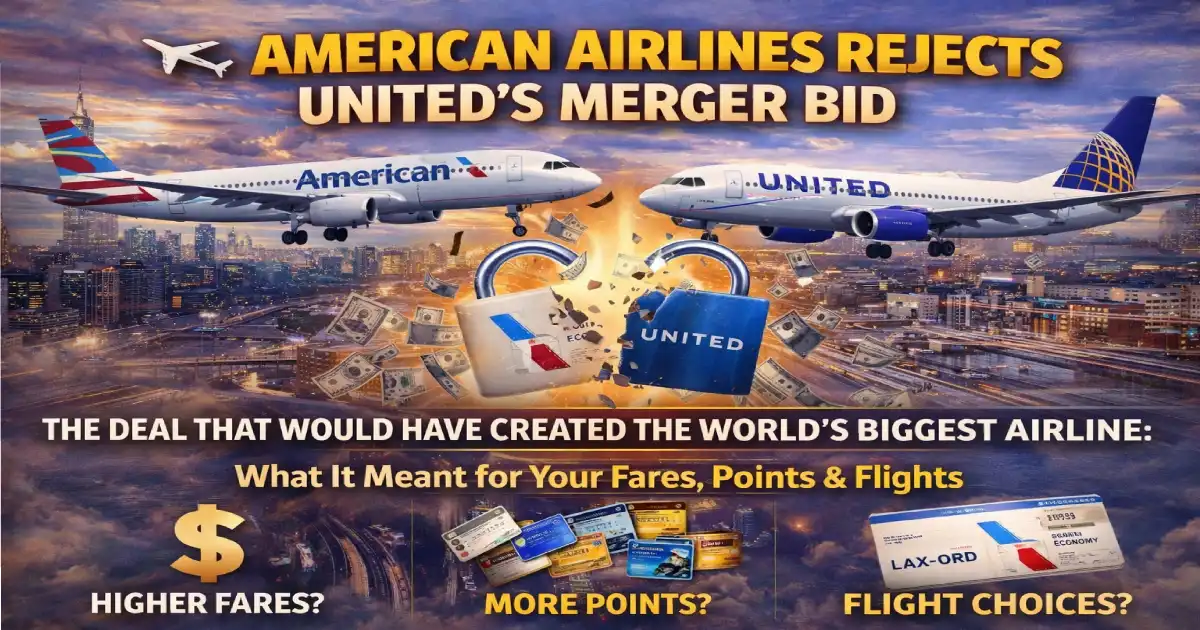
The most audacious deal in aviation history lasted one week before it was shot down. On Friday April 18, 2026, American Airlines issued a formal, unambiguous statement crushing speculation that had consumed the aviation industry since Monday: the carrier is not interested, has not been contacted properly, and considers the combination harmful to competition. American Airlines issued a firm statement declaring it is “not engaged with or interested in any discussions regarding a merger with United Airlines.” The carrier argued that a combination would harm competition and consumers, calling it inconsistent with the current administration’s approach to antitrust law and industry philosophy.
The proposal — United CEO Scott Kirby pitching a takeover of his former employer to the White House — was either the most audacious corporate move of 2026 or the most spectacular miscalculation. Either way, it is dead for now. But the story of what this merger would have meant for the 171 million passengers who fly American and United every year — and for the millions more in the UK, Canada, and Australia who connect through them — is worth understanding completely. Because while this deal is rejected, the forces driving it have not gone away.
Published: April 19, 2026 Event: American Airlines formally rejects United Airlines merger proposal Rejection Date: Friday, April 18, 2026 — after markets closed Original Proposal: United CEO Scott Kirby pitched merger to Trump White House on February 25, 2026 First Reported: Bloomberg, Monday April 14, 2026 Would Have Created: World’s largest airline by passengers, fleet, and revenue Combined Fleet: ~1,400 aircraft Market Share: ~30–40% of US domestic market Alliances Affected: Star Alliance (United) + Oneworld (American) — one would cease to exist Status: Dead — American’s rejection is formal and unambiguous What’s Next: JetBlue sale process continues; industry consolidation era not over
Understanding why American’s rejection matters requires understanding how this idea came to exist — and why it exploded into public consciousness this week.
February 25, 2026: Scott Kirby raised the merger idea during a White House meeting originally scheduled to discuss the future of Dulles International Airport. United is the dominant carrier at Dulles with an 82% market share. According to sources familiar with the talks, Kirby used the infrastructure meeting as a platform to float something far larger.
March–April: Kirby continues making the case internally and through informal channels. The CEO had been mulling a potential deal last fall, according to people familiar with his thinking — months before bringing it to the Trump administration.
Monday April 14: Bloomberg breaks the story. American Airlines stock rises 7% in morning trading on takeover speculation. United’s shares also move. The aviation industry holds its breath.
Tuesday–Thursday: Transportation Secretary Sean Duffy signals conditional openness: “Is there room for some mergers in the aviation industry? Yeah, I think there is. If there was a merger between some of the larger airlines, they would have to peel off some of their assets.” Duffy adds that Trump “loves to see big deals happen.”
Friday April 18, after market close: American Airlines issues its statement rejecting merger discussions, saying a combination would be “negative for competition and for consumers” and “inconsistent with our understanding of the administration’s philosophy toward the industry and principles of antitrust law.”
The kicker: As reported, Kirby had reportedly approached the White House before contacting American Airlines directly about a potential acquisition. This sequence — going to the president before talking to the target — shaped American’s response entirely, leaning heavily toward aligning its position with the administration’s stated goals while simultaneously rejecting the deal.
In other words: Kirby went to the boss before he went to the company. American Airlines did not appreciate that. At all.
The modern American Airlines is the product of a 2013 combination with US Airways, where several current airline executives worked — including both United’s Kirby and American CEO Robert Isom. Kirby, whom American fired in 2016, has gone head-to-head with his former employer, including in key markets like Chicago.
The personal dimension of this story is extraordinary. Scott Kirby built American Airlines into its current form — then was fired by it. He joined United, rebuilt it into the most profitable large US carrier, and then returned to try to buy back his former employer. He recounted earlier efforts at America West, later acquired by American, and said he was involved in a failed US Airways-United deal that was leaked to test reactions before Continental stepped in.
Kirby’s stated rationale was strategic and international rather than domestic: he argued that a combined airline could close the “trade deficit” in international travel, saying that while 60% of international passengers are US citizens, two-thirds of long-haul seats are operated by foreign carriers. Those claims landed in a difficult economic moment for the industry.
Translation: Kirby wants a US airline large enough to compete with Emirates, Qatar Airways, Singapore Airlines, and Cathay Pacific on equal terms. His argument is that no individual US carrier — not United, not American, not Delta — is big enough to win that fight alone. A combined United-American would be.
| Metric | Combined United + American |
|---|---|
| Fleet size | ~1,400 aircraft |
| Annual passengers | ~300 million |
| US domestic market share | ~30–40% |
| Alliance | Star Alliance (United) — Oneworld (American) would be dissolved |
| Loyalty programme | Combined MileagePlus + AAdvantage (new single programme) |
| Route overlap | 289 routes with direct competition between the two carriers |
| Hub concentration | Dallas Fort Worth (AA dominant 89% of capacity), Chicago O’Hare (both carriers), New York JFK, Newark, LAX, London Heathrow, Tokyo Narita |
| “Big 4” becomes | “Big 3” — Delta, Combined United-American, Southwest |
| Global rank | World’s largest airline by almost every metric |
The new airline would have about 1,400 planes and reach more cities than any other carrier. Costs would fall quickly through shared maintenance bases, fuel deals and crew planning.
Even before American’s rejection, antitrust experts were uniformly sceptical. “This seems hopeless to me. There are huge overlaps on a number of routes and in various metropolitan areas such as Chicago. No amount of divestitures would fix it,” said William Kovacic, director of the competition law centre at George Washington University.
An American-United merger would likely require significant divestitures on routes where the two carriers’ combining would mean only one or two airlines are serving that route — TD Cowen airline analyst Tom Fitzgerald identified 289 routes fitting that criteria now.
Antitrust lawyer Andre Barlow put it plainly: “A United-American deal would reduce the ‘Big 4’ to a ‘Big 3’ with one dominant player. There would likely be competitive issues in many city-pair routes and hubs. I am not sure this deal can get done. The Trump administration is concerned about affordability issues and this deal would reduce choices and give the airlines more pricing power.”
Combining United and American would place about a third of all air travel under one company, which would face intense backlash from federal antitrust regulators and state prosecutors. Arizona Attorney General Kris Mayes stated her office would “absolutely take a look at it.”
The international dimension would be equally complex. Say goodbye to Star Alliance and Oneworld, as well as immunised codeshares with foreign carriers. The EU, Canada, Mexico, China, the UK and several enforcement agencies in South America can also say “No” and torpedo the deal. Those jurisdictions would likely say “Nein/Non/No.”
The passenger impact of a United-American combination would have been felt most directly by US domestic travellers. Passengers could face higher fares, fewer direct flights from smaller airports, more multi-leg itineraries and fewer hub airports, all while baggage fees rise alongside pressure from high fuel costs. Smaller communities appeared especially exposed — places such as Minot or Dickinson, North Dakota, as examples of markets where nonstop options could become harder to keep if a larger combined carrier concentrated flying at its biggest hubs.
It would put “pressure on cities like Philadelphia, Phoenix and Charlotte — places where American currently runs big operations,” and locals would “pay for it in both schedule choices and ticket prices.” People who take advantage of frequent flier miles may especially lose out, as “when airlines merge, the combining loyalty programmes almost always end up repricing awards — upward.”
Some big US cities already have just one airline essentially controlling most of their flights: American has 83% of capacity in and out of Dallas-Fort Worth and 89% in Charlotte. A United-American combination at these hubs would approach monopoly levels.
AAdvantage and MileagePlus holders: A merger would eventually collapse two of the three largest US loyalty programmes into one. American AAdvantage has been a more generous programme in most respects than MileagePlus over the past half dozen years. Members of AAdvantage might benefit from being able to redeem miles on Star Alliance rather than Oneworld, since Star has more members. However, the historical pattern across every major US airline merger is the same: the combined programme raises award prices within 2–3 years of integration.
For UK travellers, the most significant consequence would have been the destruction of the Oneworld alliance. American Airlines is a founding Oneworld member. United is a founding Star Alliance member.
What Oneworld is: British Airways, Qantas, Cathay Pacific, Finnair, Iberia, Japan Airlines, Malaysia Airlines, Royal Jordanian, Qatar Airways, and American Airlines. The entire alliance — lounge access, codeshare reciprocity, points earning across partners — exists because American is in it.
A United takeover would have ended American’s Oneworld membership. British Airways’ most important transatlantic partner would have switched alliances or simply ceased to be a codeshare partner. BA’s lucrative joint business agreement (JBA) with American on transatlantic routes — which allows the two carriers to coordinate schedules and pricing across the Atlantic — would have faced immediate regulatory review and possible termination.
For British travellers: Avios earned on BA flights currently transfer and redeem on American routes. That relationship would have been in jeopardy. The points bridge between BA Executive Club and AAdvantage — one of the most popular transatlantic award combinations — would have been replaced by whatever United negotiated separately with BA.
Canada’s Air Canada is a Star Alliance member — United’s alliance. A larger United would have been a more powerful Star Alliance partner, potentially strengthening the Air Canada–United joint venture on transborder routes.
However, the 289 route overlaps between United and American include many US–Canada city pairs where both carriers currently compete. Any approved tie-up between the carriers would likely lead to asset divestitures, with some of the most visible involving gate space or takeoff and landing rights at the most congested US airports. Some Canada-serving routes could have been consolidated or cut.
For Canadian travellers: The Aeroplan–United partnership (Air Canada’s loyalty programme partners with United’s MileagePlus for cross-earning) would have become far more significant — or been restructured entirely as the US merger reshaped global alliance architecture.
United sits in Star Alliance while American belongs to Oneworld. A merged airline would likely stay with Star, leaving Qantas, JAL and others to rethink partnerships.
Qantas is Oneworld’s most important Asia-Pacific member. Its codeshare with American Airlines covers critical Australia–US routes including Sydney–Los Angeles and Sydney–Dallas (connecting via American’s DFW hub). If American’s Oneworld membership ended, Qantas would lose its most valuable US partner.
On busy routes such as Sydney–Los Angeles or Tokyo–San Francisco, flights might be trimmed. That could push fares higher in premium cabins. Smaller Pacific islands might also see reduced services.
For Australians holding Qantas Points: the ability to redeem Qantas Points on American Airlines flights — Business Class awards on AA transpacific routes are among the most popular Qantas redemptions — would have been at serious risk.
The elephant in the room throughout this week’s merger speculation is the personal history between Scott Kirby and American Airlines. Kirby didn’t just leave American — he was fired. Specifically:
Kirby’s own history explains part of the drama. He was involved in a failed US Airways-United deal that was leaked to test reactions before Continental stepped in. The pattern is consistent: Kirby has spent his career trying to consolidate US aviation, and American Airlines has been the recurring obstacle.
Whether this latest move was genuine strategic vision or a final act of corporate revenge is a question that only Kirby can answer. What is clear is that American’s board saw it as an unsolicited approach via the most powerful person in the country — and they rejected it publicly, firmly, and with pointed language about antitrust principles.
In the short term — yes. American’s public rejection is final and leaves no room for immediate re-engagement. Kirby cannot now initiate a hostile takeover — American is a public company, but a hostile bid for an airline this size would face a DOT review that could take years, and international regulators (UK CAA, EU DG COMP, Canadian Competition Bureau, ACCC) would all need to approve.
In the medium term — uncertain. The forces driving this idea have not disappeared:
✅ Fuel costs remain elevated even after the Hormuz reopening — airlines need scale to hedge efficiently ✅ International competition intensifying — Emirates, Qatar, Etihad, and Singapore Airlines continue expanding ✅ American Airlines is financially vulnerable — its net income of $111 million in 2025 vs United’s $3.35 billion tells the story ✅ Trump administration is explicitly pro-consolidation — Duffy’s “room for mergers” comment remains on the table
If it doesn’t happen under fellow wheeler-dealer Trump, it will never happen. The window for consolidation is 2026 and 2027. A successor government could introduce far stricter antitrust standards.
The most likely scenario: this specific proposal is dead. But US airline consolidation — involving some combination of the remaining large carriers — is not dead. Watch American’s financial results, watch JetBlue’s sale process, and watch whether Kirby returns to the White House with a revised, smaller proposal.
While the United-American merger is rejected, a separate and active consolidation story continues: JetBlue Airways has hired financial advisers to evaluate selling itself to a rival airline, with United Airlines, Alaska Airlines, and Southwest Airlines identified as the three most viable merger candidates. JetBlue’s stock surged as much as 19% in a single trading session when the news broke. JetBlue continues to face a strained balance sheet and $9.4 billion in total debt. The airline has not recorded a full-year profit since 2019. Its TrueBlue loyalty programme, Mint business class product, and Fort Lauderdale hub are all assets that a buyer would inherit.
The three scenarios:
United buys JetBlue: United gains a second New York hub footprint at JFK Terminal 5, strengthening its position against Delta’s JFK dominance. TrueBlue converts to MileagePlus. The Blue Sky partnership becomes a full integration. This remains the most financially logical outcome. Status: Possible but United has said prices remain firm.
Alaska buys JetBlue: Alaska gains the East Coast presence it has never had, pairing its West Coast and Pacific strength (including Hawaiian) with JetBlue’s Boston and New York fortress. Status: Complicated by Alaska still absorbing Hawaiian Airlines (operational merger completes April 22, 2026).
Southwest buys JetBlue: Southwest gains JetBlue’s premium Mint product and international routes. Status: Least likely — Southwest would gain comparatively little and has its own recovery to manage.
The United-American Airlines merger is dead — for now. American Airlines formally rejected Scott Kirby’s White House-pitched takeover bid on Friday April 18, 2026, saying the deal would harm competition and consumers. Had it succeeded, the combination would have created the world’s largest airline by a significant margin, collapsed the Oneworld alliance, threatened the British Airways–American transatlantic partnership, put Qantas’s most important US codeshare at risk, and concentrated 30–40% of US domestic air travel under a single brand. Every analysis of the passenger impact reached the same conclusion: higher fares, weaker loyalty programme value, fewer direct routes from secondary cities, and less competition at major hubs.
The rejection is good news for travellers in the short term. But the financial pressures on American Airlines — $111 million net income against United’s $3.35 billion — have not resolved. Kirby’s argument that US carriers need more scale to compete internationally has not been answered. And the JetBlue sale process continues actively. US airline consolidation is not over. This was just one battle in a longer war.
Watch American Airlines’ Q1 2026 earnings. Watch JetBlue’s sale timeline. And watch whether Kirby returns with a smaller ask.
Posted By : Vinay
This article is provided for general informational purposes only and is based on information available at the time of publication. Travel advisories, airline schedules, airport operations, visa requirements, government regulations, and other travel-related information are subject to change without prior notice. While Travel Tourister makes reasonable efforts to verify information using official announcements, government publications, airline and airport communications, and other reliable sources, we cannot guarantee that all information remains complete, accurate, or up to date at all times. Readers should independently verify any information that may affect their travel plans with the relevant airline, airport authority, government agency, embassy, or other official source before making travel, financial, or other decisions. Travel Tourister shall not be liable for any direct or indirect loss, inconvenience, or damages arising from the use of or reliance on the information contained in this article. Nothing in this publication constitutes legal, immigration, financial, or professional travel advice. If you believe any information in this article is inaccurate or outdated, please contact our editorial team. We review all credible correction requests promptly and update our content whenever appropriate.
Lastest News
2nd Floor, 39, Above Kirti Club, DLF Industrial Area, Kirti Nagar, New Delhi, Delhi 110015



Travel Tourister is a leading Travel portal where we introduce travellers to trusted travel agents to make their journey hasselfree, memorable And happy. Travel Tourister is a platform where travellers get Tour packages ,Hotel packages deals through trusted travel companies And hoteliers who are working with us across the world. We always try to find new and more travel agents and hoteliers from every nook and corners across the world so that you could compare the deals with different travel agents and hoteliers and book your tour or hotel with the one you have chosen according to your taste and budget.
Copyright © Travel Tourister, India. All Rights Reserved

 Call
Call Enquiry