Published on : 11 Apr 2026
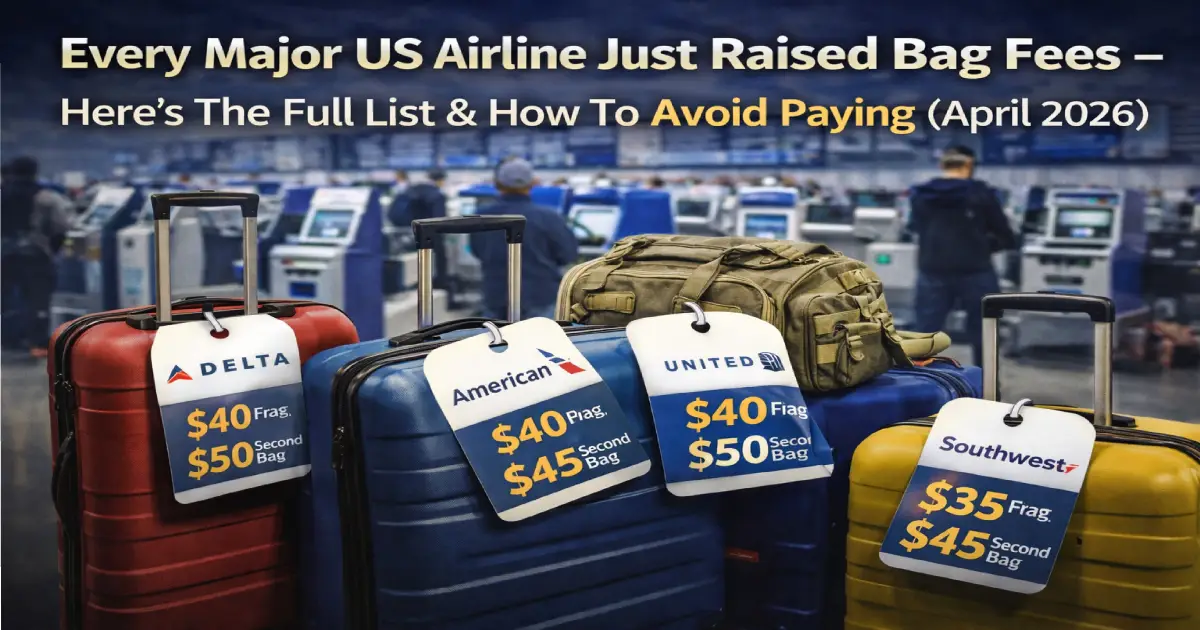
Breaking: Every major US airline has raised checked baggage fees in the same week — April 3–9, 2026. Delta, United, Southwest, American Airlines, and JetBlue have all increased what you pay to check a bag, some for the first time in two years. The trigger is a wartime fuel crisis: jet fuel prices have more than doubled since February 2026 following US and Israeli military strikes on Iran. The Strait of Hormuz — through which roughly 20% of the world’s oil passes — is under threat, and the cost is now landing squarely on your luggage tag. If you have a flight booked in the next 90 days and you planned to check a bag, you are paying more than you expected. This is every airline, every new fee, and — critically — every legal method to avoid paying a single dollar of it.
Published: April 11, 2026 Airlines Affected: American Airlines, Delta Air Lines, United Airlines, Southwest Airlines, JetBlue Airways, Alaska Airlines Fee Increase Amount: $10 per bag on first and second checked bags across most carriers Effective Dates: April 3 (United) · April 8 (Delta, Southwest) · April 9 (American) · Late March (JetBlue) Root Cause: Jet fuel price spike from $2.50/gallon to $4.88/gallon driven by Iran war disruption to the Strait of Hormuz Who Is Exempt: Elite loyalty members, co-branded credit card holders, premium cabin passengers, active-duty military Estimated Industry Revenue Impact: US airlines collected ~$5.5 billion in baggage fees in 2025 — 2026 figure will be significantly higher DOT Disclosure Rule: All new fees must appear at point of booking — airlines cannot hide them in fine print
Five of the six largest US airlines have raised their checked baggage fees within a seven-day window. This is not a coincidence and it is not a single airline’s decision. It is a coordinated industry response to the most severe aviation fuel cost shock since the 2008 oil crisis — compounded this time by active conflict in the Middle East that has disrupted global oil supply routes.
Jet fuel prices in major US markets hit approximately $4.88 per gallon in early April 2026, more than doubling from the $2.50 per gallon baseline that existed before the US and Israeli military strikes on Iran began in late February 2026. Fighting near the Strait of Hormuz — through which approximately one-fifth of the world’s daily oil supply moves — has created persistent uncertainty in crude oil markets, and that uncertainty is now priced directly into your airline ticket, your checked bag fee, and your fuel surcharges on international routes.
Airlines prefer raising baggage fees over raising base ticket prices for one specific financial reason: baggage fees are not subject to the 7.5% federal excise tax applied to domestic ticket prices. Raising a bag fee by $10 puts more money in an airline’s pocket per passenger than raising the base fare by the same amount. It is not an accident that the industry moved to ancillary fees first.
The result for travelers is stark. A family of four checking two bags each on a round-trip domestic flight now pays $320–$480 more in baggage fees than they would have in February 2026, on top of airfares that are also rising. This is the most significant single-week increase in US airline ancillary fees since 2018.
Every major US carrier’s current checked baggage fees, post-increase, for standard economy passengers without elite status or qualifying credit cards:
| Airline | 1st Bag (Online) | 1st Bag (Airport) | 2nd Bag | 3rd Bag | Effective Date |
|---|---|---|---|---|---|
| American Airlines | $45 | $50 | $60 | $200 | April 9, 2026 |
| Delta Air Lines | $45 | $45 | $55 | $200 | April 8, 2026 |
| United Airlines | $45 | $45 | $55 | $200 | April 3, 2026 |
| Southwest Airlines | $45 | $45 | $55 | N/A | April 9, 2026 |
| JetBlue Airways | $45+ (variable) | $55+ (variable) | $65+ (variable) | $200 | Late March 2026 |
| Alaska Airlines | $35 | $40 | $45 | $150 | No change yet |
| Frontier Airlines | $39–$59 | $49–$69 | $49–$69 | $99 | Existing tiered model |
| Spirit Airlines | $39–$89 | $49–$99 | $49–$99 | $99 | Existing tiered model |
Note: JetBlue uses dynamic pricing — fees vary by route, travel date, and demand. Alaska has not yet announced an increase as of April 11, 2026. Frontier and Spirit use bundle-based pricing that changes by booking window.
American Airlines — the world’s largest airline by fleet size and the dominant carrier at Dallas Fort Worth, Miami, Charlotte, Philadelphia, and Chicago O’Hare — implemented its new baggage fee structure for all tickets purchased on or after April 9, 2026.
New fee structure for domestic and short-haul international routes (US, Canada, Mexico, Caribbean excluding Cuba and Haiti, Central America excluding Panama, Guyana):
Long-haul international baggage pricing remains unchanged. American confirmed that elite AAdvantage members (Platinum, Platinum Pro, Executive Platinum, ConciergeKey), eligible co-branded Citi / Barclays AAdvantage cardholders, and first/business class passengers retain their existing free bag entitlements.
Who still gets free bags on American: ✅ AAdvantage Platinum and above — 1 free checked bag ✅ Citi / Barclays AAdvantage card holders — 1 free checked bag on AA-operated flights ✅ First and Business Class passengers — 2–3 free checked bags ✅ Active-duty US military with ID — 5 free checked bags ✅ OneWorld Sapphire and Emerald status members on AA-operated flights
Delta Air Lines — which had not raised its checked baggage fees in two years — moved on April 8, citing what the airline described as “evolving global conditions and industry dynamics.” Delta is the dominant carrier at Atlanta Hartsfield-Jackson, Detroit, Minneapolis, Salt Lake City, and Seattle.
New fee structure for domestic and short-haul international routes:
Delta’s Sky Miles Medallion members (Silver, Gold, Platinum, Diamond), eligible Delta co-branded American Express cardholders, and premium cabin passengers retain their existing free bag allowances.
Who still gets free bags on Delta: ✅ SkyMiles Medallion Silver and above — 1–3 free checked bags depending on tier ✅ Delta co-branded Amex cardholders — 1 free checked bag on Delta flights ✅ First Class and Delta One passengers — 2 free checked bags ✅ Active-duty US military — free bag allowance maintained ✅ SkyTeam Elite Plus members on Delta-operated flights
United Airlines moved first among the major carriers, implementing its new fee structure on April 3 — the earliest effective date in this wave. United CEO Scott Kirby told investors that rising fuel costs had added approximately $400 million to operating expenses. United operates primary hubs at Chicago O’Hare, Newark, Houston, Denver, San Francisco, Los Angeles, and Washington Dulles.
New fee structure for domestic, Mexico, Canada, and Latin America routes:
United MileagePlus Premier members (Silver, Gold, Platinum, 1K), eligible Chase United co-branded cardholders, and premium cabin travelers retain existing free bag entitlements.
Who still gets free bags on United: ✅ MileagePlus Premier Silver and above — 1–3 free checked bags ✅ Chase United Explorer, Quest, or Club Infinite cardholders — 1 free checked bag ✅ Business and Polaris First passengers — 2 free checked bags ✅ Active-duty US military — free allowance maintained ✅ Star Alliance Gold members on United-operated flights
Southwest’s fee increase is the most historically significant of the five carriers. For 53 years, Southwest operated its “bags fly free” policy as its defining competitive differentiator. That policy ended in early 2026 when Southwest implemented its first-ever bag fees. Now, less than a year after that historic shift, Southwest has raised those fees again.
New fee structure:
Southwest confirmed that Rapid Rewards A-List Preferred members retain a free first checked bag. Eligible Southwest co-branded Chase cardholders retain their free first bag on Southwest-operated flights. Active-duty military retain free bag allowances.
Who still gets free bags on Southwest: ✅ Rapid Rewards A-List Preferred — 1 free checked bag ✅ Southwest Rapid Rewards Priority or Performance Business Mastercard — 1 free checked bag ✅ Wanna Get Away Plus, Anytime, and Business Select fares — check at booking for potential inclusion ✅ Active-duty US military
JetBlue moved before the other four carriers, introducing its higher fee structure in late March 2026. JetBlue uses dynamic pricing for baggage, meaning fees vary based on route, travel date, and time of booking. This makes JetBlue the most important carrier to check at the exact moment of booking — the fee shown at search can differ significantly from what you pay at the airport.
General post-increase fee ranges:
Who still gets free bags on JetBlue: ✅ TrueBlue Mosaic 1, 2, 3, and 4 status — 1–2 free checked bags ✅ JetBlue Plus or Business Mastercard — 1 free checked bag ✅ Mint Class passengers — 2 free checked bags ✅ Active-duty US military
The simultaneous nature of these increases is not coincidental. It reflects a specific set of converging pressures that hit the entire industry at the same time.
The Iran War fuel shock is the primary driver. The US and Israeli military strikes on Iran beginning in late February 2026 triggered a cascade of disruptions to global oil markets. The Strait of Hormuz — through which approximately one-fifth of the world’s daily crude oil supply moves — came under threat. Jet fuel prices in major US markets moved from approximately $2.50 per gallon before the conflict to approximately $4.88 per gallon by early April 2026. That is an increase of over 95% in approximately six weeks.
Fuel is typically the single largest operating expense for an airline, representing 20–30% of total costs in normal market conditions. When fuel nearly doubles in price, the financial impact is immediate and severe. United’s CEO quantified the impact for his airline alone at approximately $400 million in added costs. Industry analysts have suggested the total additional fuel cost burden across all US carriers could reach $24 billion or more if the conflict continues at current fuel price levels.
Airlines prefer bag fees over base fares for tax reasons. A $10 increase in a base fare generates approximately $8.25 in net revenue after the 7.5% federal excise tax on domestic ticket prices. A $10 increase in a baggage fee generates the full $10 — no tax. Airlines are financially incentivized to recover fuel costs through ancillary fees rather than through base fare increases. DOT consumer protection rules require full fee disclosure at booking, but they do not cap the fee level itself.
The competitive dynamic removes the last reason to wait. In a five-airline market where all carriers face the same fuel cost increase simultaneously, the first to raise fees risks losing cost-sensitive passengers to competitors who haven’t moved yet. By the time all five move in the same week, that risk is neutralized. Every carrier benefits from the increased revenue without competitive disadvantage. This pattern repeats in every major fuel shock in aviation history.
Scenario 1: Family of 4, domestic round trip, 1 bag each Previous: 4 × $35 × 2 ways = $280 → New: 4 × $45 × 2 ways = $360 → Extra cost: $80
Scenario 2: Couple, international round trip, 1 bag each Previous: 2 × $35 × 2 ways = $140 → New: 2 × $45 × 2 ways = $180 → Extra cost: $40
Scenario 3: Solo business traveler, 12 round trips per year, 1 bag Previous: 24 × $35 = $840/year → New: 24 × $45 = $1,080/year → Extra annual cost: $240
Scenario 4: Family of 4, domestic round trip, 2 bags each Previous: 8 × $35 × 2 ways = $560 → New: 8 × $45 × 2 ways = $720 → Extra cost: $160
These are conservative estimates using prepaid online rates. Airport counter rates and JetBlue’s peak-period dynamic pricing push costs higher.
Every major US airline offers a co-branded credit card that includes at least one free checked bag per person per flight. On a round-trip for two passengers, one free bag each saves $180–$200 per year — easily exceeding most cards’ annual fees on bag savings alone.
Best cards by airline:
The math: Fly 4 round trips per year and check one bag = $360 in bag savings at $45 per bag. Against a $95–$150 annual fee, you are ahead $210–$265 per year on bag savings alone — before the signup bonus or miles earned.
All major US airlines provide free checked bags at their lowest elite tier. Fly 18–30 one-way segments per year on a single carrier and you will typically qualify:
| Airline | Lowest Elite Tier | Segments Required | Bags Included |
|---|---|---|---|
| American | AAdvantage Gold | 30 segments + 25k EQMs | 1 free bag |
| Delta | SkyMiles Silver | 25 segments | 1 free bag |
| United | MileagePlus Silver | 18 segments | 1 free bag |
| Southwest | A-List | 20 one-way flights | 1 free bag |
| JetBlue | Mosaic 1 | 30 segments | 1 free bag |
| Alaska | MVP | 20 segments | 1 free bag |
First Class, Business Class, and some Premium Economy products on US carriers include 2–3 free checked bags. If the price difference between economy and premium is less than your total bag fees, the upgrade may be cost-neutral or even cheaper.
Example: United Economy + 2 bags round trip for 2 = $180 in bag fees. United Premium Plus upgrade = $160 incremental cost. Net saving: $20 — and a significantly better seat.
Every US airline allows one carry-on bag (typically 22″ × 14″ × 9″) and one personal item at no charge on all fare classes — with one exception: American and United Basic Economy passengers are limited to a personal item only and must pay for a full-size carry-on.
Tips to make carry-on work:
For families with significant luggage volume, shipping services often undercut the new 2026 airline bag fees.
When it makes sense: A family of 4 checking 2 bags each round trip now pays $720 in airline fees. Shipping 8 bags via Luggage Forward may cost $400–$550 — a potential saving of $170–$320.
JetBlue’s Even More Space, United’s bundled Economy Plus, and similar products on other carriers include checked bags in the bundled fare price. Always compare the bundled fare total against the bare economy fare plus bag fees before booking — bundled options frequently beat the cheapest base fare at 2026 bag fee levels.
Active-duty US military personnel with valid ID receive free checked bag allowances on all major US carriers — typically 2–5 bags depending on the carrier. Government employees on official orders also qualify for expanded allowances on some carriers.
The US Department of Transportation requires all US airlines to disclose checked baggage fees clearly at the beginning of the booking process — before you see the final fare. Airlines cannot bury fees in fine print, display them only after purchase, or change the fee between when you begin searching and when you complete payment.
What DOT rules require: ✅ Bag fees must appear on the first page of search results that includes fares ✅ The fee for the first checked bag must be disclosed before you select a flight ✅ Airlines must disclose fees for your specific routing — not just a generic fee schedule ✅ Fees cannot change between the search and checkout stages of a single booking session
If an airline charges you more than disclosed: File a complaint at airconsumer.dot.gov within 60 days of travel.
What DOT does NOT protect you from: ❌ The level of the fee itself — airlines may charge any amount ❌ Fee increases that took effect before your booking date ❌ The removal of previously included services from lower fare classes
The short answer: historically, they do not — and the current environment makes a rollback unlikely in the near term.
US airlines introduced the first checked bag fees in 2008 during the previous oil price spike, explicitly calling them temporary fuel cost measures. That was 18 years ago. The fees have never been permanently removed at a major carrier. Southwest — the last major holdout — finally ended free bags in early 2026 and has already raised its new fees once.
The Iran conflict’s impact on fuel prices is the critical variable. A durable ceasefire and reopening of Strait of Hormuz shipping lanes would reduce jet fuel prices relatively quickly — potentially within 4–6 weeks of a confirmed and stable agreement. A limited ceasefire was reported in the week of April 7–11, 2026, but aviation fuel markets remain elevated as airlines and fuel traders wait to see whether it holds.
For travelers planning summer 2026: The fees you see today are more likely to be a floor than a ceiling if the conflict continues. Book with a co-branded credit card, pack carry-on where possible, and treat the current fee structure as your planning baseline for at least the next 60–90 days.
| Carrier | Bag Fee Page | Credit Card | Elite Status |
|---|---|---|---|
| American Airlines | aa.com/baggageallowance | Citi AAdvantage | AAdvantage |
| Delta Air Lines | delta.com/baggage | Delta Amex | SkyMiles Medallion |
| United Airlines | united.com/baggage | Chase United | MileagePlus |
| Southwest Airlines | southwest.com/baggage | SW Rapid Rewards Card | Rapid Rewards A-List |
| JetBlue Airways | jetblue.com/baggage | JetBlue Barclays | TrueBlue Mosaic |
| Alaska Airlines | alaskaair.com/luggage | Alaska Airlines Visa | MVP |
| DOT Complaints | airconsumer.dot.gov | — | — |
| DOT Bag Fee Rules | transportation.gov/airconsumer | — | — |
Every major US airline raised its checked baggage fees in a seven-day window in April 2026. The cause is a wartime jet fuel cost shock that has pushed fuel prices from $2.50 to $4.88 per gallon since February. Delta and Southwest now charge $45 for a first bag and $55 for a second. American charges $45 online and $50 at the airport. United charges $45. JetBlue uses dynamic pricing starting at $45. A family of four on a domestic round trip checking two bags each now pays $720 in bag fees — $160 more than two months ago.
If you are flying in the next 90 days:
The fees are not coming down quickly. Pack smart, carry the right card, and budget the new rates into every trip you book this summer.
Related Articles:
Sources: WFAA / Associated Press (industry-wide fee roundup, April 10, 2026), US Department of Transportation consumer guidelines, Bureau of Transportation Statistics
Posted By : Vinay
This article is provided for general informational purposes only and is based on information available at the time of publication. Travel advisories, airline schedules, airport operations, visa requirements, government regulations, and other travel-related information are subject to change without prior notice. While Travel Tourister makes reasonable efforts to verify information using official announcements, government publications, airline and airport communications, and other reliable sources, we cannot guarantee that all information remains complete, accurate, or up to date at all times. Readers should independently verify any information that may affect their travel plans with the relevant airline, airport authority, government agency, embassy, or other official source before making travel, financial, or other decisions. Travel Tourister shall not be liable for any direct or indirect loss, inconvenience, or damages arising from the use of or reliance on the information contained in this article. Nothing in this publication constitutes legal, immigration, financial, or professional travel advice. If you believe any information in this article is inaccurate or outdated, please contact our editorial team. We review all credible correction requests promptly and update our content whenever appropriate.
Lastest News
2nd Floor, 39, Above Kirti Club, DLF Industrial Area, Kirti Nagar, New Delhi, Delhi 110015



Travel Tourister is a leading Travel portal where we introduce travellers to trusted travel agents to make their journey hasselfree, memorable And happy. Travel Tourister is a platform where travellers get Tour packages ,Hotel packages deals through trusted travel companies And hoteliers who are working with us across the world. We always try to find new and more travel agents and hoteliers from every nook and corners across the world so that you could compare the deals with different travel agents and hoteliers and book your tour or hotel with the one you have chosen according to your taste and budget.
Copyright © Travel Tourister, India. All Rights Reserved

 Call
Call Enquiry