Published on : 20 Apr 2026
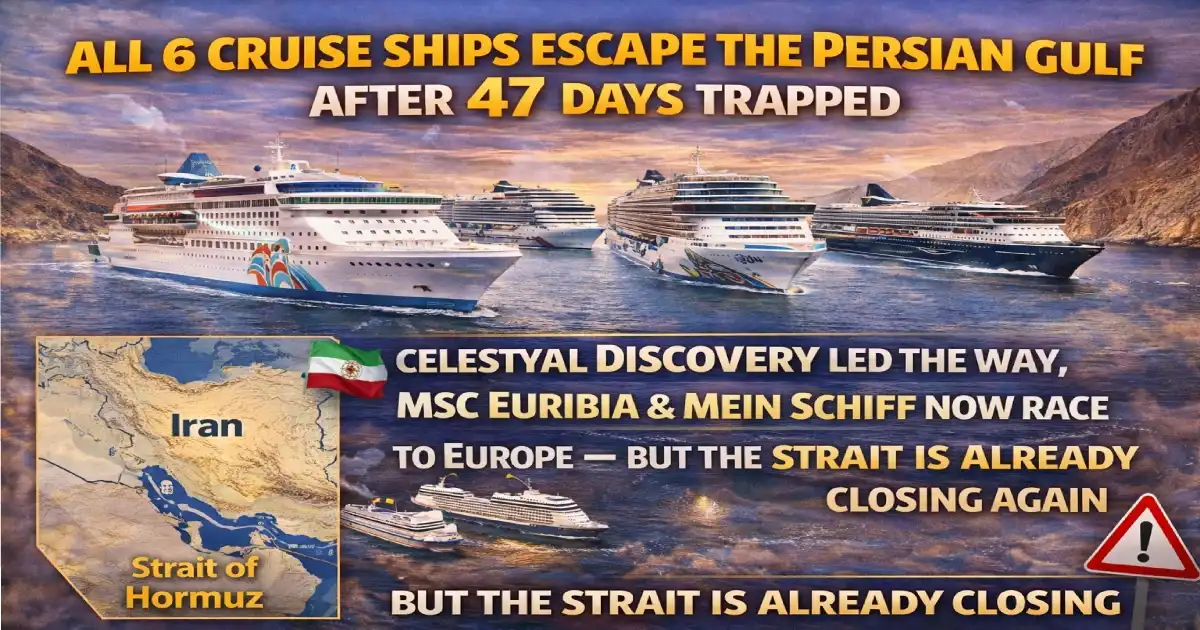
Breaking — April 19/20, 2026: They made it. All six cruise ships that have been stranded inside the Persian Gulf since late February 2026 have now cleared the Strait of Hormuz — racing through a narrow window of opportunity created by a temporary ceasefire and Iran’s brief reopening of the world’s most critical shipping lane. The last to transit, Saudi-operated Aroya Manara, pulled out of Dammam, Saudi Arabia and made its run through the Strait overnight, clearing the passage late on Sunday night April 20. For the first time in 47 days, the entire stranded fleet — six ships, thousands of cancelled passenger bookings, and crews who lived through one of the most extraordinary maritime emergencies in modern cruise history — is finally free.
But this story is not over. The Strait closed again within hours of the ships’ transit. Shots were fired at other commercial vessels in the waterway. And every ship is now sailing with skeleton crews, no passengers on board, racing across thousands of nautical miles to reach European ports in time for their summer seasons. Here is the complete ship-by-ship story of the great escape.
Published: April 20, 2026 Six Ships Stranded Since: February 28, 2026 Days Trapped: 47 Last Ship Clear: Aroya Manara — Dammam → Strait of Hormuz transit completed overnight April 19/20 First Ship Clear: Celestyal Discovery — Dubai (Port Rashid) departure April 17, 11:36 AM local time Passengers Affected: ~15,000 bookings cancelled across all ships during the crisis Crews on Board During Transit: Skeleton/essential navigation crews only — all passengers had been evacuated All Ships Currently: Repositioning with no passengers — “ghost cruises” Route Debate: Suez Canal vs Cape of Good Hope — not all ships have confirmed routing Strait Status Now: Effectively closed again — commercial traffic halted following gunfire incidents and Iran reimposing restrictions on April 18 Ceasefire Expiry: Current Lebanon ceasefire tied to reopening — set to expire approximately April 22 MSC Euribia: Kiel May 16 confirmed — summer season back ON Celestyal Discovery: Greek Islands from Lavrion May 1 — back ON TUI Cruises: Focus on onward journey to Mediterranean — dates to be confirmed Aroya Manara: Jeddah inaugural season — May 14 start
To understand the magnitude of what happened this weekend, you need to understand what these ships endured since February 28, 2026.
When the United States and Israel launched strikes against Iran’s military infrastructure on February 28, the Iranian response was immediate and decisive: Iran effectively closed the Strait of Hormuz. The narrow 21-mile-wide waterway — through which approximately 20% of the world’s oil and liquefied natural gas normally flows — went from a busy international shipping lane to a conflict zone almost overnight.
Six cruise ships were caught inside. They had been operating winter Gulf cruises — a season that had grown significantly in recent years as cruise lines expanded into the Middle East market. Within days, all six were stranded at ports across the UAE, Qatar, and Saudi Arabia:
The cruise lines moved quickly to evacuate passengers. MSC Cruises organised a series of charter repatriation flights for more than 1,500 guests who had been on board MSC Euribia alone. Aroya Cruises announced the early conclusion of its inaugural winter season. Celestyal cancelled sailings through the end of April — ultimately being forced to cancel its entire Eastern Mediterranean spring season. TUI adjusted schedules into May.
Around 15,000 passengers across all six ships had their trips cancelled. Crew members — those not essential for navigation — were also sent home, leaving behind skeleton crews to maintain the vessels. For weeks, six large cruise ships sat almost empty in Gulf ports, generating zero revenue, incurring daily docking fees, and waiting for a conflict with no apparent end date.
The financial toll was severe. Celestyal, a small two-ship operator, told UK regulators it was reviewing parts of its business and considering a possible downsizing due to the financial strain. MSC’s charter flight evacuation operation alone — seven or more flights to repatriate 1,500+ passengers at the line’s expense — represented tens of millions in unplanned costs. Carnival Corporation slashed its annual profit forecast, citing the Iran war’s impact on fuel costs, and analysts warned it faced the largest hit among major US cruise companies because it is the only one that does not hedge fuel.
Departed: Dubai (Port Rashid) — Friday April 17, 11:36 AM local time Captain: Nikolaos Vasileiou Gross Tonnage: 42,289 GT Heading: Muscat, Oman → Suez Canal (South Anchorage, estimated arrival April 24) → Eastern Mediterranean
Celestyal Discovery became the first cruise ship to transit the Strait of Hormuz since the crisis began on February 28 — a moment that cruise industry observers had been watching for 47 days. Under Captain Nikolaos Vasileiou, the ship departed Dubai on the afternoon of Friday April 17, executing what Celestyal described as “a carefully coordinated voyage plan developed in close collaboration with regional authorities and maritime security teams.”
The routing was deliberate: the southern side of the Strait, staying entirely in Omani territorial waters, as far as possible from Iranian coastline. The Celestyal Discovery is now confirmed to be heading for the Suez Canal, with an estimated arrival at Suez South Anchorage on April 24. From there, it will transit the canal and sail to the Eastern Mediterranean, where it is scheduled to resume its regular Greek Islands and Turkey sailing programme from Lavrion on May 1, 2026.
A Celestyal spokesperson said the Discovery’s transit “established a safe and proven route through the Strait, enabling other cruise operators to follow.” In effect, the small Cypriot-owned ship acted as the pathfinder for the five larger vessels that followed.
Departed: Doha, Qatar — Friday April 17, afternoon Gross Tonnage: 55,819 GT Heading: Khasab, Oman → Arabian Sea → Mediterranean Brief stop: Several nautical miles off Khor Fakkan before continuing
Celestyal Journey had been docked in Doha for what became a 49-day stay — longer than any other ship in the stranded fleet. The ship departed Doha on the afternoon of April 17, following a few hours after the Discovery, and transited the Strait via the same Omani coastal route. It made a brief stop off Khor Fakkan near the northern entrance of the Strait before continuing. Celestyal Journey is now confirmed outbound and heading toward the Mediterranean.
Departed: Dubai (Port Rashid) — Saturday April 18 (after refuelling stop) Gross Tonnage: 184,000 GT (one of the largest cruise ships in the world) Transit speed: 18.4 knots heading toward Muscat Route: Northern Europe — Kiel, Germany → Copenhagen, Denmark Summer season: NOW CONFIRMED: Kiel May 16, Copenhagen May 17 — as originally planned
MSC Euribia is the largest ship of the six by a considerable margin — at 184,000 gross tons, she carries up to 6,334 passengers at capacity and features 18 decks. She is also the most LNG-powered ship in her class, making her one of the most advanced vessels in the world. Getting her out of Dubai was operationally the most complex transit of the escape: the ship had to refuel before departure, and her sheer size meant careful coordination with maritime authorities.
MSC Cruises confirmed in an official statement: “MSC Euribia has departed Dubai, safely transited the Strait of Hormuz, and is now en route to Northern Europe. The passage was completed in close coordination with the relevant authorities.”
The most important news for the thousands of passengers who had already booked MSC Euribia’s 2026 Northern Europe season: MSC has confirmed that the May 16 departure from Kiel and May 17 departure from Copenhagen will operate as originally scheduled. Guests whose earlier sailings were cancelled — including the May 2 Kiel departure which was axed when the ship was still stranded — will be contacted directly from April 19 with options to transfer their booking to the May 16 sailing.
Departed: Abu Dhabi, UAE — Saturday April 18 Gross Tonnage: 99,000 GT Speed at last confirmed AIS report: 16.3 knots heading east Operated by: TUI Cruises (partnership between TUI Group and Royal Caribbean Group) Route: Mediterranean — dates to be confirmed
Mein Schiff 4 departed Abu Dhabi on Saturday and followed the Omani coastal route through the Strait. TUI Cruises CEO Wybcke Meier said: “The past weeks have presented all of us with extraordinary challenges.” TUI’s official statement confirmed both Mein Schiff ships had “successfully passed” the Strait by early afternoon Saturday, thanking “the captains and crews, as well as all those involved who supported and enabled the safe passage with great professionalism and prudence.”
⚠️ Note on AIS tracking: Mein Schiff 4’s AIS transponder has not been updated since Saturday — the last position showed it passing the Strait. This is consistent with reports that some ships deliberately turned off or reduced their AIS transponder signals during the transit to minimise their detectability in a conflict zone. The ship is confirmed through the Strait by TUI’s own official statement.
Departed: Doha, Qatar — Friday April 17, late night Gross Tonnage: 99,000 GT Transit speed: 17.9 knots heading toward Khasab Operated by: TUI Cruises Route: Mediterranean — dates to be confirmed
Mein Schiff 5 sailed from the Qatari port late on Friday night, following the Celestyal ships out. It transited the Strait on Saturday alongside its sister ship and MSC Euribia — the AIS tracking showed all three large ships sailing together along the southern, Omani side of the waterway. TUI has confirmed both Mein Schiff ships are now “in international waters heading toward the Mediterranean.”
Departed: Dammam, Saudi Arabia — early hours Saturday April 19 Cleared Strait: Late Sunday night April 19/20 Gross Tonnage: 150,695 GT Speed at last AIS report: 16.4 knots heading through Strait Operated by: Aroya Cruises (Saudi-backed, Cruise Saudi) Destination: Jeddah, Saudi Arabia — inaugural season starts May 14
Aroya Manara was the last holdout — and for good reason. As the Maritime Executive explained, the Saudi-owned ship was technically already in “home waters” while docked in Dammam. Unlike the European ships, which were desperate to reach their summer ports, Aroya had the relative luxury of waiting for the optimal security window. Its destination was not Europe but Jeddah on the western Saudi coast — a much shorter transit around the Arabian Peninsula through the Red Sea.
The Manara pulled out of Dammam in the early hours of Saturday morning and cleared the Strait late on Sunday night, confirmed at a cruising speed of 16.4 knots. It is expected to arrive in Fujairah, UAE, before continuing to Jeddah for its inaugural Saudi Arabian domestic season, which is scheduled to begin on May 14.
Cruise Fever confirmed: “Aroya Manara, the last of the six ships, has pulled out of Dammam and is currently making its run through the Strait of Hormuz. For the first time in nearly two months, the ‘stranded fleet’ can carry on cruising again.”
This escape story has a dramatic second act — and it is one that every passenger with a future Gulf cruise booking needs to understand.
The five European ships made their transits on Friday April 17 and Saturday April 18 — a window that lasted less than 24 hours after Iran’s Foreign Minister Abbas Araghchi announced the Strait was open for commercial traffic during the Lebanon ceasefire. By Saturday evening, Iran had effectively reversed course. The US refused to lift its naval blockade of Iranian ports, and as gCaptain reported, “observed transits of commercial ships through the strait have ground to a halt again, following a brief surge on Saturday, as tensions heightened and vessels came under gunfire in the waterway.”
The UKMTO (United Kingdom Maritime Trade Operations) issued Warning 039-26 as ships were fired on near the northern Strait, closer to Iranian waters. The Redstate report, citing OSINT technical monitoring, noted that some ships had turned off their AIS transponders during transit — a common practice to reduce targeting risk. It also reported that one vessel “may have been fired upon” in the chaos, though this was not confirmed.
The current Lebanon ceasefire — the diplomatic framework that enabled the brief Hormuz opening — is set to expire approximately April 22. US and Iranian negotiators were expected to meet in Pakistan this weekend to discuss a longer-term agreement. If talks progress, the Strait may remain accessible. If they collapse, it closes again.
The bottom line for cruise passengers: The six stranded ships escaped through a window that is now potentially shut. Any new ships or repositioning movements that did not complete the transit will face the same constraints the fleet lived with for 47 days. The window existed because of the ceasefire — and that ceasefire has a four-day clock ticking.
Every ship is now sailing as a “ghost cruise” — skeleton crew, no passengers, racing across thousands of nautical miles.
The five ships heading for Europe face a fundamental navigation decision with major time implications:
Option A — Suez Canal Route: Red Sea → Bab el-Mandeb Strait → Suez Canal → Mediterranean. This is the fastest route — approximately 7,000 nautical miles from the Strait of Hormuz to Kiel. But the Red Sea has its own security concerns: the Houthis in Yemen have been targeting commercial shipping in these waters throughout 2025–2026.
Option B — Cape of Good Hope: South around Africa, around the Cape, north up the Atlantic, into the Mediterranean. This route adds approximately 3–4 weeks to any repositioning voyage.
As of current reporting:
| Ship | Line | Next Scheduled Sailing | Status |
|---|---|---|---|
| Celestyal Discovery | Celestyal Cruises | May 1, 2026 — Greek Islands & Turkey from Lavrion | ✅ CONFIRMED ON |
| Celestyal Journey | Celestyal Cruises | Early May 2026 — Eastern Mediterranean | ✅ Targeting |
| MSC Euribia | MSC Cruises | May 16, 2026 — Kiel, Germany | ✅ CONFIRMED ON |
| MSC Euribia | MSC Cruises | May 17, 2026 — Copenhagen, Denmark | ✅ CONFIRMED ON |
| Mein Schiff 4 | TUI Cruises | Mediterranean season — May 2026 | ⚠️ Dates to confirm |
| Mein Schiff 5 | TUI Cruises | Mediterranean season — May 2026 | ⚠️ Dates to confirm |
| Aroya Manara | Aroya Cruises | May 14, 2026 — Jeddah inaugural season | ✅ On track |
If your cruise was cancelled during the Gulf crisis (March–April 2026):
MSC Cruises has confirmed that guests whose earlier sailings were cancelled will be contacted directly from April 19 with options to: ✅ Transfer their booking to the confirmed May 16 Kiel or May 17 Copenhagen sailing at no charge ✅ Request a full cash refund of any paid portion of the cruise fare without penalty
Contact MSC UK: msccruises.co.uk | 0344 561 5151
Important: If you were offered a voucher during the crisis and you would prefer cash, you are entitled to request a full cash refund. Do not accept a voucher if you prefer the refund — contact MSC’s Reservations Office directly and request a cash refund in writing.
Celestyal has confirmed the Discovery is returning to service May 1 from Lavrion, Greece (Greek Islands and Turkey). Guests with cancelled sailings through April should have already been contacted with rebooking options.
If you have not been contacted: call your travel agent or contact Celestyal directly. If your cancelled sailing was part of a package holiday booked in the UK, the Package Travel Regulations 2018 give you additional protections beyond the standard refund — your tour operator must provide a full package refund or an equivalent alternative.
TUI Cruises’ extended cancellations ran through April/May. With both ships now confirmed through the Strait, TUI is working on finalising its onward summer schedule. Monitor tui.co.uk or tui-cruises.com for updates.
MSC pulls out of Gulf cruising for 2027: MSC Cruises has already announced it will not return to the Persian Gulf for next winter. The MSC World Europa — which was scheduled to sail between November 2026 and April 2027 in the Persian Gulf — will make her first appearance in the Caribbean instead, sailing from Martinique and Guadeloupe. This is a permanent redeployment, not a temporary adjustment. The Gulf cruise market, which had been growing rapidly, faces a structural reset.
Celestyal’s financial review: The small two-ship operator told UK regulators it was reviewing parts of its business and considering possible downsizing following the financial strain of 47 days of zero revenue on both its ships. Getting the Discovery and Journey back to service by May 1 is critical to Celestyal’s 2026 financial survival.
Carnival’s profit cut: Carnival Corporation — the world’s largest cruise company — slashed its annual profit forecast, citing higher fuel costs driven by the Iran war. Analysts warned Carnival faces the largest hit among major US cruise companies because it is the only one that does not hedge fuel. The Hormuz reopening brought a 13% oil price drop, which helps — but the supply chain normalisation takes 2–3 weeks, and the strait’s current instability means that relief could be short-lived.
The new routing normal: Before the crisis, the standard Gulf-to-Europe repositioning route was Persian Gulf → Strait of Hormuz → Gulf of Oman → Red Sea → Bab el-Mandeb → Suez Canal → Mediterranean. The Houthi threat in the Red Sea had already made this route riskier in 2025. The Hormuz closure added another chokepoint. The cruise industry is now actively evaluating whether the entire Middle East circuit is viable for regular operations — or whether the risk profile has permanently changed.
While passengers were evacuated by charter flights in the first days of the crisis, the essential navigation and engineering crews remained on board for all 47 days. They kept the ships’ systems running, managed the vessels at anchor and at dock, and waited — sometimes in ports that had little recreational infrastructure for off-duty crew — for a window to escape.
TUI CEO Wybcke Meier acknowledged it directly: “The past weeks have presented all of us with extraordinary challenges.” The company’s statement thanked “the captains and crews” specifically for their “great professionalism and prudence” during the transit.
MSC’s statement described the Euribia passage as conducted “in close coordination with the relevant authorities” — a phrase that encompasses months of diplomatic and maritime security work to plan a safe transit through an active conflict zone.
Celestyal named its captain publicly — Captain Nikolaos Vasileiou of the Discovery — the first cruise ship to attempt the passage. On a ship carrying no passengers, with an armed waterway ahead, and 47 days of waiting behind him, he executed the transit that proved the route was passable and opened the door for five more ships to follow.
Forty-seven days. Six ships. Fifteen thousand cancelled passenger bookings. Skeleton crews living on near-empty vessels in Gulf ports. And then, in a 36-hour window between Friday afternoon and Sunday night, the entire stranded fleet made its run — all six ships now free, racing toward summer seasons that millions of European cruise passengers had been waiting months to board.
The Celestyal Discovery went first, alone, through a waterway that had been closed for 47 days, establishing the route that made everything else possible. MSC Euribia followed with its 184,000 tonnes. The Mein Schiff sisters slipped out of Doha and Abu Dhabi. Aroya Manara waited for the perfect moment and made its own run last. All six cleared the Strait of Hormuz.
The window has now closed again. Shots have been fired. The ceasefire expires April 22. Whether the ships will have passengers to greet them in Kiel, Copenhagen, Lavrion, and the Greek Islands in May depends not just on naval miles but on diplomats, negotiators, and a peace deal that nobody can guarantee — but that everyone is desperately working toward.
For now: the crews are safe, the ships are moving, and for the first time since February 28, the answer to the question that 15,000 cancelled passengers have been asking is yes — your cruise might actually happen.
For More Resources:
Related Articles:
Posted By : Vinay
This article is provided for general informational purposes only and is based on information available at the time of publication. Travel advisories, airline schedules, airport operations, visa requirements, government regulations, and other travel-related information are subject to change without prior notice. While Travel Tourister makes reasonable efforts to verify information using official announcements, government publications, airline and airport communications, and other reliable sources, we cannot guarantee that all information remains complete, accurate, or up to date at all times. Readers should independently verify any information that may affect their travel plans with the relevant airline, airport authority, government agency, embassy, or other official source before making travel, financial, or other decisions. Travel Tourister shall not be liable for any direct or indirect loss, inconvenience, or damages arising from the use of or reliance on the information contained in this article. Nothing in this publication constitutes legal, immigration, financial, or professional travel advice. If you believe any information in this article is inaccurate or outdated, please contact our editorial team. We review all credible correction requests promptly and update our content whenever appropriate.
Lastest News
2nd Floor, 39, Above Kirti Club, DLF Industrial Area, Kirti Nagar, New Delhi, Delhi 110015



Travel Tourister is a leading Travel portal where we introduce travellers to trusted travel agents to make their journey hasselfree, memorable And happy. Travel Tourister is a platform where travellers get Tour packages ,Hotel packages deals through trusted travel companies And hoteliers who are working with us across the world. We always try to find new and more travel agents and hoteliers from every nook and corners across the world so that you could compare the deals with different travel agents and hoteliers and book your tour or hotel with the one you have chosen according to your taste and budget.
Copyright © Travel Tourister, India. All Rights Reserved

 Call
Call Enquiry