Published on : 18 Apr 2026
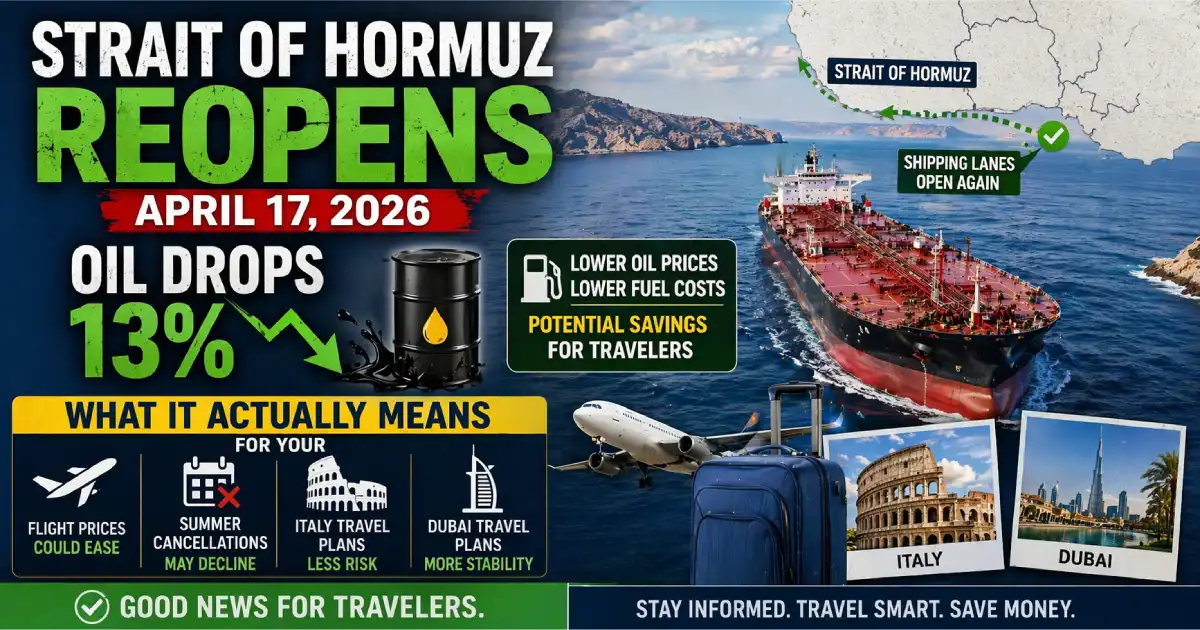
The seven-week energy crisis that has disrupted more flights, cancelled more routes, and driven up more airfares than any event since COVID-19 has a resolution — at least for now. On Friday, April 17, 2026, Iranian Foreign Minister Abbas Araghchi declared the Strait of Hormuz open to all commercial vessels. Oil prices dropped more than 10% and US stocks soared after Iran said the Strait of Hormuz is open again for commercial tankers carrying oil from the Persian Gulf to customers worldwide. Iran said the strait would remain open for the duration of the ceasefire in Lebanon. Following the announcement, oil prices dropped sharply, losing 11% in the immediate aftermath.
This is the resolution story of the spring. Your site has covered every disruption the Hormuz closure created — the Italy airport fuel rationing, the Dubai one-flight-per-day cap, the global jet fuel crisis, the KLM cancellations, the Ryanair warnings. This is what happens next. And the most important thing every traveller needs to understand is this: oil fell on Friday. Jet fuel will not. Not yet. Not for weeks. Here is the complete, honest, airline-by-airline, country-by-country guide to what the Hormuz reopening actually means for your summer.
Published: April 18, 2026 Event: Strait of Hormuz declared open — Friday April 17, 2026 Announced by: Iranian Foreign Minister Abbas Araghchi (post on X, confirmed 12:57 PM UTC) US confirmation: President Trump posted “IRAN HAS JUST ANNOUNCED THAT THE STRAIT OF HORMUZ IS FULLY OPEN” Oil price reaction: US crude tumbled 10.8% to $81.38 per barrel. Brent crude dropped 10.5% to $88.96 per barrel Duration: Tied to a 10-day Lebanon ceasefire — runs through approximately April 22 US naval blockade: Remains in full force on Iranian ports (CENTCOM confirmed — does NOT affect general shipping) Next US–Iran talks: Islamabad, this weekend Tanker backlog: 800+ tankers waiting inside the Gulf — 2–3 weeks minimum to clear Jet fuel price relief for airports: 3–6 weeks minimum — not immediate KLM 160 May cancellations: Still active — airlines will reassess week by week Italy airport NOTAM fuel caps: Remain in force pending supply normalisation Dubai 1-flight/day cap: Runs to May 31 — no announced change yet Ceasefire fragility: Iran’s parliament speaker later stated that Iran would close the Strait again if the US does not lift its blockade
The morning of April 17, 2026 began as the worst single day for European aviation of the year — three independent strikes hitting simultaneously across Germany, Spain, and the UK. Then, at around 12:57 PM UTC, everything changed.
Iran announced the Strait of Hormuz is now “completely open” for commercial traffic — a major step toward ending a war with the US and Israel that had sent energy prices surging and hit the global economy. Oil prices plunged.
United Airlines surged 8.8%. Norwegian Cruise Line jumped 7.8%. Royal Caribbean Group gained 9.5%. The Dow Jones Industrial Average briefly climbed nearly 1,070 points.
Just the previous day, IEA Executive Director Fatih Birol had told the European Commission that Europe has “maybe six weeks” of remaining jet fuel supplies, calling it “the largest energy crisis we have ever faced.” The Hormuz announcement landed 18 hours later.
The reaction was immediate, global, and historic. But for the millions of travellers with summer flights booked — the story is not over. It has only moved to its next chapter.
To understand what the reopening means, you need to understand what the closure did. Shipping traffic through the Strait of Hormuz was largely blocked by Iran since February 28, 2026, when the United States and Israel launched an air war against Iran. In retaliation, Iran’s IRGC launched 21 confirmed attacks on merchant ships and reportedly laid sea mines in the strait. Until the blockade, about 25% of the world’s seaborne oil trade and 20% of the world’s liquefied natural gas passed through it.
The aviation impact was severe and compounding:
| Date | Aviation Impact |
|---|---|
| Late Feb–Mar | Oil surges 64% vs Feb 27; jet fuel doubles |
| March | Italy 7-airport fuel rationing NOTAMs issued |
| March | SAS cancels “at least 1,000 flights” in April |
| April 1 | Global jet fuel hits $197.83/barrel (IATA) |
| April 2 | TravelTourister first covers the crisis — $4.88/gallon / $205/barrel |
| April 6 | ACI Europe warns European Commission: shortages start May if Hormuz stays closed |
| April 9 | IEA releases emergency reserves — 400 million barrels globally |
| April 10 | Dubai foreign airline cap (1 flight/day) officially activates for April 20–May 31 |
| April 12 | Qatar Airways grounds all 8 A380s — 12,000+ flights cut, 64 destinations suspended |
| April 13 | KLM announces 160 May cancellations citing “rising kerosene costs” |
| April 16 | IEA Director: Europe has “maybe six weeks” of jet fuel left |
| April 17 | Strait of Hormuz declared open — oil falls 10–13% |
According to a report by Tourism Economics, crude oil prices surged by 64% following the closure, marking the most significant price disruption since 2022. “The impact on jet fuel costs has been more severe with the crack spread reaching a record $80 per barrel, doubling jet fuel prices in weeks due to tight supply of Gulf crude,” wrote lead economist Stephen Rooney. “Air fares are expected to rise 5% to 10%.”
Here is the single most important thing travellers need to understand — and the thing that airlines themselves are reluctant to say clearly: oil prices fell on Friday. Your ticket price and your flight’s cancellation risk will not fall on Friday. Or Saturday. Or next week.
The journey from an open Strait of Hormuz to cheaper flights has multiple steps — each of which takes time:
The strait is declared open. But 800+ tankers are waiting inside the Gulf after weeks of backlog. Although the strait has been declared open, commercial traffic is unlikely to return to pre-war levels immediately after the ceasefire. Tankers must first be cleared, routed, and dispatched. Some carry crude oil. Some carry refined products including jet fuel. They begin moving.
Laden tankers departing the Gulf on April 17 take 7–12 days to reach European refineries. Tankers heading to Asian refineries (supplying Singapore, Hong Kong, Bangkok hub airports) take 12–18 days.
Refineries need time to process incoming crude into refined products — jet fuel (kerosene), diesel, gasoline. “It could take until the end of the year to get all of those barrels onto the market,” said Pavel Molchanov, senior investment strategist at Raymond James & Associates. “There are exactly the same refineries in exactly the same places in Asia and Europe, but if there is not enough oil for those refineries to operate, it’s going to lead to physical supply disruption.”
Refined jet fuel must be transported from refineries to airports — via pipeline (fastest), tanker truck, or rail. European airports like Heathrow, Frankfurt, and Amsterdam have extensive pipeline networks. Italy’s rationed airports are more exposed.
Airlines typically hedge fuel costs 6–18 months in advance. Their existing fuel hedge positions were taken out when jet fuel was at $197/barrel. Those contracts don’t disappear on April 17. Fuel surcharges introduced during the crisis may also linger in the short term despite easing oil prices.
The bottom line timeline: Analysts estimate it could take at least two to three weeks to clear the tanker backlog that built up during the closure, with full supply chain normalization expected to take considerably longer.
Likely yes — at least some of them. KLM said it would cut 160 flights next month — about 1% of its total European routes. The airline cited “rising kerosene costs” and said a limited number of flights are “no longer financially viable to operate.”
KLM’s May schedule was built and locked weeks ago. Even with oil at $88/barrel today, the airline’s May fuel costs are largely determined by hedge contracts set when oil was above $100. The 160 cancellations are proceeding unless KLM issues a specific reversal announcement. As of this writing, no reversal has been announced.
What to do: If you are on a cancelled KLM May flight — you are entitled to a full cash refund or rebooking. Contact KLM at klm.com or 020 474 7747 (UK).
Too early to say — but risk is materially reduced. Ryanair has warned that up to 5–10 percent of its flights in May, June, and July could be cut if Europe’s fuel supply keeps tightening.
The Hormuz reopening fundamentally changes the supply trajectory. If tankers flow freely and Europe’s airport fuel storage begins replenishing by mid-May, Ryanair’s worst-case cancellation scenario becomes significantly less likely. However:
✅ The ceasefire is temporary — tied to a 10-day Lebanon ceasefire running through approximately April 22 ✅ If talks fail and the strait closes again, the 5–10% risk immediately re-activates ✅ May cancellations are largely already locked based on current fuel inventory — summer improvement is more likely in June and July
What to do: If you have a Ryanair flight in May — do not assume it is now safe. Monitor your booking. The April 22 ceasefire expiry is the next critical date.
The NOTAMs remain in force. Italy’s seven-airport fuel rationing — affecting Bologna, Milan Linate, Venice Marco Polo, Treviso, Brindisi, Pescara, and Reggio Calabria — was driven by physical jet fuel supply limitations on the ground. Last week, the Airports Council International Europe wrote to the European Commission, saying jet fuel shortages could begin at the start of May if tankers do not start passing through the Strait of Hormuz.
The Hormuz opening changes the future supply trajectory — but it does not instantly replenish Italian airport fuel storage. Until Air BP Italia and other fuel suppliers at the affected airports formally lift their NOTAMs, the rationing remains active. Pilots flying into Venice, Treviso, and Bologna should still plan to arrive with extra fuel tankered from departure airports.
Relief timeline for Italian airports: Mid-May at the earliest — contingent on ceasefire holding, tankers actually transiting, and refined product reaching Italian airport pipelines.
Not immediately confirmed — but watch this space. The Dubai foreign airline cap (1 flight per day for foreign carriers — April 20 to May 31, 2026) was driven by the Gulf airspace disruption and capacity management decisions by Dubai Civil Aviation Authority. The Hormuz reopening reduces the strategic rationale for the cap — but the UAE has not announced any early reversal.
Indian carriers (IndiGo, Air India) are the worst-hit by the Dubai cap — hundreds of round-trip flights were slashed for the April 20–May 31 period. A formal announcement of cap removal would trigger a rapid scramble to restore those flights, but the process would take days or weeks, not hours.
What to do: If you are flying on an Indian carrier through Dubai — monitor dcaa.ae (Dubai Civil Aviation Authority) and your airline app daily. Do not rebook speculatively on the assumption the cap will lift; wait for an official announcement.
Marginally — and slowly. Not dramatically. Lower fuel costs typically translate into improved margins and, eventually, more stable fares. However, the operational reality is more complex. Even with maritime traffic resuming through Hormuz, it will take time for tankers to reach refineries, for fuel to be processed, and for stocks to be replenished at major airport hubs.
The honest pricing outlook for travellers:
| Period | Likely Pricing Outcome |
|---|---|
| Now–April 30 | No change — surcharges remain, Hormuz opening too fresh |
| May 1–15 | Marginal easing possible — depends on ceasefire holding |
| Late May–June | Moderate improvement if Hormuz remains open and tankers normalise |
| July–August | Meaningful recovery possible — summer peak still drives demand premium |
| September onwards | Most likely window for genuine fare normalisation |
Waiting for fares to drop is not a winning strategy this summer. The general industry guidance, including from Ryanair, is to book now and lock in today’s fare.
The single biggest risk to everything in this article is the one no one can answer: will the ceasefire hold?
President Trump cheered the reopening but said the US naval blockade on Iranian ports would remain “in full force until such time as our transaction with Iran is 100% complete.” Later on Friday, Iran’s parliament speaker Mohammad Bagher Ghalibaf said that Iran would close the Strait of Hormuz if the US does not lift its blockade.
Not yet. The opening is tied to a 10-day ceasefire that runs through approximately April 22. New US–Iran talks are scheduled for this weekend in Islamabad. The outcomes of those talks will determine whether:
✅ The ceasefire extends — and Hormuz stays open — and the supply chain begins normalising ❌ Talks collapse — Hormuz closes again — and the July/August crisis risk immediately returns
The April 22 deadline is the most important date in global aviation for the remainder of the spring. Watch for announcements from the US State Department, CENTCOM, and Iranian Foreign Ministry on or before that date.
Lufthansa said it was immediately shutting down feeder airline CityLine, earlier than planned, and taking its 27 older, less fuel-efficient planes out of service — a decision accelerated by labor disputes and high fuel prices. The CityLine shutdown and older aircraft retirement will proceed regardless of the Hormuz reopening — those are structural decisions, not temporary ones.
Hormuz impact: Improved fuel margin outlook for long-haul summer routes. Frankfurt and Munich capacity recovery will depend on pilot strike resolution, not fuel alone.
KLM cited “rising kerosene costs” for its 160 May flight cancellations and said a limited number of flights are “no longer financially viable to operate.” As of Friday, no reversal announced.
easyJet said it expects to see a pretax loss of £540–560 million for the first half of the 2026 fiscal year. CEO Kenton Jarvis said demand remains strong overall — noting that Easter travel was easyJet’s busiest ever for that holiday period. The Hormuz reopening provides easyJet with a clearer summer runway than the first half suggested.
5–10% summer cancellation warning remains on the table pending supply chain normalisation. Ryanair has not issued a reversal. The general industry guidance, including from Ryanair, is to book now and lock in today’s fare.
United Airlines surged 8.8% on the stock market following the Hormuz reopening announcement. United had cut approximately 5% of planned routes for Q2–Q3. Watch for route restoration announcements in coming weeks if the ceasefire holds.
SAS said earlier this month it would cancel “at least a thousand” flights in April due to surging fuel prices. The SAS May and June schedule will be rebuilt based on whether physical fuel is available in Scandinavia — a region highly dependent on Gulf supply via the Strait.
Qatar grounded all 8 A380s through May, with a planned June 1 return on five routes (London, Bangkok, Singapore, Paris, Sydney). The Hormuz reopening does not immediately change the A380 restart timeline — that decision was structural and logistical, not purely fuel-driven.
Gulf carriers, headquartered at the Strait’s exit point, are the most directly and immediately relieved by the reopening. Both carriers operate from Dubai and Abu Dhabi — airports that receive the most direct jet fuel supply from Gulf refineries. Capacity restoration from Emirates and Etihad is likely to be faster than for European carriers.
The UK is Europe’s largest jet fuel consumer, with only four refineries left compared to 18 in the 1970s, making it extremely dependent on imports that flow through the Strait of Hormuz. The Hormuz opening is proportionally more significant for UK aviation than for any other European country. Gatwick, Heathrow, and Manchester will see supply improvements first — Stansted and regional airports slightly later.
Surcharges: British Airways, easyJet, and Wizz Air all implemented fuel surcharges during the crisis. These will not drop immediately but should begin reducing in late May if the ceasefire holds.
US travellers flying transatlantic are less directly affected by jet fuel supply — US domestic fuel supply is primarily sourced from domestic and Western Hemisphere production. The primary US impact is route availability (airlines like United and Delta had cut international route frequencies) and transatlantic fare premiums that built up during the crisis.
United Airlines surged 8.8% on the reopening news — the market is signalling that transatlantic capacity, which the airline had been cautiously reducing, can now be defended and potentially restored.
Canada’s exposure to Hormuz was primarily through transatlantic flying costs and through the global jet fuel crack spread (the premium refiners charge to produce jet fuel). Air Canada and WestJet implemented fuel surcharges that should ease in May–June if the ceasefire holds.
Australian travellers face the longest supply chain — Australia imports a significant portion of its jet fuel from Singapore and Gulf refineries. Around one fifth of Europe-Asia demand and 10% of North America-Asia demand travels via Middle East and is at risk. For Australians flying Qantas or Emirates through Dubai, the Hormuz reopening directly improves the reliability and cost of the route. Qantas’s ultra-long-haul London and Dallas services are primarily fuelled in Australia, reducing direct exposure.
The Strait of Hormuz reopened on April 17, 2026. Oil fell 13%. Airlines’ stocks soared. This is genuine, historic, relief — for now. But the journey from an open strait to cheaper flights is measured in weeks and months, not hours. The tanker backlog will take 2–3 weeks to clear. Refineries need time to process crude. Fuel surcharges are locked into contracts. KLM’s 160 May cancellations are still proceeding. Ryanair’s summer warning is still active. Italy’s airport fuel NOTAMs remain in force. Dubai’s one-flight cap runs to May 31.
The most critical date for everything that follows is April 22 — when the 10-day Lebanon ceasefire expires and the fate of US–Iran talks in Islamabad becomes clear. If the ceasefire extends and the strait stays open, the relief that markets priced in on Friday will begin flowing into your actual flight schedule by late May. If talks collapse and the strait closes again, we are back where we were on April 16 — and summer 2026 aviation faces its most severe capacity crisis since COVID.
The Hormuz reopening is the best travel news of 2026. It is not, yet, a reason to relax your contingency planning.
Posted By : Vinay
This article is provided for general informational purposes only and is based on information available at the time of publication. Travel advisories, airline schedules, airport operations, visa requirements, government regulations, and other travel-related information are subject to change without prior notice. While Travel Tourister makes reasonable efforts to verify information using official announcements, government publications, airline and airport communications, and other reliable sources, we cannot guarantee that all information remains complete, accurate, or up to date at all times. Readers should independently verify any information that may affect their travel plans with the relevant airline, airport authority, government agency, embassy, or other official source before making travel, financial, or other decisions. Travel Tourister shall not be liable for any direct or indirect loss, inconvenience, or damages arising from the use of or reliance on the information contained in this article. Nothing in this publication constitutes legal, immigration, financial, or professional travel advice. If you believe any information in this article is inaccurate or outdated, please contact our editorial team. We review all credible correction requests promptly and update our content whenever appropriate.
Lastest News
2nd Floor, 39, Above Kirti Club, DLF Industrial Area, Kirti Nagar, New Delhi, Delhi 110015



Travel Tourister is a leading Travel portal where we introduce travellers to trusted travel agents to make their journey hasselfree, memorable And happy. Travel Tourister is a platform where travellers get Tour packages ,Hotel packages deals through trusted travel companies And hoteliers who are working with us across the world. We always try to find new and more travel agents and hoteliers from every nook and corners across the world so that you could compare the deals with different travel agents and hoteliers and book your tour or hotel with the one you have chosen according to your taste and budget.
Copyright © Travel Tourister, India. All Rights Reserved

 Call
Call Enquiry