Published on : 25 Apr 2026
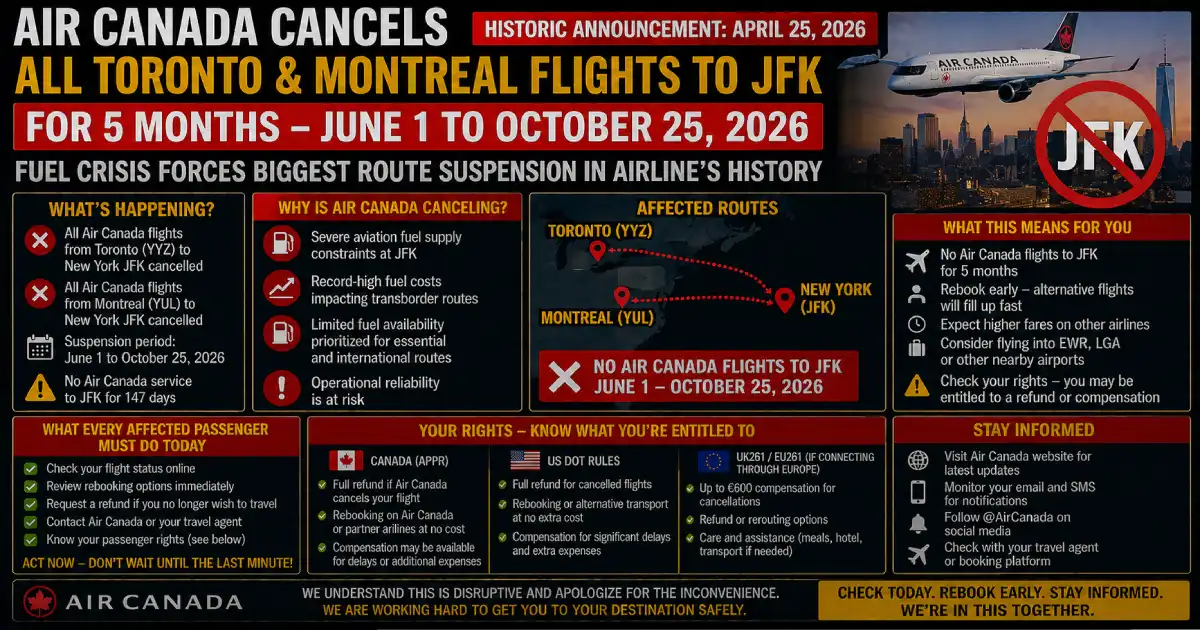
Breaking: Canada’s flag carrier will halt its twice-daily Toronto–JFK and daily Montreal–JFK rotations from June 1 until October 25, 2026, citing the extraordinary spike in global jet-fuel costs triggered by the conflict in Iran and the temporary closure of the Strait of Hormuz. This is not a minor scheduling adjustment. This is the complete withdrawal of Air Canada from one of North America’s most important business travel corridors — New York John F. Kennedy International Airport — for 147 consecutive days covering the entire peak summer travel season. Fuel now accounts for 36% of Air Canada’s operating expenses, up from 26% a year ago. Industry data from Argus Media shows the US average price of jet fuel jumping to roughly $4.32 a gallon, up from about $2.50 before hostilities in Iran began. Air Canada is not the only airline cutting routes — but it is the first major flag carrier to completely exit a Tier 1 airport for an entire summer season. If you have a Toronto–JFK or Montreal–JFK booking on Air Canada for any date between June 1 and October 25, 2026, your flight does not exist. Here is exactly what happened, what you are entitled to, and what to do right now.
Published: April 25, 2026 Announcement Date: April 17, 2026 (Bloomberg / Associated Press) Suspension Start: June 1, 2026 Suspension End: October 25, 2026 Duration: 147 days — 4 months 25 days — entire peak summer season Routes Suspended: Toronto Pearson (YYZ) → JFK · Montreal-Trudeau (YUL) → JFK (both directions) Flights Suspended: Twice-daily Toronto–JFK + daily Montreal–JFK = 3 daily rotations = approximately 420–480 seats per day Salt Lake City: Toronto–SLC also suspended June 30 — return date 2027 Fort McMurray–Vancouver: Suspended May 28 Yellowknife–Toronto: Suspended August 30 Montreal–Guadalajara: Planned new route officially cancelled Air Canada continues: 34 daily flights to LaGuardia (LGA) and Newark (EWR) — unaffected Primary cause: Jet fuel doubled from $2.50 to $4.32/gallon since Iran war started February 28 Air Canada statement: “Jet fuel prices have doubled since the start of the Iran conflict, affecting some lower profitability routes and flights which now are no longer economically feasible.” Passenger rights: Full refund OR rebooking to LGA/EWR — Air Canada must contact you proactively Revenue impact: Raymond James analysts estimate up to $18 million cut from Q3 revenue — neutral profit impact due to JFK slot costs
JFK is not just any New York airport for Air Canada passengers. It sits 14 miles from Midtown Manhattan — closer than Newark and better connected to Long Island, Brooklyn, Queens, and the JFK-served business districts. JFK is a key feeder for the East Coast, enabling onward connections via the Star Alliance to London, Frankfurt, or Asia, and also serving as another entry point for passengers travelling to Canadian cities via the USA.
The Toronto–JFK route is one of the busiest transborder corridors in North America. Toronto Pearson handles the largest volume of Canada–US business travel of any Canadian city pair, and JFK is the preferred entry for passengers connecting to London, Frankfurt, Singapore, Tokyo, and other Star Alliance global hubs that Air Canada operates through JFK via its United Airlines codeshare. Montreal-based travelers lose their only nonstop to JFK and may need to connect or switch to LaGuardia, adding complexity for time-sensitive pharmaceutical and aerospace shipments that rely on belly cargo.
These short 90-minute flights have at most eaten into the costs and razor-thin margins the airline was operating on, forcing Air Canada to make changes to protect its bottom line during these volatile times.The Toronto–JFK flight at 90 minutes of flying time burns approximately 2,500–3,000 gallons of jet fuel per round trip on a typical Airbus A220 or Boeing 737. At $4.32 per gallon, that is $10,800–$12,960 in fuel cost per rotation — before crew, airport fees, catering, or maintenance. At fares that were priced for $2.50/gallon fuel, the arithmetic simply does not work.
Air Canada has provided official confirmation on several domestic and international adjustments alongside the JFK suspension:
| Route | Suspension Date | Return Date | Impact |
|---|---|---|---|
| Toronto (YYZ) → JFK | June 1, 2026 | October 25, 2026 | Twice-daily service — full summer |
| Montreal (YUL) → JFK | June 1, 2026 | October 25, 2026 | Daily service — full summer |
| Toronto (YYZ) → Salt Lake City | June 30, 2026 | 2027 (TBC) | No summer service — full year gap |
| Fort McMurray → Vancouver | May 28, 2026 | TBC | FIFO/resource sector impact |
| Yellowknife → Toronto | August 30, 2026 | TBC | Northern Canada isolation risk |
| Montreal → Guadalajara | Cancelled | Indefinitely suspended | Planned new route killed |
Air Canada said the changes represent only a small portion of its global operations, affecting about 1% of its total annual flying capacity for 2026. But for the passengers on those specific routes — particularly the hundreds of thousands booked on YYZ–JFK and YUL–JFK through summer — 1% of total capacity means 100% of their travel plans.
This suspension does not exist in isolation. It is the direct consequence of the most severe aviation fuel cost shock since the 2008 oil price spike — and it is far from over.
The US average price of jet fuel jumped to roughly $4.32 a gallon, up from about $2.50 before hostilities in Iran. International Energy Agency chief Fatih Birol warned that Europe has “maybe six weeks or so” of jet fuel in reserve.
Fuel now accounts for 36% of Air Canada’s operating expenses, up from 26% a year ago. For context: a 10-percentage-point increase in fuel’s share of operating costs — while revenue per seat stays largely static due to forward-booked summer fares — is an existential margin crisis for short-haul routes with thin yields.
Air Canada is not alone. The same fuel economics are reshaping every airline’s network simultaneously:
United Airlines: Cutting 5% of flights. CEO Scott Kirby said jet fuel prices more than doubling would mean an extra $11 billion in annual fuel costs — more than double United’s best-ever annual profit.
Delta Air Lines: Expecting approximately $2 billion in additional fuel expense this quarter alone. Scaling back expansion plans for additional routes.
KLM: Cut 160 UK flights, citing “rising kerosene costs.”
Eurowings: Suspended Gulf routes through October 24 — the entire summer season.
Southwest Airlines: Trimmed routes and cut fuel-heavy itineraries.
It’s not just Air Canada — other major airlines like Delta, Lufthansa, and United Airlines are also rethinking their flight schedules and ticket prices to adjust for the higher costs. Expect to see more of these types of disruptions over the coming months as global fuel prices continue to cause turbulence.
If fuel prices remain above US$4 per gallon — double their pre-war level — Air Canada may re-evaluate additional US secondary hubs such as Boston and Washington Dulles. This is not idle speculation. It is a direct statement from corporate communications to travel management partners. Boston and Dulles are on Air Canada’s internal review list.
The critical point for passengers who need to reach New York from Toronto or Montreal: Air Canada is NOT leaving New York. Air Canada will continue to operate a total of 34 daily flights to LaGuardia and Newark, ensuring that travelers can still access these key airports. The suspension of JFK services is viewed as a temporary scheduling adjustment, not a permanent route closure.
| Airport | AC Status from June 1 | Daily Flights from Canada | Nearest to JFK |
|---|---|---|---|
| JFK | ❌ SUSPENDED June 1–Oct 25 | 0 | — |
| LaGuardia (LGA) | ✅ OPERATING | ~20 daily | 12 miles from Midtown |
| Newark (EWR) | ✅ OPERATING | ~14 daily | 16 miles from Midtown |
If Air Canada rebooks you to LaGuardia or Newark and you need JFK (for an onward connection, a Star Alliance partner flight, or a destination on Long Island or Queens):
LaGuardia → JFK: Approximately 12 miles. Under normal conditions, 25–35 minutes by taxi or rideshare ($35–$50). During peak hours, 45–75 minutes ($45–$65). No direct subway connection — taxi, Uber, or the new LaGuardia AirTrain (check opening status for 2026).
Newark → JFK: Approximately 30 miles via the Belt Parkway. 45–70 minutes by taxi or rideshare ($65–$95). The AirTrain to Penn Station + LIRR to Jamaica + JFK AirTrain is possible but takes 90+ minutes.
Important: If Air Canada rebooks you to LGA or EWR for a connecting Air Canada international flight, your onward booking is protected — Air Canada will accommodate the ground transfer time in the rebooking schedule. If you are using Air Canada as a feeder to a separately ticketed JFK international departure, you must contact that airline separately and explain the disruption.
Air Canada’s suspension of Toronto/Montreal–JFK routes from June 1 triggers clear obligations under Canada’s Air Passenger Protection Regulations (APPR), enforced by the Canadian Transportation Agency (CTA).
For passengers notified more than 14 days before departure: Air Canada is required to offer you a full refund OR rebooking at no additional charge on the next available Air Canada service to a comparable New York destination (LGA or EWR). You are not obligated to accept a travel voucher if you want cash.
For passengers notified less than 14 days before departure: The APPR provides stronger protections. If the change was within Air Canada’s control (it is — this is a commercial decision, not a weather event), passengers notified 0–14 days before are entitled to:
The exact words to say or write: “My Air Canada flight [flight number] from [YYZ/YUL] to JFK on [date] has been cancelled as part of the airline’s route suspension. Under Canada’s Air Passenger Protection Regulations, I am requesting [a full cash refund / free rebooking to LaGuardia or Newark at no additional charge]. Please confirm this in writing.”
For US-resident passengers who purchased tickets in the United States for Toronto/Montreal–JFK travel on Air Canada:
Under US DOT rules (enhanced April 2024), a cancelled flight entitles you to a full cash refund to your original payment method — automatically, within 7 business days for credit cards. This applies even when the cancellation is caused by the airline’s commercial decision rather than weather. Passengers holding Air Canada bookings on the Toronto-JFK and Montreal-JFK routes between June 1 and October 25 should expect direct communication from the airline regarding rebooking options. If you have not heard from Air Canada and your travel dates fall within the suspension window — contact them immediately.
Air Canada contact for rebooking/refund:
If you purchased travel insurance before April 17, 2026 (the announcement date), your policy’s “cancellation by carrier” clause may cover costs associated with the route suspension — including re-ticketing on alternative airlines, accommodation if you need to overnight in a different city, and ground transport differences between airports. Check your policy wording for “airline insolvency,” “carrier cancellation,” or “schedule change” clauses. Submit your claim as soon as Air Canada provides written confirmation of your flight’s cancellation.
If you purchased travel insurance after April 17, 2026, the suspension was already a known event — most policies will not cover known events. Check with your insurer directly.
For corporate travel managers, the implications are immediate. Toronto-area executives bound for Manhattan will likely shift to the high-frequency LaGuardia shuttle, but those with midtown or Long Island clients may face longer ground transfers. Montreal-based travelers lose their only nonstop to JFK.
Negotiating corporate discounts across multiple New York airports and purchasing refundable fares until schedules stabilise is advised.
The practical corporate travel realities from June 1:
Toronto–New York business travel: Air Canada continues 20+ daily LaGuardia flights. United Airlines, American Airlines, and Porter Airlines offer alternative YYZ–JFK and YYZ–EWR options. Delta operates YYZ–JFK via its own metal — check availability for your specific travel dates.
Montreal–New York business travel: Air Canada will still offer 34 daily flights between Canada and LaGuardia Airport in New York and Newark Liberty International Airport in New Jersey. Montreal passengers lose their only nonstop to JFK — alternative options include Air Canada via LGA, Porter Airlines to Newark, or a codeshare connection via United or another Star Alliance partner.
Star Alliance JFK connections: For passengers using Air Canada as a feeder to international Star Alliance connections through JFK — Lufthansa, Singapore Airlines, ANA, Turkish Airlines, THAI — the suspension forces a ground transfer from LGA or EWR to JFK that adds 45–90 minutes and $35–$100 to every journey. Plan accordingly. Consider booking your transatlantic or transpacific segment on a carrier that operates from LGA or EWR where possible.
Flights to Salt Lake City, typically served only from Toronto Pearson, will be suspended beginning June 30, with service expected to resume in 2027, creating a roughly six-month gap. Salt Lake City is the ski and outdoor recreation gateway for Utah — not a business hub but an increasingly important leisure market for Canadian travellers. With no return date until 2027, this suspension is structurally more concerning than the JFK pause, which has a firm October 25 resumption target.
If fuel prices remain above US$4 per gallon, Air Canada may re-evaluate additional US secondary hubs such as Boston and Washington Dulles.
The pattern emerging from Air Canada’s network review is clear: routes below a minimum yield threshold at current fuel costs are being suspended one by one, starting with the least profitable. The sequence — JFK (short-haul, high slot costs), Salt Lake City (leisure, thin margins), Fort McMurray (resource sector, limited yield), Yellowknife (Northern, subsidised demand) — tells a story of systematic network trimming that will continue for as long as jet fuel remains above $3.50/gallon.
Air Canada’s JFK suspension is a preview, not an exception. The same fuel economics that made YYZ–JFK unviable are working through every airline’s route assessment right now.
The routes most at risk across all carriers:
Short-haul transborder (US–Canada): These routes have the lowest absolute fuel costs but also the lowest fares and thinnest margins. Any route under 3 hours is under review at current fuel prices.
Medium-haul leisure (Europe–UK regional): Routes from UK regional airports (Manchester, Glasgow, Edinburgh) to secondary European destinations are under severe pressure. KLM has already cut 160 UK flights. Wizz Air is auditing its Eastern European network.
Gulf routes (any non-UAE carrier): Already suspended by EASA bulletin. These will be the last to return regardless of fuel price because safety regulation, not economics, is the primary constraint.
Long-haul low-yield (Pacific routes with indirect routing): Any route that was marginal before the crisis and now requires rerouting away from Middle East airspace — adding fuel burn and crew costs — is at risk.
| Action | Contact / Link |
|---|---|
| Air Canada rebooking / refund (Canada) | 1-888-247-2262 · aircanada.com → My Bookings |
| Air Canada rebooking / refund (US) | 1-888-247-2262 · aircanada.com |
| Air Canada app (flight management) | Download from App Store / Google Play |
| Canadian Transportation Agency (complaint) | otc-cta.gc.ca/eng/air-travel-complaints |
| US DOT (complaint if US-purchased ticket) | aviation.consumer.complaints@dot.gov |
| LaGuardia Airport live info | laguardiaairport.com |
| Newark Liberty Airport live info | newarkairport.com |
| New York City ground transport | nyc.gov/site/dot/index.page |
| LaGuardia → JFK taxi estimate | Google Maps · Uber estimate |
| Newark → JFK taxi estimate | Google Maps · Uber estimate |
| United Airlines YYZ–JFK alternatives | united.com |
| Delta Airlines YYZ–JFK alternatives | delta.com |
| Porter Airlines YTZ–EWR (Billy Bishop) | flyporter.com |
| Alternative New York arrivals checker | Google Flights |
Air Canada will halt its twice-daily Toronto–JFK and daily Montreal–JFK rotations from June 1 until October 25, 2026, citing the extraordinary spike in global jet-fuel costs triggered by the conflict in Iran. That is 147 days — the entire peak summer season — without direct Air Canada service into JFK. US average jet fuel has jumped to $4.32 a gallon, up from $2.50 before the Iran war, and IEA chief Fatih Birol has warned Europe has “maybe six weeks or so” of jet fuel reserves. Salt Lake City goes too from June 30, possibly until 2027. Fort McMurray and Yellowknife follow in August. Air Canada will continue operating 34 daily flights to LaGuardia and Newark — the JFK suspension is a temporary scheduling adjustment, not a permanent route cancellation.
Your five-point action plan if you have an Air Canada JFK booking:
Related Articles:
Sources: Bloomberg (original reporting — Air Canada JFK suspension announcement, April 17, 2026), Associated Press (Air Canada statement, fuel data from Argus Media — $4.32/gallon, April 17, 2026), CBC News (Air Canada suspension details — Toronto, Montreal, SLC, Fort McMurray,Canadian Transportation Agency (APPR passenger rights framework), US Department of Transportation (DOT automatic refund rule — April 2024)
Posted By : Vinay
This article is provided for general informational purposes only and is based on information available at the time of publication. Travel advisories, airline schedules, airport operations, visa requirements, government regulations, and other travel-related information are subject to change without prior notice. While Travel Tourister makes reasonable efforts to verify information using official announcements, government publications, airline and airport communications, and other reliable sources, we cannot guarantee that all information remains complete, accurate, or up to date at all times. Readers should independently verify any information that may affect their travel plans with the relevant airline, airport authority, government agency, embassy, or other official source before making travel, financial, or other decisions. Travel Tourister shall not be liable for any direct or indirect loss, inconvenience, or damages arising from the use of or reliance on the information contained in this article. Nothing in this publication constitutes legal, immigration, financial, or professional travel advice. If you believe any information in this article is inaccurate or outdated, please contact our editorial team. We review all credible correction requests promptly and update our content whenever appropriate.
Lastest News
2nd Floor, 39, Above Kirti Club, DLF Industrial Area, Kirti Nagar, New Delhi, Delhi 110015



Travel Tourister is a leading Travel portal where we introduce travellers to trusted travel agents to make their journey hasselfree, memorable And happy. Travel Tourister is a platform where travellers get Tour packages ,Hotel packages deals through trusted travel companies And hoteliers who are working with us across the world. We always try to find new and more travel agents and hoteliers from every nook and corners across the world so that you could compare the deals with different travel agents and hoteliers and book your tour or hotel with the one you have chosen according to your taste and budget.
Copyright © Travel Tourister, India. All Rights Reserved

 Call
Call Enquiry