Published on : 09 Apr 2026
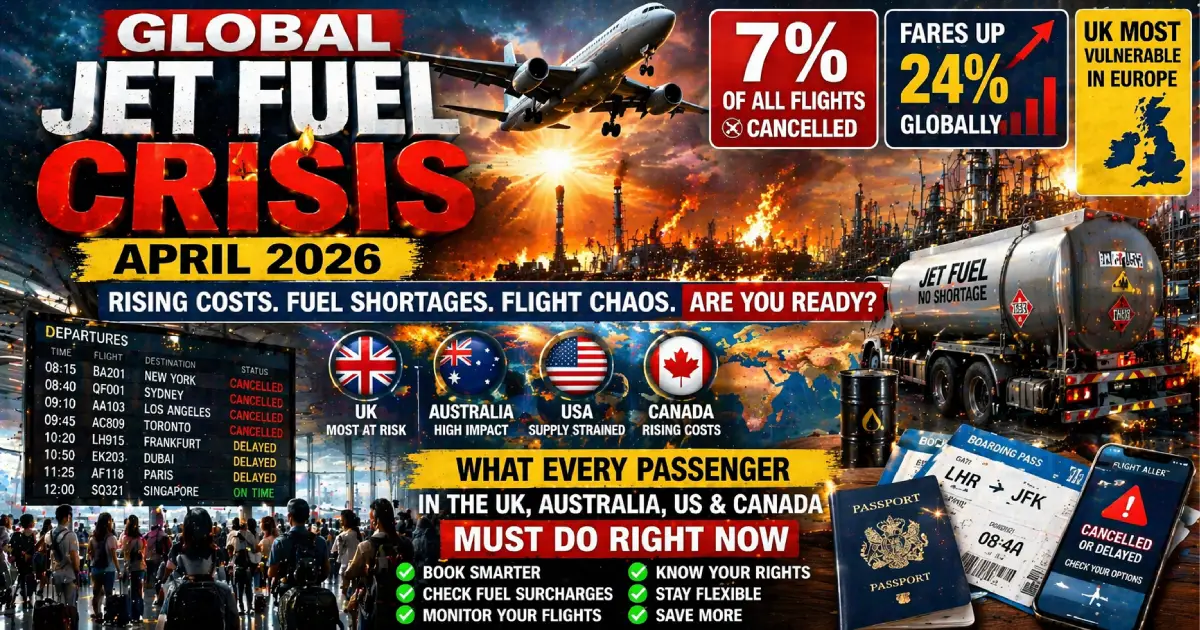
Breaking: The global aviation industry is facing its most severe fuel supply crisis since the COVID-19 pandemic — and it is getting worse. Iran’s effective closure of the Strait of Hormuz, through which around a fifth of the world’s oil supply normally flows, has triggered a global jet fuel shock that is cancelling thousands of flights, doubling fuel prices, and pushing airfares to their highest levels since at least 2019. On a single Monday in early April, nearly 7 percent of all global flights were cancelled. The UK has been identified as the most vulnerable country in Europe. Australia holds only 30 days of jet fuel in reserve. The United States is cutting 5 percent of routes. And industry leaders warn that if the Strait remains closed through summer, 5–10 percent of all scheduled flights in Europe could disappear. Here is everything every passenger in the UK, Australia, US, and Canada needs to know right now.
Published: April 9, 2026 Crisis Origin: Iran’s closure of the Strait of Hormuz — effective since US-Israel bombing campaign began February 28, 2026 Oil Lost: ~10 million barrels per day — approximately 20% of global seaborne oil supply Jet Fuel Price: Averaged $195/barrel last week (IATA) — more than double the 2025 average US Jet Fuel Cost: Up 95% since the war began (Argus U.S. data) Average Airfare: $465 — highest for this period since at least 2019 (OAG) Airfare Rise: +24% versus same week 2025 Single Day Peak: April 6 — 7,049 of 104,618 global flights cancelled (6.7%) North America: 14.6% of all scheduled departures cancelled on peak day (Cirium) Most Vulnerable Country (Europe): UK — confirmed by Ryanair CEO Michael O’Leary Italy: Fuel rationing active at 7 airports — Bologna, Venice, Milan Linate, Treviso, Brindisi, Pescara, Reggio Calabria Australia Jet Fuel Reserve: ~30 days (well below IEA 90-day recommended cover) Critical Supply Deadline: Final Hormuz-sourced jet fuel cargoes expected at European ports around April 10
Iran has closed the Strait of Hormuz to most traffic since the United States and Israel launched a widespread bombing campaign against it on February 28. Around a fifth of the world’s oil flows through the Strait of Hormuz, providing a strong bargaining chip for Iran’s government.
The Strait is the single most important maritime chokepoint for global energy. According to Bridget Payne, Head of Energy Forecasting at Oxford Economics, around 10 million barrels per day of oil supply has been removed from global markets, creating a shortfall that is increasingly difficult to offset.
Aviation is bearing the brunt. Jet fuel prices have increased by 95% since the United States and Israel launched military attacks against Iran on February 28. Higher fares, fuel surcharges, and reductions in capacity or limiting of unprofitable routes will be the new normal, energy analysts warn.
The financial scale is staggering. United Airlines CEO Scott Kirby stated directly that jet fuel prices have more than doubled in the last three weeks. If prices stayed at this level, it would mean an extra $11 billion in annual expense just for jet fuel — more than double the airline’s best-ever yearly profit.
And the worst may still be coming. The final jet fuel cargoes that passed through the Strait of Hormuz before its closure are projected to arrive at European ports around April 10, according to Argus Media. After that, unless the energy chokepoint reopens or adequate alternative routes are secured, incoming volumes may drop significantly. May could prove more challenging.
United Airlines became the first major U.S. carrier to formally reduce its schedule in response to the crisis. CEO Scott Kirby said the airline would begin “tactically pruning flying that’s temporarily unprofitable in the face of high oil prices,” cutting approximately 5 percent of planned routes during the second and third quarters of 2026. Three percentage points of cuts will target off-peak periods, including midweek and red-eye flights, while one percentage point will come from reduced service at Chicago O’Hare International Airport. The final one percentage point will come from canceled service to Israel and Dubai.
Air New Zealand axed 1,100 flights through early May, affecting 44,000 passengers, and raised fares 10 to 15 percent.
SAS plans to cancel around 1,000 flights in April due to the sharp increase in fuel costs.
Aurigny, which flies from Guernsey to Birmingham, Bristol, Dublin, Edinburgh, Exeter, Jersey, Leeds, London, Manchester, Paris and Southampton, said “difficult decisions have had to be made.” This includes cancelling certain flights between mid-April and June, combining services from nearby UK airports to reduce the number of empty seats, and the introduction of a temporary fuel surcharge of £2 on all bookings made from March 20.
Both Qantas and Virgin Australia have increased airfares due to higher fuel costs amid the Gulf crisis. Virgin Australia suspended Doha services until mid-June, scrapping wet-leased Qatar routes from eastern cities. Jetstar trimmed 12 percent of trans-Tasman flights for May, impacting Sydney–Auckland links.
Vietnam Airlines said it could cut between 10 and 20 percent of its flights if jet fuel prices reached $160–200 per barrel — a threshold already surpassed as of early April.
Air France-KLM, Cathay Pacific, Thai Airways, SAS and United Airlines have increased fares, added fuel surcharges or cut routes. Cathay Pacific raised fuel surcharges by 34 percent from April 1. Thai Airways flagged fare increases of 10 to 15 percent. AirAsia X raised fuel surcharges by about 20 percent.
Lufthansa CEO Carsten Spohr outlined two contingency scenarios to staff: a near-term reduction of 20 aircraft, cutting seat capacity by 2.5%, or a more severe grounding of 40 aircraft, representing a 5% capacity reduction.
Ryanair CEO Michael O’Leary singled out the UK as the most exposed country in Europe: “Of all the European countries at the moment, the one that is most vulnerable is the UK because of the market share that the Kuwaitis have here. There could be a surplus of jet A-1 fuel in the Middle East, but you have still got to ship it to Europe, and we don’t know when or how that happens.”
The Financial Times reported that the UK was facing an acute shortage, with no Britain-bound cargoes visible on the water as transit through the Strait of Hormuz remains blocked.
O’Leary told ITV News: “The Strait of Hormuz has been closed for 30 days. If it remains closed for 60 or 90 days, then we’re all facing an unknown scenario, and we are certainly looking at maybe having to cancel 5%–10% of flights through May, June and July.” He insisted most flights will operate but warned that delaying booking is more likely to result in paying higher prices as airfares rise.
At least 42% of the total seaborne jet fuel imports into the EU-27 and the United Kingdom passed through the Strait of Hormuz, according to Kpler trade intelligence.
What this means for UK passengers:
As of mid-March 2026, Australia held approximately 29–32 days of jet fuel in reserve — just barely meeting the minimum domestic stockpile obligation of 27 days. This is well short of the 90-day obligation for International Energy Agency members, meaning Australia cannot even offer international assistance from its reserves. Sydney Airport CEO Scott Charlton put it plainly: Sydney is completely reliant on jet fuel imports with zero local refining backup.
Australia imports over 80 percent of jet fuel from Asian refineries reliant on Middle East crude. Those Asian refiners — in South Korea, China, and Singapore — are themselves under pressure.
Australia’s Prime Minister Anthony Albanese addressed the nation, reassuring Australians that the government was prepared for fuel shortages. He urged citizens to take public transportation to keep fuel for farmers, miners, and other workers in critical industries.
Australia’s Energy Minister Chris Bowen confirmed the nation holds 39 days of petrol, 29 days of diesel, and 30 days of jet fuel in reserve. He said more than 50 ships carrying fuel are en route to Australia and are expected to arrive this month. The possibility of further shortages in June remains a point of concern if international tensions do not subside.
Australia’s Transport Minister warned major airlines that the crisis should not be used as an excuse to price-gouge: “The ACCC is already monitoring airfares, and the airlines are on notice. This isn’t an opportunity to make a commercial gain out of this.”
What this means for Australian passengers:
United Airlines CEO Scott Kirby acknowledged fares are rising: “We have to raise prices to deal with higher fuel prices.” Data from OAG shows average airfares reached $465, the highest price point for the same period since at least 2019.
U.S. carriers largely source jet fuel domestically, which gives American airlines a relative buffer compared to European and Australian carriers. However, jet fuel in the U.S. has surged 85 percent since the day before the war began in February, hitting a record $4.62 a gallon.
Delta Air Lines has already logged a $400 million charge due to rising fuel prices. The Atlanta-based carrier is deciding to shelve its Los Angeles to Anchorage route, leaving Alaska Airlines as the only airline operating that route nonstop in the busiest travel months.
What this means for US passengers:
Canadian carriers have not yet announced formal capacity cuts of the scale seen in the US, Europe, and Australia. However, industry analysts warn that if the disruption continues into mid-2026, the global travel sector could face a prolonged period of instability, marked by high fares, reduced connectivity, and volatile demand.
Canada’s aviation fuel supply is partly insulated through North American domestic sourcing, but transborder routes and international long-haul flights connecting through US hubs are exposed to the same cost pressures. Air Canada and WestJet have not announced formal fuel surcharges as of April 9, but the 24% fare increase seen in the US market will inevitably influence transatlantic and transpacific pricing for Canadian passengers.
Practical advice for Canadian passengers: Monitor Air Canada and WestJet for fare and surcharge updates. If you have summer international travel booked, check your airline’s rebooking conditions — many carriers are offering waived change fees on routes exposed to the crisis.
Italy is the most acute European flashpoint today. Air BP Italia issued emergency NOTAMs imposing strict fuel caps at Bologna, Milan Linate, Venice Marco Polo, Treviso, Brindisi, Pescara, and Reggio Calabria airports, with caps as low as 2,000 litres of uplift per non-priority aircraft. Pilots flying into Venice are advised to refuel before arrival. Priority status has been granted to medical flights, state aircraft, and long-haul flights of three hours or more. Short-haul operators face the hardest constraints, with airlines resorting to fuel tankering — carrying extra fuel from departure airports — to offset restrictions.
If you are flying into or through any of these Italian airports in April or May, your airline may have adjusted its fuel loading procedure. This can add weight, reduce range efficiency, and affect on-time performance on connecting services.
The final jet fuel cargoes that passed through the Strait of Hormuz before its closure are projected to arrive at European ports around April 10, according to Argus Media. After that, unless the chokepoint reopens or adequate alternative routes are secured, incoming volumes may drop significantly. Analysts say May could prove more challenging.
April 10 is tomorrow. The next four to six weeks are the critical monitoring window for European aviation fuel. If alternative supply routes — around the Cape of Good Hope and from US suppliers — cannot fully substitute for Hormuz volumes, May and June will see accelerating flight cuts and fare increases across Europe.
Industry experts have warned that even if the Strait of Hormuz opened tomorrow, the cost of oil and jet fuel is not going to simply drop right away — because production has been taken offline in the Middle East and storage has run out. “There’s going to be a ton of pent-up demand, and it’s going to take a long while to work through the hangover of this, even if it ends up being a short-term war,” one analyst told The Hill.
Step 1 — Book summer travel NOW, not later. Ryanair CEO Michael O’Leary warned that delaying booking is more likely to result in paying higher prices as airfares rise. This applies across all carriers and all markets. The $465 average airfare today is almost certainly lower than what summer 2026 will look like if the crisis deepens.
Step 2 — Check your airline’s fuel surcharge policy. Aurigny has introduced a £2 surcharge per booking. Cathay Pacific raised surcharges 34%. AirAsia X raised them 20%. More airlines will follow. Read the current conditions attached to any booking you make or hold — and understand whether a surcharge increase changes your right to cancel or rebook.
Step 3 — Check your specific route for potential cuts. Off-peak, midweek, red-eye, and low-yield leisure routes are being cut first. If you are flying a less popular route — regional UK, secondary European city pairs, long-haul via Doha or Dubai — check your booking directly with your airline for schedule confirmation.
Step 4 — Buy or review travel insurance NOW — before your departure date. Travel insurance purchased after a disruption begins does not cover that disruption. If your airline cancels a route due to fuel cost pressures and you have no insurance in place, you are relying entirely on the airline’s own refund process. Buy comprehensive travel insurance that covers schedule changes and cancellations.
Step 5 — For Australian passengers specifically: plan June travel with maximum flexibility. Australia’s fuel reserve buffer holds through April and May based on incoming shipments. June is the risk window. If you have June flights booked — particularly on Air New Zealand, Jetstar, or via Asian hubs — book flexible-change tickets and monitor your airline’s schedule closely.
Step 6 — For UK passengers with summer Europe bookings: be aware of route risk. If your summer flight operates with Kuwaiti-contract fuel (particularly certain Ryanair, easyJet, and regional carrier routes), monitor your booking from mid-April onwards for schedule announcements. If your route is cut, you are entitled to a full refund under UK261 or a rerouting at no extra cost.
| Airline | Country | Action Taken | Risk Level |
|---|---|---|---|
| United Airlines | 🇺🇸 US | 5% route cuts Q2–Q3 | 🟠 Active |
| Air New Zealand | 🇳🇿 NZ/🇦🇺 AU | 1,100 flights cut through May | 🔴 Active |
| SAS | 🇸🇪 Europe | ~1,000 April cancellations | 🔴 Active |
| Aurigny | 🇬🇧 UK | Mid-April to June cuts + £2 surcharge | 🔴 Active |
| Jetstar | 🇦🇺 AU | 12% trans-Tasman cuts (May) | 🟠 Active |
| Virgin Australia | 🇦🇺 AU | Doha services suspended to mid-June | 🟠 Active |
| Cathay Pacific | 🇭🇰 Asia | Surcharges +34% | 🟠 Active |
| AirAsia X | 🇲🇾 Asia | Surcharges +20% | 🟠 Active |
| Lufthansa | 🇩🇪 Europe | Contingency: 20–40 aircraft grounding | 🟡 Watch |
| Ryanair | 🇬🇧/🇮🇪 Europe | Warning: 5–10% summer cuts if Hormuz stays closed | 🟡 Watch |
| Delta Air Lines | 🇺🇸 US | $400M charge, LAX-ANC shelved | 🟡 Watch |
| Qantas | 🇦🇺 AU | Fares raised, monitoring situation | 🟡 Watch |
| Air Canada | 🇨🇦 Canada | No formal cuts yet | 🟢 Monitor |
| WestJet | 🇨🇦 Canada | No formal cuts yet | 🟢 Monitor |
This is not a short-term disruption that will clear in days. The global jet fuel crisis of April 2026 is driven by a physical supply shortage — not just price pressure — caused by Iran’s closure of the Strait of Hormuz. The head of the International Air Transport Association has said jet fuel supply could take months to recover even if the Strait of Hormuz reopens, owing to ongoing disruptions in Middle Eastern refining capacity and logistical networks.
The UK is the most exposed country in Europe. Australia has 30 days of reserve. The US is already cutting routes. Fares are at seven-year highs. And the final pre-closure Hormuz shipments are arriving at European ports tomorrow — April 10.
If you are flying anywhere in the world this summer — especially from the UK, Australia, or through any route that transits the Middle East — act now. Book your flights. Review your insurance. Check your route. Monitor your airline for schedule announcements. The passengers who prepare today will pay less, fly more reliably, and hold stronger rights than those who wait.
For More Resources:
Related Articles:
Posted By : Vinay
This article is provided for general informational purposes only and is based on information available at the time of publication. Travel advisories, airline schedules, airport operations, visa requirements, government regulations, and other travel-related information are subject to change without prior notice. While Travel Tourister makes reasonable efforts to verify information using official announcements, government publications, airline and airport communications, and other reliable sources, we cannot guarantee that all information remains complete, accurate, or up to date at all times. Readers should independently verify any information that may affect their travel plans with the relevant airline, airport authority, government agency, embassy, or other official source before making travel, financial, or other decisions. Travel Tourister shall not be liable for any direct or indirect loss, inconvenience, or damages arising from the use of or reliance on the information contained in this article. Nothing in this publication constitutes legal, immigration, financial, or professional travel advice. If you believe any information in this article is inaccurate or outdated, please contact our editorial team. We review all credible correction requests promptly and update our content whenever appropriate.
Lastest News
2nd Floor, 39, Above Kirti Club, DLF Industrial Area, Kirti Nagar, New Delhi, Delhi 110015



Travel Tourister is a leading Travel portal where we introduce travellers to trusted travel agents to make their journey hasselfree, memorable And happy. Travel Tourister is a platform where travellers get Tour packages ,Hotel packages deals through trusted travel companies And hoteliers who are working with us across the world. We always try to find new and more travel agents and hoteliers from every nook and corners across the world so that you could compare the deals with different travel agents and hoteliers and book your tour or hotel with the one you have chosen according to your taste and budget.
Copyright © Travel Tourister, India. All Rights Reserved

 Call
Call Enquiry