Puerto Rico vs Hawaii: Which Is Better for Americans? (2026 Guide)
Published on : 02 May 2026
Puerto Rico vs Hawaii — Two American Island Paradises, Two Entirely Different Experiences
By Travel Tourister | Updated May 2026
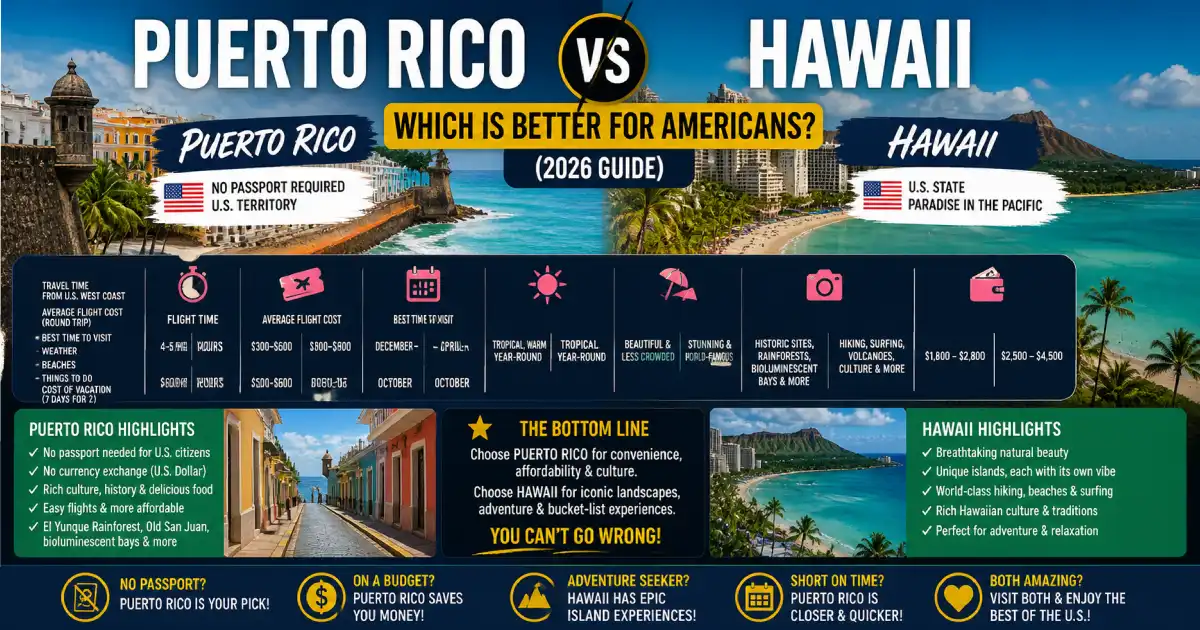
Puerto Rico and Hawaii are the two most debated island vacation destinations for American travelers — and for the most specific of reasons: both are United States territories or states requiring no passport for American citizens, both accept the US dollar, both have direct flights from every major US city, and both deliver genuinely extraordinary island experiences that are unavailable on the US mainland. The comparison is the most consequential single island planning decision available to the American traveler who has not yet decided which island paradise to prioritize — because the difference in cost ($800–$1,200 total savings in favor of Puerto Rico for most trip lengths), the difference in flight time (5.5–11 hours to Hawaii vs 2.5–3.5 hours to Puerto Rico from the East Coast), the difference in beach quality (Hawaii’s Lanikai and Hanalei Bay vs Puerto Rico’s Flamenco Beach and Vieques), and the difference in cultural depth (Puerto Rico’s 500-year Spanish colonial history and San Sebastián Festival vs Hawaii’s Polynesian heritage and luau tradition) collectively determine the island experience in ways that no single comparison point captures adequately.
I’ve visited both extensively — the Flamenco Beach morning in April when the Culebra ferry cost $4.50 and the water was the turquoise that photographs consistently misrepresent as oversaturated, the Mosquito Bay bioluminescent kayak on a July new moon night when the water glowed blue-green around every paddle stroke, the Old San Juan San Sebastián Festival Saturday when the cobblestones were the most festive in the Caribbean, the Hanalei Bay morning when the Na Pali Coast’s 4,000-foot sea cliffs were visible from the beach and the water was flatter and more blue than any ocean surface I’d seen before arriving in Kauai, the Road to Hana’s 600-plus turns and the black sand beach at the end, and the Maui snorkeling at Molokini Crater when the underwater visibility was 100+ feet in water that was turquoise above the surface and electric blue in every direction below it. Both destinations produce genuinely extraordinary experiences. Choosing between them requires the most honest self-assessment of priorities available to any American island traveler.
For complete destination guides, see our Things to Do in Puerto Rico, Best Beaches in Puerto Rico, Things to Do in Honolulu, and Best Beaches in Hawaii guides.
The Most Important Facts First
Key Fact
🇵🇷 Puerto Rico
🌺 Hawaii
Passport Required (Americans)
❌ No passport — US territory; driver’s license only
❌ No passport — US state; driver’s license only
Currency
US Dollar
US Dollar
Cell Phone Roaming
No roaming — US plans work fully
No roaming — US plans work fully
Flight from New York (JFK)
~3.5 hours direct to SJU
~11 hours direct to HNL (Oahu)
Flight from Miami
~2.5 hours direct to SJU
~9 hours direct to HNL
Flight from Los Angeles (LAX)
~6 hours (connection usually required)
~5.5 hours direct to HNL
Average Roundtrip Airfare (East Coast)
$280–$450 (off-peak)
$550–$900 (off-peak)
Average Midrange Hotel (per night)
$175–$310 (San Juan, April)
$280–$520 (Maui, Kauai midrange)
Total Budget (7 days, per person)
$1,400–$2,200 (mid-range travel)
$2,400–$4,500 (mid-range travel)
Time Zone Difference (from Eastern)
1 hour ahead (AST) — minimal jet lag
5–6 hours behind EST — real jet lag
Primary Language
Spanish and English (officially bilingual)
English (Hawaiian also official)
Islands Within Destination
Puerto Rico mainland + Culebra + Vieques
Oahu, Maui, Kauai, Big Island + more
Quick Verdict: Puerto Rico vs Hawaii
Category
🇵🇷 Puerto Rico Wins
🌺 Hawaii Wins
Winner
Overall Cost
Flights shorter + cheaper; hotels 40–50% less; local food cheap
Worth the premium — but it IS premium
🇵🇷 Puerto Rico
Best Beaches
Flamenco Beach (world-class), Vieques Red Beach (wild horses)
Lanikai, Hanalei Bay, Waianapanapa black sand — Hawaii overall finer
🌺 Hawaii (by variety)
History & Culture
Old San Juan 500-year Spanish colonial, San Sebastián Festival, Loíza African heritage
Pearl Harbor, Polynesian cultural heritage, Iolani Palace
🤝 Tie (different histories)
Bioluminescent Bay
Mosquito Bay Vieques — Guinness World Record brightest on Earth
None comparable
🇵🇷 Puerto Rico
Snorkeling & Diving
Carlos Rosario Culebra — finest shore snorkeling in PR
Molokini Crater, Hanauma Bay, Lanai — among the best in the world
🌺 Hawaii
Hiking & Scenery
El Yunque rainforest (only tropical US National Forest)
Na Pali Coast, Waimea Canyon, Haleakalā, volcanoes — Hawaii wins decisively
🌺 Hawaii
Food Scene
Mofongo, lechón, James Beard dining, rum distillery tours
Puerto Rico vs Hawaii: The Cost Comparison Every American Needs to See
The cost difference between Puerto Rico and Hawaii is the most significant single financial fact in this comparison — and it is larger than most American travelers expect before they price both destinations simultaneously.
Flights: Puerto Rico Is Dramatically Cheaper From the East Coast
From the US East Coast (New York, Miami, Boston, Washington DC, Philadelphia), Puerto Rico is the most financially efficient Caribbean island getaway available to American travelers: a 2.5–3.5 hour direct flight at prices that routinely reach $280–$400 roundtrip in off-peak months (April, May, October, November) on JetBlue, United, American, Delta, and Southwest, all of which serve Luis Muñoz Marín International Airport (SJU) in San Juan from multiple East Coast hubs. Hawaii from the same East Coast cities requires 9–11 hours of total travel (including typical connection in a hub city), with roundtrip fares averaging $550–$900 in off-peak months and $800–$1,400 during peak season. For a family of four flying from New York: Puerto Rico saves approximately $800–$1,600 in airfare alone on a single trip.
From the US West Coast (Los Angeles, San Francisco, Seattle, Phoenix), the calculation reverses partially: Hawaii is 5–6 hours direct and significantly more flight-efficient than Puerto Rico (which requires a connection via the East Coast or Atlanta, adding both time and cost). Los Angeles to Honolulu is approximately $350–$550 roundtrip on Hawaiian Airlines, Alaska Airlines, and United — competitive with Puerto Rico for West Coast travelers who must connect through Dallas or Miami to reach San Juan.
Hotels: Puerto Rico Is 40–50% Cheaper Than Hawaii’s Comparable Tier
The hotel cost difference between Puerto Rico and Hawaii is the most consistently underestimated component of the full trip budget:
Puerto Rico midrange (San Juan Condado, April): $175–$310/night — the most affordable Caribbean hotel corridor for the quality tier, with the AC Hotel by Marriott, the ESJ Tower, and the Doubletree by Hilton all delivering full-service midrange accommodation at prices unavailable in Hawaii’s equivalent tier
Hawaii midrange (Maui Ka’anapali, Kauai Princeville, April): $320–$580/night — the most expensive midrange hotel market accessible in any US state or territory; Maui’s West Shore resort corridor and Kauai’s North Shore routinely price their midrange product at rates that match Puerto Rico’s luxury tier
The 7-night hotel difference: A family of four spending 7 nights in midrange Puerto Rico accommodation saves $1,050–$1,890 in hotel costs alone compared to the equivalent Hawaii midrange tier
Food & Daily Costs: Puerto Rico Is Significantly More Affordable
Puerto Rico local food: The $4.50 ferry to Flamenco Beach. The $5 Don Juan taco at Juan in a Million. The $2.50 piragua. The $18 mofongo at a Condado restaurant. The $12 plate lunch at a local Puerto Rican cafetería. Puerto Rico’s local food culture is the most affordable quality food accessible at any Caribbean island, reflecting the US dollar economy and the local population’s genuine food culture rather than a tourist-facing price premium.
Hawaii local food: The $12 plate lunch at Rainbow Drive-In (the most affordable quality institution in Honolulu). The $4 shave ice. The $16–$22 poke bowl. Hawaii’s local food culture is genuinely affordable at the local tier — the plate lunch tradition and the food truck culture keep daily food costs reasonable for the budget-conscious visitor. Fine dining in Hawaii, however, is among the most expensive in the United States ($80–$150/person at Alan Wong’s or Mariposa).
Total 7-day trip cost comparison (per person, midrange, April, from New York):
Cost Item
🇵🇷 Puerto Rico
🌺 Hawaii (Maui)
Roundtrip airfare
$320
$720
Hotel (7 nights, midrange)
$1,750
$3,150
Food (7 days, midrange dining)
$420
$560
Activities & transport
$280
$420
Total (per person)
~$2,770
~$4,850
Cost verdict: Puerto Rico saves approximately $2,000–$2,500 per person on a 7-day trip from the East Coast — a $4,000–$5,000 savings for a couple and an $8,000–$10,000 savings for a family of four. From the West Coast, the savings are smaller (approximately $800–$1,500 per person) but still significant. Hawaii is genuinely worth the premium — it is one of the most beautiful places on earth. But the premium is real and substantial, and the visitor who cannot or will not spend it will find Puerto Rico an extraordinary consolation that is genuinely not a consolation at all.
Puerto Rico vs Hawaii: Beaches
Puerto Rico’s Beaches — World-Class at the Top, Constitutionally Free
Puerto Rico’s finest beaches — Flamenco Beach on Culebra Island ($4.50 ferry) and the Vieques National Wildlife Refuge beaches (Red Beach, Blue Beach, accessible by golf cart after the $4.50 ferry) — are genuinely world-class. Flamenco Beach has been rated among the top 10 beaches in the world by Dr. Beach, Travel + Leisure, and virtually every major beach publication for decades: the powder-white coral sand, the horseshoe bay geometry providing calm swimming conditions, and the turquoise water produced by the shallow Culebra Bank produce a beach that no Texas or Florida alternative replicates at any price. Vieques’s Red Beach, with its orange-tinted sand and the wild paso fino horses that walk the shoreline at sunrise and sunset, produces the most photographically extraordinary beach scene accessible in any US territory.
The constitutional advantage: every beach in Puerto Rico is legally guaranteed to be publicly accessible — no private resort can legally close a Puerto Rico beach, which means Flamenco Beach (consistently world-ranked) costs $4.50 to reach (the ferry) and nothing to use. This is the most financially democratic world-class beach access available in any American territory.
Puerto Rico’s beach limitation: the mainland Puerto Rico beaches are significantly inferior to Culebra and Vieques — the Condado and Isla Verde urban beaches are fine resort beaches without the world-class quality of the outer island options, and the Puerto Rico mainland beach visitor who doesn’t take the ferry to Culebra or Vieques has not experienced Puerto Rico’s beaches at their best.
Hawaii’s Beaches — The Most Diverse and Most Dramatically Beautiful
Hawaii’s beaches are the most geologically and visually diverse in the United States — produced by the volcanic island-building process that has created black sand beaches (Waianapanapa on Maui, Punalu’u on the Big Island), green sand beaches (Papakolea on the Big Island — one of only four green sand beaches in the world), white sand beaches (Lanikai on Oahu, Hanalei Bay on Kauai), and the red sand beach at Kaihalulu Bay on Maui, all on the same archipelago. The specific beaches:
Lanikai Beach (Oahu): The most consistently praised beach on Oahu — a quarter-mile of powder-white sand with the Mokulua Islands visible offshore in the most specifically turquoise water accessible on the Oahu coastline. The finest beach on the most visited Hawaiian island.
Hanalei Bay (Kauai): The most scenically dramatic beach in Hawaii — the Na Pali Coast’s 4,000-foot sea cliffs framing the north Kauai bay’s crescent of golden sand, with consistent winter surf and the most spectacular beach backdrop accessible in any US state or territory. The Hanalei Bay morning is the single most cinematically beautiful beach scene in the United States.
Waianapanapa Black Sand Beach (Maui): The most visually extraordinary beach in Maui — black volcanic sand, sea caves, dramatic basalt cliffs, and the specific color contrast of the black sand and the turquoise Pacific that produces the most photogenic single beach composition accessible in Hawaii. Reservation required (free) at recreation.gov.
Papakōlea Green Sand Beach (Big Island): One of four green sand beaches in the world — the olivine crystals eroded from the adjacent Pu’u Mahana volcanic cone produce the specific green color; a 2.5-mile walk from the nearest vehicle access point makes it the most inaccessible and the most specifically extraordinary beach in the United States.
Beach verdict: Hawaii wins on variety and overall scenic drama — the Na Pali Coast backdrop at Hanalei Bay, the black and green sand beaches, and the diversity of geological beach types unavailable anywhere else in the US produce the most visually extraordinary beach landscape accessible in American territory. Puerto Rico’s Flamenco Beach is genuinely world-class and competitive with Hawaii’s best white sand beaches — but Hawaii’s full beach range (white sand + black sand + green sand + the volcanic geology backdrop) is unmatched by any single destination in the American territory system.
Puerto Rico vs Hawaii: The Bioluminescent Bay
This category belongs to Puerto Rico unconditionally — and it is the most specifically irreplaceable experience Puerto Rico offers that Hawaii cannot replicate at any price or at any level of planning effort.
Mosquito Bay (Bahía Mosquito) on the south shore of Vieques — the Guinness World Record holder for the brightest bioluminescent bay in the world — is the most specifically magical natural light experience accessible in the Western Hemisphere. The bay’s microscopic dinoflagellates (Pyrodinium bahamense, at concentrations up to 720,000 organisms per gallon) produce a blue-green bioluminescent glow visible around every movement in the water on a moonless night: every paddle stroke, every hand trailing in the water, every fish disturbed by the kayak — the entire bay comes alive with visible biological light that no photograph or video has ever adequately captured. The experience is available on a $60–$75 kayak tour, requires a new moon night for maximum intensity, and is accessible via the $4.50 ferry from Ceiba to Vieques.
Hawaii has no bioluminescent bay of comparable intensity. Some Hawaiian bays produce faint bioluminescence under the right conditions; none produce the sustained, visible, and dramatic glow that Mosquito Bay delivers on every new moon night. This is the most frequently cited Puerto Rico experience by visitors who have been to both destinations when asked what Puerto Rico has that Hawaii doesn’t.
Bioluminescence verdict: Puerto Rico wins unconditionally — Mosquito Bay is the most vivid bioluminescent bay in the world and has no Hawaii equivalent.
Puerto Rico vs Hawaii: Hiking, Nature & Scenery
Puerto Rico — El Yunque and the Outer Island Wilderness
Puerto Rico’s natural crown jewel is El Yunque National Forest — the only tropical rainforest in the US National Forest system, 28,000 acres of the Sierra de Luquillo mountains 45 minutes east of San Juan, with 240+ tree species, 50 orchid species, and the La Mina waterfall trail (1.8 miles round trip, the most accessible and the most rewarding rainforest hike in any US territory). El Yunque is genuinely extraordinary by the standard of any tropical rainforest accessible within a 2-hour flight of the US East Coast — there is simply nothing comparable in the continental United States or in the other US Caribbean territories.
Puerto Rico’s additional natural offerings: the Vieques National Wildlife Refuge (the largest nature reserve in the Caribbean managed by the US Fish and Wildlife Service, with pristine beaches and wild horse habitat on the former Navy bombing range), the Cabo Rojo Salt Flats (the most diverse shorebird habitat in the Puerto Rico southwest), and the Camuy River Cave Park (the world’s third-largest underground river system). Puerto Rico’s natural range is more limited than Hawaii’s in geological drama but includes the most accessible tropical rainforest in the US territory system.
Hawaii — The Most Dramatically Beautiful Landscape in the United States
Hawaii’s natural landscape is the most geologically dramatic and the most visually extraordinary accessible in any US state or territory — produced by the most active volcanic island-building system on earth and shaped by 70 million years of Pacific Ocean erosion into the specific forms that make each island’s landscape irreplaceable:
Na Pali Coast (Kauai): The most dramatic coastline in the United States — 4,000-foot sea cliffs dropping directly into the Pacific, accessible by the 11-mile Kalalau Trail (the most spectacular coastal hiking trail in the US) or by helicopter or boat tour. No comparable coastline exists in the continental United States or Puerto Rico.
Waimea Canyon (Kauai): The “Grand Canyon of the Pacific” — a 3,600-foot-deep, 14-mile-long canyon carved by the Waimea River through Kauai’s volcanic interior, producing the most dramatic inland geological feature accessible in any Hawaiian island outside the active volcanoes. The 10-mile Waimea Canyon drive is the most scenic inland drive in Hawaii.
Haleakalā (Maui): The world’s largest dormant volcano — a 10,023-foot summit above the cloud line on Maui, with a crater 7 miles wide and 2,600 feet deep, the most dramatic lunar landscape accessible in the United States. The Haleakalā sunrise (requires a 3 AM drive to the summit and a timed entry reservation at recreation.gov) is the most specifically extraordinary dawn accessible in any US territory.
Hawaii Volcanoes National Park (Big Island): The most active volcanic landscape in the United States — Kīlauea’s ongoing eruptions (the most geologically active volcano in the world by annual lava output), the Thurston Lava Tube (the most accessible lava tube in the US), and the Chain of Craters Road (the most dramatic single road accessible in any US national park) make the Big Island the most geologically dynamic landscape accessible in American territory.
Road to Hana (Maui): The most scenic coastal drive in Hawaii — 64 miles of the Hana Highway’s 600+ turns past 59 bridges, 74 waterfalls, bamboo forests, and black sand beaches on Maui’s remote northeast coast.
Hiking and scenery verdict: Hawaii wins decisively — the Na Pali Coast’s sea cliffs, Haleakalā’s volcanic summit, Waimea Canyon’s canyon depth, and the active lava flows at Hawaii Volcanoes National Park collectively produce the most geologically extraordinary and the most visually dramatic natural landscape accessible in any US state or territory. El Yunque is genuinely exceptional; it is not in the same geological drama category as Kauai’s Na Pali Coast or the Big Island’s active volcanoes.
Puerto Rico vs Hawaii: History & Culture
Puerto Rico’s History — 500 Years of Spanish Colonial Layering
Puerto Rico’s history is the most specifically layered of any US territory — the island has been inhabited, contested, and culturally complex since Columbus arrived in 1493 (making Puerto Rico the oldest continuously inhabited European settlement in the United States), and the Spanish colonial architecture of Old San Juan (the most intact Spanish colonial walled city in the Western Hemisphere, with 500+ historically preserved buildings in every Caribbean color along blue cobblestone streets paved with volcanic ballast from Spanish galleons) is the most historically specific and the most architecturally extraordinary urban environment accessible in any US territory.
The cultural depth: the San Sebastián Street Festival (the most festive annual public event in the Caribbean, free admission, January 15–18, 2026 in Old San Juan), the Loíza patron saint festival (the most specifically Afro-Puerto Rican cultural celebration in the Caribbean, July, coconut vejigante masks, bomba dancing), El Morro and San Cristóbal (the most intact Spanish colonial fortifications in the Western Hemisphere, free NPS entry for the grounds), and the rum culture (Bacardí distillery tour accessible via a $0.50 ferry from Old San Juan — free tour) collectively produce the most specifically layered Caribbean cultural experience accessible in any US territory.
Hawaii’s History — Polynesian Heritage and American Reckoning
Hawaii’s history is the most politically complex and the most culturally specific of any US state — the 3,000-year Polynesian settlement tradition (the Hawaiians were among the most accomplished Pacific navigators in human history, sailing from the Marquesas Islands to Hawaii by star navigation in double-hulled canoes), the 1893 overthrow of the Hawaiian Kingdom (the US government’s official 1993 apology for the illegal overthrow of Queen Lili’uokalani acknowledges the most specific moment of American territorial acquisition by force in the Pacific), and the Pearl Harbor attack (December 7, 1941 — the most consequential single day in 20th-century American history, with the USS Arizona Memorial the most visited US military memorial in the Pacific) constitute a historical record of extraordinary depth and genuine cultural complexity.
The living cultural traditions: the Hawaiian language (one of the most successful indigenous language revitalization programs in the world, now taught in Hawaiian-language immersion schools throughout the state), the hula tradition (the most specifically Polynesian performing art accessible in the US, with the Merrie Monarch Festival on the Big Island the most prestigious annual hula competition in the world), and the aloha spirit (the specific social and cultural philosophy of mutual respect, harmony, and generous welcome that is the most distinctive cultural inheritance of the Hawaiian people and the most frequently invoked concept in the state’s self-presentation) — all represent living cultural traditions that are distinct from mainland American culture in the most genuinely specific way.
History and culture verdict: Tie — Puerto Rico wins on European colonial architectural depth and the most festive festival culture in the Caribbean; Hawaii wins on Polynesian indigenous heritage and the Pearl Harbor historical weight. They are genuinely different historical experiences with no meaningful basis for ranking one above the other.
Puerto Rico vs Hawaii: Food
Puerto Rico’s Food — Mofongo, Lechón, and the Caribbean’s Finest Rum
Puerto Rico’s food identity is built on the most specifically Caribbean and the most specifically Puerto Rican culinary heritage accessible in any US territory: mofongo (plantains fried and mashed in a wooden pilón with garlic, chicharrón, and olive oil — the most specifically Puerto Rican single dish), lechón (whole roasted pig on La Ruta del Lechón in Guavate — the most festive and the most specifically Puerto Rican food ritual accessible in the Caribbean), the piragua street cart ($1.50–$3, the most accessible and the most culturally embedded Puerto Rican street food), and the rum culture (Puerto Rico produces 70% of the rum consumed in the United States — the Bacardí distillery free tour via $0.50 ferry and the Destilería Serrallés in Ponce produce the most comprehensive rum tourism accessible in any US territory).
San Juan’s fine dining has been producing James Beard Award-nominated and award-winning restaurants for a decade — José Enrique’s restaurant in Santurce (James Beard Award winner), Santaella, and the Condado fine dining scene collectively represent the most nationally recognized Puerto Rican cuisine accessible in any Caribbean city. The Luquillo Beach kiosk corridor (60 food vendors, alcapurrias, bacalaítos, and the most complete Puerto Rican beach food culture accessible without leaving the mainland) is the finest beachside food experience accessible in any US territory.
Hawaii’s Food — Plate Lunch, Poke, and the Most Diverse Pacific Cuisine
Hawaii’s food culture is the most specifically Pacific and the most ethnically diverse food landscape in the United States — a reflection of the successive immigration waves that built Hawaii’s workforce (Native Hawaiian, Chinese, Japanese, Filipino, Portuguese, Korean, and mainland American) producing the most genuinely multicultural food tradition accessible in any US state or territory. The specific Hawaii food identity:
Plate lunch: The most specifically Hawaiian casual meal — two scoops of rice, macaroni salad, and a protein (the kalbi short ribs at Rainbow Drive-In, the most celebrated plate lunch institution in Honolulu, is the most specifically Hawaiian casual meal accessible at any price)
Poke: The Hawaiian fish preparation that became a national food trend — cubed raw fish (traditionally ahi tuna or octopus) in a soy sauce and sesame oil marinade, available at every grocery store, farmers market, and specialty poke shop in the state at prices ($12–$18/bowl) that reflect the local abundance
Shave ice: The most specifically Hawaii street food — finely shaved ice (not snow cone coarseness — genuine ribbon-thin ice shavings produced by a specialized machine) with tropical fruit syrups, condensed milk, and often ice cream or mochi at the base. Matsumoto’s in Haleiwa on Oahu’s North Shore is the most celebrated single shave ice institution accessible in Hawaii ($3–$6)
Helena’s Hawaiian Food (Oahu, James Beard Award): The most celebrated Hawaiian food restaurant in the state — the pipikaula short ribs (the most specifically ancient Hawaiian beef preparation accessible at any restaurant) and the lomi salmon are the most nationally recognized dishes; sells out by 1 PM, cash only
Luau (multiple operators): The most specifically Polynesian food and performance experience — the imu-roasted kalua pork (cooked underground in an earth oven), the poi, the haupia, and the live hula and fire knife dancing constitute the most complete and the most cultural Hawaiian food experience accessible on any island
Food verdict: Tie — Puerto Rico’s mofongo and lechón tradition versus Hawaii’s plate lunch and poke culture represent two genuinely distinctive and genuinely excellent food identities that serve different palates and cultural interests equally well. The visitor who wants Latin Caribbean food culture will find Puerto Rico more rewarding. The visitor who wants Pacific Asian fusion food culture will find Hawaii more rewarding.
Who Should Visit Puerto Rico?
Choose Puerto Rico if you:
Are an East Coast traveler (New York, Miami, Boston, Washington) who wants the most Caribbean-feeling and the most historically specific island vacation accessible within a 3.5-hour flight — Puerto Rico from New York is a shorter trip than flying from New York to Los Angeles
Want the Mosquito Bay bioluminescent bay experience — the most vivid bioluminescent bay in the world, accessible on a $4.50 ferry and a $65 kayak tour; unavailable at any comparable level in Hawaii or anywhere else in the Western Hemisphere
Want the most historically layered Spanish colonial city accessible in any US territory — Old San Juan’s 500-year walled city, El Morro fortress, and the blue cobblestone streets are the most architecturally specific and the most historically extraordinary urban environment in the US territory system
Are visiting for the San Sebastián Street Festival (January) — the most festive and the most culturally specific annual festival accessible in any US territory, with 156 years of Mardi Gras-adjacent tradition in the most beautiful colonial city in the Caribbean
Want the most affordable island vacation — Puerto Rico saves $2,000–$2,500 per person over Hawaii on a 7-day trip from the East Coast; the Flamenco Beach ferry costs $4.50; the piragua costs $1.50; the local plate lunch costs $10–$14
Want Flamenco Beach in Culebra and the wild horse beaches of Vieques — both world-class, both free (by constitutional right), both accessible via the $4.50 ferry
Are visiting with a short window (4–5 days) — Puerto Rico’s 3.5-hour flight from the East Coast makes a 4-day long weekend trip genuinely productive; Hawaii’s 9–11 hour flight makes 4 days feel rushed and jet-lagged
Who Should Visit Hawaii?
Choose Hawaii if you:
Want the most geologically dramatic and the most visually extraordinary natural landscape accessible in any US state or territory — the Na Pali Coast’s 4,000-foot sea cliffs, Haleakalā’s 10,023-foot volcanic summit, the active lava flows at Hawaii Volcanoes National Park, and Waimea Canyon’s 3,600-foot depth collectively produce a natural landscape that Puerto Rico’s beautiful but geologically modest El Yunque rainforest cannot match in dramatic scale
Want the most diverse beach geology — black sand, green sand, white sand, and red sand beaches on the same archipelago; the geological beach diversity accessible in Hawaii is unavailable in any other US state or territory
Want world-class snorkeling and diving — Molokini Crater (100-foot visibility in a submerged volcanic crater off Maui), Hanauma Bay (the most accessible and the most coral-rich snorkeling accessible on Oahu), and Lanai’s Cathedrals dive site collectively produce snorkeling and diving experiences that are among the finest accessible in the Pacific
Are a surfer targeting the most legendary surf breaks on earth — the North Shore of Oahu (Pipeline, Sunset Beach, Waimea Bay) and Maui’s Jaws/Pe’ahi (the most powerful big-wave surf break accessible in the United States) are the most specifically celebrated surfing locations in the world; Puerto Rico’s Rincón is excellent but is not Pipeline
Want to witness active volcanic activity — the Big Island’s Hawaii Volcanoes National Park, with Kīlauea’s ongoing eruptions and the lava viewing opportunities that produce the most specifically geological and the most uniquely dynamic natural spectacle accessible in the United States
Are based on the US West Coast (Los Angeles, San Francisco, Seattle) — Hawaii is 5–6 hours direct from the West Coast, making it the most accessible Pacific island destination for the 60 million Americans west of the Rockies; Puerto Rico requires a connection through the East Coast from most West Coast cities
Want whale watching — the humpback whales that winter in Hawaiian waters from December through April (most reliably on Maui’s western coastline, where the ocean channel between Maui, Lana’i, and Moloka’i is the primary Hawaiian whale nursery) are the most accessible humpback whale watching in the continental US and territories
Puerto Rico vs Hawaii: By Traveler Type
Traveler Type
Choose 🇵🇷 Puerto Rico
Choose 🌺 Hawaii
Budget travelers
✅ $2,000–$2,500 cheaper per person (East Coast)
Worth saving up for — but requires budget
East Coast Americans
✅ 3.5-hr flight, no jet lag, weekend trip possible
Best for dedicated 10+ day trip
West Coast Americans
Connection required; less efficient from LA/SF
✅ 5.5-hr direct flight — most efficient Pacific island
History & culture lovers
✅ Old San Juan 500-yr colonial city, festivals, rum
✅ Pearl Harbor, Polynesian heritage, Iolani Palace
Nature & hiking
El Yunque (only tropical US National Forest)
✅ Na Pali Coast, Haleakalā, volcanoes — wins decisively
Snorkeling & diving
Carlos Rosario (excellent shore snorkeling)
✅ Molokini, Hanauma Bay — among the best in the world
Bioluminescence seekers
✅ Mosquito Bay — the brightest bio bay on Earth
No comparable experience
Surfers
Rincón (good Caribbean surf, Nov–Apr)
✅ Pipeline, Sunset Beach — most legendary on Earth
Honeymooners
Old San Juan romance + Vieques bioluminescence
✅ Maui/Kauai — most romantic landscape in the US
Families (budget)
✅ Saves $8,000–$10,000 for family of 4 vs Hawaii
Worth it for a bucket list family trip
Festival goers
✅ San Sebastián (Jan) — most festive in the Caribbean
August–September (peak hurricane season — travel insurance essential)
June–August (peak prices, crowded Waikiki and Maui resort areas, no whales)
Minimum Trip Length
4 days (long weekend feasible from East Coast) — 7 days ideal for Culebra + Vieques + Old San Juan
7 days minimum for one island; 10–14 days for two islands
Getting Around
Rental car essential for mainland; ferry to Culebra and Vieques ($4.50); Uber available in metro San Juan
Rental car essential on every island; no public transit outside Honolulu; inter-island flights $80–$150
Tipping
20% standard — US tipping norms apply fully
20% standard — US tipping norms apply fully
Key Reservations
Culebra/Vieques ferry tickets (ATM app); Mosquito Bay kayak tour (2–4 weeks ahead in peak); El Yunque ($2 vehicle, recreation.gov)
Haleakalā sunrise (recreation.gov, 60 days ahead — sells out immediately); Road to Hana (Waianapanapa Beach, recreation.gov); Molokini snorkel tour (1–2 weeks ahead)
Pacific hurricane season June–November — Hawaii receives far fewer direct hurricane impacts; lower risk than Puerto Rico
Don’t Miss
Mosquito Bay new moon kayak; Flamenco Beach 6 AM ferry; Old San Juan evening cobblestone walk; La Ruta del Lechón Sunday
Haleakalā sunrise (book 60 days ahead); Na Pali Coast boat or helicopter; Helena’s Hawaiian Food (arrive before noon, cash only); Road to Hana full day
Frequently Asked Questions: Puerto Rico vs Hawaii
Is Puerto Rico cheaper than Hawaii?
Yes — significantly. Puerto Rico is the most affordable island vacation accessible to Americans who want a genuine tropical island experience at US-dollar prices with no passport required. The savings are largest for East Coast travelers: the roundtrip airfare from New York, Miami, or Boston to San Juan ($280–$450 off-peak) is 40–50% cheaper than New York to Honolulu ($550–$900 off-peak). Hotel rates in San Juan are 40–50% cheaper than comparable Hawaii resorts. Local food costs are dramatically lower — the $4.50 Culebra ferry, the $5 mofongo plate lunch, and the $1.50 piragua collectively produce the most affordable genuine Caribbean island daily budget accessible in any US territory. A couple spending 7 days can expect to save $3,000–$5,000 compared to the equivalent Hawaii trip from the East Coast. From the West Coast, the savings are smaller but still meaningful ($1,500–$2,500 per couple) because Hawaii’s flight distance advantage from California reduces the airfare gap.
Is Hawaii worth the extra cost over Puerto Rico?
For many travelers, yes — Hawaii is one of the most beautiful places on earth, and the Na Pali Coast’s sea cliffs, Haleakalā’s volcanic summit, Molokini’s crystal-clear snorkeling, and the active lava flows at Hawaii Volcanoes National Park collectively produce natural experiences that are genuinely unavailable anywhere else in the United States or its territories at any price. The honest assessment: Hawaii is worth every dollar for the traveler who specifically wants volcanic geology, world-class diving, the legendary North Shore surfing culture, and the most dramatic natural scenery in the US territory system. Puerto Rico is the right choice for the traveler who wants the most affordable genuine tropical island experience, the best bioluminescent bay in the world, the most historically layered Caribbean city, and the most festive annual festival in any US territory — without the $2,000+ per-person premium that Hawaii commands over its Caribbean alternative. Both are extraordinary. The value question is answered by what specifically you came for.
Can you visit Puerto Rico and Hawaii in the same trip?
Theoretically possible but logistically inefficient — Puerto Rico is in the Atlantic and Caribbean (2.5–3.5 hours from the East Coast), and Hawaii is in the Pacific (5.5–11 hours from the US mainland). Combining them in a single trip requires crossing the continental US twice (or once, if routing through a mainland hub), adding 10+ hours of flight time to an already substantial itinerary. The most efficient combination for a traveler who wants both: visit Puerto Rico as the East Coast island and Hawaii as the West Coast island in separate trips, or combine with a cross-country US road trip that visits the West Coast before flying to Hawaii. The Hawaii–Puerto Rico combination as a single trip is possible and some Caribbean–Pacific circuit itineraries do it (Caribbean → mainland US → Hawaii → home), but the logistics cost in time and money generally makes separate trips the more sensible planning approach.
Which is better for a honeymoon — Puerto Rico or Hawaii?
Hawaii wins for most honeymooners — specifically Maui and Kauai, which produce the most romantic and the most scenically specific island landscape accessible in the United States. The Hana Highway drive on the morning after arrival, the Haleakalā sunrise with the clouds below the volcano’s summit, and the Hanalei Bay evening with the Na Pali Coast turning purple in the last light are the most specifically dramatic honeymoon-landscape moments accessible in the US territory system. Puerto Rico is a genuinely romantic honeymoon — Old San Juan’s cobblestone evenings, Vieques’s Red Beach wild horses at sunset, and the Mosquito Bay bioluminescent kayak on a moonless night are all deeply romantic experiences — but the visual drama of Kauai and Maui is the most compelling argument for Hawaii as the default honeymoon recommendation when budget is not the primary constraint. If budget is a significant constraint, Puerto Rico delivers a genuinely romantic honeymoon at 40–50% of the cost, with the specific added advantage of the bioluminescent bay experience that Hawaii cannot replicate.
Is Puerto Rico safe to visit?
Puerto Rico is safe for tourists in the same way that any major American city is safe for tourists — the resort and tourist-facing areas (Old San Juan, Condado, Isla Verde, Culebra, Vieques) are well-trafficked and safe for standard visitor activity. Apply the same situational awareness you would in any unfamiliar American city: use rideshare at night in areas you don’t know, keep your possessions secure in crowded areas, and avoid unfamiliar neighborhoods after dark. The tourist-facing areas of Puerto Rico have a strong law enforcement and tourism infrastructure presence. The most important Puerto Rico safety note: purchase travel insurance for any June–November visit, as Atlantic hurricane season produces the most significant weather-related travel disruption risk of any US territory in that window.
Final Verdict: Puerto Rico vs Hawaii
Puerto Rico and Hawaii are the two finest island vacation destinations accessible to American travelers without a passport — and they are genuinely different enough that choosing between them is one of the most productively self-revealing travel planning decisions available. The most honest single-sentence verdict for each:
Choose Puerto Rico if you are an East Coast American who wants the most affordable genuine Caribbean island experience accessible within a 3.5-hour flight, the most historically extraordinary colonial city in any US territory (Old San Juan’s blue cobblestones and El Morro fortress at dawn), the most festive annual festival in the Caribbean (San Sebastián Street Festival, January, free admission), the most vivid bioluminescent bay on earth (Mosquito Bay in Vieques — book on the new moon, costs $65, unavailable anywhere in Hawaii), and Flamenco Beach’s turquoise horseshoe for $4.50 ferry fare plus $0 beach access (guaranteed by constitutional right). Puerto Rico is not “budget Hawaii.” It is its own extraordinary island — the Caribbean island that happens to accept your driver’s license, charge you dollars, and send you home with piragua stains and cobblestone memories and the specific blue-green glow of a dinoflagellate on your paddle blade at midnight that you will spend years trying to describe to people who haven’t been there.
Choose Hawaii if you want the most geologically dramatic and the most visually extraordinary natural landscape accessible in any US state or territory (the Na Pali Coast’s sea cliffs, Haleakalā’s volcanic dawn, the active lava flows of Hawaii Volcanoes National Park), the most diverse beach geology on earth (white sand, black sand, green sand, and red sand on the same archipelago), world-class snorkeling at Molokini Crater and Hanauma Bay, the most legendary surfing locations in the world (Pipeline, Sunset Beach), humpback whales visible from Maui’s shores from December through April, and the most romantic and the most scenically overwhelming island landscape in the United States. Hawaii is worth saving for. It is worth the 10-hour flight. It is worth the $4,850 per person. It is one of the most beautiful places on earth, and the American traveler who has not yet been owes themselves the experience of standing at the Haleakalā summit above the clouds at sunrise with the Pacific visible in every direction and understanding, in the most specific physical and geographical sense, that they are standing at the most remote inhabited island chain in the world and that the Pacific Ocean is the most enormous thing on the planet and that Hawaii is its most beautiful single expression.
Both islands are genuinely extraordinary. Puerto Rico is the right choice for the budget-conscious East Coast traveler, the festival-goer, and the bioluminescence seeker. Hawaii is the right choice for the nature and geology lover, the snorkeler, the surfer, and the traveler for whom the most dramatic natural landscape on earth justifies the premium. The best life includes both — visit Puerto Rico first (it costs less and is closer), save for Hawaii (it rewards the anticipation), and return to both as many times as the calendar and the budget allow.
—
For the most current visitor information, park reservations, ferry schedules, and travel advisories for Puerto Rico and Hawaii, consult these official government sources:
Discover Puerto Rico — Official Puerto Rico Tourism Company — Official Puerto Rico tourism authority covering current hotel listings, event calendars, Culebra and Vieques ferry schedules, El Yunque reservation requirements, and all official Puerto Rico visitor resources maintained by the government-supported destination marketing organization.
Go Hawaii — Hawaii Tourism Authority (Official State Government) — Official Hawaii state government tourism resource covering all six main Hawaiian islands, inter-island flight information, state park reservations, Haleakalā timed entry requirements, and current visitor guidelines from the Hawaii Tourism Authority.
Recreation.gov — Official US Federal Government Reservation System — Official US government reservation platform for El Yunque National Forest timed entry ($2/vehicle), Haleakalā National Park sunrise timed entry (required, opens 60 days ahead), Waianapanapa Black Sand Beach reservations (Maui), and all National Park Service site reservations in both Puerto Rico and Hawaii.
About Travel TouristerTravel Tourister’s island specialists have extensively explored both Puerto Rico and Hawaii — from Mosquito Bay’s bioluminescent kayak and Flamenco Beach’s 6 AM ferry to Haleakalā’s volcanic sunrise and Hanalei Bay’s Na Pali Coast backdrop — to provide the most honest and most specific comparison available for American travelers choosing between the two finest island destinations in the US territory system.Need help choosing between Puerto Rico and Hawaii? Our specialists can help you build the optimal island itinerary, book the Mosquito Bay kayak on the correct moon phase, plan the Haleakalā sunrise reservation 60 days ahead, time your visit around the San Sebastián Festival or whale season, and identify the best beaches and activities for your specific budget and travel style.
Posted By : Vinay
As a lead contributor for Travel Tourister, Vinay is dedicated to serving our Tier 1 audience (US, UK, Canada, Australia). His mission is to deliver precise, fact-checked news and actionable, data-driven articles that empower readers to make informed decisions, minimize travel risks, and maximize their adventure without compromising safety or budget.
Travel Tourister is a leading Travel portal where we introduce travellers to trusted travel agents to make their journey hasselfree, memorable And happy. Travel Tourister is a platform where travellers get Tour packages ,Hotel packages deals through trusted travel companies And hoteliers who are working with us across the world. We always try to find new and more travel agents and hoteliers from every nook and corners across the world so that you could compare the deals with different travel agents and hoteliers and book your tour or hotel with the one you have chosen according to your taste and budget.




 Call
Call Enquiry