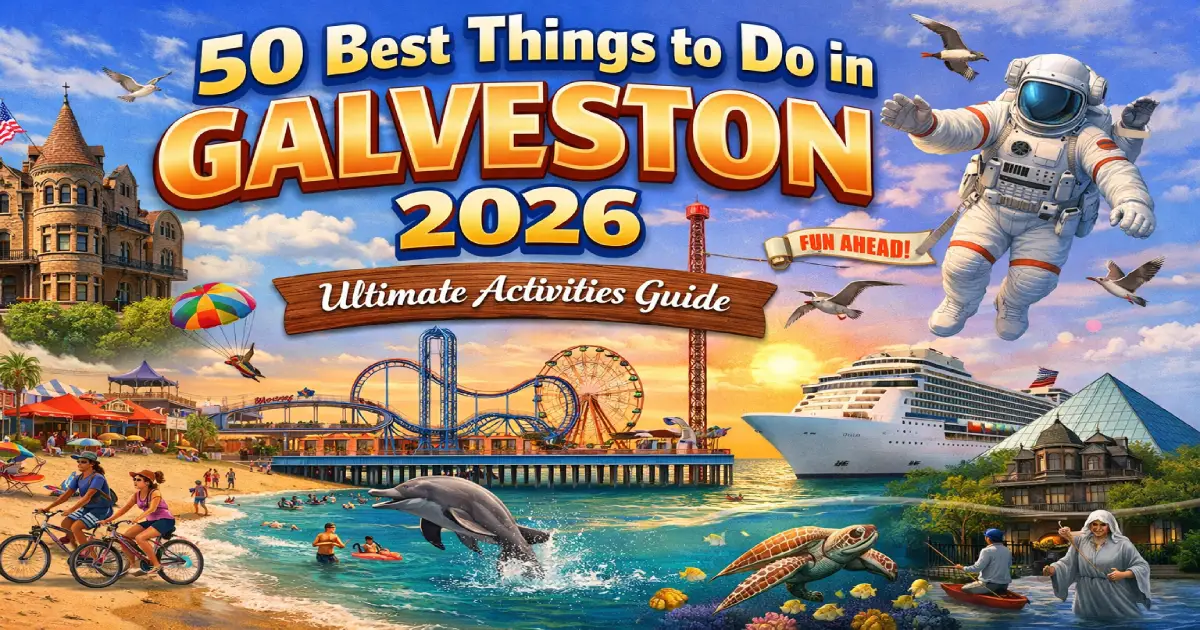
50 Best Things to Do in Galveston 2026: Ultimate Activities Guide
Published on : 04 Apr 2026
Things to Do in Galveston — The Gulf Coast’s Most Historically Layered Island City
By Travel Tourister | Updated March 2026
Galveston is the most surprising city on the Texas Gulf Coast — an island of 50 square miles connected to the mainland by a causeway, with a Victorian-era downtown (the Strand National Historic Landmark District, the largest concentration of 19th-century cast-iron commercial architecture in Texas) that survived the 1900 hurricane — still the deadliest natural disaster in American history — and was subsequently protected by the seawall (10 miles of concrete sea barrier built between 1902 and 1963) that transformed Galveston from the most hurricane-vulnerable city in America into its most thoroughly fortified. The island produces one of the finest free Mardi Gras celebrations in the United States (second only to New Orleans in participation, a claim that Galveston residents make with genuine conviction), the most historically specific railroad museum in Texas, the finest collection of Victorian residential architecture in the state, and the most accessible Gulf Coast beach within 50 miles of Houston — an urban island that has been simultaneously a port city, a Victorian resort, a hurricane victim, and a Texas cultural institution since Stephen F. Austin’s colonists first mapped it in 1821.
I’ve explored Galveston across multiple visits — the Strand on a February Mardi Gras Saturday when the parade floats were moving down Mechanic Street and the crowd was the most festive public gathering I’d encountered on the Texas Gulf Coast at any time of year, the Bishop’s Palace on an October afternoon when the restored Victorian interior was lit by the kind of specific late-afternoon Gulf light that makes the stained glass windows the most beautiful thing in any room in Galveston, the Bolivar Ferry at sunset going east across the Galveston Ship Channel when the shrimping boats were coming in and the pelicans were riding the wake and the city’s skyline was the most specific silhouette I’ve seen from any ferry in Texas, and the Pleasure Pier on a July Friday evening when the Ferris wheel was the brightest thing visible from the Seawall and the Gulf of Mexico was that specific summer-evening grey-green that belongs to no other body of water. Each visit expanded the map and confirmed the same truth: Galveston rewards the visitor who goes beyond the Seawall beach and finds the Victorian neighborhood streets, the Strand’s cast-iron architecture, and the specific Gulf Coast culture that makes this 27-mile island one of the most historically layered small cities in Texas.
This comprehensive 2026 guide breaks down Galveston’s 50 best activities using verified information from Galveston Island Convention & Visitors Bureau and years of on-the-ground expertise. We organize activities by category — historic and cultural, beaches and water, entertainment and family, food and drink, nature and outdoors, and unique Galveston experiences — with realistic costs, timing, and strategic advice for experiencing the Gulf Coast’s most historically rich island city.
Galveston Activities by Category
Category
Top Activities
Best Area
Cost Range
Historic & Cultural
The Strand, Bishop’s Palace, Railroad Museum
Downtown, East End
Free–$15
Beaches & Water
Stewart Beach, East Beach, Seawall
Seawall, East End
Free–$20
Entertainment & Family
Pleasure Pier, Moody Gardens, Schlitterbahn
Seawall, West End
$25–$65
Food & Drink
Seafood, shrimp boats, Farmers Market
The Strand, Piers
$10–$65
Nature & Outdoors
Galveston Island State Park, bird watching
West End, Bolivar
Free–$8
Unique Experiences
Mardi Gras, Bolivar Ferry, ghost tours
Island-wide
Free–$30
Historic & Cultural Activities
1. Walk The Strand Historic District — GALVESTON’S MOST ESSENTIAL ACTIVITY
Why It’s the Heart of Galveston: The Strand National Historic Landmark District — the 36-block Victorian commercial district along Strand Street and its adjacent blocks in downtown Galveston — is the most historically specific and the most architecturally impressive downtown district in Texas outside San Antonio’s River Walk. Before the 1900 hurricane, Galveston was the largest city in Texas and the most important port in the Gulf of Mexico; the Strand was its Wall Street, lined with the cast-iron-fronted commercial buildings of cotton factors, insurance companies, and banking houses that handled the cotton wealth of the entire Texas interior. The buildings survived — their cast-iron facades, ground-floor arcades, and upper-story ornamental ironwork constitute the largest single collection of 19th-century cast-iron commercial architecture in Texas — and the district’s contemporary character (galleries, boutique shops, restaurants, the Texas Seaport Museum, the 1877 tall ship Elissa) layers the present over the Victorian past in the most historically continuous downtown experience accessible on the Texas Gulf Coast.
The cast-iron architecture: The Strand’s 19th-century commercial buildings with their cast-iron facades and ornamental detail — the most concentrated collection of this architectural type in Texas, most visible at the corner of 22nd and Strand (the Hendley Building, 1858, the oldest commercial building on the Strand)
The Strand’s galleries and shops: Independent galleries (the Galveston Arts Center, the largest free-admission contemporary art gallery in the city), antique shops, and boutiques occupying the historic commercial spaces — the most historically specific retail corridor in Galveston
Best time: Weekend mornings (Saturday 10 AM–noon) when the shops are opening and the street is at its most locally active; Mardi Gras weekend (February) when the Strand becomes the most festive street in Texas
Cost: FREE to walk; galveston.com/the-strand; Strand Street, downtown Galveston; open daily
2. Visit Bishop’s Palace (Gresham’s Castle)
Why Essential: The Bishop’s Palace — the 1893 Victorian mansion at 1402 Broadway commissioned by Colonel Walter Gresham and later purchased by the Catholic Diocese of Galveston — is the most architecturally extraordinary single building in Galveston and one of the finest Victorian residential structures in the American South. The American Institute of Architects named it one of the 100 most significant buildings in American architecture. The interior — Romanesque arches, English oak staircase, the fireplace surround of silver, onyx, and mahogany that is the most specific piece of decorative craftsmanship accessible in Galveston — is as dramatically detailed as the exterior’s towers, turrets, and cast-iron cresting.
The exterior: The most photographed Victorian house in Galveston — the granite base, limestone and sandstone upper floors, and the ornamental cast-iron cresting on the roof line produce the most visually complex residential architecture accessible in Texas
The interior tours: Guided tours of the restored interior (the fireplaces, the stained glass, the English oak staircase) — the most specific Victorian domestic interior accessible in Galveston ($15/adult, 45-minute guided tour)
Christmas at Bishop’s Palace (November–December): The most elaborately decorated Victorian Christmas house in Texas — the palace’s seasonal decoration makes December visits the most festively atmospheric of any time of year
Cost: $15/adult, $10/child; galvestonhistory.org; 1402 Broadway, East End Historic District; open daily except major holidays
3. Explore the 1877 Tall Ship Elissa (Texas Seaport Museum)
The tall ship Elissa — an 1877 Scottish iron barque moored at Pier 21 in the Galveston harbor — is the second-oldest operational sailing vessel in the world and the most historically specific maritime attraction accessible in Texas. The Elissa carried cotton from Galveston to Liverpool in the 1880s; she is fully restored and sails under power annually in the Galveston harbor during special events. The Texas Seaport Museum surrounding the Elissa documents Galveston’s role as Texas’s most important historical port city, with the immigration database (the records of 133,000+ immigrants who entered the United States through Galveston between 1846 and 1948) as the most genealogically specific museum resource in the city.
The immigration database: The Galveston immigration records are the most significant genealogical resource in Texas for the descendants of European immigrants who entered through the “Ellis Island of the West” — the museum’s computer terminals provide public access to the database ($12/adult general admission includes Elissa boarding)
Cost: $12/adult; galvestonhistory.org; Pier 21, downtown waterfront; open daily
4. Visit the Galveston Railroad Museum
The finest railroad museum in Texas — the Galveston Railroad Museum in the 1913 Santa Fe Passenger Depot houses the most comprehensive collection of historic locomotives and passenger cars in the state, including a 1950 steam locomotive, a 1930s diesel engine, and the most complete collection of classic passenger cars (dining cars, Pullman sleepers, observation cars) accessible for interior exploration in Texas. The model railroad exhibit (the largest in the Southwest) and the interactive depot exhibits make this the most family-appropriate history museum in Galveston.
The Santa Fe Depot: The 1913 Spanish Mission Revival building — the most architecturally significant remaining railroad depot in Texas, with the original terrazzo floors, the mahogany ticket windows, and the waiting room’s original benches all preserved
Cost: $10/adult, $8/child; galvestonrrmuseum.com; 2602 Santa Fe Place, downtown Galveston; open daily
5. Tour the Moody Mansion
The 1895 Romanesque Revival mansion of William Lewis Moody Jr. — the most historically significant private residence in Galveston’s late Victorian economic history (Moody was the founder of the American National Insurance Company, which remains headquartered in Galveston) — is the most completely preserved Victorian domestic interior in Galveston: the original family furnishings, the family portraits, the servants’ quarters, and the basement’s wine cellar constitute the most authentically intact picture of Gilded Age Texas wealth accessible at any historic house in the city.
Cost: $10/adult; moodymansion.org; 2618 Broadway, East End Historic District; Wednesday–Sunday
6. Visit the Galveston Island Historic Pleasure Pier
Already described in the entertainment section — worth its historical context: the original Galveston Pleasure Pier opened in 1943 as a USO entertainment venue for WWII soldiers training at Fort Crockett; the current structure (rebuilt 2012 after Hurricane Ike’s destruction of the predecessor) extends 1,130 feet over the Gulf of Mexico and carries the longest roller coaster built over Gulf water accessible in Texas. The specific experience of standing at the pier’s end with the Gulf of Mexico in three directions is the most dramatically positioned entertainment venue on the Texas coast.
7. Explore the East End Historic District
The most intact Victorian residential neighborhood in Texas — the East End Historic District (bounded roughly by Broadway, 19th Street, Seawall Boulevard, and 11th Street) contains the highest concentration of late 19th-century and early 20th-century residential architecture in Galveston, including the Bishop’s Palace, the Moody Mansion, and more than 1,500 individually classified historic structures. The self-guided walking tour (map available at the Galveston Historical Foundation) delivers the most comprehensive Victorian residential streetscape accessible in Texas.
The Broadway median: The most beautiful street in Galveston — the oleander-planted median of Broadway (Avenue J) is the most specifically Galveston civic landscape, lined with the city’s most significant Victorian residential architecture in the most formal residential boulevard setting on the Texas coast
Cost: FREE self-guided walk; galvestonhistory.org for walking tour maps; East End Historic District, central Galveston
8. Visit the Bryan Museum (Texas History)
The most comprehensive collection of Texas historical artifacts accessible in Galveston — the Bryan Museum at 1315 21st Street houses J.P. Bryan’s private collection of Texas, Western American, and Native American historical artifacts (the largest privately assembled collection of Texas history materials in the world, with 70,000+ items including Stephen F. Austin documents, Sam Houston personal effects, and the most specific collection of Texas colonial-era artifacts accessible at any Texas museum). The most important Texas history museum accessible between Houston and San Antonio.
9. See the 1900 Storm Exhibit (Galveston Historical Foundation)
The 1900 hurricane that struck Galveston on September 8, 1900 — killing an estimated 6,000–12,000 people (the deadliest natural disaster in American history), destroying 3,600 buildings, and wiping out 30% of the island’s population — is the defining event of Galveston’s history and the most dramatically documented local disaster in any Texas museum. The Galveston Historical Foundation’s 1900 Storm exhibit at the Galveston County Museum provides the most comprehensive primary source documentation of the storm’s impact and the community’s recovery — the seawall construction, the grade raising (the entire island was elevated 17 feet by pumping dredged sand under the city’s foundations), and the civic reinvention that followed.
Cost: $5/adult; Galveston County Museum, 722 Moody Avenue; Wednesday–Saturday
10. Walk the Seawall and Seawall Boulevard
The 10-mile concrete seawall built between 1902 and 1963 — the most significant public infrastructure project in Texas history, the engineering response to the 1900 hurricane that killed thousands and the reason Galveston still exists as a functioning city — is the most historically specific public promenade in Texas. The Seawall’s 10-foot-wide promenade along its top provides the most direct Gulf of Mexico beach view accessible from a public walkway in Texas; cycling, walking, and in-line skating along the Seawall is the most freely accessible Galveston activity at any hour.
The Seawall bicycle path: 10 miles of paved promenade — bicycle rentals available from multiple Seawall vendors ($15–$25/hour); the most scenic urban cycling in the Texas Gulf Coast region
Cost: FREE; Seawall Boulevard, south Galveston; open 24 hours; bicycle rentals $15–$25/hour
Beaches & Water Activities
11. Swim and Play at Stewart Beach
Why It’s Galveston’s Best Family Beach: Stewart Beach — at the eastern end of Seawall Boulevard at 6th Street — is the most facility-complete public beach in Galveston: a wide Gulf Coast beach with lifeguards, restrooms, beach chair and umbrella rentals, a pavilion with food vendors, and the most complete water sports rental operation (boogie boards, kayaks, paddleboards) accessible at any Galveston public beach. The beach faces south into the Gulf of Mexico with the full summer wave pattern, the most consistent boogie board surf on the island, and the closest beach access to the Strand Historic District.
Facilities: Lifeguards (May–September), restrooms, outdoor showers, beach chair rental ($20–$25/set), umbrella rental ($20/day), food vendors, and the Stewart Beach Pavilion — the most family-complete beach facility in Galveston
Water sports rentals: Kayaks ($25–$35/hour), paddleboards ($30–$40/hour), boogie boards ($10/day) — all available from beach vendors at Stewart Beach and the adjacent Seawall concessions
Boogie boarding: The Gulf’s summer wave pattern at Stewart Beach (1–3-foot shore break, consistent southeast swells) is the most accessible boogie boarding in Texas; boogie board rentals available at the beach pavilion
Cost: $10 parking; chair rental $20–$25; galveston.com; 6th Street and Seawall Boulevard; open daily (lifeguards May–September)
12. Visit East Beach (Apffel Park)
The most festival-oriented beach in Galveston — East Beach (Apffel Park) at the island’s eastern tip is the only Galveston beach that permits alcohol consumption (a significant distinction in the Texas beach culture), producing the most socially specific beach scene accessible on the island. The annual Lone Star Rally motorcycle festival, the Mardi Gras beach events, and the summer concert series held at East Beach make it the most event-driven and the most adult-oriented of Galveston’s public beaches. The beach itself — a wide Gulf Coast strand facing east and southeast — receives the island’s most consistent waves on northeast swell days.
Cost: $10 parking; alcohol permitted; Eastern tip of Galveston Island; open daily
13. Kayak and Paddleboard the West Bay
Galveston’s West Bay — the sheltered bay between the island’s north side and the Texas mainland — is the finest flatwater kayaking and paddleboarding destination on the Texas Gulf Coast accessible from an urban launch point. The calm bay water (protected from Gulf swell by the island itself), the seagrass beds visible through the clear shallows, and the dolphin population (Atlantic bottlenose dolphins are the most reliably observed wildlife in the West Bay, particularly at dawn and dusk near the San Luis Pass and the bay’s western end) make West Bay kayaking the most nature-rich water activity accessible in Galveston.
Dolphin watching: Bottlenose dolphins are the most consistently observable wildlife in the West Bay — the most accessible dolphin watching in Texas from a paddleboard or kayak without a tour boat
Cost: Kayak rental $40–$60/day from Galveston Island State Park or West End outfitters; launch from the Galveston Island State Park bay side
14. Take a Dolphin-Watching Tour
The bottlenose dolphin population in Galveston’s waters — the most reliably accessible dolphin population on the Texas coast — is visible on guided boat tours departing from Pier 21 and Pier 25 daily. The Galveston Island Duck Tours (amphibious vehicles, $22/adult) and the multiple dolphin-watching catamaran tours ($25–$45/adult) provide the most structured dolphin viewing accessible on the island, with the Gulf waters immediately east of the island and the West Bay’s shallow seagrass areas producing the most consistent sightings.
Cost: $25–$45/adult; multiple operators from Pier 21 and Pier 25; 90-minute tours; daily departures
15. Visit Galveston Island State Park
The most ecologically diverse public land on Galveston Island — the Galveston Island State Park (2,000 acres on the west end of the island) encompasses Gulf beach, tidal marsh, freshwater ponds, and a bayou system that constitutes the most complete coastal ecosystem accessible without leaving Galveston Island. The park’s bird watching (340+ species documented, the second highest species count of any Texas state park) is the most species-rich birding accessible in the Houston-Galveston region, particularly during the spring (April–May) and fall (September–October) migrations when the park receives the most diverse warbler and shorebird passage of any coastal Texas park.
Spring migration (April–May): The Galveston Island State Park is one of the finest spring migration stopovers on the Texas coast — exhausted neotropical songbirds crossing the Gulf of Mexico make their first landfall on the Galveston coast in April, producing the most dramatic “fallout” events (hundreds of warblers in a single tree) accessible from any Texas park
Cost: $5/adult; tpwd.texas.gov; 14901 FM 3005, West Galveston Island; open daily
16. Surf Fish from the Galveston Jetties
The Galveston South Jetty — the granite rock jetty extending 3 miles into the Gulf of Mexico at the island’s eastern tip — is the most productive shore fishing structure on the Texas coast: the jetty’s granite rocks hold sheepshead, speckled trout, redfish, and flounder year-round, with the most concentrated fishing pressure on weekend mornings when the jetty is lined with Galveston’s most dedicated shore anglers. Texas fishing license required ($11/day for non-residents online at tpwd.texas.gov).
Cost: $11/day fishing license; free jetty access; South Jetty, east end Galveston Island; year-round fishing
17. Rent a Beach Cruiser and Cycle the Seawall
The 10-mile Seawall promenade — the most scenic urban cycling route on the Texas Gulf Coast — is the finest recreational cycling accessible in Galveston without leaving pavement. Beach cruiser rentals are available from multiple Seawall vendors ($15–$25/hour, $45–$65/day); the most productive cycling direction is east to west (the prevailing southeast wind is at your back going west, making the outbound ride the most pleasant half of the route).
Why It’s Galveston’s Most Fun Activity: The Galveston Island Historic Pleasure Pier — extending 1,130 feet over the Gulf of Mexico at 25th Street and Seawall Boulevard — is the most visually dramatic amusement attraction on the Texas Gulf Coast: a full-scale amusement park built over open Gulf water, with the Iron Shark roller coaster (the longest coaster built over Gulf water in Texas), a Ferris wheel whose top gondolas reach 100 feet above the Gulf surface, and 16 rides in total operating over the water. The specific experience of riding a coaster with the Gulf of Mexico below the track is unavailable at any other Texas attraction.
The Iron Shark roller coaster: The Pleasure Pier’s signature ride — a steel coaster with 100-foot drops over the Gulf water; the most specifically over-water coaster experience in Texas
The Star Flyer swing ride: A 200-foot swing chair ride rotating over the Gulf — the highest point on the Pleasure Pier and the most panoramic Galveston view accessible without a helicopter
The Ferris wheel: 100-foot height, full Gulf views — the most photogenically specific Galveston sunset activity available at the Pier
Best time: Friday and Saturday evenings when the pier is lit and the Gulf is the most atmospheric; Mardi Gras weekend when the pier is the most festively programmed
Cost: $15–$50/person depending on ride package; pleasurepier.com; 2501 Seawall Boulevard; open daily (seasonal hours vary)
19. Visit Moody Gardens
The most distinctive resort complex in Galveston — Moody Gardens’ three glass pyramids on the bay side of the island house the Rainforest Pyramid (a tropical ecosystem with free-flying tropical birds, orchids, and a fish-filled lagoon), the Aquarium Pyramid (the most comprehensive marine aquarium accessible in Galveston, with penguin exhibit and shark tank), and the Discovery Pyramid (IMAX theater and temporary exhibitions). The resort’s additional facilities (Moody Gardens Hotel, the Colonel Paddlewheel riverboat, Palm Beach seasonal water park) make Moody Gardens the most complete single-destination resort experience on the island.
The Rainforest Pyramid: The most immersive tropical ecosystem available in the Houston-Galveston region — free-flying macaws, butterflies, and tropical fish in a glass pyramid environment that replicates the specific humidity and light quality of a Central American rainforest
Combo tickets: The most economical Moody Gardens visit uses the combo ticket ($55–$65/adult) covering all three pyramids and the IMAX — the best value for a full-day visit
Cost: Single pyramid $25; combo $55–$65/adult; moodygardens.com; 1 Hope Boulevard, bay side Galveston; open daily
20. Schlitterbahn Beach Waterpark
The Galveston location of the Texas water park institution — Schlitterbahn Beach in Galveston combines the most creative water attraction engineering in Texas (the Boogie Bahn surf ride, the Surfenburg wave pool, and the most elaborate water playground network in the state) with direct Gulf beach access on the west end of the island. The most comprehensive water park experience accessible on the Texas Gulf Coast for families.
Cost: $60–$80/adult (online purchase in advance significantly cheaper); galveston.schlitterbahn.com; 2109 Gene Street; open May–September
21. Visit the Ocean Star Offshore Drilling Rig Museum
The most specifically Texas industry museum accessible in Galveston — a decommissioned offshore drilling jack-up rig moored at Pier 19, converted into a museum documenting the offshore oil and gas industry that defines the economic identity of the Texas Gulf Coast. The rig’s three levels of interactive exhibits (drilling simulations, geology displays, the blowout preventer exhibit) and the chance to walk the deck of an actual offshore rig make this the most technically specific and the most Texas-industry-authentic museum in the city.
The amphibious vehicle tours that depart from the Strand and drive through the historic districts before splashing into the Galveston Bay — the most efficiently combined land-and-water tour of Galveston’s most distinctive features, delivering the Victorian architecture of the East End, the Strand’s cast-iron facades, and the bay’s dolphin population in a single 90-minute amphibious experience. The most family-appropriate comprehensive Galveston tour accessible at any price.
Cost: $22/adult, $16/child; galvestonducktours.com; departures from the Strand; 90-minute tours daily
23. Watch Movies at the Historic Martini Theatre
The most historically atmospheric movie theater in Galveston — the 1927 Martini Theatre on Postoffice Street is the oldest continuously operating movie theater in Texas, with the original atmospheric ceiling (stars and clouds projected on the painted ceiling in the pre-air-conditioning era when the “atmospheric” ceiling was the most avant-garde theater technology), the original projection booth, and the most specifically vintage theater experience accessible in the Houston-Galveston region.
Cost: $12/adult; Postoffice Street, downtown Galveston; check current schedule at galvestonhistory.org
Food & Drink Activities
24. Eat Gulf Seafood on the Strand and Piers
Why Galveston Seafood Is Essential: Galveston’s position as the most active working shrimp boat port on the Texas Gulf Coast (the Galveston shrimping fleet is the largest in Texas) produces the most directly sourced and the most immediately fresh Gulf shrimp, crab, oysters, and fish accessible in the Houston-Galveston region. The restaurants along the Strand, Pier 21, and the Seawall serve Gulf seafood at prices that reflect the direct-from-boat supply chain rather than the mainland premium — the most affordable and the most specifically Gulf Coast seafood dining accessible within 50 miles of Houston.
Shrimp Co. (Pier 21): The most directly sourced shrimp dining in Galveston — fresh Gulf shrimp at the port’s edge, the most specifically Gulf Coast shrimping-culture dining experience accessible in the city
Gaido’s Restaurant: The Galveston seafood institution since 1911 — four generations of the Gaido family have been serving Gulf Coast seafood (the snapper throats, the shrimp Creole, and the soft-shell crab in season) in the most historically continuous restaurant operation on the Texas Gulf Coast ($35–$65/person)
Fisherman’s Wharf: The most complete seafood market and restaurant combination in Galveston — fresh Gulf seafood purchased at market prices for cooking or ordering at the adjacent restaurant
The Spot: The most Galveston-local seafood shack experience — a multilevel bar and restaurant with Gulf views, affordable seafood platters, and the most island-casual dining atmosphere accessible on the Seawall
Cost: $15–$65/person depending on restaurant; Pier 21, Seawall, and Strand areas
25. Visit the Galveston Farmers Market
The Saturday morning Galveston Island Farmers Market (Saengerfest Park, 25th and Postoffice Streets) — the most locally sourced and the most community-attended weekend market in Galveston, with Gulf Coast shrimpers selling direct (the most affordable fresh Gulf shrimp accessible anywhere in Galveston), honey producers, local bakers, and artisan food vendors in the most authentic Texas coastal farmers market format accessible in the Houston-Galveston region.
Cost: FREE entry; Saturday 8 AM–noon; Saengerfest Park, 25th and Postoffice Streets; year-round
26. Explore the Postoffice Street Arts and Entertainment District
Galveston’s most locally authentic entertainment corridor — Postoffice Street (also known as the Arts and Entertainment District) between 19th and 25th Streets houses the most concentrated collection of local bars, live music venues (the Old Quarter Acoustic Cafe, Galveston’s most beloved listening room), and independent restaurants accessible in the city. The most resident-facing and the least tourist-oriented nightlife in Galveston, at the most affordable prices accessible anywhere on the island.
Old Quarter Acoustic Cafe: The most specifically Galveston live music venue — a listening room in a historic Victorian building on Postoffice Street where Guy Clark and Townes Van Zandt performed; the finest small-room live music accessible in Galveston ($10–$15 cover)
Cost: Free to walk; drinks $5–$12; Postoffice Street, downtown Galveston; most active Thursday–Saturday evenings
27. Tour a Galveston Craft Brewery
Galveston Island Brewing Company (2021 Mechanic Street, one block from the Strand) — the most established craft brewery in Galveston, producing Gulf Coast-themed ales (the Island Gold blonde ale is the most ordered, and the Oleander IPA the most specifically Galveston-named) in a tap room occupying a historic Strand-adjacent building. The most locally embedded craft beverage experience accessible in Galveston, with the most historically specific location of any Texas Gulf Coast brewery tap room.
Cost: $6–$9/pint; galvestonislandbrewing.com; 2021 Mechanic Street; open daily from noon
Nature & Outdoor Activities
28. Bird Watch at Galveston Island State Park
Why It’s the Finest Birding in the Houston-Galveston Region: The Galveston Island State Park’s position at the Texas coast’s most active spring migration corridor — where neotropical songbirds crossing the Gulf of Mexico make first landfall after the overnight crossing — produces the most dramatically species-rich birding events accessible in the Houston-Galveston region. Spring “fallouts” (April–May, particularly after north wind events that force migrating birds to land on the Galveston coast) can produce 100+ species in a single morning in the park’s coastal prairie and live oak mottes. The Texas Ornithological Society identifies Galveston Island as one of the top five spring migration locations in North America.
Spring fallouts (April–May): The most species-diverse birding events in Texas — exhausted warblers, tanagers, buntings, and thrushes landing in the park’s live oak mottes after the overnight Gulf crossing; the most specifically dramatic birding accessible in Texas without traveling to the Trans-Pecos
Shorebirds (August–October): The tidal flats on the park’s bay side produce the most diverse shorebird assemblage in the Houston-Galveston region — the most accessible location for seeing rare shorebird species in Texas outside the Bolivar Flats
eBird hotspot: The Galveston Island State Park is one of the most active eBird hotspots in Texas — check the current species list at ebird.org before visiting for current species activity
Cost: $5/adult; tpwd.texas.gov; 14901 FM 3005, West Galveston; open daily; best visited 7–10 AM for morning birding activity
29. Take the Free Bolivar Ferry
Why It’s One of the Best Free Activities in Texas: The Bolivar Ferry — the Texas Department of Transportation’s free ferry service crossing the Galveston Ship Channel between Galveston’s east end and the Bolivar Peninsula — is simultaneously a working ferry, a wildlife viewing platform, and one of the finest free 18-minute experiences accessible on the Texas Gulf Coast. The ferry crosses the Galveston Ship Channel (one of the busiest petrochemical shipping channels in the United States) while pelicans, laughing gulls, and bottlenose dolphins accompany the vessel, and the Galveston skyline recedes behind as the ferry approaches the Bolivar Peninsula’s undeveloped coast. Free for pedestrians and vehicles. Runs 24 hours.
Pelicans on the ferry: Brown pelicans (the most characteristic Gulf Coast bird) accompany the ferry throughout the crossing — landing on the ferry railings and waiting for the galley to distribute fish scraps; the most accessible pelican encounter available in Texas from land or water
Dolphin sightings: Bottlenose dolphins ride the ferry’s bow wake in the Ship Channel — the most consistently reliable dolphin sighting accessible in Galveston without a paid tour
The Bolivar Flats (from the Peninsula side): The Bolivar Flats Shorebird Sanctuary at the tip of the Bolivar Peninsula (walk from the ferry landing) is the most productive shorebird viewing location on the Texas coast — the tidal flats visible from the levee road produce the most diverse shorebird species count of any Texas Gulf Coast location
The San Luis Pass — the natural tidal pass at Galveston Island’s western tip where West Bay opens to the Gulf of Mexico — is the most ecologically active and the most fishing-productive single location on the island: the tidal currents through the pass concentrate fish (the most productive shoreline for speckled trout, redfish, and flounder accessible from Galveston without a boat), and the beach on both sides of the pass (Galveston Island State Park to the east, Follets Island to the west, accessible from the free San Luis Pass bridge) is the most undeveloped and the most wildlife-specific Gulf Coast strand accessible from the Galveston Island road system.
Cost: FREE; FM 3005, west end Galveston Island; San Luis Pass Bridge; 30 miles from The Strand
Unique Galveston Experiences
31. Attend Mardi Gras Galveston (February) — THE MOST ESSENTIAL GALVESTON EVENT
Why It’s the Finest Mardi Gras Outside New Orleans: Mardi Gras Galveston — the annual pre-Lent celebration that transforms the Strand Historic District into the most festively programmed public space in Texas — is the second-largest Mardi Gras celebration in the United States (by attendance, a claim Galveston backs with the annual 300,000+ visitors over its 12-day run) and the most legitimate Mardi Gras tradition outside Louisiana: Galveston hosted its first Mardi Gras in 1867, predating the New Orleans canonization of the event as a purely Louisiana institution, and the Victorian architecture of the Strand produces a parade backdrop that New Orleans’s French Quarter most closely approximates in atmospheric specificity.
The Strand parades (weekend evenings): The most festive public street in Texas during Mardi Gras — parade floats, marching bands, and the most bead-and-doubloon throwing tradition accessible on the Texas coast
The Mystic Krewe of Aquarius: Galveston’s oldest and most elaborate parade krewe — the Friday night Mystic Krewe parade is the most ceremonially specific Mardi Gras event accessible outside New Orleans
2026 Mardi Gras dates: February 13–17, 2026 (Fat Tuesday is February 17, 2026)
Ticket strategy: The ticketed Strand viewing area ($25–$45/person) provides the best parade access without the general-admission crowd pressure; book hotels 4–6 months ahead for Mardi Gras weekend
Cost: FREE street access; ticketed viewing areas $25–$45; mardigrasgalveston.com; The Strand; February 13–17, 2026
32. Take a Ghost Tour of Galveston
Galveston’s ghost tour industry — anchored by the Galveston Ghost Tour (departing from the Tremont House Hotel nightly) — is the most historically substantiated ghost tour accessible in Texas: the 1900 Storm’s 6,000–12,000 fatalities, the city’s role as a yellow fever epidemic center throughout the 19th century (Galveston suffered recurring yellow fever outbreaks between 1839 and 1867), and the Victorian mansions’ documented histories produce the most specific and the most factually grounded ghost tour narrative of any Texas city. Whether or not the supernatural phenomena are credited, the historical documentation is the most compelling of any Texas ghost tour.
Cost: $20–$25/adult; galvestonghost tours.com; nightly departures from the Tremont House Hotel, 2300 Ship’s Mechanic Row
33. Visit the Galveston Art Center
The most significant free contemporary art institution in Galveston — the Galveston Arts Center (2127 Strand) presents the most ambitious and the most nationally connected contemporary art exhibitions accessible in the city, with rotating solo and group shows representing Texas and national artists in the most specifically Strand-neighborhood cultural setting. Free admission always — the most culturally ambitious free activity accessible in Galveston’s historic district.
The most celebrated annual event in Galveston’s Victorian heritage calendar — Dickens on the Strand (first weekend of December) transforms the Strand National Historic Landmark District into a Victorian Christmas market, with costumed performers (Queen Victoria and Prince Albert make annual appearances, typically played by elected Galveston community members), street vendors, strolling Dickens characters, and the most specifically Victorian holiday atmosphere accessible in Texas. The event’s authenticity — produced by the Galveston Historical Foundation against the backdrop of the actual Victorian commercial district — is the most specifically period-appropriate Christmas event accessible in the state.
Cost: $20/adult (weekend admission to the ticketed portion); galvestonhistory.org/events/dickens-on-the-strand; first weekend of December; 2026 dates: December 5–6
35. Sail on a Historic Schooner
The Galveston harbor sailing experience — the historic schooner Seabird and multiple other sailing vessels offer 2-hour sunset and daytime sailing tours of the Galveston harbor, the Ship Channel, and the Gulf approach — is the most romantically atmospheric and the most historically specific maritime activity accessible in Galveston. The view of the Galveston skyline from the Gulf approach at sunset, with the port’s crane superstructure and the Moody Gardens pyramids visible simultaneously, is the most specific Galveston panorama accessible from the water.
Cost: $45–$65/person; multiple operators from Pier 21; 2-hour tours; sunset sails most popular
More Essential Galveston Activities
36. Explore the Galveston Wharves
The Port of Galveston — the fourth-largest cruise port in the United States — is the most actively working port accessible to visitors in Texas: the shrimping fleet, the petrochemical tankers, and the cruise ships (Carnival, Royal Caribbean, and Norwegian all home-port ships from Galveston) share the waterfront in the most specific Gulf Coast port culture accessible from the Strand. The pier 21 waterfront walk delivers the most complete port-activity viewing accessible in Galveston without a tour.
Cost: FREE; Pier 21 waterfront walk; open daily
37. Rent a Golf Cart and Explore the Island
Golf cart rental — the most characteristically Galveston transportation experience, more appropriate to the island’s scale and culture than a car for many visitors — is available from multiple Strand-area vendors ($60–$85 for 4 hours, $95–$130/day). The golf cart provides the most accessible and the most specifically island-paced exploration of the East End Historic District’s residential streets, the Seawall promenade, and the Strand area in the most weather-appropriate and traffic-appropriate format for Galveston’s compact geography.
The most comprehensive historical documentation of Galveston County’s full history — the Galveston County Historical Museum in the 1921 City National Bank building at 722 Moody Avenue houses the most specific local history collection accessible in Galveston, including the 1900 Storm documentation, the Galveston immigration records, and the most complete photographic archive of Victorian Galveston accessible at any public institution.
Segway tours of the East End Historic District and the Strand — the most efficiently guided and the most technologically specific historic district tour accessible in Galveston, covering the Victorian architecture of the Broadway corridor, the Strand’s cast-iron facades, and the seawall promenade in a 90-minute guided loop that delivers more architectural context per minute than any walking tour at the same pace.
Cost: $55–$70/person; Galveston Segway Tours; 90-minute guided tours; departures from the Strand area
40. Attend Galveston’s Historic Homes Tour (May)
The annual Galveston Historical Foundation’s Historic Homes Tour (typically held in May) — the most comprehensive single-event access to Galveston’s privately owned Victorian residential interiors, with 6–10 historic homes opened to ticketed visitors for the weekend. The only event that provides interior access to the finest privately owned Victorian houses in the East End Historic District, many of which are not accessible to the public at any other time of year.
Cost: $30–$40/adult for weekend ticket; galvestonhistory.org; May annually; 2026 dates at galvestonhistory.org/events
Additional Galveston Activities
41. Play Volleyball at Stewart Beach
The most organized beach volleyball scene in Galveston — Stewart Beach’s volleyball courts (free to use, first-come) are the most socially active beach sport venue in the city, with pickup games most reliably found on summer weekend afternoons.
Cost: FREE courts; Stewart Beach, 6th Street and Seawall Boulevard
42. Fishing Charter in the Gulf
Deep-sea and near-shore Gulf fishing charters departing from Galveston piers (Pier 19, Pier 21, and the West End marinas) — the most productive offshore fishing on the Texas Gulf Coast for red snapper, king mackerel, and mahi-mahi is accessible on half-day ($80–$120/person) and full-day ($150–$250/person) charter departures from Galveston’s active charter fleet.
Cost: $80–$250/person; multiple operators from Pier 19 and Pier 21; half-day and full-day charters
43. Visit the Children’s Museum of Galveston
The most family-appropriate indoor activity in Galveston for young children — the Children’s Museum at 2618 Broadway (adjacent to the Moody Mansion) provides the most interactive and the most age-appropriate indoor museum experience for children under 12, with the most complete STEM-integrated play environment accessible in the Houston-Galveston region at the children’s museum price point.
Cost: $8/child and adult; galvestonchildrensmuseum.com; 2618 Broadway; Tuesday–Saturday
44. Watch the Shrimp Boats Come In
The Galveston shrimping fleet — the largest commercial shrimping operation based in Texas — returns to the Galveston wharves daily (most active in the late afternoon at Pier 19 and the 22nd Street boat basin), producing the most specifically Gulf Coast working-waterfront experience accessible in Galveston without a tour. The sight of the outrigged shrimp boats returning to port with pelicans following the nets is the most authentic Gulf Coast commercial fishing image accessible from a public pier in Texas.
Cost: FREE; Pier 19 and 22nd Street boat basin; daily, most active late afternoon; best August–November during the offshore shrimping season
45. Take a Glass-Bottom Boat Tour
The glass-bottom boat tours departing from Pier 21 (when conditions permit — the Gulf’s visibility requires calm wind and clear water) deliver the most accessible underwater view of the Gulf’s seafloor accessible from Galveston without snorkeling: the 1.5-hour tour passes over nearshore reefs where the glass-bottom viewing panels reveal sheepshead, flounder, and the specific Gulf Coast benthic community.
Cost: $30–$45/adult; multiple operators from Pier 21; weather dependent; spring and fall best visibility
Galveston Activities: Practical Tips
Topic
What to Know
Getting Around
Galveston Island is 27 miles long and 3 miles wide — a car is useful for reaching the West End State Park and the San Luis Pass, but the historic core (The Strand, East End Historic District, Seawall from 6th Street to 61st Street, Pleasure Pier, and Pier 21) is accessible by bicycle, golf cart, or on foot. The Galveston Island Transit (GIT) runs a hop-on/hop-off trolley along the Seawall and through the Strand ($5/all-day pass) — the most efficient non-car transportation for visitors staying in the hotel corridor. Golf cart rental ($60–$130/day) is the most specifically Galveston transport for exploring the historic neighborhoods at a pace appropriate to the island’s character. Free parking is available throughout the East End Historic District on weekdays; Seawall parking is metered ($1.25/hour) from 8 AM–10 PM.
Best Seasons
Spring (March–May): The finest Galveston season — the spring migration bird watching (April is the peak month for the Galveston Island State Park fallout events), the Historic Homes Tour (May), comfortable beach temperatures (75–82°F water by late April), and hotel prices below the summer peak. Mardi Gras season (February) requires specific event attendance but is the most festive single Galveston experience of the year. Summer (June–August): Peak beach season; temperatures 88–95°F; the most crowded and the most expensive hotel period; the most complete entertainment programming (Pleasure Pier fully operational, Schlitterbahn open). Fall (September–October): The second-finest Galveston season — hurricane risk (the primary challenge), excellent fishing, the fall shorebird migration at the Bolivar Flats, and hotel prices declining from summer peak. Winter (November–January): Dickens on the Strand (December), mild weather (55–65°F daytime), the lowest hotel prices of the year, and the most locally authentic Galveston experience when the summer-tourist crowd is absent.
Free Activities
Galveston’s free activity portfolio is extensive: The Strand walk (free 24 hours), the East End Historic District self-guided walk (free), the Seawall promenade (free 24 hours), the Bolivar Ferry crossing (free, runs 24 hours), the Galveston Arts Center (free), the Galveston Farmers Market (free entry, Saturday mornings), East Beach and Seawall beach access (free beach, parking charged), the shrimp boat viewing at Pier 19 (free), the Galveston wharves waterfront walk (free), San Luis Pass bridge fishing and beach (free), and the Stewart Beach volleyball courts (free). The most dramatic free activity in Galveston: the Bolivar Ferry at sunset, when the pelicans are on the railing and the Galveston skyline is receding behind the Ship Channel and a bottlenose dolphin appears in the ferry’s bow wake. Cost: $0. Available 24 hours. The most specific Gulf Coast experience in Texas at the most accessible price.
Mardi Gras Planning
Mardi Gras Galveston (February 13–17, 2026) is the most logistically specific major event in the Galveston calendar: (1) Hotels: Book 4–6 months ahead for Fat Tuesday weekend; the Tremont House Hotel (on the Strand, the most historically specific Mardi Gras lodging), Hotel Galvez (the most elegant), and the Strand-adjacent boutique hotels sell out first. (2) Parking: Arrive early (before 10 AM) on parade days for the closest parking; the remote parking lots with free shuttle service are the most efficient alternative. (3) The ticketed Strand viewing area ($25–$45, purchase at mardigrasgalveston.com) provides the best parade position without the general-admission crowd pressure on the Mechanic Street parade route. (4) The Mystic Krewe of Aquarius parade (Friday evening) is the most elaborate and the most ceremonially specific; the Saturday parade is the most attended. (5) Children under 12: The Tuesday Mardi Gras Funday at Moody Gardens provides the most family-appropriate Mardi Gras programming away from the adult-oriented Strand scene.
Hurricane Season Awareness
Galveston’s position on a barrier island makes it the most hurricane-vulnerable major Texas city — the 1900 Storm remains the deadliest natural disaster in American history, and the seawall (built in response) has protected the island from comparable catastrophe in subsequent storms while Hurricane Ike (2008) demonstrated that significant surge flooding above the seawall remains possible. The practical visitor guidance: purchase travel insurance for any Galveston visit between June and November; monitor the National Hurricane Center (nhc.noaa.gov) during Atlantic hurricane season; follow mandatory evacuation orders without exception if issued — the Galveston Causeway is a single two-lane structure in each direction that becomes the most consequential single road segment in Texas during mandatory evacuations. The island’s vulnerability to hurricane surge is real and historically documented; the seawall’s protection is significant but not absolute for Category 4+ storms approaching from the right angle.
Tipping
20% standard at Galveston sit-down restaurants. 22–25% at Gaido’s and the more formal Strand-area dining. Charter fishing boat captains and first mates: $50–$100/person per day charter — the most important single tipping category in Galveston’s outdoor recreation economy; the first mate’s work (rigging, baiting, gaffing, and cleaning fish) is the most labor-intensive service in any Texas outdoor activity and the most tip-dependent. Dolphin watching and sailing tour guides: $10–$15/person. Ghost tour guides: $5–$10/person tip is customary. Bolivar Ferry staff: No tip expected (Texas state employees). Beach chair and umbrella vendors: $2–$5/setup tip is appreciated at Stewart Beach. Golf cart rental: No tip expected at the rental counter.
Frequently Asked Questions: Things to Do in Galveston
What is the #1 thing to do in Galveston?
Walking the Strand Historic District — specifically the cast-iron facade corridor of Strand Street between 19th and 25th Streets, with a turn down Mechanic Street to the Tremont House Hotel and then down to Pier 21 and the waterfront — is the single most historically specific and the most architecturally rewarding Galveston activity available free to any visitor. The Strand delivers Galveston’s most genuine identity: the Victorian commercial city that survived the 1900 hurricane, rebuilt behind the seawall, and preserved its 19th-century downtown in the most authentically intact form of any Texas Gulf Coast city. For beach activities, Stewart Beach is the most facility-complete and the most family-accessible Gulf Coast beach within 50 miles of Houston. For the single most memorable Galveston experience at the lowest cost: the free Bolivar Ferry at sunset, with pelicans on the railing and dolphins in the wake and the Galveston skyline receding behind the Ship Channel, is the most specific and the most irreplaceable Galveston moment accessible at no cost whatsoever.
What is Galveston best known for?
Galveston is best known for five things, each representing a different layer of the island’s identity: (1) The 1900 hurricane — the deadliest natural disaster in American history, which killed up to 12,000 people and defined the city’s relationship with its vulnerability and its resilience; (2) The Strand Historic District — the Victorian commercial downtown that survived the storm and remains the most intact 19th-century cast-iron commercial district in Texas; (3) Mardi Gras Galveston — the second-largest Mardi Gras in the United States, with a tradition predating the event’s association with New Orleans in American tourism marketing; (4) The Gulf Coast beach — the most accessible Gulf beach for the Houston metro’s 7 million residents; and (5) The working port — the fourth-largest cruise port in the United States and the most actively working petrochemical shipping port accessible to general visitors in Texas. Together these five identities make Galveston the most historically layered and the most culturally specific small city on the Texas Gulf Coast.
How many days do you need in Galveston?
Two to three days covers Galveston’s essential experiences: Day 1 — The Strand (morning walk, Texas Seaport Museum and the Elissa, Gaido’s lunch, Bishop’s Palace afternoon, Old Quarter evening); Day 2 — Beach day (Stewart Beach or the Seawall, Pleasure Pier evening, dolphin-watching sunset cruise); Day 3 — Galveston Island State Park birding (morning), Bolivar Ferry (afternoon), ghost tour (evening). Four to five days adds the Railroad Museum, the Bryan Museum, the Moody Mansion, a fishing charter, a West End exploration to San Luis Pass, and the Moody Gardens combination if families are involved. Day-trippers from Houston (50 miles northwest) can cover the Strand, Stewart Beach, the Seawall promenade, and a Pier 21 seafood lunch in a single day — the most efficient single-day Galveston summary for the visitor with limited time.
Is Galveston worth visiting?
Galveston is significantly more worth visiting than its reputation as a “Houston beach town” suggests — the Victorian architecture of the Strand and the East End Historic District, the Bolivar Ferry’s specific Gulf Coast character, the Mardi Gras tradition that predates most American visitors’ awareness of it, the most directly sourced Gulf seafood accessible in the Houston metro area, and the specific cultural identity of an island city that rebuilt itself after the deadliest natural disaster in American history and surrounded itself with a concrete seawall that is simultaneously the most engineering-specific and the most historically meaningful public infrastructure on the Texas coast make Galveston one of the most genuinely interesting and most historically layered small cities in the state. The beach is not the finest in the Gulf (the Texas Gulf is brown rather than turquoise, and Galveston’s beach reflects this honestly); the Victorian downtown is the finest in Texas; and the combination of the two produces a coastal city experience that is genuinely unlike any other Texas destination.
What is the best beach in Galveston?
Stewart Beach is the best Galveston beach for families and visitors seeking maximum facilities — the lifeguards, chair and umbrella rentals, food vendors, and water sports rentals make it the most complete and the most family-appropriate public beach on the island. East Beach is the best for adults seeking the most socially active Gulf Coast beach scene in Galveston (the only beach permitting alcohol, the most event-programmed). The Galveston Island State Park beach (west end) is the finest for solitude and nature — the least developed and the most wildlife-specific Gulf beach accessible on the island. The honest assessment of Galveston’s beach quality: the Texas Gulf Coast produces brown (not turquoise) water due to the Mississippi River sediment plume and the shallow shelf geology; Galveston’s beaches are warm, accessible, and Gulf Coast authentic; they are not the Caribbean. The visitor who arrives expecting Caribbean water will be disappointed; the visitor who arrives expecting a genuine Gulf Coast beach experience in a historically extraordinary city will find exactly what Galveston has always been.
Final Thoughts: Galveston Rewards the Historically Curious
After mapping Galveston’s activities across multiple visits — the Strand on a Mardi Gras Saturday, the Bishop’s Palace on an October afternoon, the Bolivar Ferry at sunset, and the Galveston Island State Park’s spring warbler fallout on an April morning when there were more species in a single live oak tree than I’d expected in the entire park — three principles emerge for experiencing the Gulf Coast’s most historically layered island city:
1. The Strand is not a tourist district — it is the physical archive of the most important commercial city in 19th-century Texas, preserved by the specific accident of cast-iron construction’s resistance to the 1900 hurricane’s wind and fire, and the visitor who walks it understanding this history is walking through a different and much larger version of the district than the visitor who is simply looking for a souvenir shop. The cast-iron facades on Strand Street were fabricated in New York and New Orleans in the 1870s and 1880s and shipped to Galveston by sea — each facade a specific entry in the commercial ambition ledger of a city that was processing more cotton and generating more trade revenue than any other Texas city in the decade before the storm that erased 30% of its population in a single night. The buildings survived because cast iron doesn’t burn and their hurricane-resistant mass construction resisted the wind loads of a storm that destroyed 3,600 wooden structures around them. Walking the Strand knowing this is walking through the most specific architectural argument in Texas about what survives and what doesn’t. The buildings are the argument. The argument is worth making.
2. The free Bolivar Ferry is the single finest activity in Galveston — not because it takes you to the Bolivar Peninsula (though the Bolivar Flats’ shorebird viewing is the finest in Texas) but because the 18-minute crossing of the Galveston Ship Channel at sunset, with the pelicans landing on the railing and the dolphins in the bow wake and the working petrochemical tankers moving in both directions and the Galveston skyline receding behind you, is the most specific and the most irreplaceable Gulf Coast experience accessible at any Texas price point, which is $0. The Bolivar Ferry runs 24 hours. It is free for vehicles and pedestrians. It crosses one of the most actively working petrochemical shipping channels in the world. It produces reliable pelican and dolphin encounters without a tour. It delivers the most specific Galveston skyline view accessible from any water position available to the general public. The sunset version of this crossing — when the Channel’s petrochemical lights are beginning to illuminate and the Gulf horizon is turning orange-red behind the shrimp boats returning to port — is the most specifically Gulf Coast moment accessible in Texas at no cost. Take the ferry. Go at sunset. Let the pelican land on the railing. This is Galveston.
3. Mardi Gras Galveston in February is the most festive public street event in Texas — and the fact that it occurs in Galveston’s Victorian downtown rather than in a purpose-built entertainment district makes it the most historically specific and the most architecturally honest Mardi Gras accessible in the United States outside New Orleans. The Strand’s cast-iron facades and the gas lamp-style street lighting and the Victorian commercial buildings above the bead-throwing crowds produce a Mardi Gras backdrop that New Orleans’s French Quarter most closely approximates, and the fact that Galveston hosted its first Mardi Gras in 1867 (before the New Orleans canonization that produced the modern tourist industry version) gives the Galveston celebration a historical legitimacy that most visitors haven’t considered. Go on the Friday evening Mystic Krewe parade for the most ceremonially specific event. Return on Saturday for the most attended. Book the hotel on the Strand 4 months ahead. Arrive before the parade starts. Let the beads land where they land. This is the most festive version of Galveston, and it is worth the February drive from Houston.
Galveston is the most surprising Texas city — a place that most visitors arrive expecting a Gulf Coast beach town and leave having encountered a Victorian industrial city’s most carefully preserved downtown, the finest free ferry crossing on the Texas coast, and the most festive pre-Lent public celebration in the American South outside New Orleans. The seawall is real. The 1900 Storm is real. The cast-iron facades on Strand Street are real. The pelican on the Bolivar Ferry railing is real and costs nothing to encounter. Come for the beach. Stay for the Strand. Leave on the ferry. Come back for Mardi Gras.
For current event listings, attraction hours, and Galveston visitor information, consult Galveston Island Convention & Visitors Bureau, Galveston Historical Foundation for historic district tours and Dickens on the Strand, and Mardi Gras Galveston for 2026 parade schedules and ticket information.
—
—
About Travel TouristerTravel Tourister’s Texas Gulf Coast specialists provide honest activity recommendations based on extensive exploration across every Galveston neighborhood, beach, historic district, pier, and cultural event the island offers — from the Strand on Mardi Gras Saturday and the Bishop’s Palace on an October afternoon to the Bolivar Ferry at sunset and the Galveston Island State Park’s spring warbler fallout. We understand that Galveston rewards the visitor who goes beyond the Seawall beach and finds the Victorian city behind it.Need help planning your Galveston activities itinerary? Contact our specialists who can recommend optimal historic district walking routes, Mardi Gras hotel strategy, spring migration birding timing, fishing charter selection, and family activity clustering for any visit length or travel style. We help travelers find the full Galveston — from the finest cast-iron facade in Texas to the pelican on the free Bolivar Ferry railing.
Posted By : Vinay
As a lead contributor for Travel Tourister, Vinay is dedicated to serving our Tier 1 audience (US, UK, Canada, Australia). His mission is to deliver precise, fact-checked news and actionable, data-driven articles that empower readers to make informed decisions, minimize travel risks, and maximize their adventure without compromising safety or budget.
Travel Tourister is a leading Travel portal where we introduce travellers to trusted travel agents to make their journey hasselfree, memorable And happy. Travel Tourister is a platform where travellers get Tour packages ,Hotel packages deals through trusted travel companies And hoteliers who are working with us across the world. We always try to find new and more travel agents and hoteliers from every nook and corners across the world so that you could compare the deals with different travel agents and hoteliers and book your tour or hotel with the one you have chosen according to your taste and budget.




 Call
Call Enquiry