Puerto Rico vs Jamaica: Which Caribbean Island Wins? (2026 Guide)
Published on : 04 May 2026
Puerto Rico vs Jamaica — The Caribbean’s Two Most Visited Islands by Americans, Finally Compared Honestly
By Travel Tourister | Updated May 2026
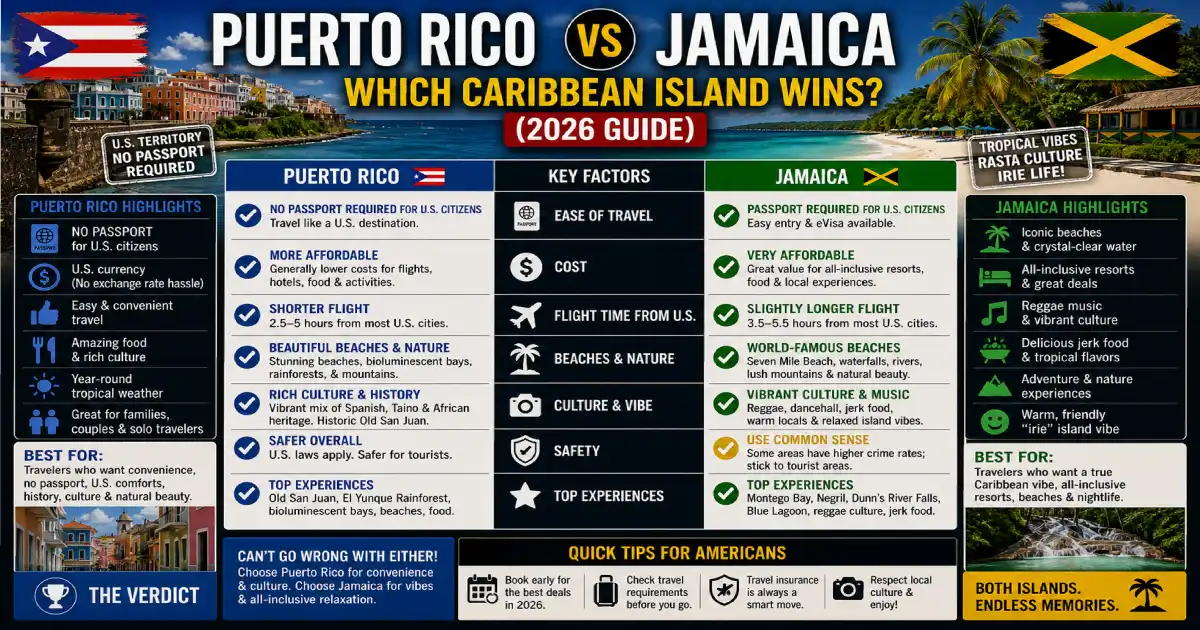
Puerto Rico and Jamaica are the two most visited Caribbean island destinations for American travelers — and the comparison between them is the most consequential single Caribbean planning decision most Americans will ever make, because the difference between them is not merely a matter of beach quality or hotel price but of the most fundamental travel planning question available: do you need a passport? Puerto Rico is a US territory — no passport required for American citizens, US dollar currency, US cell phone plans, direct flights from every major American city — and the most historically layered, the most culturally festive, and the most bioluminescent-bay-equipped Caribbean island accessible to Americans without any international travel documentation. Jamaica requires a valid US passport, accepts Jamaican dollars (though US dollars are widely accepted), and delivers the most globally recognized Caribbean music culture (reggae was born here), the most celebrated Caribbean waterfall attraction (Dunn’s River Falls in Ocho Rios, the most visited natural attraction in the Caribbean), the most legendary cliff-diving bar (Rick’s Café in Negril), and a food and cultural identity that is the most internationally exported of any Caribbean island nation.
Both islands have been producing extraordinary Caribbean experiences for American visitors for decades. Both have genuine security concerns in specific areas that require honest acknowledgment. Both have world-class beaches, genuinely excellent food cultures, and the specific warmth and creative energy that make the Caribbean the most visited tropical region accessible from the United States. The choice between them — passport vs no-passport, Spanish colonial history vs Rastafarian reggae culture, bioluminescent bays vs Blue Mountains coffee — is the most specifically productive Caribbean comparison available to the American Tier 1 traveler.
For complete destination guides, see our Things to Do in Puerto Rico, Best Beaches in Puerto Rico, and Best Caribbean Islands 2026 guides.
The Most Important Fact First: Passport Requirements
Key Fact
🇵🇷 Puerto Rico
🇯🇲 Jamaica
Passport Required (Americans)
❌ No — US territory; driver’s license only
✅ Yes — valid US passport required
Currency
US Dollar
Jamaican Dollar; USD widely accepted in tourist areas
US Cell Phone Plans
No roaming charges — US plans work fully
International roaming applies; check with carrier
Flight from New York
~3.5 hours direct to SJU
~3.5 hours direct to MBJ (Montego Bay)
Flight from Miami
~2.5 hours direct
~1.5 hours direct — Jamaica closer from Miami
Average Roundtrip Airfare (NYC)
$280–$450 off-peak
$320–$520 off-peak
Midrange Hotel (per night)
$175–$310 (San Juan, April)
$180–$320 (Montego Bay midrange, April)
All-Inclusive Available
Limited — mostly boutique and hotel options
Excellent — Jamaica is the all-inclusive capital of the Caribbean
US State Dept Travel Advisory
No advisory — US territory
Level 3: Reconsider Travel (as of 2026) — resort areas generally safe
Primary Language
Spanish and English
English and Jamaican Patois
Quick Verdict: Puerto Rico vs Jamaica
Category
🇵🇷 Puerto Rico Wins
🇯🇲 Jamaica Wins
Winner
No Passport Required
✅ Driver’s license only
❌ Passport required
🇵🇷 Puerto Rico
Best Beaches
Flamenco Beach (world top 10), Vieques NWR
Seven Mile Beach Negril, Doctor’s Cave Montego Bay
🤝 Tie
History & Architecture
Old San Juan 500-year colonial city, El Morro, San Cristóbal
Rose Hall Great House, Port Royal (17th century pirate city)
🇵🇷 Puerto Rico
Music Culture
Salsa, bomba, plena — rich tradition
Reggae birthplace — Bob Marley Museum, most globally exported music
🇯🇲 Jamaica
Bioluminescent Bay
Mosquito Bay Vieques — brightest on Earth
None comparable
🇵🇷 Puerto Rico
Waterfalls & Nature
El Yunque (only tropical US National Forest)
Dunn’s River Falls, Blue Mountains, YS Falls
🇯🇲 Jamaica
Food
Mofongo, lechón, James Beard fine dining, rum
Jerk chicken (Boston Bay), ackee & saltfish, Blue Mountain coffee
🤝 Tie
Nightlife
San Sebastián Festival (Jan), Old San Juan year-round
Rick’s Café Negril, Montego Bay strip, dancehall scene
🤝 Tie
All-Inclusive Resorts
Limited options; better for independent travel
Best all-inclusive in the Caribbean — Sandals, Beaches, Iberostar
🇯🇲 Jamaica
Safety
No US State Dept advisory; US territory protections
Level 3 advisory; resort areas safe; caution required outside tourist zones
🇵🇷 Puerto Rico
Budget Travel
$4.50 ferry to Flamenco Beach; $1.50 piragua; $10 plate lunch
Local jerk chicken very affordable; resort pricing higher
🇵🇷 Puerto Rico
Festival Culture
San Sebastián (Jan) — most festive in Caribbean
Reggae Sumfest (July) — most celebrated Caribbean music festival
🤝 Tie (different events)
Coffee
Puerto Rican mountain coffee (Yauco, Lares) — excellent
Blue Mountain Coffee — among the most expensive and most celebrated coffees in the world
🇯🇲 Jamaica
Puerto Rico vs Jamaica: The Passport Question
The passport question is the most consequential single practical difference between Puerto Rico and Jamaica for American travelers — and it resolves the comparison immediately for a specific category of visitor.
Puerto Rico is a US territory: American citizens need only a valid driver’s license or state ID to enter, travel within, and depart Puerto Rico. No passport. No international travel documentation of any kind. The US dollar is the currency. US cell phone plans work without roaming charges. US customs applies on return (no international customs declaration for most goods). For the approximately 40% of American adults who do not currently hold a valid passport, Puerto Rico is the most genuinely international-feeling Caribbean experience accessible without the 4–6 week passport application process and the $165 passport fee.
Jamaica is an independent nation: a valid US passport is required for entry. Jamaican customs and immigration apply on arrival. The Jamaican dollar is the official currency (though US dollars are accepted at most tourist-area establishments at exchange rates that favor the resort operator rather than the traveler). US cell phone plans apply international roaming charges unless the carrier’s international plan is activated. For the traveler who already holds a valid passport, this creates no obstacle — Jamaica is as accessible as Puerto Rico. For the traveler whose passport has expired, whose children lack passports, or who is planning a trip on short notice without time to apply, Puerto Rico is the only Caribbean option.
Passport verdict: Puerto Rico wins unconditionally for American travelers without a passport — this is a binary fact rather than a preference comparison. For travelers with a valid passport, both islands are equally accessible and the comparison continues across every other category.
Puerto Rico vs Jamaica: Beaches
Puerto Rico’s Beaches — World-Class at the Top, Free by Constitution
Puerto Rico’s finest beaches — Flamenco Beach on Culebra Island and the Vieques National Wildlife Refuge beaches — are genuinely world-class and constitutionally free (every beach in Puerto Rico is legally guaranteed to be publicly accessible regardless of adjacent private development). Flamenco Beach’s powder-white coral sand, turquoise horseshoe bay, and the $4.50 ferry from Ceiba make it the most accessible world-ranked beach at the most specific price in the Caribbean. Vieques’s Red Beach, with its orange-tinted sand and the wild paso fino horses that appear at sunrise and sunset, produces the most photogenically extraordinary beach scene accessible in any US territory.
Puerto Rico’s mainland beaches (Condado, Isla Verde, Luquillo) are good resort and urban beaches — not world-class individually, but the Luquillo Beach kiosk corridor (60 food vendors, alcapurrias and piraguas at the beach’s edge) makes it the most complete beach-and-food combination accessible from San Juan without a ferry.
Jamaica’s Beaches — Seven Mile Beach and the North Coast’s Resort Corridor
Jamaica’s most celebrated beach — Seven Mile Beach in Negril — is the most expansive and the most consistently praised beach on the island: a 4-mile crescent (the “seven miles” measurement uses an older longer mile) of white-golden sand with calm Caribbean swimming, the cliff-diving bars at the Negril lighthouse end (Rick’s Café’s 35-foot cliff jumps are the most theatrical beach entertainment accessible at any Caribbean beach), and the most complete resort and boutique hotel infrastructure of any Jamaica beach. The specific sunset at Negril — the Caribbean coast faces due west, producing the most directly sun-into-the-ocean sunset accessible in Jamaica — is the most photogenically specific beach evening available on the island.
Doctor’s Cave Beach in Montego Bay is the most historically significant Jamaica beach — the British governor’s physician who recommended the healing properties of the water in the 1920s gave it the name, and the curved bay with its clear water and the Montego Bay city backdrop makes it the most accessible high-quality swimming beach from the airport. Frenchman’s Cove in Port Antonio — a private cove with a freshwater river meeting the Caribbean at the beach’s edge — is the most dramatically beautiful beach in Jamaica and the most frequently cited as the finest on the island by returning visitors who have moved beyond the Montego Bay resort corridor.
Beach verdict: Tie — Flamenco Beach is world-ranked and costs $4.50 to reach; Seven Mile Beach is equally beautiful and delivers the most theatrical sunset in the Caribbean. Frenchman’s Cove edges both with the freshwater river component; Carlos Rosario in Culebra edges both for shore snorkeling. The overall beach quality is genuinely comparable; the access cost advantage goes decisively to Puerto Rico’s constitutionally free beaches.
Puerto Rico vs Jamaica: History & Culture
Puerto Rico — 500 Years of Spanish Colonial Layering
Puerto Rico’s historical identity is the most specifically layered and the most architecturally preserved of any Caribbean island — the walled city of Old San Juan (inhabited since 1521, the oldest continuously occupied European settlement in the United States, with 500+ historically preserved buildings in every Caribbean color on blue cobblestone streets paved with volcanic ballast from Spanish galleons) is the most historically specific and the most architecturally extraordinary urban environment accessible in any Caribbean destination. El Morro and San Cristóbal — the Spanish colonial fortifications protecting the harbor entrance — are the most intact military architecture of the Spanish colonial era accessible in the Western Hemisphere, both maintained free of charge by the National Park Service.
The living cultural traditions: the San Sebastián Street Festival (January — the most festive and the most culturally specific annual event in the Caribbean, free admission, the island’s entire population celebrating simultaneously in Old San Juan’s cobblestone streets), the Loíza patron saint festival (July — the most specifically Afro-Puerto Rican cultural celebration in the Caribbean, bomba dancing, coconut vejigante masks), and the 78 municipalities’ year-round patron saint fiestas patronales — all represent living cultural expressions that are the most specifically Puerto Rican and the most publicly accessible in the Caribbean.
Jamaica — Reggae Birthplace and Global Cultural Export
Jamaica’s cultural identity is the most internationally recognized of any Caribbean island nation — the island that produced Bob Marley, Peter Tosh, Bunny Wailer, and the entire global reggae tradition (music that has been listed by UNESCO as an Intangible Cultural Heritage of Humanity), that invented jerk cooking (the wood-smoke and scotch bonnet pepper tradition at Boston Bay in Port Antonio that has been replicated on every continent but is available in its most original form only at its source), that produced the Rastafarian spiritual movement (the most globally recognized Caribbean religious and philosophical tradition), and that sends Blue Mountain Coffee (the most expensive single-origin coffee by international market price, grown in the Blue Mountains at 7,500+ feet) to the most discerning coffee markets in the world.
The Bob Marley Museum in Kingston — the most visited single cultural institution in Jamaica, housed in Bob Marley’s actual home and recording studio at 56 Hope Road — is the most emotionally specific and the most historically grounded music museum accessible in the Caribbean. The museum tour ($20/adult) delivers Marley’s personal effects, the bullet holes from the 1976 assassination attempt on the studio walls, and the specific sense of a living musical tradition’s physical origin that makes it the most compelling single cultural attraction in Jamaica.
History and culture verdict: Puerto Rico wins on architectural historical depth; Jamaica wins on globally recognized cultural identity and music heritage. The visitor who wants to walk 500-year-old cobblestones: Puerto Rico. The visitor who wants to stand in Bob Marley’s house and understand where reggae came from: Jamaica. Both are genuinely extraordinary cultural experiences that reward the visitor who engages with them seriously.
Puerto Rico vs Jamaica: Food
Puerto Rico’s Food — Mofongo, Lechón, Rum, and James Beard Recognition
Puerto Rico’s food culture is built on the most specifically Caribbean and the most specifically Puerto Rican culinary heritage accessible in any US territory: mofongo (the most specifically Puerto Rican dish — plantains mashed in a wooden pilón with garlic, chicharrón, and olive oil, the culinary synthesis of African, Spanish, and Taíno traditions in a single preparation), lechón on La Ruta del Lechón (whole roasted pig on wood spits in the Guavate mountain corridor — the most festive and the most communal food ritual accessible in the Caribbean on a Sunday afternoon), and the rum culture (Puerto Rico produces 70% of US-consumed rum — the Bacardí distillery tour is accessible via a $0.50 ferry from Old San Juan).
San Juan’s James Beard Award-nominated and award-winning restaurants (José Enrique in Santurce, Santaella, and the Condado fine dining scene) collectively represent the most nationally recognized Puerto Rican cuisine accessible in any Caribbean city. The Luquillo Beach kiosk corridor’s alcapurrias and the Old San Juan piragua carts ($1.50–$3) represent the most affordable and the most authentic Puerto Rican street food culture accessible at any price point.
Jamaica’s Food — Jerk Chicken, Ackee, and the World’s Most Famous Coffee
Jamaica’s food identity is the most globally replicated Caribbean cuisine — jerk cooking (the wood-smoke and scotch bonnet pepper preparation that has spawned jerk restaurants on every continent, but which is available in its most honest and most specifically original form at the Boston Bay jerk pits in Port Antonio, where the wood fires have been going since the 1950s and the chicken is cooked over the specific allspice wood that no non-Jamaican replication uses), ackee and saltfish (the national dish — the ackee fruit’s scrambled-egg appearance and the salted codfish’s specific brininess produce the most specifically Jamaican single breakfast accessible on the island), and Blue Mountain Coffee (grown at 7,500 feet in the Blue Mountains, processed by small estates, and available at the source for a fraction of the $60–$80/lb export price — the most specific coffee tourism experience accessible in the Caribbean).
Boston Bay jerk center (Port Antonio): The most historically specific and the most authentically prepared jerk chicken accessible in Jamaica — the wood fires and the scotch bonnet marinades at Boston Bay represent the original form of a globally replicated preparation; $8–$12 per portion, the most affordable genuinely excellent food accessible in Jamaica
Scotchies (Montego Bay and Kingston): The most celebrated jerk restaurant chain in Jamaica — pimento wood-smoked jerk chicken and pork in the most authentic preparation accessible in the Montego Bay tourist corridor; the most frequently recommended by Jamaican residents
Walkerswood jerk seasoning factory (Ocho Rios area): The most famous Jamaican spice producer — factory tours available; the most specifically Jamaican food souvenir accessible at the source
Food verdict: Tie — Puerto Rico’s mofongo tradition and Jamaica’s jerk culture are equally specific, equally delicious, and equally irreplaceable in their original forms. The visitor who wants the most affordable local food: Puerto Rico’s $5 plate lunch vs Jamaica’s $8 jerk chicken are comparable value. The visitor who wants the most globally celebrated single food souvenir: Blue Mountain Coffee from Jamaica at the source versus Puerto Rican rum from Bacardí at the distillery are equally specific and equally worth the trip.
Puerto Rico vs Jamaica: Safety
Safety is the most frequently asked and the most honestly discussed topic in the Puerto Rico vs Jamaica comparison — and both destinations require honest assessment rather than either reassurance or alarmism.
Puerto Rico Safety
Puerto Rico carries no US State Department travel advisory — it is a US territory with US federal law enforcement, US federal courts, and the same constitutional protections as any US state. The tourist-facing areas (Old San Juan, Condado, Isla Verde, Culebra, Vieques) are safe and well-traveled, with the same standard urban situational awareness recommended for any unfamiliar American city. Puerto Rico has neighborhoods with elevated crime rates (as does every US city) that tourists do not typically encounter, and the tourist infrastructure is the most developed of any Caribbean island destination for the American visitor.
The most important Puerto Rico safety note for June–November visitors: Atlantic hurricane season produces the most significant weather-related travel disruption risk; purchase travel insurance and monitor the National Hurricane Center (nhc.noaa.gov) during these months.
Jamaica Safety — The Honest Assessment
Jamaica carries a US State Department Level 3 travel advisory (“Reconsider Travel”) as of 2026 — the same advisory level as countries including South Africa, Turkey, and Colombia. The specific safety concern is violent crime in urban areas outside the resort zones, particularly Kingston and parts of Montego Bay outside the Hip Strip resort corridor. The honest assessment for the tourist visitor:
Resort areas are generally safe: The all-inclusive resorts in Montego Bay, Negril, and Ocho Rios operate within managed environments where the vast majority of Jamaica visitors experience no safety incidents. The resort corridor of Montego Bay (the Hip Strip), the Negril beach zone, and the Ocho Rios tourist area are the safest public spaces on the island for visitors
Stay in tourist zones: The US State Department advisory specifically references crime in non-tourist urban areas. Visitors who remain within the resort corridors, take organized excursions to attractions like Dunn’s River Falls and YS Falls, and use resort-arranged transportation experience the island with minimal safety concern
Use recommended transportation: Use resort-provided transportation or licensed JUTA taxis rather than unregulated transportation; avoid walking outside resort areas after dark; do not venture into Kingston neighborhoods without a locally arranged guide
The specific crime risk: Jamaica has one of the world’s highest per-capita murder rates, concentrated in urban garrison communities in Kingston and parts of Montego Bay’s non-tourist areas. This statistic is real and honest. It is also largely separate from the tourist experience in the managed resort zones — the same way that crime statistics for Baltimore or Detroit do not affect the experience of visiting Baltimore’s Inner Harbor or Detroit’s Motown Museum in the daytime
Safety verdict: Puerto Rico wins clearly — the absence of a US State Department advisory, the US territorial law enforcement infrastructure, and the absence of an urban crime concentration in tourist areas make Puerto Rico the more straightforwardly safe destination for the American visitor who has not traveled internationally before or who has specific safety concerns. Jamaica is safe in its resort zones for the majority of the tourists who visit it; the honest acknowledgment of the Level 3 advisory is the most responsible guidance for any Tier 1 audience member making this decision.
Puerto Rico vs Jamaica: Music & Nightlife
Puerto Rico — Salsa, Bomba, and the Most Festive Festival in the Caribbean
Puerto Rico’s music culture is built on the most specifically Caribbean and the most African-influenced traditions accessible in any US territory: salsa (Puerto Rico shares the co-invention of salsa with New York’s Puerto Rican community — the Fania Records era and the specific New York-San Juan axis of salsa production in the 1960s–1980s makes Puerto Rico’s salsa heritage as specifically genuine as any island’s), bomba (the African-derived drum and dance tradition of Loíza, where the dancer controls the drummer’s rhythm with body movement — the most specifically Afro-Caribbean music accessible in a live performance context in Puerto Rico), and plena (the call-and-response percussion tradition that is the most specifically Puerto Rican popular music form, distinct from both salsa and bomba).
The San Sebastián Street Festival — the most attended annual event in Puerto Rico (January 15–18, 2026 in Old San Juan) — transforms the blue cobblestone streets into the most festive public space in the Caribbean: live salsa on one corner, bomba on the next, brass band from the plaza, and the specific collective joy of the island’s entire population celebrating simultaneously. Free to attend. The most underrated major Caribbean festival accessible to Americans.
Jamaica — Reggae Birthplace and Dancehall Capital
Jamaica’s music identity is the most globally recognized of any Caribbean island — reggae (the most internationally distributed Caribbean music genre, with Bob Marley’s catalog the most globally recognizable music from any Caribbean artist), dancehall (the high-tempo electronic and DJ-driven descendant of reggae that has influenced hip-hop, R&B, and Afrobeats globally since the 1980s), and ska (the upbeat precursor to reggae that was Jamaica’s primary musical export before reggae superseded it in the late 1960s) collectively represent the most internationally significant music output from a Caribbean island of 3 million people in the history of recorded music.
The practical Jamaica music experiences:
Bob Marley Museum (Kingston, 56 Hope Road): The most important single music heritage site in the Caribbean — Marley’s personal home, his recording studio, and the bullet holes from the 1976 assassination attempt preserved in the studio wall. The most emotionally specific music museum accessible in Jamaica ($20/adult)
Reggae Sumfest (Montego Bay, July): The most celebrated Caribbean music festival — the most nationally and internationally significant annual reggae event accessible in Jamaica, drawing the most celebrated reggae and dancehall artists from Jamaica and the Caribbean diaspora
Rick’s Café (Negril): The most theatrical sunset bar in the Caribbean — the 35-foot cliff jumps into the Caribbean, the live reggae, and the most dramatically positioned sunset viewing of any Caribbean bar produce the most specifically Jamaica tourist experience accessible in a single afternoon and evening
Music and nightlife verdict: Jamaica wins on global music heritage — reggae’s international significance and the Bob Marley Museum’s emotional weight make Jamaica’s music culture the most specifically and the most globally celebrated in the Caribbean. Puerto Rico’s San Sebastián Festival is the most festive single event in the Caribbean. Both are genuine, both are excellent, and both reward the visitor who shows up for the music specifically.
Puerto Rico vs Jamaica: Nature & Adventure
Puerto Rico Nature — El Yunque and the Bioluminescent Advantage
Puerto Rico’s most significant nature advantage over Jamaica: El Yunque National Forest (the only tropical rainforest in the US National Forest system, 28,000 acres of the Sierra de Luquillo with the most accessible tropical rainforest hiking in any US territory — the La Mina Falls trail is 1.8 miles round trip and produces a 35-foot waterfall accessible in 90 minutes from San Juan) and Mosquito Bay bioluminescent bay in Vieques (the Guinness World Record holder for the brightest bioluminescent bay in the world — the most specifically magical and the most irreplaceable nature experience in the Caribbean, accessible on a $65 kayak tour on any new moon night).
Puerto Rico’s additional nature offerings: the Camuy River Cave Park (the world’s third-largest underground river system, the most dramatic cave system accessible in the Caribbean as a day trip from San Juan), the Cabo Rojo Salt Flats and Playa Sucia (the most dramatically positioned mainland beach and the most productive shorebird habitat in southwestern Puerto Rico), and the Vieques National Wildlife Refuge’s 17,000+ acres of protected coastal wilderness — the largest nature reserve in the Caribbean managed by the US Fish and Wildlife Service.
Jamaica Nature — Blue Mountains, Waterfalls, and the Most Famous Climb in the Caribbean
Jamaica’s nature experiences are the most varied and the most physically dramatic of any Eastern Caribbean island:
Dunn’s River Falls (Ocho Rios): The most visited single natural attraction in the Caribbean — the 600-foot cascading limestone waterfall descending directly to a white sand beach on the Caribbean coast, with the organized chain-of-hands group climb (tourists hold hands and climb the falls together, guided by a licensed falls guide) producing the most theatrical and the most communally specific nature experience accessible in Jamaica ($25/adult). The most visited attraction in Jamaica and the single experience that most first-time Jamaica visitors cite as unforgettable.
Blue Mountains National Park: The most biodiverse and the most vertically dramatic landscape in Jamaica — the Blue Mountain Peak (7,402 feet, the highest point in Jamaica) accessible by an overnight hike departing at 2 AM from the Whitfield Hall guesthouse for the summit sunrise. The most challenging and the most rewarding hiking accessible in the Caribbean outside volcanic summit hikes on other islands. The coffee estates on the mountain’s slopes produce the most celebrated single-origin coffee in the world at the most specific coffee tourism experience available in the Caribbean.
YS Falls (St. Elizabeth): The most naturally pristine waterfall complex in Jamaica — eight waterfalls on the YS River in the remote south coast of Jamaica, accessible by bamboo raft on the river, with rope swings and natural swimming pools at each waterfall level. Less crowded than Dunn’s River Falls and more ecologically intact ($20/adult).
Luminous Lagoon (Falmouth): Jamaica’s bioluminescent bay — the Luminous Lagoon near Falmouth on the north coast produces a genuine bioluminescent effect (fish and boats leave visible light trails in the water) but at significantly less intensity than Puerto Rico’s Mosquito Bay. The boat tour ($20/adult) is accessible and pleasant; the glow is real but notably less dramatic than Mosquito Bay’s Guinness-record brightness.
Nature verdict: Tie with Puerto Rico winning bioluminescence; Jamaica winning waterfall spectacle. Dunn’s River Falls is the most iconic single nature experience in the Caribbean and genuinely worth the Ocho Rios excursion. Mosquito Bay is the most specifically extraordinary nature experience in the Caribbean and unavailable at any comparable intensity in Jamaica. El Yunque and the Blue Mountains are equally rewarding tropical mountain experiences. The visitor who prioritizes waterfalls: Jamaica. The visitor who prioritizes bioluminescence: Puerto Rico, unconditionally.
Puerto Rico vs Jamaica: All-Inclusive vs Independent Travel
This is the most practically useful single comparison point for the majority of American Caribbean vacation planners — and the answer is genuinely asymmetric:
Jamaica — The All-Inclusive Capital of the Caribbean
Jamaica pioneered the Caribbean all-inclusive resort model and remains its most developed and most competitive market. The Sandals, Beaches, Iberostar, Moon Palace, and Royalton resort chains all operate their most celebrated Jamaica properties — the Sandals Montego Bay and Sandals Royal Caribbean produce the most consistently praised all-inclusive experiences of any Caribbean brand, and the Beaches Negril is the most celebrated family all-inclusive in the region. For the traveler who wants to pay one price and have everything included (meals, drinks, water sports, entertainment, and transfers), Jamaica’s all-inclusive sector is the most developed, the most competitive, and the most value-complete in the Caribbean. All-inclusive pricing: $300–$600/person/night at Sandals and Beaches, with the full resort experience including premium spirits, gourmet dining, snorkeling, kayaking, and nightly entertainment.
Puerto Rico — Better for Independent Travel
Puerto Rico’s accommodation landscape is less developed in the all-inclusive format — the island has a handful of all-inclusive properties (the El Conquistador Resort and the Melia Coco Beach are the most complete) but significantly fewer than Jamaica’s resort-dense north coast. Puerto Rico’s strength is independent travel: the $4.50 ferry to Flamenco Beach, the $65 bioluminescent bay kayak tour, the $18 mofongo plate lunch, and the free Old San Juan cobblestone walk produce a genuinely extraordinary Caribbean experience at a total daily cost that the all-inclusive format cannot match for value-conscious independent travelers.
All-inclusive verdict: Jamaica wins clearly — if all-inclusive is the primary vacation format preference, Jamaica’s Sandals and Beaches properties are the most celebrated in the Caribbean and significantly more developed than Puerto Rico’s limited all-inclusive sector. Independent travelers who prefer to customize their experience: Puerto Rico’s flexibility, lower costs, and constitutional free-beach access make it the superior independent-travel destination.
🇯🇲 Jamaica (cheaper; Puerto Rico’s is dramatically better)
Waterfall Attraction
El Yunque La Mina Falls (free hike after $2 vehicle entry)
Dunn’s River Falls $25; YS Falls $20
🇵🇷 Puerto Rico (cheaper but different scale)
Cell Phone Costs
$0 roaming — US plans work fully
$10–$25/day international plan (varies by carrier)
🇵🇷 Puerto Rico
Museum Entry
El Morro NPS grounds free; museum $10
Bob Marley Museum $20
🇵🇷 Puerto Rico (more free NPS sites)
Cost verdict: Puerto Rico wins overall — the no-roaming advantage, the lower airfare from the East Coast, the constitutionally free beach access, and the El Yunque free-hike-after-$2-vehicle-entry collectively make Puerto Rico the more affordable independent-travel Caribbean destination. At the all-inclusive tier, Jamaica and Puerto Rico are comparable in price — Jamaica simply has more and better all-inclusive options.
Who Should Visit Puerto Rico?
Choose Puerto Rico if you:
Don’t have a valid passport — the most binary and the most decisive reason; Puerto Rico is the only Caribbean destination requiring no passport for Americans
Want the most vivid bioluminescent bay experience in the world — Mosquito Bay in Vieques (Guinness World Record) is unavailable in Jamaica at any comparable intensity
Want the most historically preserved Spanish colonial city in the Caribbean — Old San Juan’s El Morro fortress, blue cobblestones, and 500 years of preserved architecture are unavailable in Jamaica
Are visiting for the San Sebastián Street Festival (January) — the most festive public event in the Caribbean; free to attend
Prefer independent travel over all-inclusive format — Puerto Rico’s $4.50 Culebra ferry, $1.50 piragua, and free beach access reward the independent traveler
Are a first-time international traveler who wants the safest and the most logistically familiar Caribbean experience — US dollar, US cell plans, US law enforcement, no customs complexity
Are bringing children without passports — the most practical no-passport family Caribbean vacation available
Who Should Visit Jamaica?
Choose Jamaica if you:
Want an all-inclusive resort experience — Jamaica’s Sandals, Beaches, and Iberostar properties are the most celebrated all-inclusive resorts in the Caribbean; Puerto Rico’s all-inclusive sector is significantly less developed
Are a music lover who specifically wants to visit Bob Marley’s home and recording studio at 56 Hope Road in Kingston — the most emotionally specific music heritage experience in the Caribbean
Want to climb Dunn’s River Falls — the most iconic and the most theatrical single nature experience in the Caribbean; not available in Puerto Rico
Want to eat the original jerk chicken at Boston Bay in Port Antonio — the most specific and the most historically authentic jerk experience available anywhere in the world; Puerto Rico’s jerk is a pale echo
Are visiting for Reggae Sumfest (July, Montego Bay) — the most celebrated Caribbean music festival and the most internationally significant reggae concert accessible in the Caribbean
Want to experience Seven Mile Beach Negril at sunset with Rick’s Café cliff diving — the most theatrical and the most specifically Jamaica sunset experience available
Are a coffee enthusiast who wants Blue Mountain Coffee at its source — the most expensive and the most celebrated single-origin coffee in the world, available at the estate level in the Blue Mountains
Can You Visit Both Puerto Rico and Jamaica?
Yes — and for the Tier 1 traveler who has a valid passport and 10+ days, combining Puerto Rico and Jamaica produces the most complete English-speaking Caribbean experience accessible in a single trip. They are approximately 1,000 miles apart (no direct ferry; requires a short flight or routing through a hub city). The most efficient combination routing:
7–10 day combination: Fly into San Juan (SJU) → 3 days Puerto Rico (Old San Juan, El Yunque, Mosquito Bay on new moon night, Flamenco Beach ferry) → fly San Juan to Montego Bay ($80–$150 on JetBlue or American, 2-hour flight) → 4 days Jamaica (Dunn’s River Falls, Bob Marley Museum day trip from Montego Bay, Negril Seven Mile Beach and Rick’s Café sunset, Blue Mountain coffee day trip) → fly Montego Bay home
Island-hopper routing: Fly from the US mainland to Puerto Rico first (shorter flight from the East Coast), then connect to Jamaica; return from Jamaica directly to the US mainland — the most efficient routing that minimizes backtracking
Puerto Rico vs Jamaica: Practical Tips
Topic
🇵🇷 Puerto Rico
🇯🇲 Jamaica
Best Time to Visit
April (post-spring-break value, dry season); January for San Sebastián Festival
December–April (dry season); July for Reggae Sumfest
Worst Time
August–September (peak hurricane season — travel insurance essential)
September–October (peak hurricane season + heaviest rainfall)
Best Area to Stay
Old San Juan (history walkers); Condado (resort amenities); Vieques (beach + bio bay)
Negril (Seven Mile Beach + Rick’s Café); Montego Bay (airport + Hip Strip); Port Antonio (most authentic)
Don’t Miss
Mosquito Bay new moon kayak ($65); Flamenco Beach 6 AM ferry ($4.50); Old San Juan sunset cobblestone walk (free)
Bob Marley Museum Kingston ($20); Boston Bay jerk chicken ($10); Rick’s Café Negril sunset cliff diving (free to watch)
Safety Tip
Standard urban awareness; hurricane travel insurance June–November
Stay in resort zones; use licensed JUTA taxis or resort transport; avoid Kingston and non-tourist areas after dark
Key Reservations
Culebra ferry (ATM app); Mosquito Bay kayak (2–3 weeks ahead peak season); El Yunque ($2, recreation.gov)
Dunn’s River Falls (jamaicaattractions.com, book 1 week ahead peak season); Blue Mountain Coffee Estate tour (check individual estate schedules)
Getting Around
Rental car for mainland; ferry to Culebra and Vieques; Uber in metro San Juan
Resort shuttle or JUTA licensed taxis; rental car for independent travelers (drive on left); no Uber in Jamaica
Frequently Asked Questions: Puerto Rico vs Jamaica
Do I need a passport for Puerto Rico or Jamaica?
Puerto Rico requires no passport for American citizens — a valid US driver’s license or state ID is sufficient for entry, travel, and departure. Puerto Rico is a US territory, meaning American citizens have full territorial rights without international travel documentation. Jamaica requires a valid US passport — a driver’s license alone is not sufficient for entry into Jamaica, and American citizens who arrive at Kingston or Montego Bay airports without a valid passport will be denied entry and returned to their departure city. If you do not currently have a valid US passport and want a Caribbean vacation within the next 4–6 weeks, Puerto Rico is the only Caribbean destination that does not require one.
Is Jamaica safe for American tourists?
Jamaica’s resort areas (Negril’s Seven Mile Beach, Montego Bay’s Hip Strip, Ocho Rios’s tourist corridor) are generally safe for American tourists who remain within the managed resort zones and use licensed JUTA taxis or resort-provided transportation. The US State Department’s Level 3 (“Reconsider Travel”) advisory reflects Jamaica’s elevated crime statistics in urban areas outside the tourist zones — particularly Kingston and parts of Montego Bay’s non-tourist neighborhoods. The most honest safety guidance: the majority of American tourists who visit Jamaica’s all-inclusive resorts and take organized excursions to major attractions (Dunn’s River Falls, Bob Marley Museum, Negril) experience no safety incidents. The safety concern is real and should not be dismissed; staying within the well-established tourist infrastructure dramatically reduces the risk. Purchase travel insurance, use resort-arranged transportation, and consult the US State Department’s current Jamaica travel advisory (travel.state.gov) before booking.
Which has better beaches — Puerto Rico or Jamaica?
Both destinations produce genuinely world-class beaches, with different specific advantages. Puerto Rico’s Flamenco Beach in Culebra is consistently ranked in the world’s top 10 beaches and costs $4.50 to reach on the ferry — no Jamaica beach offers that specific value equation. The Vieques NWR beaches (Red Beach, Blue Beach) are among the most pristine in the Caribbean. Jamaica’s Seven Mile Beach in Negril is the most celebrated and the most expansive on the island, with the theatrical Rick’s Café cliff diving at the western end producing the most specifically Jamaica beach experience. Frenchman’s Cove in Port Antonio (a private cove with a freshwater river meeting the Caribbean at the beach’s edge) is the most dramatically beautiful single beach in Jamaica and genuinely competitive with Flamenco Beach for overall beauty. Overall beach quality: essentially a tie at the top end, with Puerto Rico winning on access value (constitutional free beaches, $4.50 ferry) and Jamaica winning on the all-inclusive resort beach infrastructure.
Which is better for a honeymoon — Puerto Rico or Jamaica?
Both are genuinely excellent honeymoon destinations — the choice depends on the couple’s specific priorities. Jamaica wins for the all-inclusive honeymoon — the Sandals Royal Caribbean and Sandals Montego Bay are the most celebrated couples-only all-inclusive resorts in the Caribbean, with the butler service, private plunge pools, and the Seven Mile Beach sunset as the most specifically romantic resort package accessible. Puerto Rico wins for the experience-driven honeymoon — the Mosquito Bay bioluminescent kayak on a new moon night (the most romantically extraordinary natural experience in the Caribbean), the Old San Juan cobblestone evening with the El Morro ramparts lit at dusk, and the Vieques wild horse beaches at sunrise collectively produce a honeymoon that is more experientially specific and more uniquely Caribbean-colonial in character than Jamaica’s resort-centric alternative. Both produce honeymoon memories. Jamaica produces the more luxurious resort honeymoon. Puerto Rico produces the more specifically extraordinary experiential honeymoon.
Is Puerto Rico or Jamaica better for food?
Both produce genuinely distinctive and genuinely excellent Caribbean food traditions that serve different palates — the comparison is a tie at the top end with specific category winners. Puerto Rico wins on: James Beard Award-nominated fine dining (the most nationally recognized Caribbean restaurant scene accessible in any US territory), the mofongo tradition (the most specifically Puerto Rican single dish), and the rum culture (70% of US rum is Puerto Rican). Jamaica wins on: the most globally replicated Caribbean food tradition (jerk chicken at Boston Bay has been copied on every continent), the most celebrated single-origin coffee in the world (Blue Mountain Coffee at the estate), and the most iconic national dish internationally (ackee and saltfish is the most specifically Jamaican and the most frequently cited Caribbean national dish). The visitor who wants the most internationally famous Caribbean food identity: Jamaica. The visitor who wants the most regionally specific and the most locally rooted Caribbean food experience: Puerto Rico’s lechón on a Sunday at La Ruta del Lechón is the most communal and the most irreplaceable Puerto Rican food moment.
Final Verdict: Puerto Rico vs Jamaica
Puerto Rico and Jamaica are the two most consequential Caribbean choices for American travelers — and the most honest single-sentence verdict for each:
Choose Puerto Rico if you want the most logistically accessible and the most culturally layered Caribbean island experience available to Americans without a passport — the Old San Juan cobblestones and El Morro fortress that are the most historically specific urban environment in any US territory, the Mosquito Bay bioluminescent kayak that is the most vivid natural light experience in the Western Hemisphere, the Flamenco Beach turquoise that costs $4.50 to reach and $0 to use, the San Sebastián Festival’s cobblestone-street celebration that is the most festive public event in the Caribbean, and the mofongo and lechón that are the most specifically Puerto Rican food available at any price. Puerto Rico is not “Jamaica without the passport requirement.” It is its own island, with its own 500-year history, its own African-Spanish-Taíno cultural synthesis, its own bioluminescent bay that no other island in the hemisphere can match, and its own constitutional guarantee that every beach is free. It is the most underestimated major Caribbean destination available to Americans, and the visitor who goes expecting a consolation prize and finds the best bio bay on earth and a San Sebastián Festival Saturday in Old San Juan will return understanding that Puerto Rico was never the consolation and was always the destination.
Choose Jamaica if you want the most internationally recognized Caribbean cultural identity (reggae music, the Bob Marley Museum, the jerk tradition), the most celebrated all-inclusive resort experience in the Caribbean (Sandals Montego Bay and Sandals Royal Caribbean are the most consistently praised couples resorts in the region), the most iconic Caribbean waterfall experience (Dunn’s River Falls — 600 feet of limestone cascade directly to the Caribbean coast, climbed hand-in-hand with strangers in the most communal single tourist experience in the Caribbean), the most legendary cliff-diving bar in the world (Rick’s Café at Negril, where the 35-foot jumps happen while the sun sets into the Caribbean and the live reggae plays from the bar terrace), and the most celebrated single-origin coffee on earth (Blue Mountain Coffee at the estate, at a fraction of the $60/lb export price). Jamaica requires a passport and a US State Department Level 3 advisory awareness. Both are honest requirements for a genuinely extraordinary island that has produced more globally significant music, more globally replicated food, and more globally recognized cultural output per square mile than any other Caribbean island nation of its size. The passport is worth getting. The island is worth visiting. The jerk chicken at Boston Bay is worth the drive from Montego Bay.
Both islands are genuinely extraordinary. Puerto Rico requires no passport. Jamaica requires a passport and deserves one. The best Caribbean life includes both — and the 1,000 miles between them is the most productively island-hopping air corridor in the Caribbean for the American traveler who has the passport, the time, and the appetite for both the bioluminescent bay and the jerk pit.
—
For the most current visitor information, safety advisories, entry requirements, and travel planning resources for Puerto Rico and Jamaica, consult these official government sources:
Discover Puerto Rico — Official Puerto Rico Tourism (Government-Supported) — Official Puerto Rico destination marketing organization covering hotel listings, event calendars, ferry schedules to Culebra and Vieques, El Yunque reservation requirements, and all current visitor resources for Puerto Rico.
Visit Jamaica — Jamaica Tourist Board (Official Government Agency) — Official Jamaica government tourism authority covering resort areas, attraction listings, licensed JUTA taxi information, Dunn’s River Falls booking, and all current Jamaica visitor resources maintained by the Jamaica Tourist Board.
US Department of State — Official Jamaica Travel Advisory — Official US government travel advisory for Jamaica including the current safety level designation, specific risk areas, emergency contact information for US citizens in Jamaica, and the most authoritative guidance for American travelers visiting the island.
—
About Travel TouristerTravel Tourister’s Caribbean specialists have extensively explored both Puerto Rico and Jamaica — from Mosquito Bay’s bioluminescent new moon kayak and Old San Juan’s San Sebastián Festival cobblestones to Jamaica’s Bob Marley Museum and Boston Bay jerk pits — to provide the most honest and most specific comparison available for American Tier 1 travelers choosing between the Caribbean’s two most visited and most genuinely different island destinations.Need help choosing between Puerto Rico and Jamaica? Our specialists can help you plan the optimal island itinerary, book the Mosquito Bay kayak on the correct moon phase, navigate the Jamaica resort corridor safely, time visits around the San Sebastián Festival or Reggae Sumfest, and identify the best food, beaches, and cultural experiences at each destination for any travel style or budget.
Posted By : Vinay
As a lead contributor for Travel Tourister, Vinay is dedicated to serving our Tier 1 audience (US, UK, Canada, Australia). His mission is to deliver precise, fact-checked news and actionable, data-driven articles that empower readers to make informed decisions, minimize travel risks, and maximize their adventure without compromising safety or budget.
Travel Tourister is a leading Travel portal where we introduce travellers to trusted travel agents to make their journey hasselfree, memorable And happy. Travel Tourister is a platform where travellers get Tour packages ,Hotel packages deals through trusted travel companies And hoteliers who are working with us across the world. We always try to find new and more travel agents and hoteliers from every nook and corners across the world so that you could compare the deals with different travel agents and hoteliers and book your tour or hotel with the one you have chosen according to your taste and budget.




 Call
Call Enquiry