Puerto Rico vs Cancun: Which Should You Visit in 2026?
Published on : 04 May 2026
Puerto Rico vs Cancun — No Passport vs Mexico: The Decision 10 Million Americans Make Every Year
By Travel Tourister | Updated May 2026
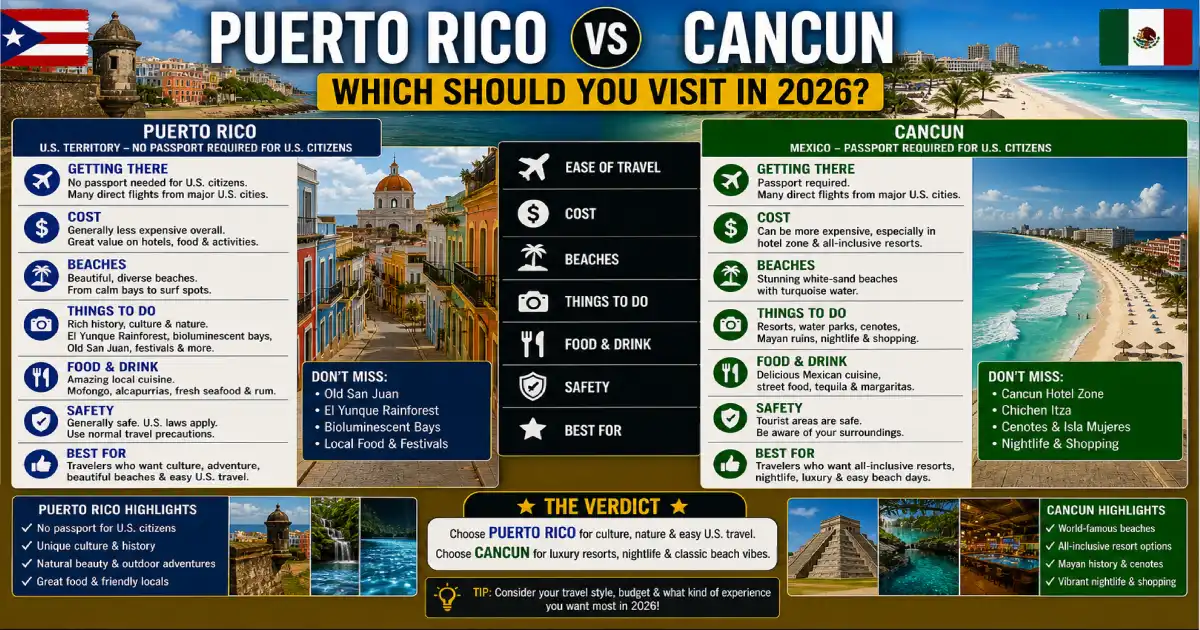
Puerto Rico and Cancun are the two most-searched Caribbean vacation destinations by American travelers — and they sit on opposite sides of the most consequential single travel planning question available: do you need a passport? Puerto Rico is a US territory — no passport, US dollar, US cell plans, no customs complexity, direct flights from every major American city in 2.5–3.5 hours from the East Coast. Cancun is in Mexico — passport required, Mexican peso (though US dollars are widely accepted in the Hotel Zone), international roaming charges apply, and US customs on return with the $800 duty-free limit. The passport question alone resolves the comparison for millions of American travelers who haven’t renewed their documentation or who are planning on short notice. But for the 148 million Americans who hold valid passports, the comparison goes deeper — into beach water color (Cancun’s turquoise is objectively more vivid), all-inclusive resort infrastructure (Cancun’s Hotel Zone is the most developed all-inclusive corridor in the Western Hemisphere), historical depth (Puerto Rico’s Old San Juan vs Cancun’s day-trip access to Chichén Itzá and the Mayan ruins), bioluminescence (Puerto Rico’s Mosquito Bay is the world’s brightest, unavailable near Cancun), safety (both carry specific advisories that require honest discussion), and value (Cancun’s all-inclusive pricing is extremely competitive; Puerto Rico’s independent travel value is among the best in the Caribbean).
This guide breaks down every meaningful category honestly and delivers the clearest verdict on which destination is right for your specific trip priorities in 2026.
For complete guides, see our Things to Do in Puerto Rico, Best Beaches in Puerto Rico, and Best Caribbean Islands 2026 guides.
The Most Important Facts First
Key Fact
🇵🇷 Puerto Rico
🇲🇽 Cancun
Passport Required (Americans)
❌ No — US territory; driver’s license only
✅ Yes — valid US passport required for Mexico
Currency
US Dollar only
Mexican Peso; USD accepted in Hotel Zone (poor exchange rate)
US Cell Phone Plans
No roaming — US plans work fully
Most US carriers include Mexico — check your plan
Flight from New York
~3.5 hours direct to SJU
~4 hours direct to CUN
Flight from Miami
~2.5 hours direct
~1.5 hours direct — Cancun closer from Miami
Flight from Chicago/Midwest
~4 hours (often connection required)
~3.5 hours direct — Cancun wins from Midwest
Average Roundtrip Airfare (NYC)
$280–$450 off-peak
$250–$420 off-peak — often cheaper than PR
All-Inclusive Resorts
Limited — Puerto Rico better for independent travel
6,000+ cenotes in Yucatan — most unique freshwater experience in the Americas
🇲🇽 Cancun
Snorkeling & Diving
Carlos Rosario Culebra — excellent shore snorkeling
Mesoamerican Barrier Reef (2nd largest in world) — world-class diving
🇲🇽 Cancun
Food Culture
Mofongo, lechón, James Beard fine dining, rum
Cochinita pibil, Yucatecan cuisine, taco al pastor, mezcal
🤝 Tie (different traditions)
Nightlife
Old San Juan, San Sebastián Festival (Jan)
Coco Bongo, Hotel Zone club strip — most famous nightlife in Mexico
🇲🇽 Cancun (for club nightlife)
Safety
No US State Dept advisory — US territory
Level 2 advisory — Hotel Zone generally safe; exercise caution
🇵🇷 Puerto Rico
Independent Travel Value
$4.50 ferry to Flamenco Beach; free beaches constitutionally
Outside Hotel Zone very affordable; street tacos $1–$2
🇲🇽 Cancun (local cost of living very low)
Tap Water Safety
✅ Safe — US EPA standards
❌ Do NOT drink tap water
🇵🇷 Puerto Rico
Rainforest Access
El Yunque — only tropical US National Forest
No rainforest; jungle mangroves accessible by tour
🇵🇷 Puerto Rico
Puerto Rico vs Cancun: The Passport Question
Puerto Rico requires no passport for American citizens — driver’s license or state ID only, US dollar currency, no customs declaration on return, US cell phone plans work without roaming charges. Cancun requires a valid US passport — the most commonly forgotten and most frequently expired travel document among the approximately 40% of American adults who do not currently hold one. For any American without a current valid passport, Puerto Rico is the only major Caribbean destination accessible immediately.
For the 148 million Americans who hold valid passports, the passport question becomes a matter of preference rather than logistics. Cancun is equally accessible — the flight from New York is approximately 4 hours (30 minutes longer than San Juan), and from the Midwest and South (Chicago, Dallas, Houston, Atlanta), Cancun is actually closer and better served with direct flights than Puerto Rico. From Miami, Cancun is a 1.5-hour direct flight — the most accessible major Caribbean destination from South Florida. The passport difference for the already-passport-holding American traveler is a 10-second document check at the Cancun customs line rather than a genuine travel barrier.
Passport verdict: Puerto Rico wins unconditionally for Americans without a passport. For passport holders, this distinction matters less than every other category in this comparison.
Puerto Rico vs Cancun: Beaches & Water
Puerto Rico Beaches — World-Ranked, Constitutionally Free
Puerto Rico’s finest beaches — Flamenco Beach on Culebra Island (consistently ranked in the world’s top 10 by Dr. Beach, Travel + Leisure, and Condé Nast Traveler) and the Vieques National Wildlife Refuge beaches (Red Beach, Blue Beach, Sun Bay) — are the most genuinely world-class beaches accessible in any US territory. Flamenco Beach’s powder-white coral sand, turquoise horseshoe bay geometry, and the $4.50 ferry that delivers it make it the most affordable world-ranked beach access available to Americans without leaving US territorial waters. Every Puerto Rico beach is constitutionally free and publicly accessible — no resort can close a Puerto Rico beach to the public.
Puerto Rico’s mainland beaches (Condado, Isla Verde, Luquillo) are good resort beaches — warm, swimmable, and well-facilitated — but notably inferior in water clarity to both Culebra and Cancun. The honest mainland Puerto Rico beach assessment: take the ferry to Culebra or Vieques. The mainland beaches are for mornings before the ferry and evenings after it.
Cancun Beaches — The Most Vivid Turquoise in the Caribbean
Cancun’s Hotel Zone beaches deliver the most immediately and most visually striking Caribbean water color accessible anywhere in the Mexican Caribbean — the specific turquoise of the water between Cancun and Isla Mujeres, produced by the shallow Yucatan shelf’s white sand bottom reflecting sunlight through the water column, is objectively more vivid and more cinematically Caribbean-looking than any mainland Puerto Rico beach and genuinely competitive with Culebra’s finest days. The Hotel Zone’s 14 miles of Caribbean-facing beach provides the most consistently excellent swimming conditions of any Mexico resort corridor, with the calm western Caribbean producing waves small enough for comfortable all-day swimming.
The specific best Cancun-area beaches:
Playa Delfines (Hotel Zone, free public beach): The most panoramic and the most Instagram-famous public beach in Cancun — the famous CANCUN sign, the widest beach in the Hotel Zone, and the most open-water Caribbean view accessible without a resort wristband. Free to access; no resort required.
Playa Norte, Isla Mujeres (20-min ferry, $10 roundtrip): The most frequently cited “best beach near Cancun” — a calm, shallow Caribbean bay with water so clear the sand bottom is visible at chest depth; voted among the Caribbean’s finest beaches repeatedly. The most specific ferry-accessible beach upgrade from the Hotel Zone.
Playa Mujeres (north of Hotel Zone): The most pristine and the least crowded beach accessible from Cancun — the upscale hotel corridor north of the Hotel Zone where the beach is wider, cleaner, and less developed than the main Hotel Zone strip.
Beach verdict: Cancun wins on Hotel Zone water color and accessibility; Puerto Rico wins on Flamenco Beach’s world ranking and the constitutional free-access principle. The honest single comparison: Cancun’s Hotel Zone beach is more immediately and more consistently turquoise than Puerto Rico’s mainland beaches. Culebra’s Flamenco Beach on a calm day is competitive with Cancun’s finest. The $4.50 ferry makes Flamenco more specifically extraordinary as a value equation.
Puerto Rico vs Cancun: History & Culture
Puerto Rico — 500 Years of Spanish Colonial Depth
Old San Juan is the most historically layered and the most architecturally preserved Spanish colonial city in the Caribbean — inhabited since 1521, with 500+ historically classified buildings in every Caribbean color along blue cobblestone streets, the El Morro and San Cristóbal fortifications (the most intact Spanish colonial military architecture in the Western Hemisphere, maintained free by the National Park Service), and the Bacardí rum distillery accessible via a $0.50 ferry from the old city. The San Sebastián Street Festival (January) is the most attended and the most festive annual event in the Caribbean. The Loíza Afro-Puerto Rican cultural tradition, the bomba and plena music, and the 78 municipios’ year-round patron saint festivals represent the most continuously living Caribbean cultural calendar accessible in any US territory.
Cancun — Gateway to the Mayan World
Cancun itself has almost no pre-resort history — the Hotel Zone was a barrier island of 117 inhabitants when FONATUR (Mexico’s national tourism development fund) selected it for development in 1974. What Cancun provides is access — to the most significant ancient civilization accessible as a day trip from any Caribbean resort destination:
Chichén Itzá (2.5-hour drive, or organized tour): One of the New Seven Wonders of the World — the El Castillo pyramid (the most photographed single pre-Columbian structure in the Americas), the Great Ball Court (the largest in Mesoamerica), and the Temple of Warriors constitute the most significant accessible Mayan archaeological complex in Mexico. Every organized Chichén Itzá tour from Cancun includes a cenote swim; book directly or through the hotel for the most organized access ($65–$85/person including transport). The most compelling single day trip accessible from any Caribbean resort hotel.
Tulum (1.5-hour drive south): The most photographically dramatic Mayan ruins — the cliff-top coastal site overlooking the turquoise Caribbean produces the most specifically Yucatan-landscape composition accessible at any Mexican archaeological site. Overcrowded in peak season; the earliest morning visit (timed entry opens at 8 AM) is the most crowd-managed; $5 entry + transport.
Ek Balam (2.5 hours, less visited): The most rewarding alternative Mayan site for visitors who want to climb a pyramid — Ek Balam’s main pyramid (El Torre, 96 feet tall) is still open for climbing in 2026, unlike Chichén Itzá and Tulum’s now-roped-off structures; the stucco jaguar masks at the summit are the most specifically beautiful Mayan decorative work accessible to climbing visitors anywhere in the Yucatan. The most undervisited genuinely significant Mayan site accessible as a day trip from Cancun.
History verdict: Tie — different civilizations equally extraordinary. Puerto Rico wins on urban colonial architectural depth and the living cultural traditions of a Caribbean city. Cancun wins on the access to pre-Columbian archaeological grandeur — Chichén Itzá is one of the New Seven Wonders of the World; Old San Juan is not. Both are genuinely world-class historical experiences; the choice between them reflects the visitor’s interest in Spanish colonial Caribbean history versus ancient Mayan civilization history.
Puerto Rico vs Cancun: The Cenote Experience
This category belongs to Cancun unconditionally — and it is the most specifically irreplaceable natural experience that Cancun offers that Puerto Rico cannot replicate at any price or at any level of planning effort.
The Yucatan Peninsula contains more than 6,000 cenotes — natural sinkholes formed by the collapse of limestone cave ceilings over underground rivers, producing freshwater swimming holes of extraordinary clarity and geological drama. The specific cenote experiences:
Cenote Ik Kil (adjacent to Chichén Itzá): The most photographically famous cenote in the Yucatan — a circular 26-meter-deep sinkhole with hanging vines, cliff platforms, and the most dramatic vertical drop into turquoise water accessible at any Yucatan cenote. Typically combined with Chichén Itzá tours ($10 entry)
Gran Cenote (Tulum): The most snorkeling-productive and the most geologically complete cenote accessible from Tulum — the stalactite and stalagmite formations visible through the crystal-clear water produce the most dramatic underwater geological view accessible at any Yucatan cenote ($20 entry)
Cenotes Dos Ojos (Tulum area): The most extensive cave diving and cave snorkeling system accessible in the Yucatan — the “Two Eyes” cenote system connects to the longest underwater cave system in the world, producing the most specifically extraordinary snorkeling accessible at any Yucatan cenote for the prepared visitor ($18 surface + guided tour required for cave sections)
Rio Secreto (30 min from Playa del Carmen): The most accessible semi-submerged cave system in the Cancun-Riviera Maya corridor — guided tours through the underwater crystal formations in the most specifically cave-tourist-developed cenote experience accessible from Cancun ($65/person guided tour)
Puerto Rico has no cenotes. The Camuy River Cave Park (the world’s third-largest underground river system) is accessible as a day trip from San Juan and is genuinely extraordinary — but it is a cave tour, not a swimming cenote. The specific experience of swimming in crystal-clear 77°F freshwater surrounded by stalactites in a natural limestone cave is available in the Yucatan and nowhere in Puerto Rico or any other Caribbean island at comparable scale or accessibility.
Cenote verdict: Cancun wins unconditionally — 6,000+ cenotes are accessible within day-trip distance of the Hotel Zone, producing the most unique freshwater swimming experience in the Americas. Puerto Rico has no equivalent.
Puerto Rico vs Cancun: Food
Puerto Rico Food — Mofongo, Lechón, James Beard, and Rum
Puerto Rico’s food culture is built on the most specifically Caribbean and the most historically layered culinary heritage in any US territory — mofongo (the Afro-Puerto Rican plantain preparation that is the most specifically Puerto Rican single dish), lechón asado on La Ruta del Lechón in Guavate (the whole-roasted pig tradition that is the most communal and the most festive food ritual accessible in the Caribbean on a Sunday afternoon), and the rum culture that produces 70% of all US-consumed rum on the island. San Juan’s James Beard Award-winning and nominated restaurants (José Enrique, Santaella) represent the most nationally recognized Caribbean fine dining accessible in any US territory. The Luquillo kiosk corridor and the Old San Juan piragua carts represent the most affordable and the most culturally embedded street food accessible at any Caribbean beach city.
Cancun Food — Yucatecan Tradition and Mexico’s Most Accessible Street Food
Cancun’s food identity operates on two distinct levels that the visitor must navigate deliberately to find the best version:
Hotel Zone dining (the tourist tier): The most expensive and the least specifically Mexican food in Mexico — the Hotel Zone’s restaurants serve an international menu aimed at American and European palates, at prices that are 3–5x the cost of the same food in downtown Cancun. The Hotel Zone’s all-inclusive buffets are comprehensive and convenient; the à la carte Hotel Zone restaurants are the most expensive and the least culturally specific food in Cancun.
Downtown Cancun and the Yucatan (the authentic tier):
Cochinita pibil: The most specifically Yucatecan slow-roasted pork dish — marinated in achiote paste and sour orange, wrapped in banana leaves, and slow-cooked in an underground pit (pib) for 8+ hours; available at every traditional Yucatecan restaurant in downtown Cancun for $5–$8/plate and representing the most specifically regional Mexican cuisine accessible from any Cancun hotel
Tacos al pastor: Mexico City’s signature taco — the Lebanese-influenced vertical spit (the trompo) with marinated pork shaved to order, pineapple from the top, and the specific combination of cilantro, onion, and salsa verde that is the most nationally ubiquitous and the most globally replicated Mexican street food. Downtown Cancun tacos: $1–$2 each at the most authentic stands
Sopa de Lima (Yucatecan lime soup): The most specifically Yucatecan dish accessible in any Cancun area restaurant — a chicken broth with fried tortilla strips, shredded chicken, and the distinctive Yucatecan lime (a smaller, more aromatic variety than the Persian lime used elsewhere in Mexico) that produces the most regionally specific single soup accessible in the Yucatan
Mezcal: The smokier, more complex agave spirit that has become Mexico’s most specifically appreciated artisanal drink — available at Cancun’s Mezcalería bars in the downtown area at prices that are the most affordable for quality mezcal accessible in Mexico’s tourist corridor
Food verdict: Tie — different traditions equally excellent when engaged authentically. Puerto Rico wins when comparing San Juan’s fine dining scene to Cancun’s Hotel Zone restaurants. Cancun wins when comparing downtown Cancun’s $1.50 taco al pastor to Puerto Rico’s most affordable street food. The most productive food strategy in Cancun: eat breakfast at the all-inclusive buffet, take a taxi downtown for lunch tacos ($1.50 each), return to the Hotel Zone for the sunset cocktail, and skip the Hotel Zone dinner in favor of a downtown Yucatecan restaurant where the same food costs 40% less in a more atmospheric setting.
Puerto Rico vs Cancun: All-Inclusive Resorts
This is the most asymmetric category in the entire comparison — and the one that most decisively determines the right destination for the specific traveler type.
Cancun All-Inclusives — The Best in the Western Hemisphere
Cancun’s Hotel Zone and the adjacent Riviera Maya corridor contain the most developed, the most competitive, and the most comprehensively reviewed all-inclusive resort market in the Americas — 150+ all-inclusive properties ranging from the budget-tier (Hotel Krystal Cancun, $120–$180/person/night) to the ultra-luxury (Nizuc Resort and Spa, $600–$900/person/night) with the most complete mid-tier market (RIU Cancun, Moon Palace, Hard Rock, Iberostar, Royalton — all $200–$380/person/night) that represents the best value-per-included-amenity in any Caribbean all-inclusive market.
What the Cancun all-inclusive price includes: all meals (typically 5–8 restaurants with à la carte dining), unlimited premium spirits (the most consistently cited all-inclusive advantage — not well brands but actual premium spirits at the best Cancun properties), all non-motorized water sports (kayaking, snorkeling equipment, paddle boards), nightly entertainment, and in many cases included excursions (Chichén Itzá, cenote tours, sailing). The Moon Palace’s all-inclusive package is the most frequently cited by returning visitors as the most comprehensively value-complete all-inclusive in the Cancun market — the premium tequila and mezcal selection at the Moon Palace bars alone frequently justifies the upgrade from mid-tier pricing for spirits-oriented travelers.
Puerto Rico All-Inclusives — Limited but Improving
Puerto Rico’s all-inclusive sector is the most underdeveloped aspect of its tourism infrastructure relative to its overall quality — the island has fewer than 10 true all-inclusive properties, with the El Conquistador Resort in Fajardo and the Melia Coco Beach in Río Grande being the most complete. The El Conquistador’s water park and private island (Palomino Island, accessible by ferry) produce the most specifically resort-complete all-inclusive experience available in Puerto Rico — but at prices ($350–$550/person/night) that exceed the comparable Cancun all-inclusive tier for a less developed infrastructure.
Puerto Rico’s comparative disadvantage in the all-inclusive category is structural — the island’s independent hotel and boutique property market is the most developed, and the food and cultural experiences available outside the resort grounds are the most rewarding per dollar, making the all-inclusive format less essential in Puerto Rico than in Cancun. The visitor who wants an all-inclusive format: Cancun. The visitor who wants independent island exploration: Puerto Rico.
All-inclusive verdict: Cancun wins decisively — 150+ properties vs Puerto Rico’s fewer than 10 all-inclusives, at prices that are frequently more competitive for the mid-tier, with the most complete included-amenities package in the Western Hemisphere.
Puerto Rico vs Cancun: Nightlife
Puerto Rico Nightlife — Old San Juan Year-Round and San Sebastián Festival
Puerto Rico’s nightlife is the most historically specific and the most culturally embedded of any Caribbean island — the Old San Juan bar corridor (La Factoria, the most celebrated cocktail bar in the Caribbean, located in a former factory building at 148 Calle San Francisco, with live salsa in the back room every Thursday–Saturday), the Condado restaurant-to-bar transition after 10 PM, and the Santurce arts district’s craft beer bars and salsa clubs collectively produce a nightlife landscape that is active 12 months per year and significantly more culturally specific than Cancun’s club-heavy Hotel Zone scene.
La Factoria deserves specific mention — it is the most celebrated single bar in Puerto Rico and one of the most reviewed craft cocktail bars in the Caribbean, with 6 distinct rooms each serving a different menu (the mezcal room, the rum room, the natural wine room) and the live salsa in the back starting at midnight on weekends. The most specific Puerto Rico nightlife experience accessible at any address in the island.
Cancun Nightlife — The Most Famous Club Strip in Mexico
Cancun’s Hotel Zone nightlife is the most internationally recognized Mexican club scene — Coco Bongo (the most theatrically spectacular club in Mexico, with acrobatic shows, confetti cannons, and the most Las Vegas-adjacent nightclub experience accessible in the Caribbean corridor), The City (the largest nightclub in Latin America by capacity, with international DJ bookings and the most production-heavy club experience in Cancun), and the Hotel Zone’s continuous strip of clubs from Señor Frog’s (the most spring-break-identified venue) to the most upscale cocktail lounges in the Nizuc and Live Aqua resort area collectively produce the most concentrated and the most high-energy nightlife corridor in any Mexican resort city.
Coco Bongo specifically: the $60–$80/person cover charge includes unlimited drinks (the most important single Coco Bongo fact — the drinks are genuinely unlimited and genuinely included, making the cover charge the most efficiently priced all-you-can-drink nightlife admission in the Cancun Hotel Zone). The acrobatic Spiderman, Michael Jackson, and Madonna tribute shows are theatrical rather than artistic, and the crowd is the most specifically international (Americans, Canadians, Europeans, and Mexicans sharing the same dance floor at 2 AM) of any Cancun venue. Go on a Friday or Saturday for the most attended and the most theatrically complete version of the Coco Bongo experience.
Nightlife verdict: Cancun wins for club-format nightlife; Puerto Rico wins for culturally specific and year-round authentic nightlife. The visitor who wants the most theatrically produced club experience in the Caribbean: Cancun’s Coco Bongo. The visitor who wants the most culturally specific and the most historically embedded nightlife: Old San Juan’s La Factoria and the San Sebastián Festival. Both are genuinely excellent at what they do; they do entirely different things.
Puerto Rico vs Cancun: Safety
Both destinations require an honest safety discussion — not alarmism, but not dismissal either.
Puerto Rico Safety
Puerto Rico carries no US State Department travel advisory — it is a US territory with US federal law enforcement, US federal court jurisdiction, and the same constitutional protections as any American state. The tourist areas (Old San Juan, Condado, Isla Verde, Culebra, Vieques) are safe and well-trafficked. Puerto Rico has elevated crime rates in specific urban neighborhoods (as does every US city) that tourists do not typically encounter. The most important Puerto Rico safety note: purchase travel insurance for any June–November visit during Atlantic hurricane season.
Cancun Safety — The Honest Assessment
Quintana Roo (the Mexican state containing Cancun) carries a US State Department Level 2 travel advisory (“Exercise Increased Caution”) as of 2026 — the most commonly issued advisory level, applied to approximately 80 countries including many that Americans visit routinely. The specific Cancun safety context:
The Hotel Zone is extensively patrolled: The Cancun Hotel Zone (Zona Hotelera) has a significant tourist police presence, security checkpoints at major resort entrances, and a generally safe environment for tourists who remain within the managed resort corridor. The vast majority of Cancun’s 6+ million annual American visitors experience no safety incidents.
Organized crime presence in Quintana Roo is real: The US State Department advisory reflects the presence of organized crime operations in Quintana Roo that occasionally produce violent incidents, typically in areas away from the Hotel Zone tourist corridor and involving non-tourist targets. The incidents that affect tourists most commonly involve petty theft, scams, and predatory pricing rather than violent crime.
Tap water is not safe: Do not drink Cancun tap water — use only bottled water (agua purificada), including for brushing teeth. All-inclusive resorts provide purified water; the risk is primarily at local restaurants and convenience stores where travelers might forget the precaution.
Transportation scams: The most common Cancun tourist safety issue — unofficial taxis, unauthorized tour operators, and predatory timeshare presentations are the most frequently reported negative Cancun visitor experiences. Use only authorized SITCAN taxis (licensed taxi cooperative at the airport) or pre-booked hotel transportation.
Safety verdict: Puerto Rico wins — the absence of any US State Department advisory and the US territorial law enforcement infrastructure make Puerto Rico the more straightforwardly safe destination. Cancun’s Hotel Zone is generally safe for the tourist who exercises standard international travel awareness; the Level 2 advisory is the most common advisory issued and applies to dozens of popular destinations. Purchase travel insurance for both destinations.
Puerto Rico vs Cancun: Cost Comparison
Cost Category
🇵🇷 Puerto Rico
🇲🇽 Cancun
Cheaper?
Roundtrip Airfare (NYC)
$280–$450
$250–$420
🇲🇽 Cancun (slightly)
All-Inclusive (per person/night)
$280–$420 (limited options)
$160–$380 (150+ options, more competitive)
🇲🇽 Cancun
Midrange Independent Hotel
$175–$310/night (San Juan)
$180–$320/night (Hotel Zone)
🤝 Comparable
Local Street Food
Piragua $1.50; plate lunch $10–$14
Taco $1–$2; cochinita pibil plate $5–$8
🇲🇽 Cancun (local food cheaper)
World-Class Beach Access
Flamenco Beach $4.50 ferry + free
Hotel Zone beach free; Isla Mujeres $10 ferry
🤝 Comparable
Mayan Ruins Day Trip
Not available
Chichén Itzá $65–$85 organized tour
🇲🇽 Cancun (has it)
Cenote Swimming
Not available
$10–$25 cenote entry
🇲🇽 Cancun (has it)
Bio Bay Kayak Tour
$65 (world’s brightest — Mosquito Bay)
Not available at comparable intensity
🇵🇷 Puerto Rico (has it)
Nightclub Entry (Coco Bongo)
No equivalent
$60–$80 (includes unlimited drinks)
🇲🇽 Cancun (has it)
Cost verdict: Cancun wins slightly for all-inclusive travelers; Puerto Rico wins for independent travelers who prioritize value and free beach access. The all-inclusive format at Cancun’s mid-tier ($160–$280/person/night) delivers the most comprehensively value-complete resort experience at a price that Puerto Rico’s limited all-inclusive sector cannot match. Outside the all-inclusive format, Puerto Rico’s constitutional free beaches, lower airfare from the East Coast, and no international roaming charges collectively make it the more affordable independent-travel Caribbean destination for most American Tier 1 travelers.
Who Should Visit Puerto Rico?
Choose Puerto Rico if you:
Don’t have a valid passport — the most binary and most decisive reason; no passport required, full stop
Want the most vivid bioluminescent experience in the world — Mosquito Bay Vieques (Guinness World Record) is the most irreplaceable single Puerto Rico experience and unavailable anywhere near Cancun
Want the most historically layered colonial city in the Caribbean — Old San Juan’s 500 years of Spanish colonial architecture, El Morro, and the San Sebastián Festival are unavailable in Cancun’s 50-year-old resort city
Want the safest Caribbean destination with no State Department advisory — US territory, US law enforcement, US constitutional protections
Prefer independent travel over all-inclusive format — Flamenco Beach for $4.50, constitutionally free beaches, $1.50 piragua, and El Yunque for $2 vehicle entry reward the independent traveler
Want El Yunque’s tropical rainforest — the only tropical US National Forest, 45 minutes from San Juan, with no equivalent accessible from Cancun
Are visiting from the US East Coast for a long weekend — the 3.5-hour flight from New York makes a 4-day Puerto Rico trip genuinely productive without jet lag or international customs complexity
Who Should Visit Cancun?
Choose Cancun if you:
Want an all-inclusive resort vacation — Cancun’s 150+ all-inclusive properties at $160–$380/person/night represent the most comprehensively value-complete all-inclusive market in the Americas; Puerto Rico cannot compete in this category
Want to swim in a cenote — the 6,000+ Yucatan cenotes (crystal-clear freshwater sinkholes in limestone caves) are the most unique freshwater swimming experience in the Americas and are entirely unavailable in Puerto Rico or any other Caribbean island
Want to visit Chichén Itzá — one of the New Seven Wonders of the World, 2.5 hours from the Hotel Zone; the most significant pre-Columbian archaeological site accessible as a day trip from any Caribbean resort hotel in the world
Are visiting from the US Midwest or South (Chicago, Dallas, Houston, Atlanta) — Cancun has more direct flights and shorter travel times from most US central and southern cities than Puerto Rico
Want the most famous nightlife in Mexico — Coco Bongo’s theatrically produced shows with unlimited drinks for $60–$80 cover, the Hotel Zone’s continuous club strip, and the most internationally attended spring break destination in Mexico
Want to snorkel or dive the Mesoamerican Barrier Reef — the second-largest coral reef system in the world, running along the entire Quintana Roo coastline and accessible by boat from the Hotel Zone or from Isla Mujeres and Cozumel day trips
Want the most vivid and the most consistently turquoise Hotel Zone water color — the Cancun Hotel Zone’s Caribbean turquoise on a calm day is the most immediately striking beach water color accessible from any Mexican resort
Can You Visit Both Puerto Rico and Cancun?
Yes — and the combination is more logistically efficient than Puerto Rico and Hawaii because both destinations are in the same general Caribbean-Gulf region. The most efficient routing:
8-day combination (East Coast travelers): Fly New York → San Juan (3.5 hrs) → 4 days Puerto Rico (Old San Juan, El Yunque, Flamenco Beach, Mosquito Bay) → fly San Juan to Cancun (3.5-hour direct on JetBlue or United, $80–$150) → 4 days Cancun (cenote + Chichén Itzá day, Hotel Zone beach, Coco Bongo night, Isla Mujeres day) → fly Cancun home
10-day combination: Add a Tulum day trip from Cancun and a Vieques overnight from Puerto Rico for the most complete version of both destinations
Puerto Rico vs Cancun: Practical Tips
Topic
🇵🇷 Puerto Rico
🇲🇽 Cancun
Best Time to Visit
April (dry, post-spring break value); January for San Sebastián Festival
December–April (dry season, best water clarity); avoid March spring break if not seeking that scene
Worst Time
August–September (peak hurricane season)
September–October (hurricane season + heaviest rain); March spring break if crowds not desired
Best Area to Stay
Old San Juan (history walkers); Condado (resort amenities); Vieques (beach + bio bay)
Hotel Zone KM 8–14 (best beach sections); Playa Mujeres (most pristine, quieter)
Don’t Miss
Mosquito Bay new moon kayak ($65); Flamenco Beach 6 AM ferry ($4.50); Old San Juan evening walk (free)
Cenote Ik Kil + Chichén Itzá (same day tour $65–$85); Isla Mujeres Playa Norte (ferry $10); Coco Bongo Friday night ($70)
Avoid
Mainland PR beaches without taking Culebra/Vieques ferry — you haven’t seen PR beaches until you’ve taken the ferry
Tap water; unauthorized taxis at airport; timeshare presentations (any “free gift” offer); Hotel Zone restaurants for every meal (eat downtown for 40% less)
Key Reservations
Culebra ferry (ATM app, 2–3 days ahead); Mosquito Bay kayak (2–3 weeks peak); El Yunque ($2, recreation.gov)
Chichén Itzá tour (hotel desk or viator.com, 1 week ahead peak); Gran Cenote Tulum (timed entry online); Coco Bongo (online $5 cheaper than door)
Safety
Standard US city awareness; hurricane insurance June–November
Stay in Hotel Zone; use SITCAN authorized taxis; don’t drink tap water; travel insurance always
Frequently Asked Questions: Puerto Rico vs Cancun
Is Puerto Rico or Cancun better for an all-inclusive vacation?
Cancun wins the all-inclusive comparison decisively — 150+ properties at $160–$380/person/night with the most complete included-amenities packages in the Americas versus Puerto Rico’s fewer than 10 all-inclusive properties at generally higher prices for less developed infrastructure. If the all-inclusive format is the primary vacation structure, Cancun is the correct choice. The RIU Cancun, Moon Palace, and Iberostar Selection Cancun represent the most consistently excellent all-inclusive value in the $200–$300/person/night tier, with unlimited premium spirits, 5–8 restaurant options, and the most comprehensively programmed entertainment schedule accessible at any Caribbean all-inclusive resort.
Is Cancun safe for American tourists in 2026?
Cancun’s Hotel Zone is generally safe for American tourists who remain within the managed resort corridor and exercise standard international travel awareness. The US State Department’s Level 2 advisory (“Exercise Increased Caution”) for Quintana Roo is the most commonly issued advisory level — applied to approximately 80 countries including many that Americans visit routinely without incident. The specific Cancun safety guidance: use only SITCAN authorized airport taxis (never approach unknown taxi drivers who approach you first in the arrivals hall), stay within the Hotel Zone for nightlife rather than venturing into downtown Cancun after midnight, do not display expensive electronics or jewelry in non-resort public areas, and purchase comprehensive travel insurance that includes medical evacuation for any Mexico trip. The organized crime presence in Quintana Roo is real; it primarily affects Mexican citizens in non-tourist areas and has produced isolated but serious tourist-adjacent incidents that the Level 2 advisory reflects. The all-inclusive resort format minimizes exposure to the specific risks that the advisory identifies.
Which has better water and beaches — Puerto Rico or Cancun?
The honest answer divides by location within each destination. Cancun’s Hotel Zone beach water is more consistently turquoise than Puerto Rico’s mainland beaches — the shallow Yucatan shelf’s white sand bottom and the western Caribbean’s calm conditions produce the most vivid and the most consistently blue-green beach water accessible from any Cancun resort. Puerto Rico’s Flamenco Beach in Culebra (accessed via the $4.50 ferry) is genuinely competitive with Cancun’s finest Hotel Zone beach days and superior on its best days. The practical comparison: if you are staying at a Hotel Zone all-inclusive and judging by the water visible from your resort’s beach, Cancun wins. If you are willing to take the $4.50 Culebra ferry and spend the day at Flamenco Beach, Puerto Rico is fully competitive. Puerto Rico’s constitutional guarantee of free beach access means no resort can gate its beach from the public — a meaningful quality-of-life advantage that Cancun’s private resort beach sections do not provide.
Which is better for families — Puerto Rico or Cancun?
Cancun wins for families specifically seeking an all-inclusive resort vacation — the family all-inclusive properties (Dreams Riviera Cancun, Nickelodeon Hotels & Resorts Riviera Maya, Beaches-affiliated properties) produce the most comprehensively family-programmed resort experience in the Americas, with kids clubs, waterparks, family pools, and the Chichén Itzá day trip providing the most educational family day accessible from any Caribbean resort. Puerto Rico wins for families who want the most adventurous and the most nature-based family Caribbean experience — El Yunque’s rainforest hike, the Culebra ferry day, the Mosquito Bay bioluminescent kayak (suitable for children 8+ on stable kayaks), and the Old San Juan history walk produce the most specifically educational and the most independently adventurous family Caribbean itinerary accessible in any US territory. Puerto Rico also requires no passports for American children — a meaningful practical advantage for the family who has not completed the children’s passport application process.
Final Verdict: Puerto Rico vs Cancun
Puerto Rico and Cancun serve genuinely different traveler priorities so completely that choosing between them is less “which is better” and more “which matches what you came for.” The most honest single-sentence verdict:
Choose Puerto Rico if you want the most historically layered and the most culturally specific Caribbean island accessible to Americans without a passport — the Old San Juan cobblestones that are 500 years old and free to walk, the Mosquito Bay bioluminescent kayak that costs $65 and glows brighter than any other bay in the world on a new moon night, the Flamenco Beach that costs $4.50 to reach and $0 to use because the Puerto Rican constitution guarantees it to you, the El Yunque rainforest that is the only tropical US National Forest and 45 minutes from your San Juan hotel, and the San Sebastián Festival in January that is the most festive public event in the Caribbean and is entirely free to attend in the most beautiful colonial city in the American territory system. Puerto Rico does not have 150 all-inclusive resorts. It does not have cenotes. It does not have Chichén Itzá. What it has is the most specifically extraordinary combination of history, bioluminescence, free world-class beaches, and cultural festival accessible in any Caribbean destination without a passport — and that combination, available to any American with a driver’s license and a $4.50 ferry ticket and the willingness to take it, is the most specifically Puerto Rican and the most specifically irreplaceable Caribbean experience available to American travelers in 2026.
Choose Cancun if you want the most comprehensively developed all-inclusive resort vacation in the Americas — unlimited premium spirits included in the cover charge, 5–8 restaurant options without leaving the resort, the most turquoise Hotel Zone beach water accessible from a sun lounger without a ferry, Chichén Itzá as a day trip to one of the New Seven Wonders of the World, cenote swimming in crystal-clear 77°F freshwater in a limestone cave, Coco Bongo’s theatrical unlimited-drink nightclub experience, and the most specific and the most globally replicated beach resort format accessible in the Caribbean corridor. Cancun requires a passport and exercises increased caution awareness. Both requirements are honest. Both are manageable. And the destination that delivers on the other side of those requirements is one of the most comprehensively developed and the most consistently turquoise resort cities in the Americas — the all-inclusive capital of the Western Hemisphere, with the Mayan civilization accessible as a day trip and the cenotes available the morning after.
The best Caribbean life includes both. Visit Puerto Rico first — it costs less, requires no passport, and rewards the independent traveler with the brightest bio bay on earth. Visit Cancun next — get the passport, book the all-inclusive, swim the cenote, climb to Chichén Itzá at dawn before the crowds. Return to both as many times as the calendar and the appetite allow. They are 1,000 miles apart and entirely different islands, and both are genuinely worth the trip.
—
For the most current visitor information, entry requirements, safety advisories, and travel planning resources for Puerto Rico and Cancun, consult these official government sources:
Discover Puerto Rico — Official Puerto Rico Tourism (Government-Supported DMO) — Official Puerto Rico destination marketing organization covering current hotel listings, event calendars including the San Sebastián Street Festival, ferry schedules to Culebra and Vieques, El Yunque National Forest reservation requirements, and all official Puerto Rico visitor resources.
Visit Mexico — Official Mexico Tourism Board (Secretaría de Turismo) — Official Mexican federal government tourism resource covering all Cancun and Riviera Maya destination information, current visa and entry requirements for American visitors, hotel and resort listings, and the most authoritative Mexico visitor guidance from the federal Secretaría de Turismo.
US Department of State — Official Mexico Travel Advisory — Official US government travel advisory for Mexico including the current Quintana Roo state-level safety designation, specific risk areas within Cancun and the Riviera Maya, emergency contact information for US citizens in Mexico, and the most authoritative safety guidance for American travelers visiting Cancun.
—
About Travel TouristerTravel Tourister’s Caribbean and Mexico specialists have extensively explored both Puerto Rico and Cancun — from Mosquito Bay’s new moon bioluminescent kayak and Old San Juan’s San Sebastián Festival cobblestones to Cancun’s cenote swims, Chichén Itzá at dawn, and Coco Bongo’s unlimited-drink Friday night — to deliver the most honest comparison available for American travelers choosing between the Caribbean’s two most-searched island destinations.Need help planning your Puerto Rico or Cancun trip? Our specialists can help you build the optimal itinerary, book the Mosquito Bay kayak on the correct moon phase, choose the best Cancun all-inclusive for your budget, plan the Chichén Itzá + cenote day combination, and identify the best food, beaches, and activities at each destination for any travel style or budget.
Posted By : Vinay
As a lead contributor for Travel Tourister, Vinay is dedicated to serving our Tier 1 audience (US, UK, Canada, Australia). His mission is to deliver precise, fact-checked news and actionable, data-driven articles that empower readers to make informed decisions, minimize travel risks, and maximize their adventure without compromising safety or budget.
Travel Tourister is a leading Travel portal where we introduce travellers to trusted travel agents to make their journey hasselfree, memorable And happy. Travel Tourister is a platform where travellers get Tour packages ,Hotel packages deals through trusted travel companies And hoteliers who are working with us across the world. We always try to find new and more travel agents and hoteliers from every nook and corners across the world so that you could compare the deals with different travel agents and hoteliers and book your tour or hotel with the one you have chosen according to your taste and budget.




 Call
Call Enquiry