Published on : 15 May 2026
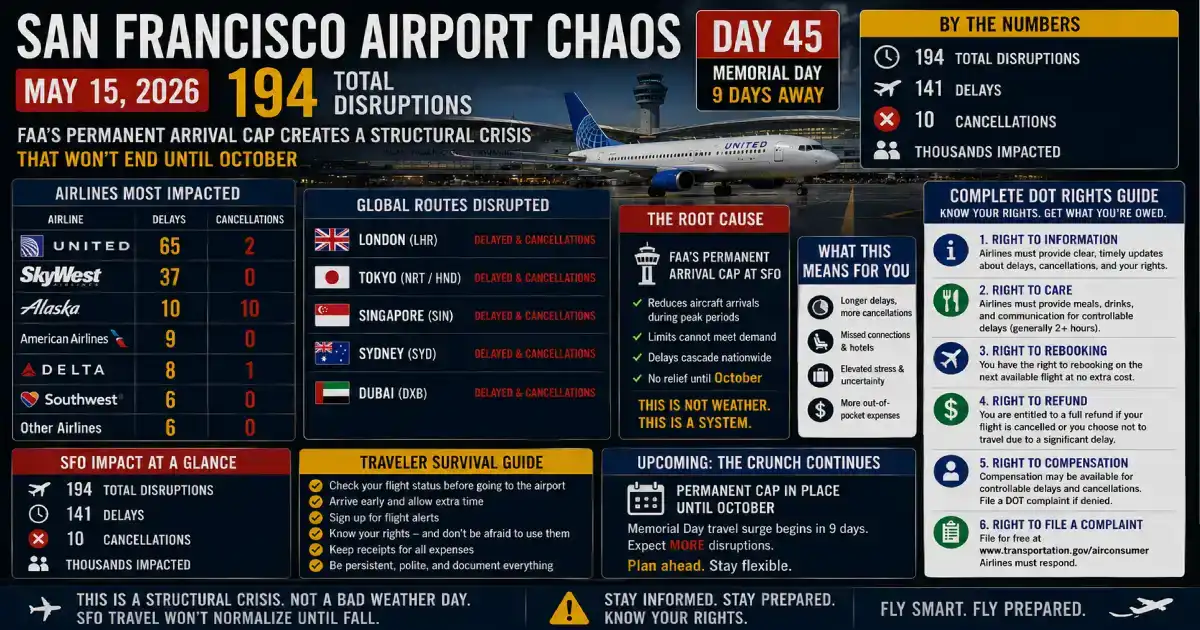
Breaking: San Francisco International Airport — the primary gateway to the Bay Area, Silicon Valley’s most important flight hub, and one of America’s three busiest international airports for trans-Pacific routes — records 189 delays and 5 cancellations — 194 total disruptions on Friday, May 15, 2026, the 45th consecutive day of elevated US aviation disruption since Good Friday April 1. United Airlines — SFO’s dominant carrier — records the largest single-carrier burden today with 65 delays and 1 cancellation. SkyWest Airlines, United’s primary regional feeder at SFO, records 37 delays that strip connecting passengers from United’s long-haul departure banks before they have even boarded. Alaska Airlines records 10 delays and 2 cancellations. Southwest Airlines records 21 delays and 2 cancellations. Delta Air Lines records 12 delays. American Airlines records 6 delays. And beyond the US carriers: Air Canada, British Airways, Air India, Lufthansa, Emirates, Cathay Pacific, Singapore Airlines, Virgin Atlantic, and WestJet are all recording delayed services — with international routes to London Heathrow, Frankfurt, Hong Kong, Singapore, Dubai, Tokyo Narita, Sydney, and Vancouver all disrupted. But today’s 194 disruptions are not the whole story. The real story is the reason they will never fully resolve until October 2, 2026: the FAA’s permanent arrival rate cut that reduced SFO from 54 flights per hour to 36 flights per hour — a 33% capacity reduction — that makes every bad weather day, every wave of national disruption, and every Friday afternoon departure bank worse than it would otherwise be. This is not a crisis that gets better next week. It is structural. Here is every carrier, every international route, every right you hold, and every action you must take.
Published: May 15, 2026 — Friday SFO Total Disruptions: 194 (189 delays + 5 cancellations) Day of Crisis: Day 45 — 45th consecutive elevated disruption day since Good Friday April 1, 2026 Worst Carrier by Delays: United Airlines — 65 delays + 1 cancellation = 66 total Second Worst: SkyWest Airlines — 37 delays + 0 cancellations = 37 total Third: Southwest Airlines — 21 delays + 2 cancellations = 23 total Fourth: Alaska Airlines — 10 delays + 2 cancellations = 12 total Fifth: Delta Air Lines — 12 delays + 0 cancellations = 12 total Sixth: American Airlines — 6 delays + 0 cancellations = 6 total International Carriers Disrupted: Air Canada · British Airways · Air India · Lufthansa · Emirates · Cathay Pacific · Singapore Airlines · Virgin Atlantic · WestJet International Routes Broken: London Heathrow (LHR) · Frankfurt (FRA) · Hong Kong (HKG) · Singapore (SIN) · Dubai (DXB) · Tokyo Narita (NRT) · Sydney (SYD) · Vancouver (YVR) Domestic Routes Disrupted: Seattle (SEA) · Los Angeles (LAX) · San Diego (SAN) · Las Vegas (LAS) · Boston (BOS) · Chicago (ORD) · Phoenix (PHX) · Salt Lake City (SLC) · Dallas (DFW) · Washington DC (DCA/IAD) Regional Airports Hit: Hollywood Burbank (BUR) · Palm Springs (PSP) · Boise (BOI) · Santa Barbara (SBA) · Eugene (EUG) FAA Structural Crisis: Permanent arrival cap — 54 → 36 flights per hour (33% cut) — in effect throughout 2026 until October 2 Runway 1R Construction: Active since March 30, 2026 — six-month closure — reopens October 2, 2026 Compound Effect: FAA parallel runway ban + Runway 1R construction = SFO operating at two-thirds of pre-crisis arrival capacity SFO Delay Probability: SFO officials anticipate 25% of arriving flights experience delays of 30 minutes or more under the new FAA restriction alone Friday Amplifier: Friday is SFO’s highest-volume travel day — peak Silicon Valley business departures + leisure travel surge converge simultaneously Memorial Day Countdown: ⏱️ 9 DAYS (May 23, 2026) — 45.1 million Americans travelling O’Hare FAA Cap Status: Active since May 17 — now in first week of enforcement Passengers Affected Today: Est. 15,000–22,000 across SFO’s domestic and international network
Every other disrupted US airport in the 45-day post-Easter crisis has a recovery horizon. O’Hare’s FAA summer cap — while reducing capacity — creates structure that can improve scheduling integrity. Dallas Fort Worth’s Texas thunderstorm disruptions are weather events; clear skies eventually follow. Atlanta’s Delta crew scheduling crisis can be resolved by hiring. Nashville’s Saturday disruptions abate when leisure demand moderates.
San Francisco International Airport’s crisis has no near-term recovery horizon. It is structural. And it will not resolve until October 2, 2026.
The Three-Layer Structural Crisis at SFO:
🔴 Layer 1 — FAA Permanent Parallel Runway Ban (ongoing indefinitely): The FAA told KQED that the agency’s “safety measure prohibits flights from making side-by-side approaches to SFO’s parallel east-west runways in clear weather when the pilots acknowledge having the other aircraft in sight.” The new rule requires staggered approaches, with one aircraft offset from the aircraft on the parallel runway. This is not temporary. FAA spokesman Ian Gregor said officials decided that SFO’s longstanding practice of landing two planes at the same time on closely spaced parallel runways that are just 750 feet apart — along with congested airspace — was too dangerous. He could not say why the practice had been allowed. The FAA is now exploring ways to safely restore some additional capacity, but no timeline exists for restoring side-by-side landings.
🔴 Layer 2 — Runway 1R Construction (through October 2, 2026): SFO closed Runway 1 Right for construction on March 30, 2026 — unrelated to the FAA restriction — in a project predicted to last six months. The airport is forecasting that 15% of flights will be delayed over the next half a year due to this project alone. The north-south runways are entirely out of commission for a repaving project that is responsible for nine of the 18-flights-per-hour reduction in arrivals. The runway reopens October 2, 2026. Until then, SFO cannot use its north-south runway pair for any arrivals.
🔴 Layer 3 — Day 45 National Positioning Deficit: The 45-day post-Easter crisis has left every US carrier with accumulated positioning debt — aircraft and crews working their way back from Easter’s 5,600-disruption peak, O’Hare’s flooding, Spirit’s collapse, Texas thunderstorms, and every subsequent cascade. At SFO, this national positioning deficit means the inbound aircraft that are theoretically supposed to land at SFO’s already-reduced 36-per-hour rate are themselves arriving late from their origin cities — compressing the already-tight arrival schedule further.
The compound result: Previously, SFO was capable of handling 54 landings per hour under ideal conditions. The FAA has enforced a new landing cap of 36 arrivals per hour — a 33% reduction. The runway under construction is expected to last until October 2, which should alleviate some delays. Combined, SFO is currently operating at approximately two-thirds of its pre-crisis arrival capacity. SFO spokesperson Doug Yakel said the FAA restriction would “increase the delay potential to approximately 25% of arriving flights experiencing a delay of at least 30 minutes.” When the national network adds its own positioning failures on top of that structural 25% baseline, today’s 194 disruptions are the mathematical result.
| Rank | Carrier | Delays | Cancellations | Total | Key Routes Affected |
|---|---|---|---|---|---|
| 🥇 1 | United Airlines | 65 | 1 | 66 | Chicago ORD · New York EWR · Boston BOS · Tokyo NRT · London LHR · Frankfurt FRA |
| 🥈 2 | SkyWest Airlines | 37 | 0 | 37 | United Express feeders — regional California, Pacific NW, Mountain West |
| 🥉 3 | Southwest Airlines | 21 | 2 | 23 | Las Vegas LAS · Los Angeles LAX · Denver DEN · Dallas DAL |
| 4 | Delta Air Lines | 12 | 0 | 12 | Atlanta ATL · Salt Lake City SLC · Minneapolis MSP · Boston BOS |
| 5 | Alaska Airlines | 10 | 2 | 12 | Seattle SEA · Portland PDX · San Diego SAN · Regional California |
| 6 | American Airlines | 6 | 0 | 6 | Dallas DFW · Phoenix PHX · Chicago ORD · Los Angeles LAX |
| 7 | Air Canada | delays | — | — | Vancouver YVR · Toronto YYZ |
| 8 | British Airways | delays | — | — | London Heathrow LHR |
| 9 | Lufthansa | delays | — | — | Frankfurt FRA |
| 10 | Emirates | delays | — | — | Dubai DXB |
| 11 | Singapore Airlines | delays | — | — | Singapore SIN |
| 12 | Cathay Pacific | delays | — | — | Hong Kong HKG |
| 13 | Air India | delays | — | — | Mumbai BOM |
| 14 | Virgin Atlantic | delays | — | — | London LHR |
| 15 | WestJet | delays | — | — | Vancouver YVR · Calgary YYC |
| SFO TOTAL | — | 189 | 5 | 194 | Domestic + international cascade |
65 delays + 1 cancellation = 66 total disruptions — United Airlines absorbs the dominant share of today’s SFO chaos.
United Airlines is not merely SFO’s largest carrier. United IS San Francisco International Airport in the same way that Southwest is Love Field or Delta is Atlanta. United operates approximately 45–50% of all SFO daily departures — and crucially, United operates the long-haul international rotations that make SFO economically essential to the Bay Area. Every delayed United trans-Pacific departure to Tokyo, Hong Kong, Singapore, or Sydney is not just an aviation statistic. It is a technology executive missing a Tokyo partnership meeting, an Australian family beginning their US summer holiday 3 hours late, a Singapore-based investment banker losing a connection home.
United’s SFO international routes disrupted today:
SFO → NRT (Tokyo Narita): United operates SFO as its primary West Coast gateway for trans-Pacific routes. The SFO → Tokyo service is one of United’s most commercially important long-haul rotations — carrying Silicon Valley’s technology industry traffic between San Francisco and Japan’s technology and manufacturing sector. Today’s delay on this service reflects the compound pressure: a late-arriving inbound aircraft (delayed by the FAA arrival cap), combined with crew positioning that is itself downstream of the 45-day national crisis.
SFO → LHR (London Heathrow): United operates SFO → LHR daily. For UK passengers routing home from San Francisco or connecting from the US West Coast to the UK, today’s delayed SFO → LHR departure creates a risk of missed onward connections at Heathrow. If the SFO → LHR flight arrives more than 3 hours late due to United’s operational causes, UK261 compensation of £520 per passenger applies.
SFO → FRA (Frankfurt): United’s SFO → FRA service connects the Bay Area to one of Europe’s most important business hubs. Delayed Frankfurt arrivals of 3+ hours (controllable cause) trigger EU261 compensation of €600 per passenger.
SFO → SIN (Singapore): Singapore Airlines codeshares on this corridor, and the Singapore route is among SFO’s most commercially important with the growing Singapore–US technology investment corridor. Today’s delay affects both United-operated and Singapore Airlines-marketed passengers.
What United passengers at SFO must do: ✅ United app exclusively — SFO’s United Terminal 3 customer service desks are running 2–4 hour queue times on a 66-disruption day; app processing is the only viable real-time tool ✅ Check your inbound aircraft on FlightAware before leaving for the airport — if your United inbound from Chicago, Denver, or Houston is already delayed, your SFO departure will be late before the day has started ✅ Tokyo NRT connection passengers: United operates SFO → NRT with crew duty hour implications on long-haul sectors — ask specifically about crew status if your departure is running more than 60 minutes behind schedule ✅ London/Frankfurt connections: If your SFO → LHR or SFO → FRA arrives 3+ hours late due to United operational causes, document the delay cause at the gate before boarding
37 delays + 0 cancellations = 37 total disruptions — SkyWest is today’s second-worst carrier at SFO.
SkyWest Airlines operates SFO as a United Express feeder — the dozens of shorter routes connecting smaller California and western US cities to the SFO hub before passengers connect onto United’s mainline domestic and international services. SkyWest’s routes from SFO include:
Today’s 37 SkyWest delays at SFO are stripping connecting passengers from United’s long-haul departure banks. A passenger flying Boise → SFO → Tokyo on a United ticket has a SkyWest-operated first leg. When SkyWest’s BOI → SFO segment is 75 minutes late — a routine outcome when SFO’s arrival rate is capped at 36 per hour — the connection to the Tokyo flight is gone before the passenger has even reached San Francisco.
Critical passenger guidance — SkyWest at SFO: ✅ Contact United — not SkyWest for all rebooking. United owns your complete itinerary; SkyWest handles operations only ✅ If SkyWest feeder delay causes missed SFO long-haul connection: United must rebook you on the next available service to your final destination — including overnight accommodation if the next flight is tomorrow (for controllable causes) ✅ Regional airport passengers (Burbank, Palm Springs, Boise, Santa Barbara): These routes have low daily frequency — a missed or cancelled SkyWest service may have no same-day alternative. Contact United immediately.
10 delays + 2 cancellations = 12 total disruptions — Alaska Airlines at SFO today.
Alaska Airlines is SFO’s second-largest carrier and the dominant airline for routes between San Francisco and the Pacific Northwest — particularly Seattle (SEA), Portland (PDX), and regional California destinations. Alaska’s 2 cancellations today — while a small absolute number — are significant for the routes they affect: routes connected to Seattle, Portland, San Diego, and regional California airports were among those impacted.
Alaska’s SFO disruptions today are also significant in the context of the airline’s historic expansion. Alaska launched the first-ever Seattle–Rome nonstop (AS180) on April 28. The Seattle hub disruption that feeds SFO is itself downstream of the national cascade — and Alaska’s growing trans-Pacific ambitions mean that SFO disruptions increasingly affect passengers routing through Seattle on long-haul connections.
What Alaska passengers at SFO must do: ✅ Alaska Airlines app — Alaska’s self-service rebooking is among the cleanest in the US industry; no desk queues needed ✅ Atmos Rewards members: Alaska’s loyalty programme has no cancellation fees — any cancelled or significantly delayed Alaska flight entitles you to full rebooking or cash refund with zero penalty ✅ Pacific Northwest connection passengers: If your SFO → SEA Alaska flight is cancelled and you are connecting to an international service at Seattle (AS180 Rome, AS → London, or another route), contact Alaska immediately — the carrier has extensive rerouting options
SFO’s role as America’s primary West Coast international gateway makes today’s international disruptions uniquely consequential.
Tokyo Narita (NRT): United Airlines’ SFO → NRT is one of the most commercially important trans-Pacific routes in US aviation. Any delay on this service has downstream consequences for passengers connecting at Narita to domestic Japan routes, Southeast Asian connections, and Korean Air/ANA connections to dozens of regional Asian destinations.
Hong Kong (HKG): Cathay Pacific operates SFO–HKG as one of its primary US gateway routes. Today’s Cathay Pacific delay at SFO affects passengers routing through Hong Kong to mainland China, Southeast Asia, South Asia, and the broader Cathay network.
Singapore (SIN): Singapore Airlines operates SFO–SIN, and United codeshares on this corridor. Today’s delay affects Silicon Valley–Singapore technology corridor traffic.
Sydney (SYD): The SFO–Sydney corridor connects two of the Pacific’s most important technology and finance hubs. Australian travellers routing through San Francisco will find today’s disruption adds to the already-elevated Australian aviation disruption that has been recorded throughout May 2026. Australia and New Zealand are experiencing massive aviation disruption with 282 delays and 11 cancellations recorded today. Australian passengers connecting SYD → SFO → domestic US are doubly exposed — disruption at both ends of their journey.
London Heathrow (LHR): British Airways and United both operate SFO–LHR. Today’s delays affect UK passengers routing between London and San Francisco, including those connecting to Seattle (Alaska’s new London route) and other West Coast destinations.
UK261 implications: If your SFO → LHR flight arrives at London Heathrow 3+ hours late due to airline-operational causes (United or British Airways — not weather, not ATC): UK261 compensation of £520 per passenger applies.
Frankfurt (FRA): Lufthansa operates SFO–FRA. Today’s Lufthansa delay at SFO affects European business travellers routing between San Francisco and Germany, and passengers connecting at Frankfurt to wider European destinations.
EU261 implications: If your SFO → FRA Lufthansa flight arrives at Frankfurt 3+ hours late due to operational causes: EU261 compensation of €600 per passenger applies.
Emirates operates SFO–DXB as part of its ongoing network restoration following the Middle East airspace disruption. Emirates is now operating flights to 137 destinations across 72 countries, covering Europe, Asia, Africa and the Americas, as it continues to rebuild its global network. Today’s Emirates delay at SFO reflects both the carrier’s network-rebuilding pressures and the structural SFO arrival cap affecting all international carriers at the airport.
Air Canada and WestJet both operate SFO–Vancouver services, connecting San Francisco to Canada’s primary Pacific gateway. Today’s delays on these routes affect Canadian passengers routing between Vancouver and the Bay Area, and passengers connecting at Vancouver to Air Canada’s trans-Pacific network to Tokyo, Hong Kong, and Sydney.
APPR implications: If your SFO → YVR Air Canada or WestJet flight arrives at Vancouver 3+ hours late due to airline-operational causes: Canadian APPR compensation of CAD $400–$1,000 per passenger applies.
| Before FAA Cap | After FAA Cap (March 2026) | Impact |
|---|---|---|
| 54 arrivals/hour | 36 arrivals/hour | -33% capacity |
| Side-by-side landings permitted | Side-by-side landings banned | Staggered approaches required |
| North-south runways operational | Runway 1R closed until October 2 | Further -9 arrivals/hour |
| Marine fog impact: moderate | Marine fog impact: severe | Less capacity to absorb delays |
| 15% of flights delayed | 25–40% of flights delayed | Structural delay baseline |
| Recovery from disruption: 2–3 hours | Recovery from disruption: 4–6 hours | Longer cascade duration |
The runway reopening timeline: Once runway work is completed and capacity constraints eased, the airport could regain some lost throughput — though the permanent FAA limit on simultaneous landings will continue to shape future schedules. What this means: when Runway 1R reopens on October 2, SFO will regain 9 of the 18-per-hour lost arrivals — but the parallel runway safety ban (the other 9 per hour) remains permanently in place. SFO will never return to 54 arrivals per hour under the current regulatory framework.
Memorial Day weekend (May 23–26) is 9 days away. For SFO passengers planning to travel over Memorial Day, the structural FAA cap creates specific risks that other airports don’t face:
Friday May 22 — the busiest departure day: Memorial Day weekend travel typically peaks on Friday afternoon and evening. At SFO, Friday is already the highest-demand day of the week for Silicon Valley business travel — meaning the Friday departure banks are the tightest of any day. A Friday May 22 departure from SFO involves:
Recommendation for Memorial Day SFO passengers: ✅ Fly Thursday May 21 instead of Friday May 22 if any schedule flexibility exists — the Friday SFO delay risk is the highest of any Memorial Day day ✅ Allow minimum 3-hour domestic connections at SFO — the FAA arrival cap means late inbounds compound faster than at unrestricted airports ✅ Allow minimum 4-hour international connections at SFO — customs + the arrival cap = 4 hours is the safe minimum ✅ Check for Bay Area fog forecast before your flight — marine fog is the acute trigger that fires on top of the structural capacity limitation and can push delays from 30 minutes to 2+ hours instantly ✅ Alternative Bay Area airports: Oakland (OAK) and San Jose (SJC) are not subject to the SFO arrival cap. If your destination is reachable via OAK or SJC (Southwest serves both; Alaska and United serve SJC; Southwest serves OAK), check availability as a lower-risk alternative
✅ If your flight is CANCELLED: Full cash refund to original payment method within 7 business days — OR rebooking at your choice. Always.
“Under DOT regulations, I am requesting a full cash refund to my original payment method within 7 business days.”
✅ If delayed 2+ hours: Meal vouchers — request at gate desk immediately ✅ If delayed 3+ hours domestic: Full cash refund right — you may leave the airport ✅ Overnight stranding (controllable cause): Hotel + transport
If your SFO → LHR flight arrives at London Heathrow 3+ hours late due to airline-operational causes (not weather, not ATC):
| Carrier | Distance | Compensation |
|---|---|---|
| British Airways SFO → LHR | >3,500km | £520 per passenger |
| United Airlines SFO → LHR | >3,500km | £520 per passenger |
File at: ba.com/compensation · caa.co.uk/passengers (6-year limit)
If your SFO → FRA Lufthansa flight arrives at Frankfurt 3+ hours late (operational cause):
€600 per passenger — file at lufthansa.com/compensation (3-year German limit)
If your SFO → Canadian airport flight arrives 3+ hours late (controllable):
CAD $400–$1,000 per passenger — file at aircanada.com/claims or otc-cta.gc.ca (1-year limit)
SkyWest operates as United Express. Your rebooking rights are with United — not SkyWest. United must rebook you on the complete itinerary to your final destination.
Step 1 — Check FlightAware before leaving the office or hotel Search your flight number at flightaware.com → click “inbound flight.” SFO’s structural arrival cap means that late inbounds from Chicago, Houston, Denver, and New York are the primary source of afternoon departure delays. If your inbound aircraft is delayed at its origin city, the departure board will not show the delay for another 1–2 hours.
Step 2 — Know SFO’s terminal layout for faster rebooking
| Carrier | Terminal | Notes |
|---|---|---|
| United Airlines | Terminal 3 | Largest terminal — customer service desks run 2–4hr queues; use app |
| Alaska Airlines | Terminal 2 | Shorter queues than United |
| Southwest Airlines | Harvey Milk Terminal 1 | Self-service easiest — no change fees |
| Delta Air Lines | Terminal 1 | Delta Sky Club available for eligible members |
| American Airlines | Terminal 2 | AA app fastest |
| International carriers | International Terminal (G) | Long queues — use carrier apps |
Step 3 — Bay Area alternative airports
| If SFO is too disrupted | Alternative | Distance from SF | Southwest? |
|---|---|---|---|
| Oakland Airport (OAK) | BART direct from downtown SF | 12 miles | ✅ Yes |
| San Jose Airport (SJC) | CalTrain + bus | 45 miles | ✅ Yes |
If your SFO flight is cancelled and you rebook at OAK or SJC on a different carrier, you must first obtain a cash refund from your SFO carrier and purchase the OAK/SJC ticket independently. Airlines will not rebook you to a different Bay Area airport on a different carrier.
Step 4 — International passengers: claim your rights at the gate BEFORE boarding a delayed flight For UK261, EU261, and APPR claims, you need to document the delay BEFORE the flight departs. Ask the gate agent:
Screenshot the departure board. Keep your boarding pass. File the claim when you land.
Step 5 — Bay Area fog forecast — the most important SFO weather indicator The marine layer — low coastal clouds — is SFO’s primary weather trigger. Check the National Weather Service Bay Area forecast (weather.gov/mtr) before your flight. If the marine layer is forecast to persist past 10am, expect delays on morning arrival banks that cascade into afternoon departures.
| Service | Phone | App/Web |
|---|---|---|
| United Airlines | 1-800-864-8331 | united.com / United app |
| Alaska Airlines | 1-800-252-7522 | alaskaair.com / Alaska app |
| Southwest Airlines | 1-800-435-9792 | southwest.com |
| Delta Air Lines | 1-800-221-1212 | delta.com / Fly Delta app |
| American Airlines | 1-800-433-7300 | aa.com / AA app |
| British Airways | 1-800-247-9297 | ba.com |
| Lufthansa | 1-800-645-3880 | lufthansa.com |
| Singapore Airlines | 1-800-742-3333 | singaporeair.com |
| Cathay Pacific | 1-800-233-2742 | cathaypacific.com |
| Air Canada | 1-888-247-2262 | aircanada.com |
| Emirates | 1-800-777-3999 | emirates.com |
| SFO Airport | 650-821-8211 | flysfo.com |
| FlightAware SFO | — | flightaware.com/live/airport/KSFO |
| Bay Area Weather | — | weather.gov/mtr |
| DOT Complaints | — | airconsumer.dot.gov |
| UK CAA (UK261) | — | caa.co.uk/passengers |
| EU261 Claims | — | airhelp.com |
| Canadian CTA (APPR) | — | otc-cta.gc.ca |
| Oakland Airport (OAK) | 510-563-3300 | oaklandairport.com |
| San Jose Airport (SJC) | 408-392-3600 | flysanjose.com |
Friday May 15, 2026 is Day 45 of the US aviation crisis — and at San Francisco International Airport, it is a day defined not just by today’s 194 total disruptions (189 delays + 5 cancellations), but by the structural reality that makes every day at SFO worse than it should be: the FAA’s permanent cut in arrival capacity from 54 flights per hour to 36 — a 33% reduction — combined with Runway 1R construction that remains active until October 2, 2026. SFO officials anticipate 25% of arriving flights experiencing a delay of at least 30 minutes as a structural baseline — before any weather, before any national cascade, before any Day 45 positioning debt is added.
United Airlines absorbs the largest share with 65 delays and 1 cancellation. SkyWest records 37 delays stripping connecting passengers from United’s long-haul departure banks. Southwest records 21 delays + 2 cancellations. Alaska records 10 delays + 2 cancellations. Delta records 12 delays. American records 6 delays. International carriers including British Airways, Lufthansa, Singapore Airlines, Cathay Pacific, Emirates, and Air Canada are all disrupted — with routes to London, Frankfurt, Tokyo, Hong Kong, Singapore, Sydney, Dubai, and Vancouver all broken.
If you are flying through SFO today or over Memorial Day (9 days away):
SFO’s structural crisis does not resolve until October 2, 2026. Until then, every Friday at SFO is a risk management exercise.
Related Articles:
Also Read:
Posted By : Vinay
This article is provided for general informational purposes only and is based on information available at the time of publication. Travel advisories, airline schedules, airport operations, visa requirements, government regulations, and other travel-related information are subject to change without prior notice. While Travel Tourister makes reasonable efforts to verify information using official announcements, government publications, airline and airport communications, and other reliable sources, we cannot guarantee that all information remains complete, accurate, or up to date at all times. Readers should independently verify any information that may affect their travel plans with the relevant airline, airport authority, government agency, embassy, or other official source before making travel, financial, or other decisions. Travel Tourister shall not be liable for any direct or indirect loss, inconvenience, or damages arising from the use of or reliance on the information contained in this article. Nothing in this publication constitutes legal, immigration, financial, or professional travel advice. If you believe any information in this article is inaccurate or outdated, please contact our editorial team. We review all credible correction requests promptly and update our content whenever appropriate.
Lastest News
2nd Floor, 39, Above Kirti Club, DLF Industrial Area, Kirti Nagar, New Delhi, Delhi 110015



Travel Tourister is a leading Travel portal where we introduce travellers to trusted travel agents to make their journey hasselfree, memorable And happy. Travel Tourister is a platform where travellers get Tour packages ,Hotel packages deals through trusted travel companies And hoteliers who are working with us across the world. We always try to find new and more travel agents and hoteliers from every nook and corners across the world so that you could compare the deals with different travel agents and hoteliers and book your tour or hotel with the one you have chosen according to your taste and budget.
Copyright © Travel Tourister, India. All Rights Reserved

 Call
Call Enquiry