Published on : 13 May 2026
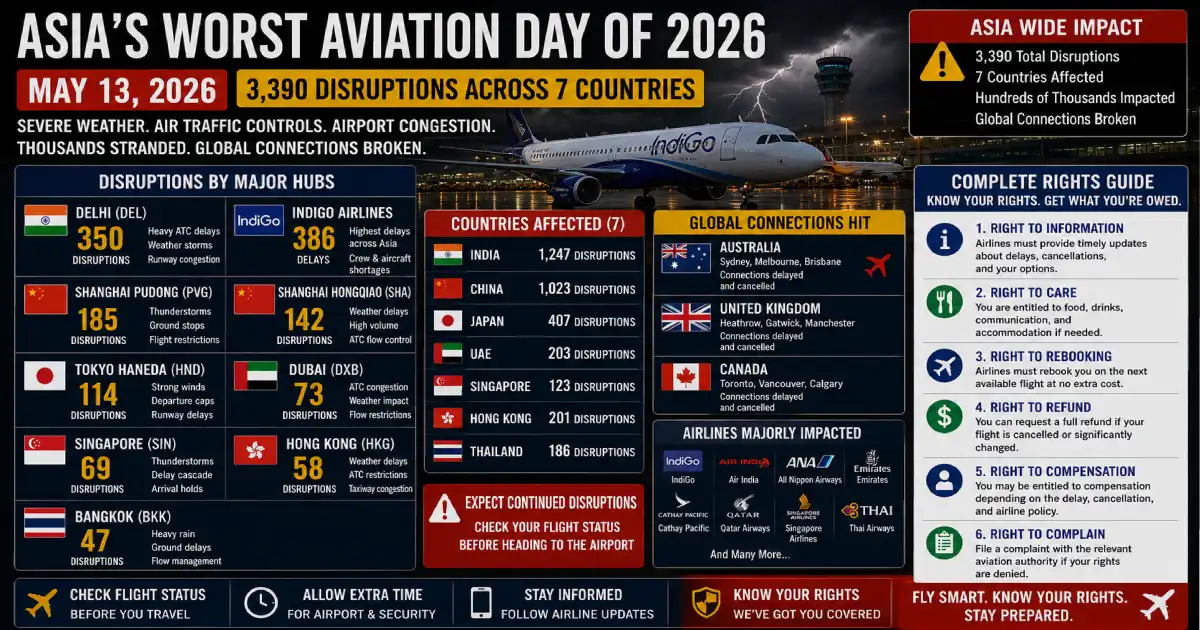
At the same moment Charlotte Douglas was recording 209 delays, Toronto Pearson was absorbing 113, and Phoenix was pushing past 300 for the third consecutive day — Asia was quietly recording its worst single aviation day of 2026.
In a disruption event of genuinely historic scale, 448 flights have been cancelled and 2,942 more delayed across a staggering 30-plus airports spanning seven countries — India, China, Japan, the UAE, Malaysia, Thailand, and Saudi Arabia — making May 13, 2026 the most chaotic single aviation day the Asia-Pacific region has experienced this year.
3,390 total disruptions. One day. Seven countries. Thirty airports. And the number that defines this crisis above all others: IndiGo alone has recorded 386 delays — the highest single-airline delay count of any carrier anywhere in the world today.
For Australian, British and Canadian readers, this crisis is not a distant regional story. It is your connecting hub network. Emirates at Dubai is disrupted. Japan Airlines at Tokyo Haneda is disrupted. AirAsia at Kuala Lumpur is disrupted. Cathay Pacific’s Hong Kong operation is disrupted. Air New Zealand’s transpacific routing through Japan is disrupted. Every major hub between Australia and Europe — Dubai, Singapore, Kuala Lumpur, Bangkok, Hong Kong, Tokyo — is absorbing elevated disruption today simultaneously. The post-Middle East conflict aviation crisis has now merged with Asia’s own structural pressures into a single connected global disruption event.
Published: May 13, 2026 Asia total disruptions: 3,390 — 2,942 delays + 448 cancellations Countries affected: India · China · Japan · UAE · Malaysia · Thailand · Saudi Arabia Airports affected: 30+ across all 7 countries Worst airline (delays): IndiGo — 386 delays + 7 cancellations Worst airline (cancellations): Shenzhen Airlines — 84 cancellations Worst airport (delays): Delhi Indira Gandhi (DEL) — 350 delays Worst airport (cancellations): Shenzhen Bao’an (SZX) — 42 cancellations Both Shanghai airports simultaneously: PVG 171/22 + SHA 67/20 = 238 delays + 42 cancellations Both Chengdu airports simultaneously: TFU 85/28 + CTU 63/13 = 148 delays + 41 cancellations Tokyo Haneda: 112 delays + 2 cancellations (JAL 60, ANA 30, ANA Wings, Skymark) Dubai: 67 delays + 6 cancellations (FlyDubai, Emirates, SpiceJet, Saudia, Air India) Sharjah: 18 delays + 6 cancellations Jeddah: 56 delays + 9 cancellations Riyadh: 52 delays + 1 cancellation Kuala Lumpur: 96 delays + 11 cancellations (AirAsia, Malindo Air, Malaysia Airlines) Bengaluru: 232 delays (IndiGo + Air India Express primary) Australian connections broken: Dubai (Emirates/Qantas) · Tokyo (JAL/ANA) · Singapore cascade (Air India) · KL (AirAsia) China Eastern alone: 264 delays + 65 cancellations Root causes: Summer monsoon weather + rising fuel costs + Middle East geopolitical cascade + post-COVID demand surge without matching infrastructure Japanese remote island communities: Tokunoshima 8 cancellations + Yakushima 5 cancellations — cut off entirely
Airline operations across Asia remained under pressure as unstable weather patterns, thunderstorms, low visibility conditions, runway congestion, and air traffic restrictions impacted multiple airport systems simultaneously. Meteorological agencies across several countries had already issued alerts regarding heavy rainfall, thunderstorm activity, strong crosswinds, and reduced visibility conditions in parts of Southeast Asia and East Asia.
But weather alone does not produce 3,390 disruptions across 7 countries simultaneously. Five structural factors converged today.
1. India’s monsoon pre-season pressure. India’s pre-monsoon period — April through mid-June — produces the most volatile flying weather of the year across the subcontinent. Thunderstorm cells develop rapidly over the Gangetic Plain and the Deccan Plateau, reducing visibility at Delhi, Bengaluru, Mumbai and Kolkata to near-zero for periods of 30–90 minutes. During these cells, Delhi’s four runways close to arrivals, creating ground delay programmes that cascade through IndiGo’s entire 280-aircraft network. IndiGo’s 386 delays today are not a failure of operations management — they are the mathematical consequence of operating India’s largest carrier through its most weather-volatile season.
2. China’s spring fog and convective weather pattern. China experienced storm-related operational slowdowns around Shanghai and surrounding eastern aviation corridors, affecting Shanghai Airlines and China Eastern. Shanghai’s two airports — Pudong and Hongqiao — are among the world’s most throughput-intensive aviation facilities. When convective weather reduces Pudong’s approach capacity from 60 arrivals per hour to 30, the resulting queue extends backwards through the entire China Eastern and Air China domestic network. Beijing, Guangzhou, Chengdu and Shenzhen all feel it within 90 minutes.
3. Middle East fuel and conflict cascade. Rising fuel costs and geopolitical tensions in West Asia have pressured airlines to trim schedules and cancel services, with knock-on effects escalating delays when departure slots shrink and aircraft rotations back up in networked schedules. Dubai’s disruptions today — 73 total including Sharjah — directly reflect the continuing UAE airspace pressure from Iranian conflict proximity. FlyDubai and Emirates both disrupted.
4. Post-Spirit US disruption feeding Asia. This is the invisible factor in today’s Asia crisis. US carriers’ 43-day disruption has cascaded into transatlantic schedules, which have cascaded into European hub operations, which have cascaded into Middle East-connecting flights, which have cascaded into Asia inbounds. A United flight out of Dallas that was delayed by the O’Hare cascade in April eventually produced a late connection at Tokyo Narita for passengers heading onward to Australia. By Day 43 of the US crisis, the positioning debt has reached Tokyo.
5. Post-COVID demand surge without matching infrastructure. Asian aviation demand has recovered faster than the rest of the world — China’s domestic aviation is running 15–20% above 2019 levels, India’s is running 25% above, Southeast Asia is at record volumes. The infrastructure — runways, terminals, ATC capacity, aircraft — has not expanded proportionally. Every airport operating at 115% of designed capacity has zero buffer for any disruption event.
India is today’s primary crisis country. Indira Gandhi International Airport in Delhi reported the highest delay count with 350 delayed flights. Kempegowda International Airport in Bengaluru recorded 232 delays, heavily impacting IndiGo and Air India Express operations.
IndiGo — 386 delays + 7 cancellations: IndiGo is India’s largest airline by passenger volume — operating 280+ aircraft on 300+ daily routes across India and 30+ international destinations. IndiGo alone recorded 386 delays — the highest single-airline delay count of any carrier anywhere in the world today. This number reflects both IndiGo’s scale and the compound effect of weather-induced ground stop at Delhi propagating through every IndiGo rotation nationwide. An aircraft delayed at Delhi at 08:00 misses its 09:30 Bengaluru turnaround. The Bengaluru–Mumbai sector is then late. The Mumbai–Kolkata sector is late. By 16:00, the original Delhi delay has produced 5–6 downstream late departures across different cities.
SpiceJet — 55 delays + 7 cancellations: SpiceJet’s disruptions at Delhi, Mumbai and Bengaluru compound the Indian aviation picture. SpiceJet has been operating under financial pressure throughout 2026 — its reduced fleet means less redundancy when weather events hit.
Air India Express: India’s international budget arm is heavily disrupted at Bengaluru today. Air India Express serves the important Gulf corridor — Bengaluru to Dubai, Abu Dhabi, Muscat, Doha — carrying India’s massive diaspora workforce community. Delays on this corridor today affect Indian workers in the Gulf trying to return home, and Australian passengers connecting via the Gulf from India.
For Australian readers with Indian heritage: If you have family in India whose travel plans are affected today, the Australian government’s travel advice (smartraveller.gov.au) does not cover internal Indian aviation disruptions — contact Air India, IndiGo or SpiceJet directly using the contacts at the base of this article.
China’s aviation disruption today is defined by cancellations rather than delays — a structural difference from India’s picture.
Shenzhen Bao’an International Airport recorded the highest cancellation total in Asia today with 42 cancellations, driven by weather and ATC slot restrictions. China Eastern accumulated 264 delays and 65 cancellations across Shanghai, Guangzhou, Kunming, Qingdao, and Shenzhen. Beijing Daxing handled 99 delays and 13 cancellations from China Eastern, China Southern, China United, and XiamenAir.
Both Shanghai airports simultaneously: Shanghai Pudong: 171 delays + 22 cancellations. Shanghai Hongqiao: 67 delays + 20 cancellations. Both airports were hit simultaneously by storm-related operational slowdowns affecting Shanghai Airlines and China Eastern operations along eastern China corridors. When both Shanghai airports are simultaneously disrupted, the entire China Eastern mainline network is affected — Shanghai is China Eastern’s home hub.
Both Chengdu airports simultaneously: Chengdu Tianfu: 85 delays + 28 cancellations. Chengdu Shuangliu: 63 delays + 13 cancellations. Chengdu’s dual-airport disruption is the most operationally unusual event of today’s crisis. Two airports in the same city — China’s fourth largest — both simultaneously disrupted. For passengers connecting through Chengdu on either airport, both options are simultaneously compromised.
High-speed rail alternative for Chinese domestic passengers: For Chinese domestic travelers: consider high-speed rail for Shenzhen–Guangzhou, Beijing–Shanghai, and Chengdu–Chongqing segments where China’s extraordinary bullet train network offers a genuinely competitive alternative to aviation during mass cancellation events. The Beijing–Shanghai Fuxing HSR train runs 1,318km in 4.5 hours — genuinely competitive with flying when you include airport processing time. Chengdu–Chongqing by HSR takes 1 hour.
Tokyo Haneda Airport experienced more than 100 delays, primarily affecting Japan Airlines (60 delays) and All Nippon Airways (30 delays), along with ANA Wings and Skymark.
Tokyo Haneda Airport — Japan’s most passenger-dense domestic hub and the gateway for many international visitors entering the country — recorded 112 delays and 2 cancellations.
Japan Airlines’ 60 delays at Haneda today cascade into JAL’s domestic network — connections from Haneda to Sapporo, Osaka, Fukuoka, Naha, and every regional city are delayed. For Australian and UK readers whose Japan holiday begins with a Haneda arrival: delays today affect your domestic Japan connection if you are connecting onward within Japan.
Japanese remote island communities — the human cost: The pattern at Japan’s remote island airports — Tokunoshima (7 delays, 8 cancellations) and Yakushima (3 delays, 5 cancellations) — is particularly significant for a country where remote island communities depend on aviation as their primary and often only reliable connection to Japan’s main islands. For these communities, a day of mass cancellations is not an inconvenience — it is an isolation event.
Dubai International Airport recorded 67 delays and six cancellations, impacting regional and international operations. FlyDubai, Emirates, SpiceJet, Saudia, and Air India were among the airlines most affected.
Sharjah International added 18 delays and 6 cancellations, doubling the UAE’s disruption footprint.
For Australian passengers routing through Dubai: Emirates’ 67-delay day at DXB today affects every Australia–Dubai–London/Europe routing. A delayed Emirates DXB arrival from Sydney that was supposed to connect to a London Heathrow departure is now running late for the European market. If you are transiting Dubai on Emirates today, build a 90-minute minimum buffer for all connections.
Note: The 1-flight-per-day foreign airline cap at DXB continues through May 31. BA, KLM, and Lufthansa remain at reduced frequency. Emirates itself is operating, but under today’s disruption pressure.
Kuala Lumpur International in Malaysia recorded 96 delays and 11 cancellations involving AirAsia, Malindo Air, Malaysia Airlines, and Indonesia AirAsia. Thai Airways faced 27 delays at Bangkok Suvarnabhumi Airport.
Kuala Lumpur is the primary alternative hub for Australian passengers routing from Australia to Europe via Southeast Asia — the “Kangaroo Route” via KL and beyond. A 107-disruption day at KLIA today affects every Australian passenger using Malaysia Airlines’ premium economy Kangaroo Route product, and every AirAsia passenger on Australia–Kuala Lumpur budget connections.
King Abdulaziz International in Jeddah: 56 delays + 9 cancellations. King Khalid International in Riyadh: 52 delays + 1 cancellation.
Saudi Arabia’s aviation disruptions today reflect the continuing Gulf geopolitical pressure — Saudia operations disrupted at both its primary hubs — and the early summer heat conditions beginning to affect ground operations at both airports. The Jeddah disruptions coincide with preparations for the Hajj pilgrimage season, when King Abdulaziz International operates at maximum throughput for weeks on end.
For Australian, UK and Canadian readers, today’s Asia disruptions affect specific connecting hub routes that carry the highest Australia–Europe and Canada–Asia traffic volumes.
Dubai (Emirates — Australia’s primary long-haul carrier): 67 delays + 6 cancellations at DXB today, with Emirates among the affected carriers. Qantas codeshares on Emirates. Australia’s most popular Europe connection is Sydney/Melbourne → Dubai → London/Frankfurt/Paris. A disrupted Dubai day hits that connection chain directly.
Tokyo (JAL/ANA — Australia’s Japan connection): 114 total disruptions at Haneda. Australia–Japan tourism is booming post-yen weakening. Air New Zealand, Qantas and Japanese carriers all operate Australia–Japan routes. A disrupted Tokyo day cascades into onward Japanese connections for Australian tourists.
Kuala Lumpur (AirAsia/Malaysia Airlines — Budget Australia–Europe): 107 disruptions at KLIA. AirAsia X operates direct Malaysia Airlines codeshare from Australia to KLIA, connecting to onward European services. Today’s KUL disruption affects that corridor.
The Singapore buffer: Singapore Changi — not specifically cited in today’s worst data — remains the most reliable alternative connecting hub for Australia–Europe passengers whose preferred routing through Dubai or KL is disrupted. Singapore saw no major disruption today. If your Dubai or KL connection is broken: Singapore Changi via Qantas, Singapore Airlines, or Scoot is your most reliable alternative.
Rights vary dramatically by country across today’s affected airports. Here is the precise summary for each jurisdiction:
India’s Directorate General of Civil Aviation (DGCA) provides passenger protections for domestic Indian flights:
✅ Refund for cancellations: Full refund within 7 days for any cancelled domestic flight ✅ Meals for delays 2+ hours (controllable) ✅ Hotel for overnight cancellations (controllable) ✅ Cash compensation for controllable cancellations with less than 2-week notice: ₹5,000–₹10,000 depending on route distance
For international flights departing India: EU261 applies to European carrier–operated departures (Lufthansa, Air France, British Airways at Delhi). For Air India and IndiGo international sectors: Indian consumer protection law applies.
Japanese aviation consumer protection is among the most passenger-friendly in Asia:
✅ Refund for cancellations: Full refund for any flight cancelled by the airline ✅ Rebooking: On next available JAL/ANA service ✅ Meals: Provided for significant delays — typically triggered at 2 hours ❌ Fixed cash compensation: No EU261 equivalent — no fixed delay compensation
For foreign carriers at Tokyo: EU261 applies to Lufthansa, Air France, British Airways, KLM departing Haneda for European destinations.
UAE regulations provide: ✅ Refund: For cancelled flights — cash or travel voucher (passenger’s choice) ✅ Meals: For delays exceeding 2 hours ✅ Hotel: For overnight delays within airline control ✅ Compensation: AED 600–1,200 (approx. £130–£260) for controllable cancellations with short notice on UAE-operating airlines
For European carriers (Lufthansa, Air France, KLM) at Dubai: EU261 applies. €600 for controllable delays of 3+ hours on Europe-bound flights.
✅ Refund: For cancelled flights within 7 days ✅ Meals and hotel: For delays caused by airline-controllable factors ✅ Compensation: MYR 200–400 (approx. £35–£70) for controllable cancellations on Malaysian carriers
✅ Refund: For cancelled flights ✅ Meals: For delays exceeding 2 hours Limited fixed compensation framework — primarily duty of care protections
If you are an Australian resident and your connecting itinerary through an Asian hub was disrupted by an airline operating under an Australian Consumer Law–accessible booking:
✅ Consequential losses claim: Under ACL, if a cancellation caused you quantifiable losses (missed hotel nights, forfeited tour deposits), you may be entitled to compensation for those consequential losses from the airline ✅ ACCC guidance: accc.gov.au/consumers/travel
| Carrier | Contact |
|---|---|
| IndiGo | goindigo.in · 1800 180 3838 (India) |
| Air India | airindia.com · 1800 180 1407 (India) |
| SpiceJet | spicejet.com · 1860 180 3333 (India) |
| China Eastern | ceair.com · +86 95530 (China) |
| Japan Airlines | jal.co.jp · 0570-025-031 (Japan) · 1-800-525-3663 (US/AUS) |
| ANA | ana.co.jp · 0570-029-709 (Japan) |
| Emirates (DXB) | emirates.com · 0800 014 9009 (UK) · 1300 303 777 (AUS) |
| FlyDubai | flydubai.com · +971 600 544 445 |
| AirAsia (KUL) | airasia.com · 1300 889 933 (Malaysia) |
| Malaysia Airlines | malaysiaairlines.com · 1300 88 3000 (Malaysia) |
| Thai Airways | thaiairways.com · +66 2 356 1111 |
Delhi IGI Airport live status: newdelhiairport.in Tokyo Haneda live status: tokyo-haneda.com Dubai DXB live status: dubaiairports.ae FlightAware: flightaware.com → search DEL, HND, PVG, DXB, KUL Australian government travel advice: smartraveller.gov.au
Related Articles:
Posted By : Vinay
This article is provided for general informational purposes only and is based on information available at the time of publication. Travel advisories, airline schedules, airport operations, visa requirements, government regulations, and other travel-related information are subject to change without prior notice. While Travel Tourister makes reasonable efforts to verify information using official announcements, government publications, airline and airport communications, and other reliable sources, we cannot guarantee that all information remains complete, accurate, or up to date at all times. Readers should independently verify any information that may affect their travel plans with the relevant airline, airport authority, government agency, embassy, or other official source before making travel, financial, or other decisions. Travel Tourister shall not be liable for any direct or indirect loss, inconvenience, or damages arising from the use of or reliance on the information contained in this article. Nothing in this publication constitutes legal, immigration, financial, or professional travel advice. If you believe any information in this article is inaccurate or outdated, please contact our editorial team. We review all credible correction requests promptly and update our content whenever appropriate.
Lastest News
2nd Floor, 39, Above Kirti Club, DLF Industrial Area, Kirti Nagar, New Delhi, Delhi 110015



Travel Tourister is a leading Travel portal where we introduce travellers to trusted travel agents to make their journey hasselfree, memorable And happy. Travel Tourister is a platform where travellers get Tour packages ,Hotel packages deals through trusted travel companies And hoteliers who are working with us across the world. We always try to find new and more travel agents and hoteliers from every nook and corners across the world so that you could compare the deals with different travel agents and hoteliers and book your tour or hotel with the one you have chosen according to your taste and budget.
Copyright © Travel Tourister, India. All Rights Reserved

 Call
Call Enquiry