Published on : 16 May 2026
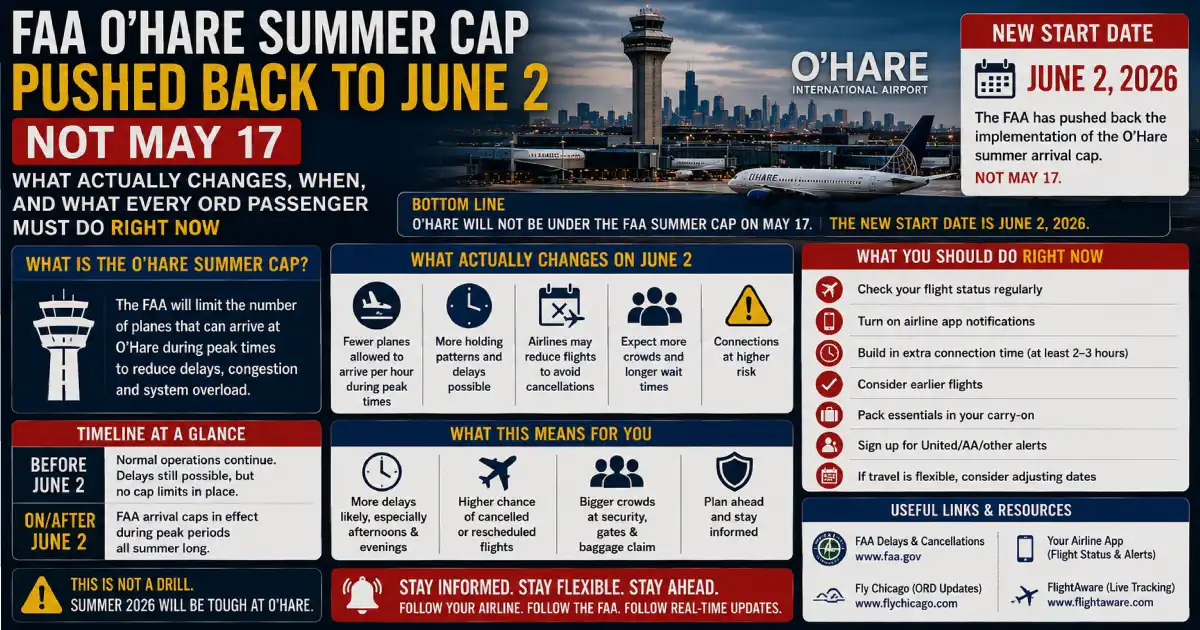
If you have been watching the countdown to May 17 as the day Chicago O’Hare’s overcrowding problem finally gets fixed — there is breaking news you need to know.
The flight reductions originally were set to begin May 17, but the FAA agreed to push back the start date to June 2 to give airlines more time to adjust their schedules “due to certain crew scheduling already assigned for the Summer 2026 scheduling season.”
The cap is real. The cuts are real. The $75,000-per-flight penalty is real. But the start date has shifted — from May 17 to June 2. That means two more weeks of the old O’Hare. Two more weeks of the overcrowded, construction-strained, cascade-generating airport that produced 46 days of the worst US aviation disruption in modern history. Memorial Day weekend (May 23–26) — which arrives before June 2 — will be flown under pre-cap conditions. That is a critical piece of information for every American planning a Memorial Day flight through Chicago.
Here is everything that is confirmed, everything that changes, and everything you need to do right now.
Published: May 16, 2026 — Saturday CRITICAL UPDATE: FAA cap start date moved from May 17 → June 2, 2026 Reason: Crew scheduling already assigned for Summer 2026 season — airlines needed more transition time Cap takes effect: June 2, 2026 — 17 days from today Cap expires: October 24, 2026 Daily limit: 2,708 operations — down from 3,080 planned — 372 fewer peak-day flights United Airlines cut: Revised summer schedule of 650 daily departures — reduced from around 780 — still 11% higher than 2025. Carrying 13% more passengers on larger aircraft. American Airlines cut: Approximately 40 arrivals and departures per day Penalty for exceeding cap: Up to $75,000 per flight Basis of allocation: FAA allocates based on approved Summer 2025 schedules — not Summer 2026 filed schedules Memorial Day (May 23–26): ❌ Pre-cap — OLD O’Hare conditions FAA operational hours: 6:00am–11:59pm · half-hour limit increments: 30–84 operations per half-hour Construction context: Taxiways A & B rehabilitation, new routing to accommodate concrete work west of main terminal — ongoing through summer Post-cap outlook: FAA does not expect to impose scheduling restrictions beyond end of summer — significant construction progress anticipated Passengers affected by United cuts: United notifying customers on rolling basis — check united.com → My Trips
The June 2 delay has one consequence that every US family planning a Memorial Day trip through O’Hare must understand immediately: Memorial Day weekend falls before the cap takes effect.
May 23–26 is Memorial Day weekend — one of the three busiest US travel periods of the year. O’Hare will be operating under its full pre-cap, over-scheduled, 3,080-planned-operations regime on the busiest travel weekend of spring. The construction constraints remain. The ATC staffing limitations remain. And the 14.9% increase in planned operations compared to last summer remains in force through May 31.
Last summer, only 56% of flights departing out of O’Hare didn’t experience any delays. Similarly, only 58% of the flights arriving at the airport that summer didn’t experience any delays. That was before the additional 14.9% capacity increase. Memorial Day 2026 through O’Hare is the highest-risk holiday travel weekend for delays in recent American aviation history.
If you are flying through O’Hare over Memorial Day weekend: Every practical avoidance strategy applies.
The FAA agreed to push back the start date to June 2 to give airlines more time to adjust their schedules “due to certain crew scheduling already assigned for the Summer 2026 scheduling season.”
The logistics of cutting 200 United flights per day at O’Hare are not simple. Chicago-based United, in a letter to employees, did not share exactly which flights would be cut between May 14 and Oct. 24. But the company is in the process of notifying affected customers.
Crew scheduling is the binding constraint. Airlines assign pilots and cabin crew to specific aircraft rotations months in advance. A United crew scheduled to fly ORD–EWR–ORD–LAX–ORD on a specific summer day has had that rotation locked into their contract for weeks. Cancelling or modifying that rotation requires union negotiation, notification periods, rebidding processes, and in some cases premium pay for disrupted schedules. The FAA’s concession — two extra weeks to June 2 — gives United and American the minimum time needed to manage the crew transition without triggering mass grievances or schedule chaos.
The irony: the delay means O’Hare’s worst travel weekend (Memorial Day) occurs under the worst possible conditions.
The FAA said in its order that the planned 3,080-operation schedule “will exceed the airport’s capacity throughout the Summer 2026.” The agency attributed disruptions to extensive construction projects — rehabilitation work on Taxiways A & B resulting in partial closures, and various taxiway closures paired with new routing to accommodate concrete work west of the main terminal area.
The FAA cap operates in 30-minute increments, ranging from 30 operations per half-hour during low demand periods to 84 operations per half-hour at peak periods. The cap is effective from 6:00am to 11:59pm — overnight operations are unrestricted.
The practical effect: airlines cannot bank departures in the same concentrated waves that currently drive the cascade. O’Hare’s current structure has approximately 8–10 departure banks per day — concentrated bursts of 80–120 aircraft pushing back simultaneously. Those banks create the ground congestion, the ATC sequencing delays, and the gate conflicts that produce today’s 1,600+ daily disruptions. The cap’s half-hour limits spread those banks out — smoothing the departure curve and giving ATC, gates, and taxiways the capacity to recover between waves.
The FAA allocates operations based on approved Summer 2025 schedules rather than the larger Summer 2026 schedules airlines filed — meaning United’s aggressive 2026 schedule increase is rolled back to its 2025 baseline.
United made the largest year-over-year schedule increase at O’Hare by far. This order favors American Airlines by freezing the 2025 status quo. American had already done a large rebuild of its schedule for summer 2025. American will cut around 40 flights, while United will cut around 200 from its announced schedule.
The competitive context matters for passengers: On Sunday July 20, 2025, American had 483 flights and United had 575. On Sunday July 19, 2026, American had been scheduled to operate 526 flights (+43 or 9%) and United 773 (+198 or 34%). The FAA cap stops United from using its 2026 schedule to secure more gates in the 2027 reallocation.
For passengers, the carrier scorecard translates to specific booking implications:
United passengers: United’s revised summer schedule of 650 daily departures is reduced from around 780 — still 11% higher than 2025. Because it is using larger aircraft on some routes, it will carry 13% more passengers this summer. More passengers on fewer flights means higher load factors. United flights through O’Hare this summer will be fuller than last year. Standby and upgrade opportunities will be reduced. Book early and confirm your specific flight has not been cut.
American passengers: American cuts approximately 40 daily flights — a much smaller proportional reduction. American’s summer O’Hare schedule is largely intact. American said the FAA’s order will improve reliability and reduce delays for customers traveling through O’Hare this summer.
| Date | O’Hare Status | Key Facts |
|---|---|---|
| Now through June 1 | Pre-cap — old overcrowded schedule | 3,080 planned peak operations · construction still active |
| Memorial Day May 23–26 | ❌ PRE-CAP — HIGHEST RISK PERIOD | Busiest travel weekend + worst conditions |
| June 2, 2026 | ✅ CAP TAKES EFFECT | 2,708 daily operations · 372 fewer peak flights |
| June 2 → October 24 | Post-cap summer | United 650 daily departures (from 780) · American -40 |
| October 24, 2026 | Cap expires | FAA expects construction significantly advanced |
| 2027 | New gate allocation | United potentially regains positions from 2026 data |
United Airlines has been notifying affected customers on a rolling basis since the cap was announced in April. Chicago-based United is in the process of notifying affected customers. If you have not received notification but have an ORD booking for June 2–October 24, 2026: do not assume your flight is safe. Check actively.
Step 1 — United passengers: Open the United app → My Trips → tap your summer ORD itinerary. If the flight status shows your original booking, it is (currently) intact. If it shows a schedule change notification — your flight has been modified. United will offer free rebooking or a full cash refund for cap-driven schedule changes.
Step 2 — American passengers: Open the American Airlines app → My Trips → check your ORD itinerary. American has been contacting affected passengers directly. If you received an email with subject line “Important: change to your itinerary” — your flight was cut. Call 1-800-433-7300 or use the app to rebook fee-free.
Step 3 — Other carriers through ORD: Airlines that connect through ORD on United or American codeshares — Air Canada, Lufthansa, British Airways, Japan Airlines — should check their booking references in their home airline’s app. Schedule changes at the operating carrier (United or American) cascade into codeshare bookings.
Under US DOT rules (April 2024): a cancelled flight entitles you to a full cash refund to your original payment method within 7 business days for credit cards. No vouchers. No eCredits unless specifically requested.
The exact words to use: “My flight [number] has been cancelled as part of the FAA schedule reduction at O’Hare. Under US DOT regulations I am requesting a full cash refund to my original payment method — not a voucher. Please confirm this in writing.”
Alternatively: Free rebooking on the next available same-airline service at no additional charge. Your choice, not the airline’s.
If your ORD–LHR (London), ORD–FRA (Frankfurt), or other transatlantic service is cancelled due to the schedule reduction, EU261/UK261 cash compensation MAY apply — but it is complex. The FAA cap is a regulatory action, which some airlines will argue is extraordinary circumstances. However, the cap was announced weeks in advance and is driven by airline overscheduling (United’s competitive capacity dumping) — not an unforeseeable external event. This is likely to be contested. File your claim at airhelp.com and let the process determine eligibility.
If any carrier refuses your DOT refund: file a credit card chargeback under the Fair Credit Billing Act immediately. Cite “services not rendered.”
The FAA said that it doesn’t think it will have to impose scheduling restrictions beyond the end of the summer because it anticipates that there will be “significant progress on airfield construction through the Summer 2026 season.”
The O’Hare expansion project — the largest infrastructure investment in the airport’s history — is simultaneously the problem and the solution. The construction is what created the taxiway restrictions and gate constraints that made 3,080 operations unsafe this summer. But that same construction, when complete, will give O’Hare a significantly expanded capacity that exceeds the pre-cap baseline. By 2028–2030, the expanded O’Hare will be able to safely handle volumes that currently would trigger the cascade that defined April–May 2026.
The summer of 2026 is the trough — the period when construction constraints are at maximum and capacity is at minimum — before the new infrastructure delivers. The cap is the mechanism that makes the trough survivable.
Two days after the FAA cap takes effect on June 2, Southwest Airlines exits O’Hare entirely on June 4, 2026. The two events — the cap taking effect and Southwest’s departure — occur within 48 hours of each other.
Southwest has operated a significant O’Hare presence for years but announced in March 2026 that it would exit ORD as part of its network restructuring response to the fuel crisis and the competitive pressures that the gate allocation fight between United and American created at the airport. From June 4, Southwest’s Chicago operations concentrate entirely at Midway (MDW).
For passengers: if you have a Southwest O’Hare booking for June 4 or beyond, contact Southwest immediately. Full DOT cash refund or alternative routing through Midway or other Southwest hubs is available.
| Action | Contact / Link |
|---|---|
| United flight check + cap notifications | united.com → My Trips · united.com/travelinfo |
| United customer service | 1-800-864-8331 |
| American Airlines flight check | aa.com → My Trips · aa.com/travelinfo |
| American customer service | 1-800-433-7300 |
| Southwest O’Hare exit (June 4) | southwest.com → Manage Reservations · 1-800-435-9792 |
| FAA O’Hare cap order | regulations.gov → search “O’Hare 2026” |
| FlightAware — ORD live | flightaware.com/live/airport/KORD |
| O’Hare airport official | flychicago.com/ohare |
| DOT complaint (refund refused) | aviation.consumer.complaints@dot.gov |
| EU261 claim | airhelp.com |
| UK261 claim | bott.co.uk |
| Chicago Midway alternatives | flychicago.com/midway |
| CTA Blue Line (ORD train) | transitchicago.com |
| FAA NAS Status | nasstatus.faa.gov |
The FAA agreed to push back the O’Hare summer cap start date from May 17 to June 2, to give airlines more time to adjust schedules due to crew scheduling already assigned for the Summer 2026 season. The cap limits O’Hare to 2,708 daily operations — cutting as many as 372 flights on peak days — through October 24, 2026. Only 56% of O’Hare departures were on time last summer. United’s revised schedule drops from 780 to 650 daily departures — still carrying 13% more passengers on larger aircraft. American cuts approximately 40 flights per day. The allocation is based on 2025 schedules — effectively handing American a win by freezing United’s aggressive 2026 expansion. Memorial Day (May 23–26) falls before the June 2 cap — meaning the busiest travel weekend of spring occurs under full pre-cap, over-scheduled conditions.
Your five-point action plan right now:
Related Articles:
Posted By : Vinay
This article is provided for general informational purposes only and is based on information available at the time of publication. Travel advisories, airline schedules, airport operations, visa requirements, government regulations, and other travel-related information are subject to change without prior notice. While Travel Tourister makes reasonable efforts to verify information using official announcements, government publications, airline and airport communications, and other reliable sources, we cannot guarantee that all information remains complete, accurate, or up to date at all times. Readers should independently verify any information that may affect their travel plans with the relevant airline, airport authority, government agency, embassy, or other official source before making travel, financial, or other decisions. Travel Tourister shall not be liable for any direct or indirect loss, inconvenience, or damages arising from the use of or reliance on the information contained in this article. Nothing in this publication constitutes legal, immigration, financial, or professional travel advice. If you believe any information in this article is inaccurate or outdated, please contact our editorial team. We review all credible correction requests promptly and update our content whenever appropriate.
Lastest News
2nd Floor, 39, Above Kirti Club, DLF Industrial Area, Kirti Nagar, New Delhi, Delhi 110015



Travel Tourister is a leading Travel portal where we introduce travellers to trusted travel agents to make their journey hasselfree, memorable And happy. Travel Tourister is a platform where travellers get Tour packages ,Hotel packages deals through trusted travel companies And hoteliers who are working with us across the world. We always try to find new and more travel agents and hoteliers from every nook and corners across the world so that you could compare the deals with different travel agents and hoteliers and book your tour or hotel with the one you have chosen according to your taste and budget.
Copyright © Travel Tourister, India. All Rights Reserved

 Call
Call Enquiry