Published on : 05 Jun 2026
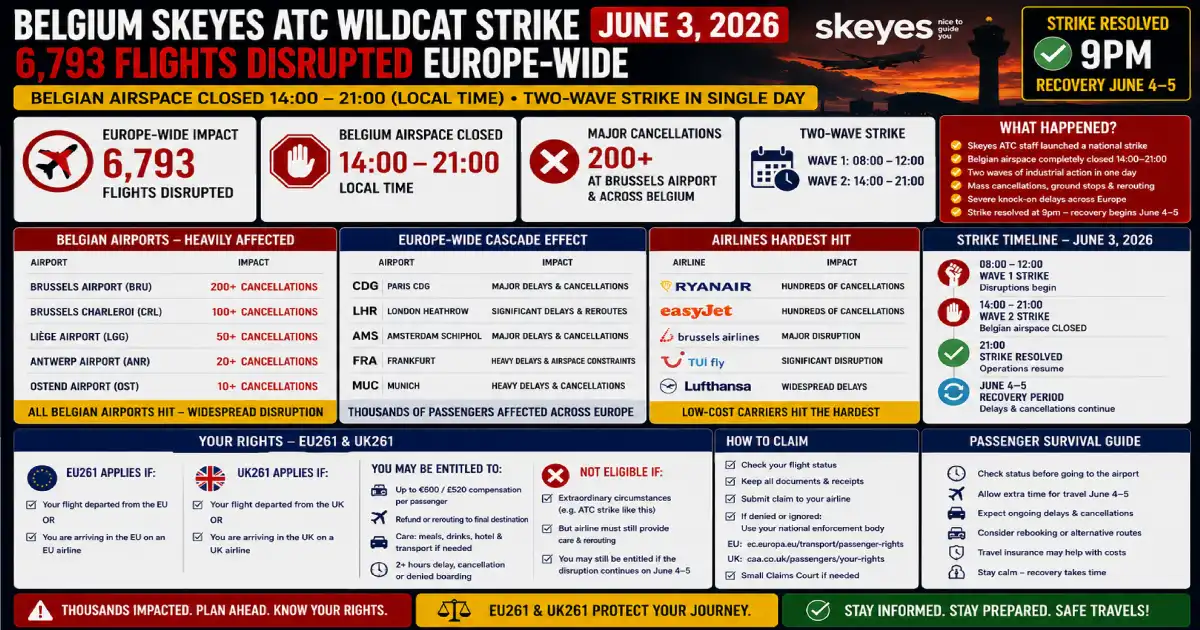
Zero warning. Zero notice. Zero contingency plan. On June 3, 2026, Belgium’s air traffic controllers walked out twice in a single day — first at 02:30 in the middle of the night, and again at 14:00 in the middle of the afternoon — closing the country’s entire airspace and detonating the largest single ATC disruption event in European aviation in 2026.
A wildcat strike by Skeyes air traffic controllers on June 3, 2026 effectively closed Belgian airspace and disrupted 6,793 flights across Europe. Brussels Airport and Brussels South Charleroi Airport were at the centre of the disruption, while major hubs including Paris Charles de Gaulle, London Heathrow, Amsterdam Schiphol, Frankfurt and Munich also saw heavy delays and cancellations. easyJet and Ryanair were among the airlines hit hardest.
The strike by air traffic controllers at Belgian air traffic control agency Skeyes ended after agreement was reached between management and the trade unions on Tuesday evening. The strike had brought air traffic to and from Belgium to a standstill. Air traffic returned to normal — but Wednesday June 4 and Thursday June 5 were set to be busy days at the airport as many flights had been delayed.
The agreement ended the walkout. It did not erase the disruption. 6,793 flights — delayed, diverted, and cancelled across fourteen countries — do not recover overnight. Passengers stranded at Brussels, Charleroi, Paris, London, Frankfurt, and Amsterdam on June 3 are still dealing with the downstream consequences today, June 5, as aircraft and crews reposition and the European network processes the backlog from its worst single ATC event of the year.
Published: June 5, 2026 — (Skeyes Strike Day 3 · Recovery Ongoing) Strike type: WILDCAT — zero advance notice — two separate waves in one day Wave 1: 02:30–07:00 local — overnight spontaneous walkout — Liège + Charleroi first, then all Skeyes departments Wave 2: 14:00–21:00 local — second formal action — ALL Belgian airports suspended — Belgian airspace closed Total flights disrupted: 6,793 across Europe — 634 cancellations + 6,159 delays Brussels Airport (BRU): ~200 flights cancelled (afternoon wave) + ~25 delayed + 2 diverted (morning wave) Brussels South Charleroi (CRL): All flights cancelled from 14:15 + 30 cancellations from morning wave Also affected: Liège (LGG) · Antwerp (ANR) · Ostend-Bruges (OST) Cascade airports: Paris CDG · London Heathrow · Amsterdam Schiphol · Frankfurt · Munich Countries disrupted: Belgium · UK · France · Germany · Netherlands · Czech Republic · Austria · Greece · Poland · Croatia · Italy · Switzerland · Spain · and more Hardest-hit airlines: Ryanair · easyJet · Brussels Airlines · Transavia · TUI fly Belgium · Wizz Air · British Airways Strike cause: Dispute over Namur digital control centre replacing Liège + Charleroi towers from 2027 — preliminary agreement rejected by rank and file Resolution: Agreement reached 21:00 June 3 — strike ended — flights resumed from 21:00 Recovery status June 4–5: Ongoing — June 4 + 5 congested as delayed aircraft and crews reposition EU261 compensation: ⚠️ ATC strike = extraordinary circumstance — cash compensation UNLIKELY — but refund + care + rerouting fully apply UK261: Same framework — refund + care + rerouting — no cash compensation for ATC cause
The Skeyes crisis of June 3 is the story of a management-labour breakdown that produced two entirely separate industrial actions in a single 24-hour period — an almost unprecedented sequence in European ATC history.
The workers are protesting the conditions under which the future digital control tower in Namur will be put into service, which is set to centralise the operations of the control towers at Liège and Charleroi airports starting in 2027.
Trade unions at Skeyes have been in negotiations with management over the transition after staff became concerned the shift to digital control towers would reduce the number of air traffic controllers over time. A preliminary agreement was struck between the parties on Monday June 2, which involved salary increases, fixed monthly pay rises and salary cap bonuses. Additional benefits under the proposed deal included an extra mileage allowance for three years and two days of leave for staff who chose to relocate closer to the new Namur centre. However, staff rejected the agreement, prompting a wave of spontaneous strike action beginning on Monday evening when control tower employees at Liège and Charleroi walked out, with others across Skeyes’ departments following suit.
The rank-and-file rejection is the critical detail. A management team negotiates with union secretaries. Union secretaries sign a preliminary agreement. They go back to their members — and the members say no. This is not an unusual pattern in European labour disputes, but when it happens at an ATC provider managing the airspace of a country that sits at the geographic heart of the European flight corridor, the consequences are immediate and enormous.
The dispute covers transitional arrangements for Skeyes’ new digital control centre in Namur covering Liège and Charleroi airport towers. A Monday preliminary agreement with one union secretary was never put to or supported by the rank and file, with controllers also citing concerns over digital-system security, social impact of the Namur relocation, shift-scheduling, and unequal pay between airport control towers.
Four separate grievances embedded in a single dispute — digital-system security, relocation impact, shift-scheduling, and pay inequality — meant that even if management addressed the headline wage issue, the walkout had multiple triggers that could sustain it independently. This complexity is why the June 3 resolution, when it came, required more than a wage offer.
According to Skeyes, staff members walked off the job between 02:30 and 07:00 local time in protest over arrangements concerning the new digital control centre in Namur. At Brussels Airport, no passenger flights were cancelled as a direct result of the overnight strike. However, the disruption affected flight schedules, with around 25 departures expected to leave later than planned. Two inbound flights were also diverted to other airports. Liège Airport reported that approximately 20 flights were affected by the industrial action.
The first wave — overnight, spontaneous, starting in the early hours — is the most technically significant in terms of its downstream effect. The critical morning wave at Charleroi, Liège, and then Brussels began at 02:30. The European air traffic management system begins its daily planning cycle in the early hours of the morning. Flight plans are filed, slot times are allocated by Eurocontrol, and aircraft begin their pre-departure positioning. A loss of Belgian ATC from 02:30 means every flight plan involving Belgian airspace filed for the morning departure wave — from Ryanair’s early-morning Charleroi departures to cargo services at Liège to transiting international flights — is invalidated, re-routed, or held.
Air traffic controllers struck at Skeyes early in the morning, but flights resumed around 09:30 AM. A five-hour overnight walkout. Flights partially recovered by mid-morning. And then — the second wave.
Belgian air traffic controllers launched a second industrial action on Tuesday June 2, disrupting flight operations at airports across the country just hours after a spontaneous overnight strike had already affected air traffic. According to a Eurocontrol network operations message, air traffic control services at several Belgian airports would be unavailable for significant periods during the afternoon and evening. The disruption affected Belgium’s major airports including Brussels Airport, Antwerp Airport, Charleroi Airport, Liège Airport and Ostend-Bruges Airport. At Brussels Airport, approach and tower services were unavailable between 12:15 UTC and 19:00 UTC (14:15 to 21:00 local time).
Brussels Airport confirmed that due to the strike, no air traffic was possible between 2pm and 9pm, forcing airlines to cancel all arrivals and departures scheduled during peak disruption hours. Passengers were advised not to travel to the airport for affected flights. The airport further stated that flights planned between 7pm and 9pm faced delays and would be rescheduled where possible after normal operations resumed later in the evening. In total, around 200 flights were cancelled at Brussels Airport alone.
Air traffic was expected to be suspended until 21:00. “Despite the removal of the item regarding the digital control tower from the joint committee’s agenda, air traffic controllers have decided to provide only minimum service, which includes state flights, medical flights and Search and Rescue flights,” explained Skeyes spokesperson Audrey Dorigo.
The minimum service declaration is the most extreme tool available in Belgian labour law for essential services — it means that only safety-critical operations continue. No scheduled passenger services. No cargo. No positioning flights. 200 aircraft at Brussels alone grounded from 14:00 to 21:00 on a Tuesday afternoon in the first week of June — peak summer booking period, peak connecting traffic through the heart of Europe.
The strike by air traffic controllers at Skeyes ended after agreement was reached between management and the trade unions on Tuesday evening. Air traffic returned to normal. Wednesday and Thursday were set to be busy days at the airport as many flights had been delayed.
Around 40 departing and 40 arriving flights were scheduled to take place after 9pm. However, delays remained possible for these flights. Flights initially scheduled after 7pm departed later than planned. Between 2pm and 7pm, the strike resulted in the cancellation of approximately 140 flights, including both departures and arrivals. Brussels Airport stated: “We regret the impact of this unannounced strike on our passengers and, together with our partners, have done everything possible to accommodate and inform travellers.”
Belgium is not the largest country in Europe. Brussels Airport is not the continent’s busiest hub. So why did a Belgian ATC strike disrupt 6,793 flights across 14+ countries and cascade into CDG, Heathrow, Schiphol, Frankfurt and Munich?
The answer is geography and architecture. Belgium sits at the geographic crossroads of the most densely trafficked airspace in the world. Every flight from London to Paris passes through or alongside Belgian airspace. Every flight from Amsterdam to Madrid. Every flight from Scandinavia to the Mediterranean. Every transatlantic departure from northern Europe routing over the North Sea. Skeyes manages the airspace up to 7,500 metres — the layer in which virtually all short and medium-haul European commercial aviation operates.
Skeyes manages air traffic to and from Belgian airports and airspace up to an altitude of approximately 7,500 metres. Aircraft overflying Belgium at higher altitudes are managed by Eurocontrol, which was unaffected by the strike.
This distinction is crucial and is the reason why 6,793 flights were affected rather than just the roughly 800 Belgian-airport daily movements. The flights crossing Belgian airspace below 7,500 metres — transiting from the UK to Germany, from France to the Netherlands, from Ireland to Eastern Europe — could not follow their planned routes. Eurocontrol, which manages upper airspace, issued re-routing instructions that added distance, time, and fuel consumption to thousands of transiting services. Airlines that couldn’t re-route absorbed ground stops and delays at their origin airports while waiting for revised routing clearances.
The Skeyes wildcat strike triggered 6,159 massive flight delays and 634 outright flight cancellations that tore through the United Kingdom, Belgium, France, Germany, Czech Republic, Austria, Greece, Poland, Croatia, Italy, Netherlands, Switzerland and Spain.
Fourteen countries. Every major European aviation hub. The single largest ATC disruption event in European aviation in 2026.
Morning wave (02:30–09:30): Around 25 delayed departures and 2 diverted arrivals. No direct passenger cancellations. Cargo disrupted.
Afternoon wave (14:00–21:00): Approach and tower services suspended 14:15–21:00. Approximately 140–200 flights cancelled between 14:00 and 19:00. Around 40 departures and 40 arrivals resumed from 21:00, though with delays.
Recovery (June 4–5): Wednesday and Thursday set to be exceptionally busy as many flights delayed from June 3 create a recovery backlog. Positioning debt from 200+ Brussels cancellations feeds into the June 4 morning wave.
Live status: brusselsairport.be → Flight Information
Charleroi was the hardest-hit Belgian airport in absolute terms of proportional disruption. As the primary Ryanair Belgium base — handling over 90% of Ryanair’s Belgian operations — Charleroi’s closure from 14:15 is the single most significant cause of Ryanair’s June 3 Belgian disruption.
Brussels South Charleroi Airport announced on its website that all its flights scheduled to arrive or depart from 14:15 were cancelled. In addition, the morning wave produced 30 passenger flight cancellations at Charleroi from the overnight walkout.
Charleroi’s relatively thin schedule — mostly Ryanair point-to-point services with no connecting hub function — means that a cancellation here cannot be absorbed by rerouting passengers through an alternative terminal or carrier. Every cancelled Charleroi departure is a passenger who simply cannot travel that day.
Live status: charleroi-airport.com → Flights
Liège is a primarily cargo airport — the European hub for DHL and TNT operations — but also handles passenger services. The morning wave disrupted approximately 20 Liège flights, including DHL cargo operations that run through the night. DHL confirmed at least 12 cargo flights were delayed as a result of the Skeyes action.
Liège is also directly at the heart of the Namur dispute — the new digital control centre is specifically intended to replace the Liège and Charleroi towers, meaning Liège-based controllers had the most direct personal stake in the walkout.
Both airports confirmed disruption during the afternoon wave, with tower services unavailable during the 14:15–21:00 window. Antwerp’s tower was suspended between 15:00 UTC and 19:00 UTC, while Ostend-Bruges was similarly affected.
CDG absorbed significant cascade disruption from the Belgian airspace closure — both from transiting traffic that could not follow planned Belgian airspace routings and from aircraft originating at Belgian airports that could not depart and were therefore unavailable for CDG connections. Air France and its partner carriers at CDG recorded elevated delays through the afternoon and evening of June 3 as a direct consequence of the Skeyes closure.
London Heathrow saw heavy delays and cancellations as a result of the Belgian airspace closure. Heathrow’s position as the primary UK departure point for flights routing over Belgium to continental and Eastern European destinations made it particularly exposed. British Airways services to Brussels and beyond, easyJet’s Gatwick-based continental network, and Ryanair’s Stansted operations all experienced the Belgian closure’s downstream effect through re-routing instructions and ground stops.
Schiphol is geographically the most exposed major European hub to a Belgian airspace closure. Amsterdam is immediately north of Belgium — virtually every KLM and Transavia short-haul departure to Southern Europe, Spain, Portugal and Italy passes through or adjacent to Belgian airspace. Ground stops and re-routing instructions at Schiphol on June 3 produced cascading delays through KLM’s connecting hub operation, affecting passengers on inbound connections from North America and Asia who were transiting Schiphol for European onward legs.
Both Lufthansa hubs recorded delays from the Belgian cascade — aircraft arriving from Western Europe that had been re-routed around Belgian airspace arrived late, disrupting turnaround schedules and feeding delays into the afternoon and evening departure waves at both airports.
Ryanair operates more flights through Charleroi and Brussels than any other carrier. Ryanair was among the airlines hit hardest by the Skeyes strike. Charleroi is Ryanair’s primary Belgian base — a carrier that built its Brussels-area presence specifically on Charleroi’s lower costs and Skeyes-managed airspace. Every Charleroi flight cancelled from 14:15 is a Ryanair passenger stranded.
Ryanair’s response protocol during ATC strikes: the carrier typically offers free flight changes and fare-free rebooking for passengers on a confirmed disruption day. Check ryanair.com → My Trips for an active advisory — if your June 3 Ryanair service was cancelled or delayed, the rebooking and refund options below apply.
Contact: ryanair.com → My Trips → Manage | Ryanair app → Chat
easyJet was among the airlines hit hardest by the Belgian airspace closure. easyJet operates from Brussels Airport and has significant Belgian-routed network services connecting the UK, France, Spain, and other European markets through Belgian airspace. The combination of Brussels Airport’s 200-flight cancellation wave and the re-routing impact on easyJet’s non-Belgian services that transit Belgian airspace produced a multi-layer disruption for the carrier.
Contact: easyjet.com → Manage Bookings | easyJet app → disruption handling
Brussels Airlines is Belgium’s flag carrier and the carrier most completely dependent on Skeyes-managed airspace. Every Brussels Airlines departure and arrival involves Belgian airspace exclusively — there is no alternative routing. The complete 14:00–21:00 suspension of Belgian airspace meant Brussels Airlines’ entire afternoon and evening schedule ceased to exist.
Brussels Airlines’ recovery on June 4 and 5 is the most complex of any carrier affected — the carrier needs to reposition aircraft and crews that were spread across Europe at the point when the strike ended, bring them back to Brussels, and then restore a schedule that was effectively wiped for seven hours.
Contact: brusselsairlines.com → Manage Booking | Brussels Airlines: +32 2 723 23 62
British Airways’ London Heathrow–Brussels Zaventem service — one of the most frequently operated routes in BA’s European short-haul network — was among the routes directly cancelled during the afternoon wave. BA’s business-class passengers on this high-yield corporate corridor are among the passengers most likely to claim under EU261 or UK261 for care and assistance. Note: BA’s Heathrow-Brussels service departs from the UK — UK261 applies for the departure leg.
Contact: ba.com → Manage My Booking | BA: 0800 727 800 (UK)
All three carriers confirmed June 3 disruptions on their Belgian-airport operations. Transavia (Air France’s low-cost subsidiary) operates from Brussels to French and holiday destinations — its afternoon departures were cancelled. TUI fly Belgium handles holiday charter operations from Brussels and Charleroi to Mediterranean destinations — summer-peak cancellations on this carrier affect passengers who have booked full holiday packages. Wizz Air operates from Charleroi to Eastern European destinations — its evening services from CRL were grounded.
This is the most important section for passengers whose June 3 Belgian-disrupted flights they are trying to claim for — and the legal landscape is specific, nuanced, and frequently misrepresented by airlines.
Because the disruption was caused by air traffic control staff rather than the airlines themselves, compensation under EC261 is unlikely in most cases. But that doesn’t mean passengers are without support. Airlines should still provide care and assistance during long delays, including meals and refreshments, hotel accommodation and transport if stranded overnight, and the right to be rerouted or given a full refund.
An ATC strike — a walkout by government or state-agency air traffic controllers — is classified as an extraordinary circumstance under EU261 Article 5(3). Extraordinary circumstances exempt airlines from paying cash compensation (the €250/€400/€600 scale). They do NOT exempt airlines from their care and duty obligations or their refund obligations.
The critical legal distinction — what you ARE and ARE NOT owed:
| Right | ATC strike — do you get it? |
|---|---|
| Cash compensation €250–€600 | ❌ No — extraordinary circumstance |
| Full refund for cancelled flight | ✅ YES — unconditional, within 7 days |
| Rerouting to final destination | ✅ YES — on earliest available flight |
| Meals during 2+ hour delay | ✅ YES — duty of care applies regardless |
| Hotel for overnight cancellation | ✅ YES — duty of care applies regardless |
| Ground transport airport–hotel | ✅ YES — duty of care applies regardless |
Even after operations restarted, knock-on disruption on June 4 looked hard to avoid while delayed aircraft, crews, and passengers were repositioned.
Here is the most important legal point for June 4 and 5 passengers: once the Skeyes strike ended at 21:00 on June 3, airlines can no longer cite the ATC strike as the cause of subsequent cancellations. A Ryanair or easyJet cancellation on June 4 or 5 — caused by an aircraft being out of position or a crew exceeding duty hours because of the June 3 disruption — is an airline operational failure, not an extraordinary circumstance.
If your June 4 or 5 flight was cancelled and the airline cited the Belgium ATC strike — challenge it. The strike ended June 3. Positioning debt is a controllable operational failure. EU261 cash compensation of €250–€600 applies to controllable June 4 and 5 cancellations.
Say to your airline: “The Skeyes strike ended on June 3 at 21:00. My flight was cancelled on June 4/5. The cause of my cancellation is your operational failure to reposition aircraft and crew — this is a controllable disruption and I am entitled to EU261 cash compensation.”
For June 4 and 5 knock-on cancellations, and for any June 3 disruptions where the airline itself (not ATC) was responsible for the cancellation or delay:
| Route distance | Compensation per passenger |
|---|---|
| Up to 1,500km | €250 |
| 1,500km–3,500km | €400 |
| Over 3,500km (4hr+ delay) | €600 |
For passengers whose flights departed from a UK airport — including Heathrow and Gatwick services connecting to Belgian routes — UK261 applies rather than EU261. The compensation scale is:
| Route distance | UK261 compensation |
|---|---|
| Up to 1,500km | £220 |
| 1,500km–3,500km | £350 |
| Over 3,500km | £520 |
The ATC extraordinary circumstance rule applies identically under UK261 — no cash compensation for the ATC-caused disruption itself. June 4 and 5 knock-on cancellations: same logic as EU261 — controllable, compensation applies.
For any flight cancelled as a result of the June 3 Skeyes strike — regardless of extraordinary circumstance classification — you are entitled to a full cash refund within 7 business days to your original payment method. No vouchers unless you specifically consent to them.
The process: contact your airline directly first. Ryanair and easyJet have self-service refund portals that process ATC disruption refunds without requiring a phone call. Brussels Airlines requires contact with its customer relations team for disruption refunds.
If you were at a Belgian airport or connecting airport during the June 3 disruption and faced a delay of 2+ hours:
Meals: Food and drink vouchers — your right under EU261 Article 9, regardless of cause. Minimum two vouchers for a standard delay of 4+ hours. If the airline did not provide vouchers: keep all food receipts and claim reimbursement as reasonable out-of-pocket expenses.
Hotel: If the June 3 cancellation resulted in an overnight strand — and the next available flight is on June 4 — the airline must arrange hotel accommodation and ground transport, regardless of the ATC extraordinary circumstance. Keep your hotel receipts if you booked independently; submit for reimbursement.
Communications: Two free phone calls or internet access to notify family or colleagues.
Step 1: Document everything. Screenshot your cancelled flight notification with the stated reason. Photograph the airport departures board. Keep all receipts from meals and accommodation purchased during the disruption.
Step 2: File directly with your airline:
Step 3: For June 4 or 5 knock-on cancellations where you believe cash compensation applies: state clearly in your claim that the ATC strike ended at 21:00 on June 3 and your cancellation is an airline operational failure, not an extraordinary circumstance.
Step 4: If rejected or unresolved in 8 weeks: escalate to your national enforcement body.
Step 5: Assisted claims (no-win-no-fee): AirHelp (airhelp.com), Flightright (flightright.eu), Bottonline (bottonline.co.uk for UK claims)
Time limits: 2 years (UK) / 3 years (most EU countries) from the date of disruption
The strike ended at 9pm on June 3 and air traffic returned to normal. Wednesday June 4 and Thursday June 5 were set to be busy days at the airport as many flights had been delayed.
For passengers travelling through Belgian airports or on routes that cross Belgian airspace on June 5:
Brussels Airport: Operating under recovery conditions today. Departures board will show some residual delays from aircraft that arrived late on June 4 and are still working through their rotation backlog. Allow extra time — arrive 3 hours before departure for international services, 2.5 hours for EU short-haul.
Charleroi: Ryanair’s primary Belgian base should be operating normally today, but check your specific flight on ryanair.com → My Trips and enable app notifications for gate changes and delay updates.
Connecting through CDG, Heathrow, Schiphol: If your June 5 itinerary involves a connection through any of these hubs and your incoming leg routes through Belgian airspace — the June 3 positioning debt has largely cleared by June 5, but any connection shorter than 90 minutes through these hubs should be treated as elevated-risk during the June 4–5 recovery window.
The most important question for summer 2026 travellers is whether the June 3 resolution is durable or whether the Skeyes dispute could produce further wildcat action.
Agreement was reached between management and the trade unions on Tuesday evening. The specific terms of the resolution were not immediately disclosed by either party.
The structural nature of the Namur dispute — job security in the digital age, relocation impact, digital system safety — is not resolved by a single evening’s negotiation. The rank-and-file rejection of the preliminary agreement on June 2 demonstrated that union secretaries and the workers they represent are not always aligned. Until the Namur transition itself is either redesigned or the transitional package is formally approved by the membership at a properly constituted ratification vote, the risk of further spontaneous action at Skeyes cannot be fully excluded.
For summer 2026 travellers booking flights involving Belgian airports or Belgian airspace routing: travel insurance with strike cover is strongly recommended. The Belgian ATC dispute is not resolved — it is paused.
| Airline / Airport | Website | Contact |
|---|---|---|
| Ryanair | ryanair.com → My Trips | App chat / ryanair.com/contact |
| easyJet | easyjet.com → Manage Bookings | 0330 365 5000 (UK) |
| Brussels Airlines | brusselsairlines.com | +32 2 723 23 62 |
| British Airways | ba.com → Manage My Booking | 0800 727 800 (UK) |
| Transavia | transavia.com → My Booking | Via website contact form |
| Wizz Air | wizzair.com → My Bookings | App chat |
| Brussels Airport | brusselsairport.be → Flights | +32 2 753 77 53 |
| Charleroi Airport | charleroi-airport.com → Flights | +32 71 25 12 11 |
| AirHelp (claims) | airhelp.com | Claim online — no win no fee |
| UK CAA | caa.co.uk/passengers | Complaint portal |
| Belgian transport authority | mobilit.belgium.be | EU261 enforcement |
| FlightAware Brussels | flightaware.com/live/airport/EBBR | Live flight tracking |
Related Articles:
Posted By : Vinay
This article is provided for general informational purposes only and is based on information available at the time of publication. Travel advisories, airline schedules, airport operations, visa requirements, government regulations, and other travel-related information are subject to change without prior notice. While Travel Tourister makes reasonable efforts to verify information using official announcements, government publications, airline and airport communications, and other reliable sources, we cannot guarantee that all information remains complete, accurate, or up to date at all times. Readers should independently verify any information that may affect their travel plans with the relevant airline, airport authority, government agency, embassy, or other official source before making travel, financial, or other decisions. Travel Tourister shall not be liable for any direct or indirect loss, inconvenience, or damages arising from the use of or reliance on the information contained in this article. Nothing in this publication constitutes legal, immigration, financial, or professional travel advice. If you believe any information in this article is inaccurate or outdated, please contact our editorial team. We review all credible correction requests promptly and update our content whenever appropriate.
Lastest News
2nd Floor, 39, Above Kirti Club, DLF Industrial Area, Kirti Nagar, New Delhi, Delhi 110015



Travel Tourister is a leading Travel portal where we introduce travellers to trusted travel agents to make their journey hasselfree, memorable And happy. Travel Tourister is a platform where travellers get Tour packages ,Hotel packages deals through trusted travel companies And hoteliers who are working with us across the world. We always try to find new and more travel agents and hoteliers from every nook and corners across the world so that you could compare the deals with different travel agents and hoteliers and book your tour or hotel with the one you have chosen according to your taste and budget.
Copyright © Travel Tourister, India. All Rights Reserved

 Call
Call Enquiry