Published on : 03 Jun 2026
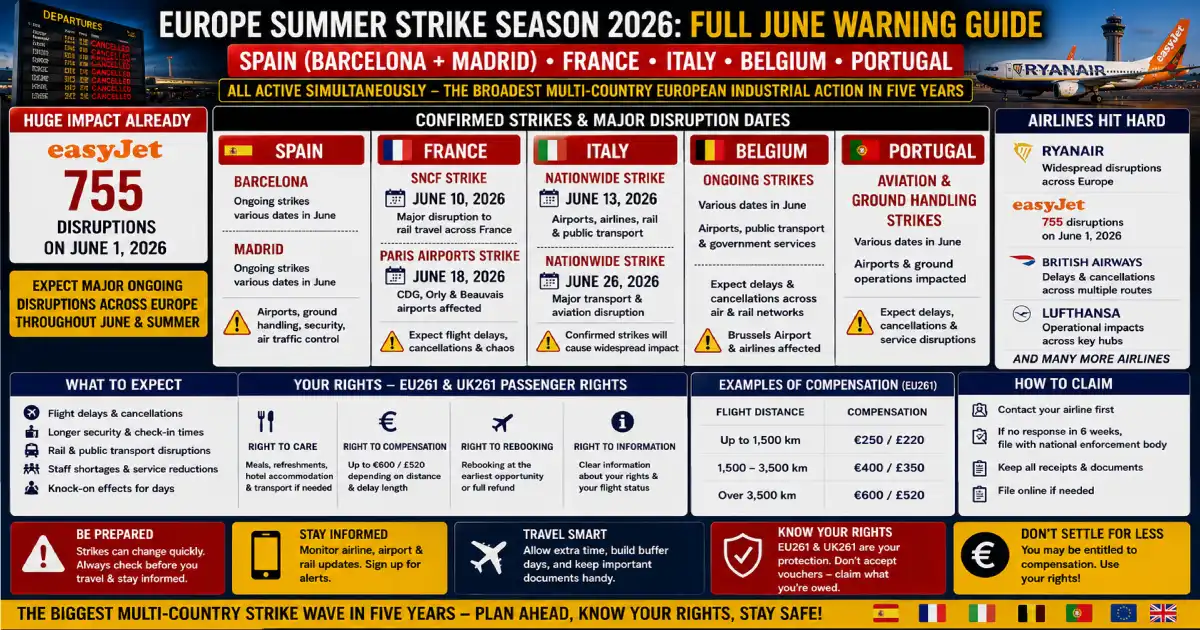
The map of Europe right now is not a summer holiday map. It is a strike map. Five countries — Spain, France, Italy, Belgium, and Portugal — are simultaneously in active industrial action that is disrupting flights, trains, airports, and ground services across the continent’s most popular summer destinations. This is not a temporary spike. This is a structural pattern that runs through September 1, and every week of summer 2026 carries a specific, identifiable disruption risk that passengers can plan around — if they know what is coming.
On June 1, 2026 alone, easyJet recorded 32 flight cancellations and 723 severe delays, disrupting primary aviation gateways across Europe including London, Paris, Amsterdam, Milan, Lisbon, Berlin, and Barcelona. That single-day figure — 755 total disruptions on one carrier — is not a weather event or an IT outage. It is the cumulative expression of a European industrial landscape in which ground handlers, cabin crew, air traffic controllers, and rail workers across multiple sovereign states are simultaneously in active dispute with their employers and governments.
This is your complete country-by-country guide to everything that is confirmed, everything that is scheduled, and exactly what it means for your summer 2026 European travel.
Published: June 3, 2026 — Wednesday (Day 63 · European Summer Strike Season · Peak Begins) Countries in active strike action: Portugal 🇵🇹 · Spain 🇪🇸 · France 🇫🇷 · Italy 🇮🇹 · Belgium 🇧🇪 easyJet June 1: 32 cancellations + 723 delays = 755 disruptions — single carrier, single day Spain ground handling: Mondays, Wednesdays, Fridays — Groundforce + Azul (Ryanair) — 12 airports — INDEFINITE Spain ATC: SAERCO — 14 airports — extended multiple times — June status active Italy ATC + ground: June 13 (Verona + Cagliari) + June 26 (nationwide ground handling) — confirmed France SNCF: June 10 — all 4 major unions — TGV + Intercités + TER Paris airports: June 18 — CDG + Orly + Le Bourget — CGT, CFDT, Unsa, Sud Aérien Belgium SNCB: Recurring pattern — structural dispute ongoing — Eurostar risk Portugal: Strike day June 3 — recovery lag June 4–5 — 500+ flights cancelled Most exposed carriers: Ryanair · easyJet · British Airways · Lufthansa · ITA Airways · Vueling · Air Nostrum · TAP Most exposed airports: Barcelona El Prat · Madrid Barajas · Rome Fiumicino · Milan Malpensa · Paris CDG · Brussels-Midi (rail) EU261 compensation: Up to €600 per passenger for controllable cancellations UK261 compensation: Up to £520 per passenger for UK-departing flights
The European aviation and rail strike pattern of summer 2022 — which saw easyJet cancel thousands of flights, ground handlers walk out at Heathrow, and Spanish airport workers cause chaos during peak July and August weeks — was widely described as a post-pandemic structural breakdown of the continent’s transport workforce relationships. Three years later, the disputes look structurally similar but broader.
In 2022, the disruption was primarily concentrated in the UK and Spain. In 2026, the geographic spread is categorically wider. Five countries are simultaneously in active industrial dispute across aviation and rail. The disputes are driven by a common theme — wage demands that have not kept pace with inflation across the 2022–2025 period, combined with government reform packages in Portugal, Belgium, and France that their transport workforces are actively resisting.
Spain’s peak holiday season may be the most turbulent in years after unions representing air-traffic controllers, ground-handling crews and baggage staff have pledged rolling stoppages through at least the end of June. An indefinite ATC strike launched on April 17 has already been extended to May 31 and could continue, while ground-handling unions have called partial walk-outs every Monday, Wednesday and Friday at major hubs including Madrid-Barajas, Barcelona-El Prat, Málaga, Alicante and Palma de Mallorca.
This is not a single bad week. This is the architecture of European summer travel in 2026 — and it requires a country-by-country, carrier-by-carrier understanding to navigate.
Spain is the most complex strike environment in Europe right now because it is not a single dispute — it is three simultaneously active industrial actions at different layers of the aviation system, involving different workers, different companies, and different legal frameworks.
Layer 1 — Groundforce Ground Handling (INDEFINITE since March 30)
Since March 30, 2026, staff at 12 major Spanish airports including Barcelona, Madrid, Alicante, Palma and Malaga have been engaged in ongoing industrial action. These workers are employed by Groundforce and Menzies, two key ground handling companies in Spain. The strikes involve partial work stoppages affecting the processing of passengers at security, check-in counters and baggage handling. Work stoppages operate on Mondays, Wednesdays and Fridays between 05:00–07:00, 11:00–17:00, and 22:00–midnight.
This means that every Monday, Wednesday, and Friday in June and July 2026, the ground handling operation at 12 Spanish airports is running at reduced staffing during three defined windows. The result is not mass cancellations — it is systemic operational friction. Bags are processed more slowly. Check-in queues are longer. Gate assignments take longer to update. And in a system operating at summer peak capacity, that friction cascades into missed connections, delayed departures, and mishandled baggage.
The airports confirmed in the Groundforce dispute: Barcelona El Prat · Madrid Barajas · Málaga · Alicante · Valencia · Palma de Mallorca · Ibiza · Bilbao · Gran Canaria · Tenerife Norte and Sur · Lanzarote · Fuerteventura
Layer 2 — Azul Handling / Ryanair Ground Staff (RECURRING)
UGT (FeSMC) has called nationwide partial stoppages at Azul Handling — Ryanair’s ground handling operation in Spain — every Wednesday, Friday, Saturday and Sunday across all Spanish Ryanair bases including Madrid, Barcelona, Valencia, Sevilla, Málaga, Alicante, Ibiza, Palma, Girona, Tenerife Sur and Lanzarote.
Ryanair is Europe’s highest-frequency low-cost carrier into Spain. A recurring four-day weekly partial stoppage on its own ground handling operation creates a baseline of disruption on the carrier’s highest-volume days — weekends and Fridays — across the entire Spanish network.
Layer 3 — SAERCO ATC (14 Airports)
An indefinite ATC strike by SAERCO launched on April 17 has already been extended multiple times. The 14 airports affected by SAERCO are separate from Madrid-Barajas and Barcelona El Prat, which are AENA-operated and NOT subject to the SAERCO dispute.
The SAERCO-affected airports — Lanzarote, Fuerteventura, La Palma, Sevilla, Vigo, Jerez, and other regional towers — serve some of the UK’s most popular leisure destinations: the Canary Islands, Andalucia’s Costa del Sol, and the western Atlantic coast. Under minimum service rules, this strike produces capacity restrictions rather than total shutdowns — but airlines must plan reduced operations, and any deterioration in the dispute could escalate rapidly.
| Day/Date | Disruption active | Airports at risk |
|---|---|---|
| Every Mon/Wed/Fri | Groundforce partial stoppage 05:00–07:00, 11:00–17:00, 22:00–midnight | BCN, MAD, AGP, ALC, PMI, VLC, IBZ, BIO, LPA, TFS, TFN, ACE, FUE |
| Every Wed/Fri/Sat/Sun | Azul (Ryanair) partial stoppage | All Ryanair Spain bases |
| June 13 | SAERCO ATC — status TBC | 14 regional towers |
| June 26 | Italy nationwide ground handling (cross-border effect) | Rome, Milan, Naples, Venice, Bologna |
On June 1, 2026, disruptions across Barcelona El Prat and Adolfo Suárez Madrid-Barajas involved 11 flight cancellations and dozens of delays, affecting Lufthansa, Eurowings, British Airways, easyJet, SAS, and Air Nostrum, with ripple effects across domestic and international routes.
For UK, Australian, and US passengers flying to Spain this summer:
If your Spain flight is on a Monday, Wednesday, or Friday: Your check-in and baggage handling window falls within the Groundforce stoppage hours. Arrive 30 minutes earlier than you normally would. Check your bag in online. If at all possible, travel with cabin baggage only — mishandled bags are the most common outcome of ground handling partial strikes, not cancellations.
If you are flying Ryanair to Spain on a Wednesday, Friday, Saturday, or Sunday: Your ground handling is being performed by a workforce in ongoing dispute. Check your flight status the evening before. Ryanair’s app is the fastest source of gate changes and delay notifications during disruption windows.
If your Spain itinerary includes Lanzarote, Fuerteventura, Tenerife, Sevilla, or Vigo: The SAERCO ATC dispute adds a capacity-restriction risk on top of the ground handling dispute. Flights to these airports may operate at reduced frequency even on days without a scheduled Groundforce stoppage.
Italy’s strike pattern in 2026 has been the most frequent and varied of any European country — rotating through ATC actions, carrier-specific cabin crew walkouts, ground handler disputes, and general strikes, with the dates confirmed through June 26.
June 13: ATC controllers at Verona Airport and airport staff at Cagliari-Elmas will strike from 06:00 to midnight. June 26: A full 24-hour nationwide strike covering ground handling across all Italian airports — tight connections should not be scheduled on this date. Airports most exposed: Rome Fiumicino, Milan Malpensa, Naples, Venice, and Bologna. Strikes are bound by protected bands — 07:00–10:00 and 18:00–21:00 — morning departures and evening arrivals generally get through.
The protected band rule is Italy’s most passenger-critical legal feature. Under Italian law, ATC and ground handling strikes must protect two time windows: 07:00–10:00 and 18:00–21:00. Flights departing within these windows are guaranteed to operate even on full strike days. Flights outside those windows face varying degrees of risk depending on the specific action and union participation rate.
On May 11, 2026, simultaneous ATC and easyJet cabin crew and pilot strikes in Italy significantly disrupted air traffic. ITA Airways cancelled approximately 38% of its flights, mostly short-haul, scheduled for the day.
On April 10, 2026, air traffic control strikes in Italy caused 464 cancellations and 713 delays across airlines including Ryanair, Wizz Air, Helvetic, and easyJet at airports including Rome, Milan, Venice, and Bologna.
The April and May precedents establish the June risk profile clearly. When Italian ATC strikes, the impact is severe — not the 10–20% cancellation rate seen in Spain under minimum service rules, but 38–40% of the daily schedule grounded. The June 26 nationwide ground handling strike has no ATC minimum service protection — it is a different worker category — and represents the highest single-day Italy risk of the entire summer.
June 13 (Verona + Cagliari): If you are flying into or out of Verona (VRN) or Cagliari (CAG) on June 13, book flights in the protected windows — departing between 07:00–10:00 or 18:00–21:00. Flights outside those windows at these two airports face a full day of disruption risk.
June 26 (Nationwide ground handling): Do not schedule tight connections through any Italian airport on June 26. This is the critical strategic advice for any Italy traveller with a June 26 booking. If your itinerary includes a connection at Rome Fiumicino or Milan Malpensa on June 26 — even within a protected flight time window — the ground handling slowdown affects baggage transfer, gate turnaround, and connecting passenger processing in ways that the flight itself may not reflect.
Carrier exposures: ITA Airways, Ryanair, easyJet, Wizz Air, and British Airways are the most exposed carriers for Italian disruption events. easyJet operates a significant Italian base operation — its cabin crew in Italy have staged multiple walkouts in 2026, with routes between the UK and Rome, Naples and Cagliari feeling the strongest impact.
France’s summer 2026 disruption risk is concentrated on two specific confirmed dates — but the Sud-Rail rolling strike programme creates a background of unpredictable rail disruption that runs until September 1.
The second national rail strike of 2026 is confirmed for June 10, and it is the first to be backed by all four major French rail unions — CGT-Cheminots, Sud-Rail, Unsa-Ferroviaire, and CFDT-Cheminots. They are protesting against organisational restructuring measures that they say are harming employees’ mental and physical wellbeing, alongside ongoing cost-of-living concerns. A strike in January 2026 caused little disruption and saw only SUD-Rail and the CGT file motions.
The four-union joint action changes the risk profile dramatically. When only one or two unions strike, SNCF can cover much of the gap with volunteer and non-striking staff. When all four major unions act simultaneously, the volunteer pool is radically smaller. June 10 is the highest-risk SNCF strike date of the year so far.
SNCF publishes its strike-day timetable by 17:00 on June 9 — the evening before the strike. That is when passengers with June 10 bookings will know the definitive picture for their specific service. If you have a June 10 TGV, Intercités, or Eurostar Paris booking, mark 17:00 on June 9 as the moment to check sncf-connect.com or the SNCF Connect app and take action if your service is listed as cancelled or reduced.
On June 18, the joint union of employees at Roissy-Charles-de-Gaulle Airport — CGT, CFDT, Unsa and Sud Aérien — is calling a strike at all three Paris airports: CDG, Orly and Le Bourget. The action protests tougher security clearance rules that threaten workers’ access badges.
CDG is Europe’s second-busiest airport and the primary hub for Air France’s long-haul network to North America, the Caribbean, Africa, Asia and the Middle East. An airport staff strike at CDG on June 18 does not merely reduce services — it threatens to close the ground operation even if airlines themselves are not striking. Workers who cannot access the airside zones without their security badges cannot perform ground handling, baggage, or check-in functions regardless of the flight schedule.
For any Air France long-haul passenger transiting through CDG on June 18: Begin monitoring airfrance.com → Travel Advisories from June 15. Air France’s standard protocol when a CDG strike is confirmed to have material impact is to issue a free date-change waiver. Take it when it appears — do not wait for the morning of June 18.
The SUD-Rail union has filed a rolling strike notice covering the period through September 1, allowing workers to engage in last-minute walkouts across the summer. Over the summer, with workers giving short notice, it may be harder for the SNCF to organise replacements. Disruption to train schedules will be publicised the evening before at around 17:00, detailing changes to the following day’s schedule on the SNCF Connect website or application.
The rolling strike notice means that any day between now and September 1, SUD-Rail members can strike at any location within France’s rail network with just the prior-evening’s notice. For passengers travelling France by train in July and August — particularly on TGV routes to the south — this creates an irreducible background risk on every single day of travel.
Practical implication: Buy flexible TGV fares or Intercités fares for all France travel through August. The cost premium for a flexible ticket versus a non-refundable advance fare is typically €10–€30 — a trivial insurance cost against the risk of a same-morning cancellation notice with no refund rights on a non-flex ticket.
Belgium’s rail industrial dispute in 2026 is the deepest of any country in Western Europe, driven by a fundamental disagreement about the future structure of the country’s railway sector.
The core of the dispute is the Belgian government’s plan to phase out civil-service status for new recruits at passenger operator SNCB/NMBS and infrastructure manager Infrabel from June 2026 — a move unions claim will erode job security, pensions and bargaining power. The formal strike notices have been filed as irrevocable by the unions unless the government scraps the reforms entirely.
The structural nature of this disagreement — government reform versus union resistance — means that it cannot be resolved by negotiation the way a wage dispute can be. Unless the Belgian government reverses its policy, the strike actions will continue to recur throughout the summer.
The Eurostar Impact: Brussels-Midi is the Belgian connection point for every Eurostar service between London and continental Europe. Eurostar trains to Paris route through Brussels-Midi. Trains to Amsterdam route through Brussels-Midi. During SNCB strike actions, international services are not automatically cancelled — but the reduced staffing and infrastructure availability creates a meaningful reliability risk for cross-border passengers.
During SNCB strike actions, a limited alternative train service operates based on available staff, and the detailed schedule is published on belgiantrain.be at the latest 24 hours before the strike starts. International trains through Belgium — including Eurostar, TGV, and ICE services — are affected.
Monitoring strategy for Belgium: Check b-europe.com/EN/Disruptions and the Rail Europe bulletin board at help.raileurope.com for any new Belgian strike notice. SNCB strike notices are typically filed 5 to 8 days in advance, giving passengers a meaningful window to rebook international rail services.
Portugal’s June 3 general strike — the second of 2026 after the December 2025 action that cancelled approximately 400 flights — has formally ended at midnight. Lisbon Humberto Delgado Airport was hardest hit, with Porto, Faro, Funchal and Ponta Delgada all affected, and TAP Air Portugal cutting up to 300 services.
The recovery lag is the active risk now. See the companion article — Europe After Portugal: What Happens to Your Flights June 4–7 — for the full June 4–5 positioning debt guide, including the critical legal point that June 4 cancellations are controllable disruptions eligible for EU261 cash compensation, not extraordinary circumstances.
easyJet is the single carrier most exposed to the summer 2026 European strike pattern because its network explicitly covers every country in active dispute — Spain, France, Italy, Portugal, and Belgium are all core easyJet markets with significant base operations.
easyJet operates one of Europe’s largest short-haul networks, serving key airports across the United Kingdom and continental Europe. Routes connecting London, Paris, Amsterdam, Milan, Lisbon, Barcelona, Berlin and other major cities form a significant portion of the carrier’s schedule — making any large-scale disruption the potential for thousands of passengers to be affected in a single day.
The June 1 figure — 32 cancellations and 723 delays — is the result of simultaneous pressure across multiple countries in a single day. Spain ground handling disruption, Portuguese pre-strike aircraft repositioning, Italian network positioning debt from the May 29 general strike, and the background Day 61 European aviation crisis all combined in that single 755-disruption total.
easyJet passengers — what to do now:
Check easyjet.com → Manage Bookings for any active travel advisories on your specific route. For Italy bookings June 13 or June 26, watch for waiver announcements from easyJet’s communications team in the week before those dates. For Spain bookings on Monday, Wednesday or Friday — flag your flight status the night before. For France bookings June 10 — treat that date as disruption-probable until SNCF confirms its strike-day timetable on June 9 evening.
Ryanair is Europe’s second most exposed carrier due to the specific structure of the Spain ground handling dispute — its own ground handler, Azul, is in a four-day-per-week recurring strike programme.
British Airways, Lufthansa, Air France, Iberia, Ryanair and easyJet have all issued alerts to passengers from the UK, Germany, France, the Netherlands, Belgium and the US, warning of widespread flight delays, cancellations and severe baggage handling disruptions at Spain’s busiest airport hubs.
Ryanair’s Spain network is one of the densest in Europe — the carrier operates from Barcelona, Madrid, Valencia, Sevilla, Málaga, Alicante, Ibiza, Palma, Girona, Tenerife Sur, Lanzarote and Santiago, which means the Azul ground handling dispute affects virtually its entire Spanish operation four days per week.
The most important legal concept for summer 2026 is the distinction between disruptions that trigger EU261 cash compensation and those that don’t. Passengers lose money every year by failing to claim when they are entitled, and airlines save money by classifying controllable disruptions as extraordinary circumstances.
| Disruption type | Cash compensation? | Refund? | Duty of care? |
|---|---|---|---|
| Airline staff strike (own cabin crew) | ✅ YES — controllable | ✅ YES | ✅ YES |
| Ground handling dispute (third-party) | ✅ YES — controllable | ✅ YES | ✅ YES |
| ATC strike (state/government employer) | ❌ NO — extraordinary | ✅ YES | ✅ YES |
| National general strike (Portugal June 3) | ⚠️ DISPUTED — depends on facts | ✅ YES | ✅ YES |
| Post-strike knock-on (June 4+) | ✅ YES — operational failure | ✅ YES | ✅ YES |
| Weather | ❌ NO | ✅ YES | ✅ YES |
The ground handling dispute rule is the most underused: When Spain’s Groundforce workers strike and your bag is mishandled or your departure is delayed by three or more hours because check-in desks were understaffed, that delay is caused by a third-party ground handler — and the airline bears responsibility for operational disruption caused by its contracted service providers. EU261 cash compensation applies.
Always ask at the gate: “What is the stated reason for this delay or cancellation?” If the airline says “ground handling” or “crew availability” or “aircraft out of position” — that is a controllable disruption and cash compensation applies.
| Route distance | Compensation per passenger |
|---|---|
| Up to 1,500km | €250 |
| 1,500km–3,500km | €400 |
| Over 3,500km (4hr+ delay) | €600 |
| Route distance | Compensation per passenger |
|---|---|
| Up to 1,500km | £220 |
| 1,500km–3,500km | £350 |
| Over 3,500km | £520 |
Applies to all cancellations regardless of cause. Cash within 7 days. No vouchers unless you specifically choose one.
Meals for delays of 2+ hours. Hotel for overnight cancellations. Ground transport hotel-to-airport. Free communications. Keep every receipt.
| Date | Country | Disruption | Risk | Key airports/routes |
|---|---|---|---|---|
| Every Mon/Wed/Fri | 🇪🇸 Spain | Groundforce partial stoppages | 🔴 HIGH | BCN, MAD, AGP, ALC, PMI + 8 more |
| Every Wed/Fri/Sat/Sun | 🇪🇸 Spain | Azul (Ryanair) partial | 🟡 ELEVATED | All Ryanair Spain bases |
| Jun 4–5 | 🇵🇹 Portugal | TAP/easyJet recovery lag | 🔴 HIGH | LIS, OPO, FAO, FNC |
| Jun 10 | 🇫🇷 France | SNCF 4-union national strike | 🔴 HIGH | All TGV + TER + Eurostar Paris |
| Jun 13 | 🇮🇹 Italy | ATC Verona + Cagliari staff | 🟡 ELEVATED | VRN, CAG — 06:00–midnight |
| Jun 18 | 🇫🇷 France | Paris CDG + Orly + Le Bourget | 🔴 HIGH | Air France all long-haul + all CDG connections |
| Jun 22 | 🇪🇺 EU-wide | EES border processing peak | 🟡 ELEVATED | All Schengen entry — UK/AUS/US passports |
| Jun 26 | 🇮🇹 Italy | Nationwide ground handling | 🔴 HIGH | FCO, MXP, NAP, VCE, BLQ — all day |
| Jul ongoing | 🇧🇪 Belgium | SNCB recurring actions | 🟡 ELEVATED | Eurostar + cross-border rail |
| Until Sep 1 | 🇫🇷 France | Sud-Rail rolling notice | 🟡 ELEVATED | Any French rail service — 24hr notice |
| Carrier / Operator | Website | Phone |
|---|---|---|
| easyJet | easyjet.com → Manage Bookings | 0330 365 5000 (UK) |
| Ryanair | ryanair.com → Manage Flights | Via app chat |
| British Airways | ba.com → Manage My Booking | 0800 727 800 (UK) |
| Lufthansa | lufthansa.com → My Bookings | 0371 945 9747 (UK) |
| ITA Airways | ita-airways.com | Via booking reference |
| TAP Air Portugal | flytap.com → Manage Booking | +351 211 234 408 |
| Air France | airfrance.com → Travel Advisories | 0207 660 0337 (UK) |
| Eurostar | eurostar.com → Manage Booking | 03432 186 186 (UK) |
| SNCF (France) | sncf-connect.com | SNCF Connect app |
| SNCB (Belgium) | belgiantrain.be | b-europe.com/EN/Disruptions |
| AirHelp (claims) | airhelp.com | Claim online |
| UK CAA | caa.co.uk/passengers | Complaint portal |
| EU261 national bodies | aviationadr.org.uk (UK) | Via national regulator |
| Flightright (EU claims) | flightright.eu | Claim online |
Related Articles:
Posted By : Vinay
This article is provided for general informational purposes only and is based on information available at the time of publication. Travel advisories, airline schedules, airport operations, visa requirements, government regulations, and other travel-related information are subject to change without prior notice. While Travel Tourister makes reasonable efforts to verify information using official announcements, government publications, airline and airport communications, and other reliable sources, we cannot guarantee that all information remains complete, accurate, or up to date at all times. Readers should independently verify any information that may affect their travel plans with the relevant airline, airport authority, government agency, embassy, or other official source before making travel, financial, or other decisions. Travel Tourister shall not be liable for any direct or indirect loss, inconvenience, or damages arising from the use of or reliance on the information contained in this article. Nothing in this publication constitutes legal, immigration, financial, or professional travel advice. If you believe any information in this article is inaccurate or outdated, please contact our editorial team. We review all credible correction requests promptly and update our content whenever appropriate.
Lastest News
2nd Floor, 39, Above Kirti Club, DLF Industrial Area, Kirti Nagar, New Delhi, Delhi 110015



Travel Tourister is a leading Travel portal where we introduce travellers to trusted travel agents to make their journey hasselfree, memorable And happy. Travel Tourister is a platform where travellers get Tour packages ,Hotel packages deals through trusted travel companies And hoteliers who are working with us across the world. We always try to find new and more travel agents and hoteliers from every nook and corners across the world so that you could compare the deals with different travel agents and hoteliers and book your tour or hotel with the one you have chosen according to your taste and budget.
Copyright © Travel Tourister, India. All Rights Reserved

 Call
Call Enquiry